
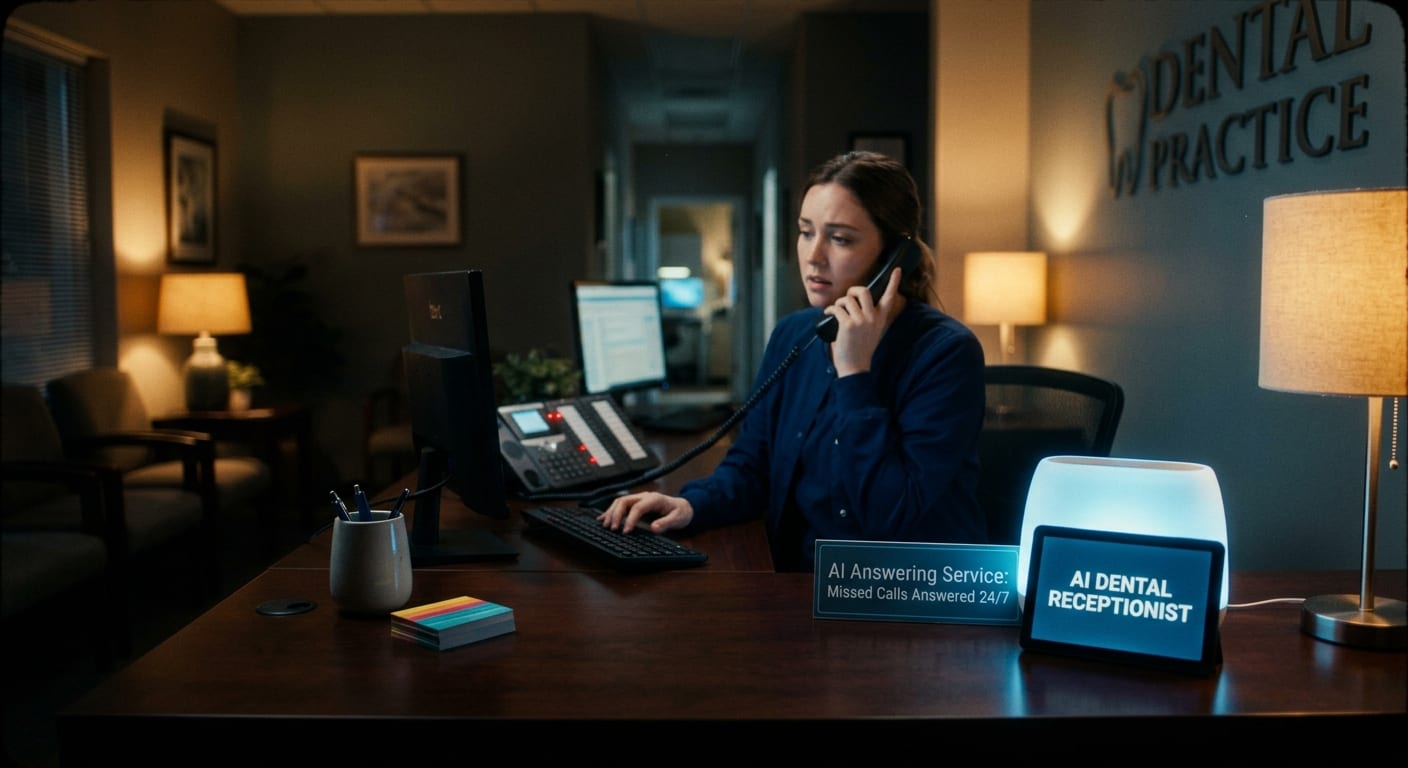
The Phone Problem Most Dental Practices Don't Measure
A patient has a toothache on a Tuesday afternoon. They Google "dentist near me," find three practices, and start calling down the list. The first one rings four times and goes to voicemail. They hang up. They don't leave a message. They call the next number. This happens in dental offices hundreds of times a day — and the practice that lost that call almost never knows it happened.
Industry data from dental management research firms consistently estimates that small dental practices miss between 25% and 40% of all inbound calls. During lunch hours and after 5 PM, that number climbs toward 60%. The revenue consequence is significant: the average new dental patient generates $1,200–$2,500 in first-year production, with lifetime patient value often exceeding $15,000 when family referrals and ongoing care are included. For a five-operatory practice fielding 60 calls on a busy day, missing 20 of them isn't an operational inconvenience — it's a meaningful revenue leak.
What an AI Answering Service Actually Is
The term gets used loosely, so it's worth being precise. An AI answering service for dental practices is a voice-based or phone-integrated system that uses large language models and speech recognition to handle inbound calls without a human on the other end. Unlike the phone trees of the 1990s, modern AI systems can hold a real conversation: they understand natural speech, ask clarifying questions, handle interruptions, and resolve most routine call purposes without transferring the patient to anyone.
For dental practices specifically, these systems are typically trained — or configurable — to handle the most common call types: appointment scheduling (new and existing patients), appointment confirmations and reschedules, insurance verification intake, after-hours triage and emergency call routing, directions and hours, and basic FAQ responses ("Do you accept Delta Dental? Do you offer payment plans?"). The AI doesn't replace your front desk. It handles the overflow, the after-hours volume, and the routine calls that eat 60–70% of receptionist time — freeing the human staff to focus on patients who are physically in the chair.
How the Technology Works in Practice
When a call comes in and no staff member is available — or after the practice closes — the AI system picks up, introduces itself naturally ("Thanks for calling Riverside Family Dental, this is our automated assistant — how can I help you today?"), and proceeds through the conversation. If a patient wants to schedule a cleaning, the AI checks the calendar integration, offers available slots, confirms the appointment, and sends a confirmation text. The patient never waited on hold. The practice never lost the call. The interaction typically takes 2–3 minutes and creates a completed booking in the practice management software.
More sophisticated systems also offer real-time escalation: if a patient describes symptoms suggesting a dental emergency, the AI can route to an on-call number or take a detailed message flagged as urgent. The key technical requirement is integration with your practice management software — Dentrix, Eaglesoft, Open Dental, and Curve are all supported by most major AI voice platforms. Without that integration, the AI can take messages but can't actually book, which cuts its utility significantly.
The Real Cost of Missed Calls: A Simple Calculation
Before evaluating AI solutions, it helps to quantify what the status quo is actually costing. Here's a straightforward framework:
| Metric | Conservative Estimate | Moderate Estimate |
|---|---|---|
| Daily inbound calls (small practice) | 35 | 60 |
| Estimated missed call rate | 20% | 35% |
| Missed calls per day | 7 | 21 |
| % that are new patient inquiries | 25% | 30% |
| New patient inquiries missed per day | 1.75 | 6.3 |
| Conversion rate (inquiry → booked patient) | 40% | 40% |
| New patients lost per day | 0.7 | 2.5 |
| Average first-year production per patient | $1,200 | $1,500 |
| Monthly revenue at risk | ~$18,000 | ~$81,000 |
These numbers aren't meant to be taken as exact — they're a framework to prompt a real audit. Pull your phone system data for 30 days. How many calls came in after 5 PM? How many rang during your lunch hour? Most practices that do this exercise for the first time are surprised by what they find. The conservative scenario in the table above — less than one new patient lost per day — still projects to over $200,000 in missed annual production. That context matters when you're evaluating whether a $400/month AI service is worth the investment.
AI vs. Traditional Answering Services: What's the Difference
Many dental practices already use a human answering service for after-hours calls — typically a contracted call center that answers on behalf of the practice. These services have their place, but they have a structural limitation: they're scripted and passive. The agent takes a message and tells the patient someone will call them back. The patient doesn't get scheduled. The appointment isn't booked. The callback often doesn't happen until the next business day, and by then the patient has moved on.
| Feature | Human Answering Service | AI Answering Service |
|---|---|---|
| Available 24/7 | Yes (with contract) | Yes |
| Can book appointments | Rarely | Yes (with PMS integration) |
| Handles concurrent calls | Limited (queue) | Unlimited simultaneous |
| Consistent script adherence | Variable | 100% |
| HIPAA compliance | Varies by vendor | Varies by vendor |
| Monthly cost (small practice) | $150–$400 | $250–$800 |
| Setup complexity | Low | Moderate (PMS integration) |
| Captures patient data | Basic message | Full intake fields |
The critical difference is resolution rate — the percentage of callers who leave with their problem actually solved. Human answering services typically achieve a resolution rate of 10–20% (mostly limited to taking messages). Well-implemented AI systems for dental practices routinely report resolution rates of 60–80% for after-hours calls, because the AI can actually complete the booking. That gap is where the ROI difference lives.
What to Look for When Evaluating Dental AI Voice Systems
Not all AI answering services are created equal, and several have been built as generic call center tools with a thin dental overlay. Here's what actually differentiates the good ones from the mediocre ones:
Native Practice Management Software Integration
This is non-negotiable. If the AI can't read your calendar and write to it, it becomes an expensive message-taker. Before any demo, ask specifically: "Does your system integrate with [your PMS]? Can it book, confirm, and reschedule appointments in real time?" Get a live demonstration of this, not a screenshot. Demand access to their integration documentation.
HIPAA Business Associate Agreement
Any vendor handling patient calls is a business associate under HIPAA. They must sign a BAA. If a vendor hesitates on this or says "we're working on it," walk away. This is a compliance requirement, not a negotiating point.
Call Escalation Logic
How does the system handle calls it can't resolve? Emergencies, distressed patients, billing disputes — these need a clear escalation path to a live person or at minimum a priority callback queue. Ask for the complete decision tree the AI follows when a call falls outside its training scope.
Call Recording and Analytics
The best vendors give you dashboards showing call volume by hour, resolution rates, appointment types booked, and common unresolved call topics. This data is valuable beyond the AI itself — it tells you where your scheduling bottlenecks actually are, which hours you're understaffed, and what patients are calling about most.
Training Customization and Voice Quality
Can you customize how the AI represents your practice? Can it use your practice name naturally? Does it sound like a person or an airport announcement? Ask for call recordings from current dental clients. Voice quality and natural conversation flow directly affects patient trust — a stilted, robotic voice increases hang-up rates.
Implementation: What the First 90 Days Actually Look Like
The practices that get the most out of AI answering systems are the ones that treat implementation as a project, not a plug-in. Most vendors will handle the technical integration in the first two weeks. What takes longer is the configuration: teaching the system your scheduling rules (how far out do you book new patients? what's your cleaning hygiene protocol? which slots are blocked for emergencies?), building the FAQ library, and testing the call flows.
Expect 2–4 weeks to reach stable, reliable performance. During that period, monitor call recordings weekly. You'll catch edge cases — unusual insurance questions, Spanish-speaking callers, patients who ramble — and you'll use those recordings to refine the system's responses. By week six, most practices report that the AI is handling after-hours scheduling without any staff involvement and managing 30–50% of daytime overflow during peak hours.
Staff adoption is a separate challenge. Front desk staff sometimes perceive AI call handling as a threat to their jobs. The practices that navigate this best are transparent about the goal: the AI handles routine and overflow calls so staff can focus on in-office patient experience — which is where human presence actually matters. Reframing the technology as a workload solution, not a headcount reduction, tends to produce better staff buy-in and better system tuning feedback.
A Practical Decision Framework
Before committing to any AI answering service, run this three-step audit for your practice:
The dental phone channel has been under-optimized for decades because staffing it felt like the only option. AI voice technology has made it a solvable problem — one with a measurable payback period and a clear operational benefit for both patients and front desk teams. The practices adopting it now aren't doing so because it's trendy; they're doing it because the math is straightforward and the patient experience argument has become equally hard to ignore. If your practice consistently answers calls, provides immediate scheduling, and follows up on unresolved contacts, you have a structural advantage over competitors that still route to a Thursday-morning callback queue. That advantage compounds over time in the form of patient acquisition and retention.
For practices exploring this space, agencies specializing in AI automation for healthcare and dental — such as Epiphany Dynamics — can help evaluate the right fit without the vendor bias that comes from a direct sales pitch.