
The Retail Revenue Gap Most Med Spas Never Measure
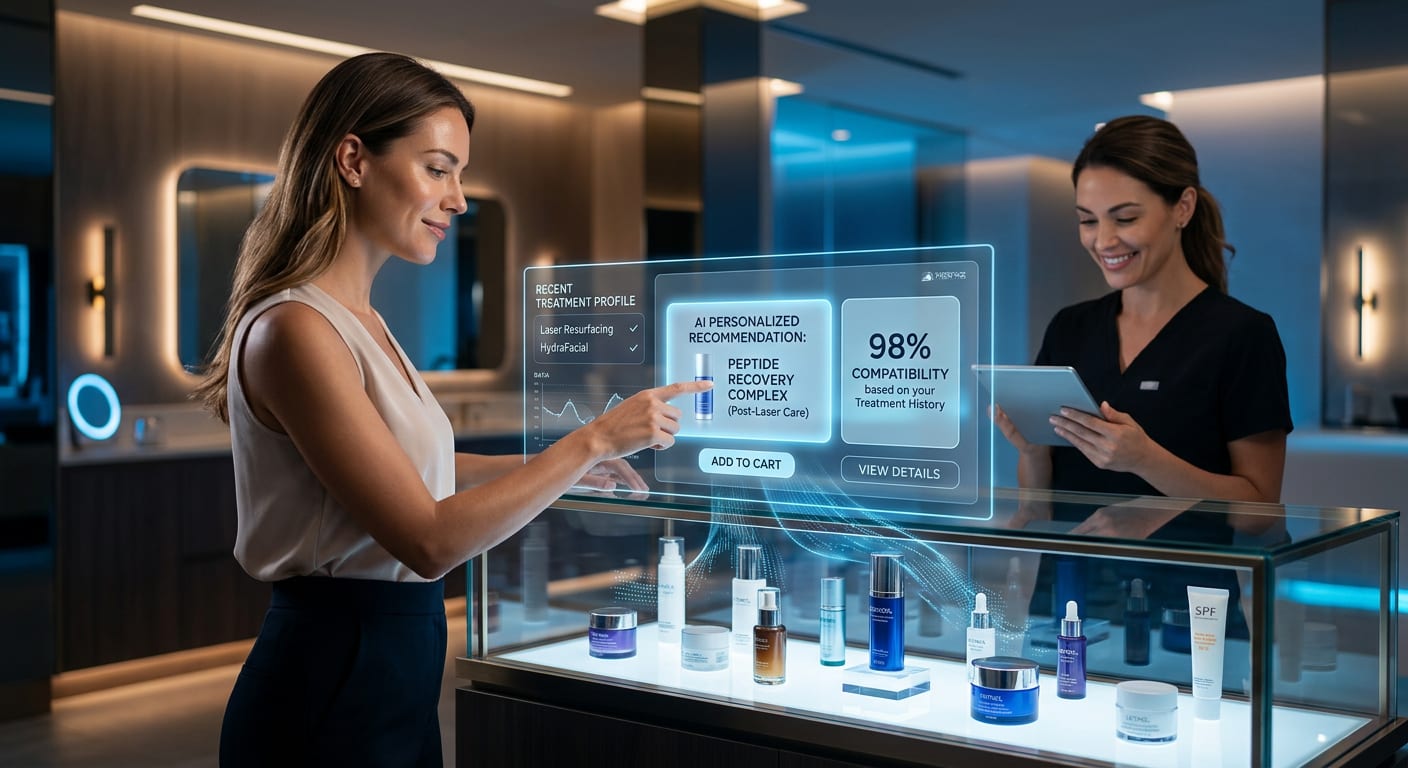
Walk into any well-run med spa and you'll see the same scene: a glass display case filled with serums, SPF formulas, retinols, and peptide creams. The staff knows the products. The clients are primed — they just had a chemical peel, a laser resurfacing, or a HydraFacial and their skin is literally responding to treatment. Yet industry benchmarks from the American Med Spa Association (AmSpa) consistently show that retail accounts for only 10–15% of the average practice's total revenue, compared to 20–28% for high-performing operations. The gap isn't a product selection problem. It's a timing and personalization problem.
The structural challenge is real: a single aesthetician managing back-to-back appointments simply doesn't have the bandwidth to recall each client's full treatment history, cross-reference it against available inventory, and surface two or three genuinely relevant product suggestions — all while managing checkout. Most clinics default to generic recommendations ("everyone should use SPF daily") that convert poorly because they feel impersonal. AI-driven product recommendation automation solves this by processing client data continuously and delivering hyper-relevant suggestions through channels — post-appointment email, SMS, booking confirmations — where clients are unhurried and receptive.
How AI Recommendation Engines Work in a Med Spa Context
Unlike e-commerce recommendation engines that rely primarily on browsing history and prior purchases, med spa recommendation systems are built on clinical data. The inputs are richer and more actionable: treatment type, skin condition from intake notes, provider observations, prior product purchases, appointment frequency, and time elapsed since the last visit. A client completing a series of IPL photofacials has fundamentally different product needs than someone two weeks post-filler. An effective recommendation engine knows the difference — and responds at the right moment, not just generically.
The core architecture follows a consistent stack:
The engine is self-refining. If a client consistently ignores recommendations in one category but clicks through on another, the system adjusts its weighting accordingly. Within 60–90 days of live data, recommendation relevance measurably improves at the individual client level — without any manual intervention.
The Revenue Math: What Automated Recommendations Actually Deliver
AmSpa benchmarks put the average med spa at $1.3–$1.8 million in annual revenue. At a 12% retail share, that's roughly $156,000–$216,000 in retail annually. If the average retail transaction is $82 (a reasonable mid-market benchmark), that translates to approximately 1,900–2,600 retail transactions per year. The question is: what happens to those numbers when AI recommendation automation is introduced?
| Metric | Without Automation | With AI Recommendations | Change |
|---|---|---|---|
| Post-appointment email click-through rate | 3–5% | 12–18% | 3–4x lift |
| Retail conversion rate (per active client) | 10–15% | 22–30% | ~2x |
| Average retail transaction size | $72 | $94 | +$22 |
| Retail as % of total revenue | 12% | 18–22% | +6–10 pts |
| Repurchase rate (90-day window) | 18% | 31% | +72% |
For a $1.5M practice, moving retail from 12% to 20% of revenue adds $120,000 annually. Product gross margins in med spa retail typically run 50–65%, making incremental retail dollars meaningfully more profitable than incremental service revenue — which carries higher labor, consumable, and overhead costs. This is one of the few revenue levers in aesthetic medicine that scales without adding treatment rooms or headcount.
A 60-Day Implementation Framework
The barrier to entry is lower than most practice managers expect. There's no custom software build required, no developer on retainer. What's needed is clean data, a workable integration, and a content workflow for product metadata and trigger copy.
Days 1–14: Data Audit and Platform Readiness
Before selecting any tool, audit your existing data infrastructure. The critical questions: Does your EMR capture structured skin condition notes, or are provider observations freeform text? Is your product catalog in an exportable format (CSV or API)? Is your client email list segmented by any dimension, or is it a flat list? Most practices have more usable data than they realize — it's simply not organized for automated use. If your EMR supports API access (Jane App and Aesthetic Record both do), this dramatically compresses setup time. If it doesn't, a manual data export workflow is a viable starting point.
Days 15–30: Integration Build and Initial Segmentation
Establish the two core data connections: treatment history into the recommendation engine, and recommendation engine into your email or SMS platform. Build 4–6 initial client segments based on primary treatment category. Keep segmentation simple at this stage — the system refines itself as data accumulates, and over-engineering segments on day one creates maintenance overhead without meaningful additional lift. Define three trigger events to start: appointment completed, 30 days post-appointment, and lapsed client (90+ days since last visit). These three alone will cover the majority of your conversion opportunity.
Days 31–60: Content, Launch, and First Optimization Pass
Write recommendation templates for each segment-trigger combination. Personalize the lead sentence to reference the actual treatment ("After your recent VI Peel, here's what Dr. Navarro recommends for the next two weeks"). Include 2–3 product options ranked by recommendation confidence, not margin. Test subject lines rigorously — in aesthetic email, lines that reference the specific treatment outperform generic subject lines by 30–40% on open rate. After 30 days of live data, pull performance by segment and prioritize fixing your lowest-converting triggers first.
Compliance and Data Privacy: Get This Right Before You Build
Med spas operate in a nuanced regulatory environment. If your practice is affiliated with a medical entity and your EMR contains health information subject to HIPAA, using treatment data to drive retail marketing requires careful handling. The key distinction: HIPAA permits PHI use for "treatment, payment, and healthcare operations," but using clinical notes to generate product recommendations for revenue purposes occupies a gray zone. Most healthcare compliance attorneys recommend having a signed Business Associate Agreement (BAA) in place with any third-party vendor processing that data — before the integration goes live, not after.
Many practices handle this cleanly through explicit consent. A simple checkbox added to intake forms — "I consent to receiving personalized product recommendations based on my treatment history" — satisfies both regulatory requirements and practical conversion goals. Clients who actively opt in convert at substantially higher rates than those who receive unsolicited automated messages. Build the consent mechanism into your intake workflow before building the automation layer. It takes less than a day and protects the entire program.
The Two Failure Modes to Avoid
The most common implementation failure isn't technical — it's catalog neglect. A recommendation engine is only as good as the product metadata it has to work with. If your catalog contains 180 SKUs but only 40 have accurate treatment associations, skin type flags, key ingredient tags, and reorder timelines, your recommendations will be effectively limited to those 40 products. Catalog enrichment is unglamorous work, but it directly determines recommendation quality. Every product should carry: a primary treatment association (e.g., "post-laser care," "brightening protocol"), compatible skin types, core active ingredients, and an expected repurchase window. This metadata is what allows the engine to match clients to products accurately rather than arbitrarily.
The second failure mode is over-automation that erodes the provider relationship. If every client receives a product recommendation email within ten minutes of checkout — regardless of context — it begins to feel transactional rather than advisory. The highest-performing implementations use recommendation automation selectively: triggered by meaningful clinical events, spaced to feel thoughtful, and written in a voice that sounds like it came from the provider rather than a CRM. An email that says "Dr. Chen wanted to make sure you saw this before your next visit" outperforms "Based on your recent appointment, you might be interested in..." by a measurable margin. Automation should amplify the provider relationship — not expose the machinery behind it.
Start With One Trigger, Measure, Then Expand
The practices seeing the strongest results from AI product recommendation automation didn't implement everything simultaneously. They picked the highest-volume treatment category in their practice — typically injectables or signature facials — and built a single automated follow-up for it. They measured conversion for 30 days, made adjustments based on real data, and expanded from there. The technology is sophisticated enough to support complexity; the real challenge is internal change management. Front desk staff and providers need to understand the recommendation logic, trust it, and reinforce it in person rather than inadvertently contradicting it. When the team sees the first quarter's retail numbers move, buy-in typically follows on its own.
The retail opportunity in med spa has always existed — what's changed is the infrastructure available to capture it consistently and at scale. For practices ready to move past batch email blasts and into genuine per-client personalization, the tooling is mature, the implementation timeline is realistic, and the revenue impact shows up within a single quarter. Agencies and platforms now specialize in exactly this kind of turnkey AI automation for aesthetic practices, compressing what used to be a six-month build into something closer to 60 days for operators who come in with clean data and a willingness to iterate.