
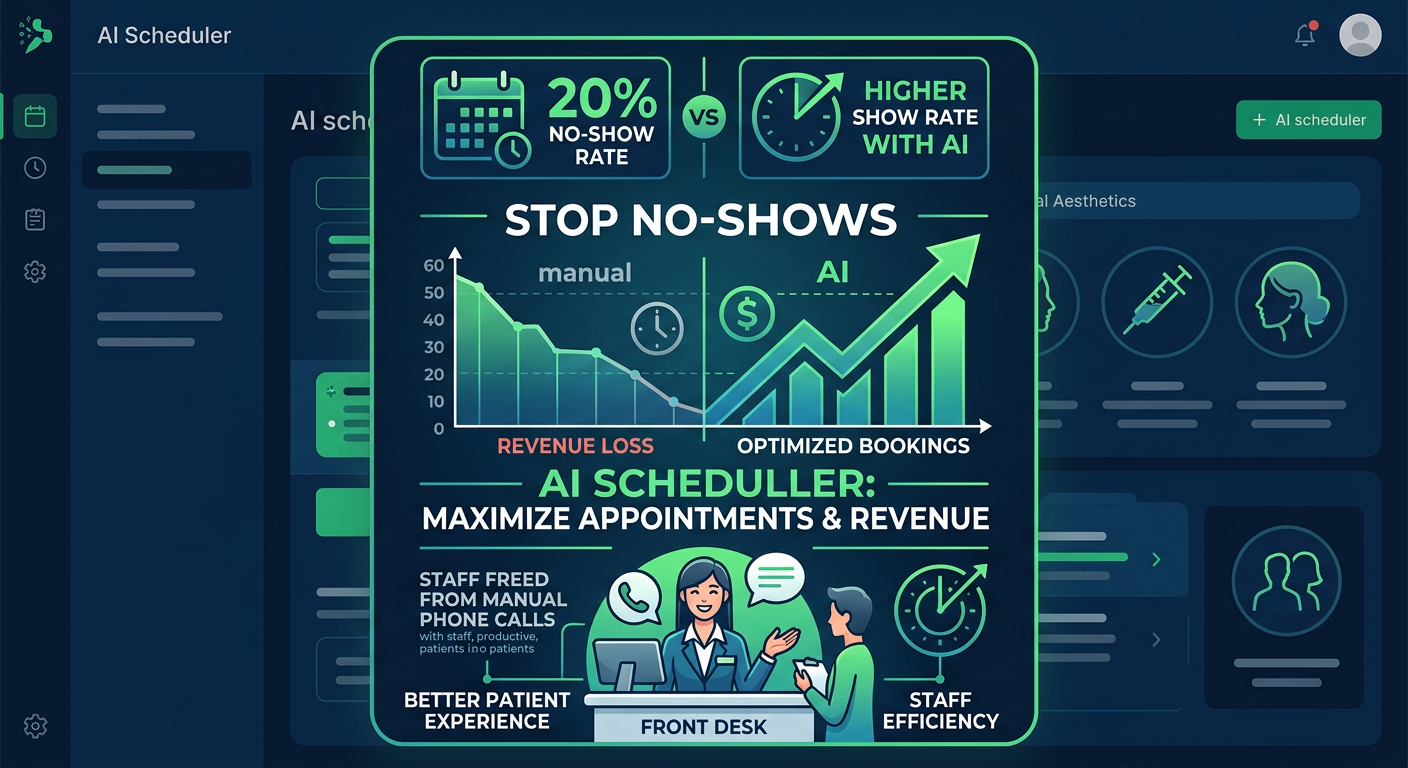
The Revenue Problem Hiding in Your Front Desk
A Botox clinic running 12 appointments per day at an average ticket of $450 stands to lose roughly $21,600 per month if just 20% of those bookings don't show. That's not a hypothetical — industry data from the American Med Spa Association consistently puts no-show rates between 15% and 25% for aesthetic clinics that rely on manual booking and phone-based confirmation. The math is brutal, and it compounds every time a front desk employee spends an hour on confirmation calls instead of delivering in-clinic patient experience.
AI scheduling software changes this equation — but not in the way most vendors pitch it. For a Botox clinic specifically, the ROI comes from several compounding factors that most operators don't measure until they see the numbers laid out side by side. This guide breaks down exactly where the value is, how to calculate it for your specific practice volume, and what to ask before committing to any system.
The True Cost of Manual Scheduling
Most clinic owners treat scheduling as administrative overhead — a necessary cost of doing business. The more accurate framing is that scheduling is a revenue management function, and every inefficiency in it directly clips your top line.
Run the calculation. At 12 appointments per day, five days per week, a 20% no-show rate means 2.4 unfilled slots daily. At $450 per session, that's $1,080 in lost revenue each day — roughly $21,600 per month. The American Academy of Facial Esthetics estimates that no-shows and late cancellations cost medical aesthetic practices between $150,000 and $250,000 annually at moderate volume levels. Even smaller clinics running 6–8 appointments per day face $80,000–$120,000 in annual leakage from this single issue.
Staff time is the second cost most owners undercount. Healthcare operations consultants estimate that front desk employees at small-to-mid-size aesthetic clinics spend 2.5 to 3 hours per day on scheduling-related tasks — confirmation calls, rescheduling, waitlist management, and new patient intake coordination. At $18/hour, that's roughly $1,000 per month in direct labor cost before accounting for the opportunity cost of hours not spent on in-clinic patient experience. The third cost is often invisible: attrition from scheduling friction. A 2023 Weave Healthcare report found that 42% of patients who couldn't reach a medical office within two contact attempts booked with a competitor. In a market where Botox clinics frequently operate within a five-mile radius of each other, a missed call at 9pm on a Tuesday is a lost patient — potentially for years.
What an AI Scheduler Actually Does for a Botox Clinic
The term "AI scheduler" gets applied loosely. Some vendors slap the label on a basic online booking widget. Genuine AI scheduling — the kind that moves the needle for a Botox practice — does five specific things a static booking page cannot.
Intelligent Multi-Step Intake
A Botox appointment isn't just a time slot. First-time patients need intake forms, consent documents, and often a contraindications screener covering blood thinners, recent facial procedures, or pregnancy status. An AI scheduler handles this conversationally via SMS or chat before the appointment — collecting information, flagging cases that need provider review, and routing complex inquiries to a human. This reduces chair-side prep time by an average of 8–12 minutes per new patient, which adds up fast at volume.
Dynamic Reminder Sequences
Static booking systems send one email 24 hours before the appointment. AI systems build multi-step sequences: an immediate confirmation after booking, a 72-hour reminder with an easy reschedule link (critical — making cancellation frictionless gives you time to fill the slot), a morning-of reminder, and a parking and arrival message two hours before. Clinics implementing multi-step sequences consistently report no-show rate reductions of 30–50% compared to single-reminder workflows.
Automated Waitlist Fill
When a cancellation comes in, an AI system texts the waitlist in priority order, offers the slot, confirms the replacement booking, and updates the calendar — without a front desk employee involved. This is where the real revenue recovery happens. A clinic that fills even 50% of its cancellations through automated waitlist management recovers a substantial portion of monthly revenue leakage at zero additional labor cost.
After-Hours Booking Capture
Data from Mindbody and Vagaro consistently shows that 35–40% of bookings in wellness and aesthetics happen outside business hours — evenings and weekends. An AI scheduler doesn't go home at 5pm. Every after-hours booking captured is revenue that would otherwise require a next-day callback, with meaningful conversion drop-off in between.
Cadence-Based Reactivation
Botox requires maintenance every 3–4 months. A good AI system tracks each patient's appointment cadence — if a regular client hasn't booked at the 90-day mark, an automated, personalized text triggers. These reactivation campaigns, sent through scheduling-integrated AI rather than generic bulk email, consistently see 15–25% re-booking rates in aesthetic clinic case studies, according to MedSpa Network operator survey data.
AI vs. Traditional Scheduling: Side-by-Side
The table below compares a standard phone and manual workflow against a modern AI scheduling system across the metrics that matter most for a Botox clinic's operations and revenue.
Capability
Traditional (Phone/Manual)
AI Scheduler
Booking availability
Business hours only
24/7, instant confirmation
Reminder system
1 call or email, day before
Multi-step SMS/email sequence
No-show rate (typical)
18–25%
8–14%
Cancellation fill rate
20–30% (manual calls)
45–60% (automated waitlist)
New patient intake
In-person or mailed forms
Digital, pre-appointment via SMS
Staff scheduling hours/day
2.5–3 hours
30–45 minutes (oversight only)
Patient reactivation
Manual outreach campaigns
Automated cadence-based triggers
Monthly software cost
$0–$50 (basic tools)
$200–$800 depending on volume
Running the ROI Numbers for a Mid-Size Clinic
Using a realistic scenario — 12 appointments per day, five days per week, $450 average ticket — here's what the monthly math looks like when an AI scheduler is deployed:
Total estimated monthly lift: $19,220–$21,520 against a software cost of $400–$800/month. That's a 25x–50x return on the tool cost, with most of the gain appearing in the first 60 days as the system learns your patient patterns and waitlist fills faster. The numbers shift at different volume levels, but the ratio holds — the software cost is almost never the binding constraint.
Five Questions to Ask Before Choosing a System
Not all AI schedulers are built for the specific demands of an aesthetic medicine practice. Before committing, run through these evaluation criteria with every vendor you speak with.
1. Does it integrate with your existing practice management software?
Disconnected systems create double-entry work that eats the labor savings quickly. Look for native integrations with common aesthetic platforms — Aesthetic Record, Nextech, Jane App, or Boulevard — or a robust API that your operations team can connect. A scheduling tool that doesn't sync with your patient records in real time will create more problems than it solves.
2. How does it handle contraindication screening?
A scheduler that books a patient on Warfarin for a Botox appointment without flagging it creates liability. Your AI system needs configurable intake logic that can filter and flag specific patient inputs — medical history, current medications, recent procedures — before confirmation is issued. Ask vendors for a live demonstration of this workflow, not just a slide in a deck.
3. What does the waitlist workflow actually look like?
Ask the vendor to walk you through what happens when a same-day cancellation comes in. The difference between a system that blasts your entire waitlist simultaneously and one that works through a prioritized list with two-way SMS confirmation is enormous — for both fill rate and patient experience. Simultaneous blasts lead to confusion and double-booking; sequential prioritized outreach fills the slot cleanly.
4. Can you customize reminder timing and content?
Your patients are not general practitioner patients. Botox clients often have specific concerns about bruising windows, downtime, and pre-treatment restrictions — avoiding alcohol, blood thinners, and certain supplements. Reminder messages should include your specific pre-treatment instructions, not generic boilerplate that your front desk has to follow up on anyway. If the system doesn't allow message customization, it will create work rather than eliminating it.
5. What's the escalation path when AI hits its limits?
Every AI system will encounter edge cases it can't resolve — complex medical questions, billing disputes, or a patient expressing concern about a previous result. The best systems escalate to a human seamlessly, passing full conversation context along so the patient doesn't have to repeat themselves. Ask how this handoff works in practice before you sign anything.
The Bottom Line
For a clinic doing meaningful volume, an AI scheduler is the highest-ROI operational investment currently available in aesthetic medicine. The math is straightforward: cut no-shows by half, fill cancellations automatically, capture after-hours bookings, and systematically reactivate lapsed patients. At $400–$800 per month against $15,000–$20,000 in recovered and captured monthly revenue, the only real question is why it wasn't in place sooner.
The practices pulling ahead in medical aesthetics right now aren't necessarily the ones with the best injectors — they're the ones that have systematized every step of the patient journey from first contact through rebooking. Scheduling is where that journey starts, and it's where most clinics are still leaving significant money on the table. For practices looking to implement this kind of AI-powered front desk infrastructure from scratch, companies like Epiphany Dynamics are building solutions designed specifically around the aesthetic medicine workflow.