
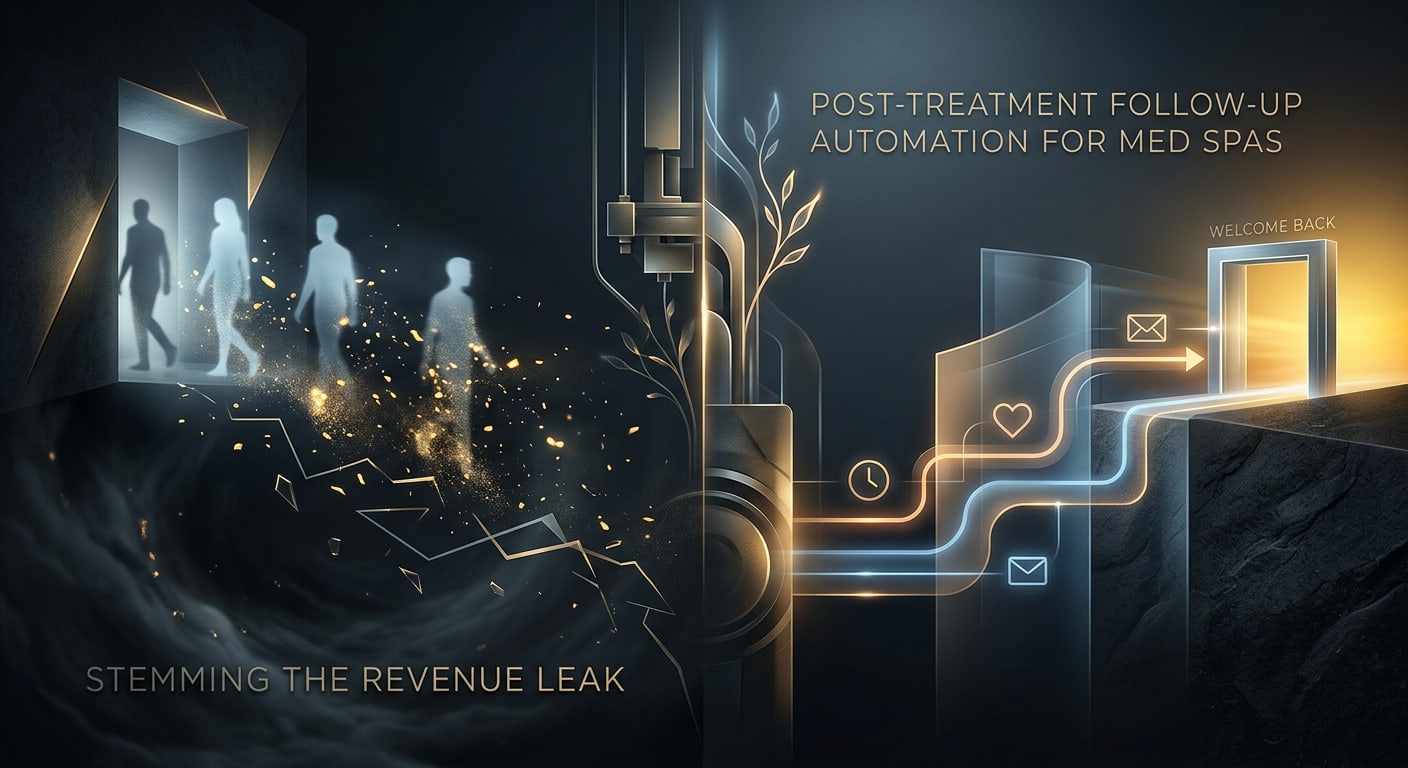
The Retention Problem Nobody Talks About
Most med spas obsess over new client acquisition — paid ads, influencer partnerships, referral programs. But there's a much cheaper, faster path to revenue growth sitting right in the existing client database: getting past clients to come back. The math is unambiguous. Acquiring a new customer costs 5–7 times more than retaining an existing one, and yet the average aesthetic practice invests the overwhelming majority of its marketing budget chasing cold audiences while warm ones quietly walk away.
Industry benchmarks for aesthetic practices put average first-visit retention somewhere between 30–40%. That means for every 10 clients who come in for a Botox appointment or a HydraFacial, 6 or 7 never return. When med spa client lifetime value typically runs $1,200–$3,500 per year, that's not a minor inefficiency — it's a structural revenue leak. The root cause is almost always the same: no systematic follow-up. After the appointment, clients walk out the door and hear nothing. Maybe a generic review request a week later. No reminder that their neuromodulator is fading at day 80. No educational content about complementary treatments. No personal check-in. The practice fills the next slot and moves on.
What a Follow-Up Sequence Actually Needs to Do
A post-treatment follow-up sequence isn't just a rebooking reminder. It serves four distinct functions, and collapsing them into a single "please rebook" message is why so many automation attempts underperform. Each function targets a different moment in the post-visit client relationship and requires a different tone, channel, and call to action.
| Function | Timing | What It Looks Like | Why It Matters |
|---|---|---|---|
| Clinical check-in | 24–48 hours post-visit | SMS asking about comfort, swelling, or bruising | Catches adverse reactions early; builds genuine trust |
| Results nurturing | Day 7–14 | Message with care tips, what full results look like, what to expect | Reinforces perceived value of the treatment |
| Rebooking trigger | Treatment-cycle specific | Timely reminder aligned to when results begin to fade | Captures rebooking at peak relevance — before the client forgets |
| Reactivation | 60–90 days past rebooking window | Re-engagement campaign for clients who didn't respond | Recovers dormant clients before they convert to a competitor |
The distinction between rebooking trigger and reactivation matters more than most practices realize. A rebooking trigger is proactive — it lands right at the moment the treatment's effects are naturally waning, making it feel helpful and well-timed rather than pushy. Reactivation is recovery work. It requires a different message, often with an incentive or urgency anchor, because you're trying to re-engage someone who has already drifted. Treating these as the same message with the same tone is one of the most common automation mistakes.
Treatment-Specific Timing: Why One Sequence Doesn't Fit All
Cookie-cutter follow-up sequences underperform because treatment cycles vary enormously. A client who received lip filler needs a reminder at month 5–6. A client who started a laser hair removal series needs guidance on inter-session intervals every 4–6 weeks. Sending the wrong cadence — or worse, a generic one — erodes trust rather than building it. The practice management system or CRM should tag clients by procedure code and trigger distinct automations accordingly.
Injectables (Neuromodulators — Botox, Dysport, Xeomin)
Dermal Fillers (Lips, Under-Eye, Cheeks, Jawline)
Facial Services (HydraFacial, Chemical Peels, Microneedling)
The critical architectural requirement is procedure-level segmentation. Many practice management systems offer a generic "appointment completed" trigger. That's not enough. The automation must branch based on what was actually performed. If the scheduling software doesn't support this natively — Mindbody, Jane App, Vagaro, and Aesthetic Record all have varying levels of automation granularity — a middleware tool like Make.com or Zapier can bridge between the booking system and a dedicated messaging platform, reading the service name or code and routing to the appropriate sequence.
Channel Strategy: SMS, Email, and AI Voice
The channel matters as much as the message. The single most common mistake med spas make in follow-up automation is defaulting to email for everything, then wondering why rebooking rates don't move. The open-rate disparity between SMS and email is not subtle — it's structural.
| Channel | Avg Open Rate | Best Use Cases | Key Considerations |
|---|---|---|---|
| SMS | 95–98% | Clinical check-ins, rebooking triggers, time-sensitive reminders | Keep under 160 characters; TCPA prior written consent required |
| 22–26% | Educational content, treatment guides, longer-form nurturing | Strong for value delivery; weak for urgency; high design investment | |
| AI Voice / Ringless Voicemail | ~60–70% listen rate | High-value client reactivation after 90+ days of silence | Feels personal; reserve for dormant high-LTV clients |
Approximately 90% of SMS messages are read within three minutes of receipt (industry benchmark, Mobile Marketing Association). For a rebooking trigger where timing is critical — reaching the client precisely when results begin to wane — SMS is not optional; it's the primary channel. Email is better suited for Day 14 results education, where the message is longer and benefits from visual content like before/after comparisons or care tip graphics.
A practical channel sequence for a standard injectable client: Day 1 SMS → Day 14 SMS with optional email → Day 75 SMS → Day 90 email (educational, results-focused) → Day 120 ringless voicemail if still no rebook. Each touchpoint escalates slightly in effort, reflecting the increasing cost of losing that client relationship. One critical compliance note: automated SMS marketing requires prior written consent under the Telephone Consumer Protection Act (TCPA). This is non-negotiable. Ensure intake forms capture explicit consent for automated marketing messages — not just appointment reminders, which fall under a different provision.
The Revenue Math: What This Actually Produces
Making this concrete removes the abstraction. Consider a mid-sized med spa running 200 injectable appointments per month at an average ticket of $450. At a 35% retention rate — the industry baseline — roughly 130 of those clients never rebook. That's $58,500 in monthly revenue potential sitting unrealized. A well-executed post-treatment follow-up automation system realistically improves retention to 55–65% within the first year. Here's what the conservative scenario looks like:
| Metric | Before Automation | After Automation (Conservative) |
|---|---|---|
| Monthly injectable appointments | 200 | 200 |
| Retention rate | 35% | 55% |
| Clients who rebook | 70 | 110 |
| Additional monthly rebookings | — | +40 |
| Revenue impact (@ $450 avg) | — | +$18,000/mo |
| Annual revenue impact | — | +$216,000 |
These figures don't include upsells, cross-sells, or referrals — all of which retained clients generate at 3–4x the rate of newly acquired clients. They also don't capture the staff time saved by eliminating manual rebooking outreach. The compounding logic is even more compelling over a multi-year horizon: a client who visits three times per year at $450 generates $1,350 annually. That same client, retained for three years and moved into a complementary service line, is realistically worth $5,000–$8,000 in cumulative revenue before any price appreciation.
Implementation: Three Practical Paths
The most common obstacle to follow-up automation isn't technology — it's integration. Most med spas run a practice management system, a separate email platform, and possibly a standalone SMS tool, none of which communicate natively. There are three realistic paths to getting a working system in place, depending on budget and technical tolerance.
Path 1 — Native Platform Features (Lowest Cost, Most Limited)
Most modern practice management systems include basic automation. Mindbody's Marketing Suite and Jane App's built-in email automation can handle simple post-visit sequences at minimal cost. The limitations are real: typically email only, limited procedure-level segmentation, and constrained branching logic. This is a viable starting point — better than nothing — but most practices will outgrow it within six months once they see what's missing.
Path 2 — Middleware Integration (Mid-Tier, Full Dual-Channel)
Connecting the booking system to a dedicated CRM and SMS platform via Make.com or Zapier enables full procedural segmentation and dual-channel capability. An example stack: Vagaro → Make.com → ActiveCampaign (email) + Twilio (SMS). Setup cost runs 10–15 hours of configuration; monthly platform fees typically land between $150–$300. This approach provides near-complete flexibility. The tradeoff is that someone on the team needs to own the technical configuration and maintain it as the workflow evolves.
Path 3 — AI-Native Platforms (Highest Capability, Lowest Ongoing Friction)
Platforms purpose-built for aesthetic practices — or broader AI front-desk solutions that handle multi-channel follow-up — consolidate booking, follow-up, and reactivation into a single managed workflow. The meaningful upgrade over Path 2 is conversational capability: rather than one-way broadcast messages, the client can reply to a check-in text and receive an intelligent, context-aware response. Two-way SMS conversations see 40–60% higher response and rebooking rates compared to one-way blasts. The tradeoff is a higher monthly cost and vendor dependency.
Regardless of which path fits the practice, the minimum viable automation should cover three things: a Day 1 clinical check-in via SMS, a treatment-specific rebooking trigger at the appropriate interval, and a 90-day reactivation sequence for non-responders. Everything beyond that is optimization built on a working foundation.
Making Automation Feel Human
The primary reason med spa owners resist automation is fear that it'll feel impersonal or robotic. That's a legitimate concern, and it's entirely avoidable with deliberate message design. The clinical check-in should read like it came from a real person: "Hi Sarah, it's [Practice Name] — just checking in after your Botox yesterday. How are you feeling? Totally normal to see some minor swelling or tenderness. Let us know if you have any questions!" This gets replies. A message that opens with "Dear Valued Client, Your Post-Visit Survey is Ready" gets unsubscribes.
Personalization tokens — first name, treatment name, provider name — are the baseline requirement. The ceiling is dynamic sequencing based on client history: referencing their specific treatment area, noting their last visit date, or flagging that they're due for a seasonal treatment they've had before. Modern AI-powered platforms make this level of personalization accessible without a dedicated marketing team or database engineer. The client experience is a sequence that feels like thoughtful follow-through from a practice that knows them — because through the data, it does.
The practices winning on retention in 2025 aren't outspending competitors on Google Ads. They're building systematic client relationships that run automatically between appointments, without adding headcount. That's the real compounding advantage: automation that handles the relationship-maintenance work the front desk never had bandwidth to do manually. For med spas serious about growth, this infrastructure isn't a nice-to-have — it's the foundation everything else is built on. Solutions like those offered by Epiphany Dynamics are making this level of intelligent follow-up accessible to independent practices that previously couldn't justify a custom build.