
The Revenue That Walks Out the Door Every Quarter
A patient comes in for her first round of Botox. She's thrilled with the results. She tells you she'll be back in three months. She means it. But three months later she's buried in a work project, hasn't scheduled, and by the time she surfaces it's been six months. The results have long faded. She's not sure it's worth starting over. You've lost her — and she probably doesn't even know why she drifted away.
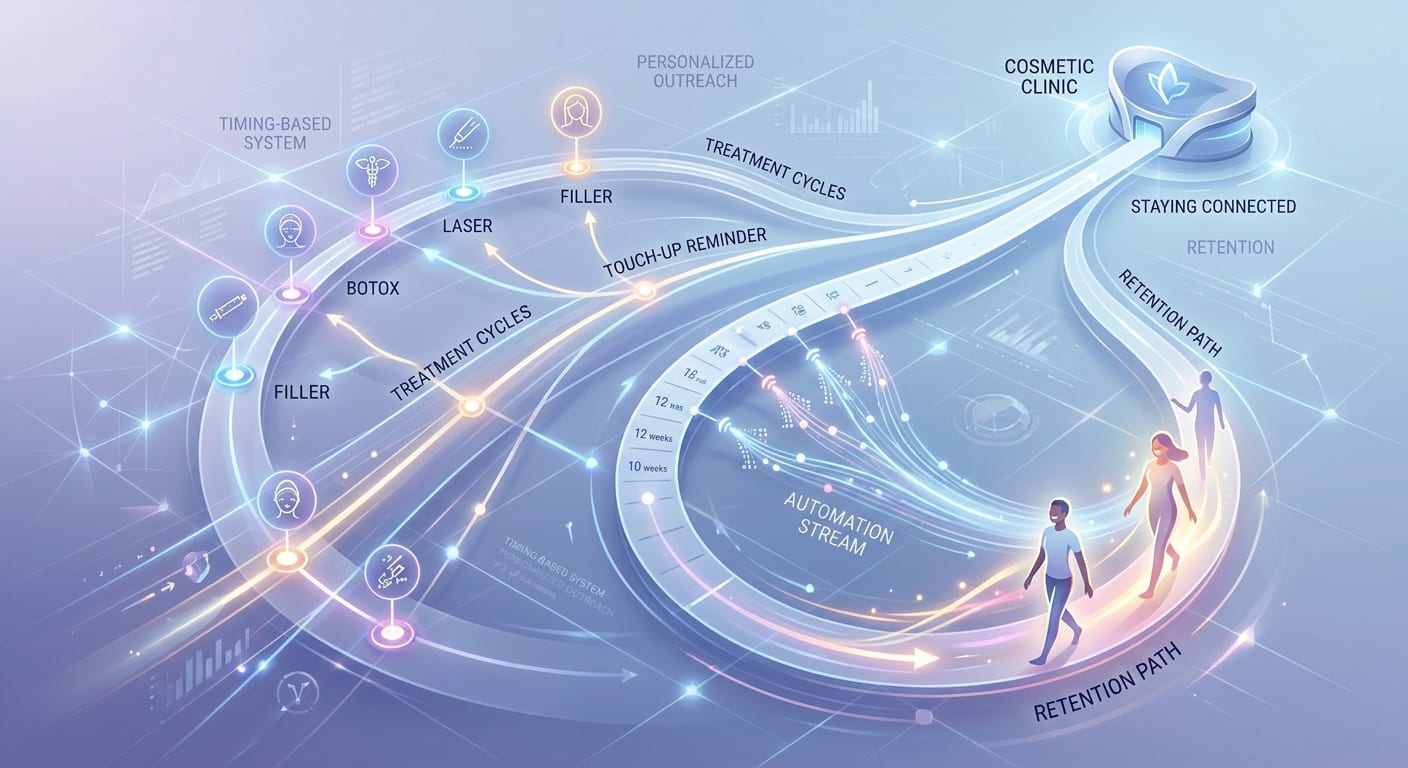
This plays out dozens of times every month in cosmetic clinics across the country — not because the treatment failed, but because there was no system to bring the patient back at the right moment. Industry retention data from aesthetic medicine practices consistently shows that 60–70% of new cosmetic patients don't return for a follow-up within the recommended treatment window. A meaningful share of those never come back at all. Treatment touch-up reminder automation is the structural fix — a timing-based system that triggers personalized outreach at exactly the right point in each patient's cycle, without requiring staff to track hundreds of individual timelines manually.
Treatment Cycles: The Foundation of the Whole System
Every effective touch-up reminder system is built on one thing: treatment-specific timing logic. The system needs to know that a Botox patient should hear from you around week 10–12, not week 24. A laser resurfacing patient needs different follow-up than someone who received lip filler. Getting this wrong means reminders that feel random or irrelevant — and a patient who's already booked with a competitor by the time yours arrive.
The trigger point is not the same as the treatment interval. If filler lasts 9–12 months, you're not sending a reminder at month 9 — you're sending it at month 7 or 8, giving the patient enough lead time to schedule without feeling rushed. The standard sweet spot is 3–4 weeks before the recommended return date. Here's how common cosmetic treatments map to practical reminder windows:
| Treatment | Avg. Duration of Results | Optimal Reminder Trigger | Avg. Visit Revenue |
|---|---|---|---|
| Botox / Dysport | 3–4 months | 10–11 weeks post-treatment | $350–$550 |
| Dermal Fillers (lips, cheeks) | 6–12 months | 5–6 months post-treatment | $600–$1,200 |
| Laser Skin Resurfacing | Series of 3–6 sessions | 4–6 weeks after each session | $400–$800/session |
| Microneedling | 4–6 week intervals (series) | 3 weeks post-treatment | $300–$500 |
| Chemical Peels | 4–6 weeks (series) | 3 weeks post-treatment | $150–$350 |
| Body Contouring (CoolSculpting, etc.) | 6–12 months, maintenance-based | 5–6 months post-treatment | $700–$1,500 |
This table isn't just a reference — it's the schema your automation system should be built on. Before choosing any platform or tool, a clinic needs to map every service it offers with three data points: (1) average duration of results, (2) optimal reminder trigger point, and (3) the message angle. Whether you're framing a reminder as "your results are starting to fade" or "time to lock in your next session" matters for open and conversion rates — and those two framings are appropriate at different points in the cycle.
Why Staffing Your Way Out of This Doesn't Work
The first instinct many clinic owners have is to assign reminder calls to a front desk team member. It seems simple. In practice, it collapses fast. A mid-sized clinic seeing 30–40 patients per week generates 120–160 patient touchpoints per month that theoretically need follow-up scheduling — before accounting for multi-treatment plans, seasonal surges, and the individual variation in how long results last from patient to patient. Staff burn out, reminders get skipped, and timing windows close.
The bigger cost isn't labor — it's the revenue that quietly disappears. At a conservative average Botox visit value of $450, losing just 15 patients per month to no-return attrition costs a clinic roughly $6,750 in monthly recurring revenue. Annually, that's over $80,000 in appointments that should have happened but didn't. For most small-to-mid cosmetic practices, that gap is the difference between a profitable year and a stressful one. No front desk hire closes that gap reliably. Only a system does.
The Automation Framework: Segmentation, Timing, and Channel
Effective touch-up reminder automation operates in three layers. Get all three right and you have a system that feels personal to the patient while running in the background without meaningful staff involvement.
Layer 1: Segmentation by Treatment Type
Every patient record needs to be tagged at point of service with the specific treatment received. That tag drives the automation sequence. A Botox patient enters a "Botox follow-up" workflow. A microneedling patient enters a different one. Patients on package deals or prepaid series get sequences with milestone-based messaging rather than single-appointment timing. Without this tagging discipline at intake, the whole system degrades into generic outreach that patients learn to ignore.
Layer 2: Timing Logic — The Trigger Window
The automation fires based on service date, not the calendar. Most platforms let you configure this as "X days after service date." A standard Botox sequence on a 90-day cycle looks like this:
The Day 3–5 check-in is often underestimated. It's not a rebooking message — it's a trust-building touchpoint that conditions patients to expect communication from the clinic and gives them a low-friction way to raise any concerns before they become a bad review.
Layer 3: Channel Selection
SMS open rates consistently hover around 95–98%, with the majority of texts read within three minutes. Email open rates in wellness and healthcare sit around 20–25%. For time-sensitive rebooking reminders, SMS wins by a wide margin. A well-designed system uses both: SMS for the primary reminder (short, action-oriented, with a direct booking link), email as a supporting channel with more detail — before/after photos, seasonal promotions, or service menu updates. Two-way SMS capability — where patients can reply to confirm or request a call — significantly increases conversion over one-way blasts. TCPA consent must be captured at intake for any SMS outreach program.
The ROI Math: What Recovery Actually Looks Like
Let's model a clinic with 200 active Botox patients on a 90-day cycle — a realistic baseline for a mid-sized practice doing consistent volume.
| Metric | Without Automation | With Automation |
|---|---|---|
| Patients due for rebooking per quarter | 200 | 200 |
| % who rebook within 30 days of window | ~60% | ~80–85% |
| Appointments captured per quarter | 120 | 160–170 |
| Revenue at $450/visit | $54,000 | $72,000–$76,500 |
| Quarterly revenue recovered | — | $18,000–$22,500 |
| Platform cost (mid-range estimate) | — | ~$450–$900/quarter |
At those numbers, the ROI ratio on automation is roughly 20:1 to 40:1 — and that's only accounting for Botox. Layer in fillers, laser sessions, and upsell opportunities that emerge during rebooking conversations, and the compounding effect becomes significant. A Botox patient who returns consistently every 90 days is worth $1,800/year on Botox alone before any additional services. Retention infrastructure is simply more capital-efficient than acquisition advertising once it's operational: you're spending to re-engage someone who already trusts you, versus spending to convince a stranger to make a first appointment.
What to Evaluate Before Choosing a Platform
Not every CRM or practice management tool handles treatment-specific timing logic well. Before committing to a platform, evaluate it against these four criteria:
Retention Is an Operational Problem, Not a Marketing One
Most cosmetic clinics compete on provider skill, treatment results, and atmosphere. Those matter. But in a market where patients have more options than ever, the clinic that brings patients back predictably wins on lifetime value even when the initial experience is roughly equivalent across providers. Touch-up reminder automation isn't a marketing tactic — it's operational infrastructure that makes retention a system rather than a hope.
The practices building durable books of business right now aren't necessarily the ones with the biggest ad budgets or the most engaged social media. They're the ones who mapped their treatment cycles, built reliable follow-up sequences, and made rebooking friction-free. That loop — great treatment, timely reminder, seamless rebooking, repeat — running in the background and compounding over years, is what turns a busy practice into a stable one. If your clinic still relies on patients remembering to call you, the revenue you're leaving on the table isn't hypothetical. The math above makes it concrete. AI-powered patient communication tools like those developed by teams focused on aesthetic practice automation — including Epiphany Dynamics — are making it easier than ever for smaller clinics to deploy these systems without enterprise-level budgets or technical overhead.