
Calendar Integration, CRM, and AI: What Service Businesses Actually Gain
Service businesses lose significant revenue to no-shows, and wellness and beauty businesses are hit especially hard. Text-based appointment reminders backed by CRM-calendar integration can reduce that leakage when the cadence, data, and rebooking path are designed correctly.
A service business bleeding appointments to no-shows isn't facing a customer problem. It's a systems problem. Here's how CRM-calendar-AI integration closes.
Epiphany Dynamics is an AI automation agency: we help businesses find and fix operational bottlenecks with AI receptionists, lead follow-up, and workflow automation.
Free 30-minute audit. We name at least 3 things you can automate, ranked by impact.
Book a free AI audit
Patrick Gibbs
Service businesses lose significant revenue to no-shows, and wellness and beauty businesses are hit especially hard. Text-based appointment reminders backed by CRM-calendar integration can reduce that leakage when the cadence, data, and rebooking path are designed correctly. This guide explains how CRM-calendar-AI integration actually works in practice, what outcomes to expect, and how to implement it without turning a scheduling fix into an enterprise IT project.
A busy med spa with treatment rooms and front desk staff can look fully booked on paper while still leaving appointment capacity unbilled every month. The slots exist. The clients exist. The problem is the gap between when someone decides to book and when they actually show up confirmed. That gap between interest and completed visit is where most service business revenue quietly disappears. Our guide on AI appointment reminders that cut no-shows significantly covers the sequencing that closes this gap, and it’s where connecting your calendar to your CRM with an AI layer finally makes a measurable difference.
This is a breakdown of how the system actually works, what outcomes to expect, and how to implement it without turning it into a bloated technology project. No particular software is being sold here. This is just the mechanics, clearly explained.
The Scheduling Gap Is a Data Problem
Service businesses across industries share the same operational issue: appointment data lives in one place, client history lives somewhere else, and communication happens manually in a third. When a client books through your website, that booking rarely triggers a CRM record update. When a CRM record shows a client has gone quiet, nothing automatically reaches out to them. These systems do separate jobs, and the gap between them eats revenue. Our guide on AI integration with existing CRM systems covers the data architecture approach that makes these connections work reliably.
The business case should be built from your own booking data. Pull your current appointment count, average ticket, confirmed no-show pattern, and rebooking rate. Then model what happens if more clients confirm, reschedule early, or rebook without waiting on a staff callback. The exact upside changes by business, but the source of the leakage is consistent: unconfirmed appointments, late cancellations, and clients who never get pulled back into the calendar.
Text-based appointment reminders can cut no-shows when they make confirmation and rescheduling easy. SMS reminders with confirmation links usually outperform email in service settings, because clients check their phones more reliably than inboxes. The gap is that many businesses still rely on staff to send them manually, which means they go out inconsistently, late, or not at all when the front desk is slammed.
What Integration Actually Means in Practice
“Calendar integration” gets thrown around loosely, so it’s worth being specific. At the base level, you have a booking tool. Calendly, Acuity, Jane App, or a native CRM calendar. When a client books, that event writes back to the CRM as a contact activity. The CRM then triggers automated sequences: a confirmation message, a pre-visit reminder, a final reminder, and a post-visit follow-up. None of this requires staff action once it’s configured, and the exact timing should be tuned to your business rather than copied from a default template.
The AI layer sits on top of that foundation. Instead of static reminder messages, AI personalizes communication based on CRM data. A client who has rescheduled before gets a different message cadence than one who has never missed. A client who is overdue for a return visit gets a different prompt than someone booking their first appointment. A human could apply this logic, but only if they had time to review each record individually. AI applies the same rules consistently without asking the front desk to manually inspect every appointment.
| System State | What Changes | Operational Impact |
|---|---|---|
| No reminders | Clients must remember appointments on their own | More avoidable gaps and fewer early reschedules |
| Manual reminders | Staff sends reminders when capacity allows | Better than silence, but inconsistent under load |
| Automated reminders only | Confirmations and reminders fire from the calendar | Routine follow-up becomes reliable and easier to track |
| CRM + calendar + AI integration | Messages adapt to client history and booking behavior | Rebooking and win-back logic runs without manual review |
The rebooking difference is where long-term revenue lives. Getting a client to reschedule instead of ghost is the difference between a one-time gap and a retained relationship.
What the AI Layer Actually Does
In this context, “AI” means three distinct capabilities: natural language scheduling conversations, predictive timing for outreach, and behavior-based segmentation for follow-up. These aren’t vague features. Each one addresses a specific failure in how service businesses currently handle client communication at scale.
Scheduling conversations via AI means a client can text “Can I move my Thursday to Friday?” and the system checks availability, confirms the rebook, updates the CRM record, and responds in plain language without a human in the loop. This is already running in dental and medical offices using platforms like Weave and NexHealth. The alternative is a client waiting for a callback during business hours, getting frustrated, and booking with a competitor down the street. That scenario plays out every day in businesses that haven’t closed this gap.
Predictive timing is subtler but still useful. Marketing and sales benchmarks consistently show that message timing affects open and response rates. An AI layer routes outreach to the window when a specific client has historically engaged, rather than blasting everyone at the same hour. Behavior-based segmentation means the system distinguishes between a high-value loyal client who’s overdue and a first-time inquiry who hasn’t confirmed. The messaging, channel, and urgency level differ. Without automation handling this at scale, every client gets treated the same by default, which is both lazy and expensive.
Practical Implementation Without Overbuilding
Most service businesses don’t need an enterprise CRM or a custom integration build to get this working. The realistic tool stack for a small-to-mid service business: HubSpot (the free tier is genuinely functional for this), GoHighLevel (built specifically for service business scheduling and AI follow-up), or Zoho CRM for businesses that want more configuration control. For medical and dental specifically, Jane App and Kareo handle HIPAA compliance while including native scheduling with CRM-adjacent features. If you’re booking through Calendly and not ready to migrate, a Zapier connection to your CRM closes most of the gap at low cost. Our automated scheduling software guide compares all the major platforms by business type and budget.
The integration path that actually gets implemented, rather than planned and abandoned, is incremental. Get bookings writing to a CRM first. Get the automated reminder sequence live next. Add the AI conversation layer after you’ve watched the base automation run cleanly. Businesses that try to build every layer simultaneously almost always stall, because there are always edge cases in booking flow that need to be resolved before the automation works reliably.
A realistic budget depends on the tools chosen, appointment volume, compliance needs, and whether you’re running AI conversation capability or just automated sequences. Compare that cost against your own no-show exposure, missed rebooking opportunities, and staff time spent manually confirming appointments. The investment question isn’t whether generic math pencils out. It’s whether your actual calendar data supports the build.
Where This Setup Fails
The most common failure mode isn’t technical. It’s data quality. A CRM with incomplete contact records, mismatched phone numbers, or duplicate entries can’t personalize accurately. An AI drawing the wrong history sends the wrong message at the wrong time, which can actually damage client relationships rather than strengthen them. Cleaning contact data before turning on automation pays back faster than most owners expect, because the system compounds on clean data. One afternoon of deduplication work often unlocks months of reliable automation.
The second failure point is message frequency. Automated systems can over-contact clients if the cadence isn’t designed deliberately. Aggressive reminder sequences can increase unsubscribe rates and generate complaints from clients who feel pestered. The fix is straightforward: cap outreach to the minimum useful cadence and always include an easy opt-out. But that cadence has to be designed intentionally. The default settings in most tools are often too aggressive, and running defaults without reviewing them is a common mistake.
Finally, the AI conversation layer needs a defined human escalation path. When a client sends something the AI can’t resolve cleanly (a complaint, a billing dispute, a complicated situation involving multiple appointments), the system has to hand off to a staff member quickly and cleanly. Systems that lack a clear handoff create bad client experiences fast, and a bad experience from an automated response often lands harder than a bad experience from a human, because it feels like the business didn’t care enough to involve a person. Design the escalation before you turn the AI on, not after you get a complaint about it.
Also on the blog: Automated Client Feedback Systems: A Guide for Service Companies.
The Honest Takeaway
Calendar integration tied to a CRM and AI removes the manual coordination tax from your scheduling workflow, applies consistent follow-up at a volume no staff can sustain, and helps recover revenue that’s currently disappearing from your calendar. The businesses that see results fastest are the ones that start by calculating exactly how much their own no-show and rebooking gaps are costing them. That number usually reframes the entire conversation about whether to invest in tooling. If you’re evaluating which system fits your operation and scale, firms like Epiphany Dynamics can help you scope the right stack without overbuilding for your current size.
Frequently Asked Questions
Q: How much revenue does a service business lose to no-shows?
No-show losses depend on your appointment count, average ticket, no-show pattern, and whether empty slots can be refilled. The clean way to estimate the impact is to multiply missed appointments by average visit value, then separate unrecoverable gaps from appointments that could be saved through confirmation, early rescheduling, or waitlist outreach.
Q: What does calendar integration with a CRM actually enable?
At minimum, every booking writes back to the CRM as a contact activity, triggering automated sequences: confirmation, pre-visit reminder, final reminder, and post-visit follow-up. The AI layer on top personalizes cadence based on each client’s history: a client who has rescheduled before gets a different message sequence than someone with a perfect attendance record.
Q: How much do no-show rates drop with AI reminders versus manual reminders?
The typical progression is directional: no reminders leave more appointments exposed, manual reminders help but depend on staff consistency, automated reminders close more gaps, and CRM-calendar-AI integration adds personalization and rebooking logic. The rebooking rate also improves when clients can confirm, reschedule, or rebook without waiting on a staff callback, which is where long-term revenue really compounds.
Q: What tools do service businesses use for calendar-CRM integration?
Common stacks include HubSpot (free tier works for most SMBs), GoHighLevel (purpose-built for service business scheduling and follow-up), and Zoho CRM for more configuration control. For medical and dental, Jane App and Kareo handle HIPAA compliance with native scheduling features. If you’re on Calendly and not ready to migrate, a Zapier connection to your CRM closes most of the gap at low cost.
Q: What is the biggest failure mode when implementing scheduling automation?
Dirty contact data is the most common failure. A CRM with incomplete records or mismatched phone numbers can’t personalize accurately, and an AI drawing the wrong client history sends the wrong message at the wrong time, potentially damaging relationships rather than strengthening them. Cleaning contact data before activating automation pays back faster than expected, because clean data compounds.
Patrick Gibbs
AI Automation Expert
Patrick Gibbs helps professional practices implement AI automation that captures more leads, books more appointments, and scales without adding overhead. He's the founder of Epiphany Dynamics and creator of the AI Front Desk system.
Related Solutions
Build this into a real workflow
Related Posts
AI Automation Agency for SMBs: What to Look For
A practical guide to choosing an AI automation agency for SMB workflows, from call intake and scheduling to CRM updates, follow-up, and maintenance.
Appointment Reminder Automation for Small Business (2026 Guide)
For a service business with a meaningful no-show rate, the revenue leak is worth measuring. This guide covers how reminder automation works, which tools to.
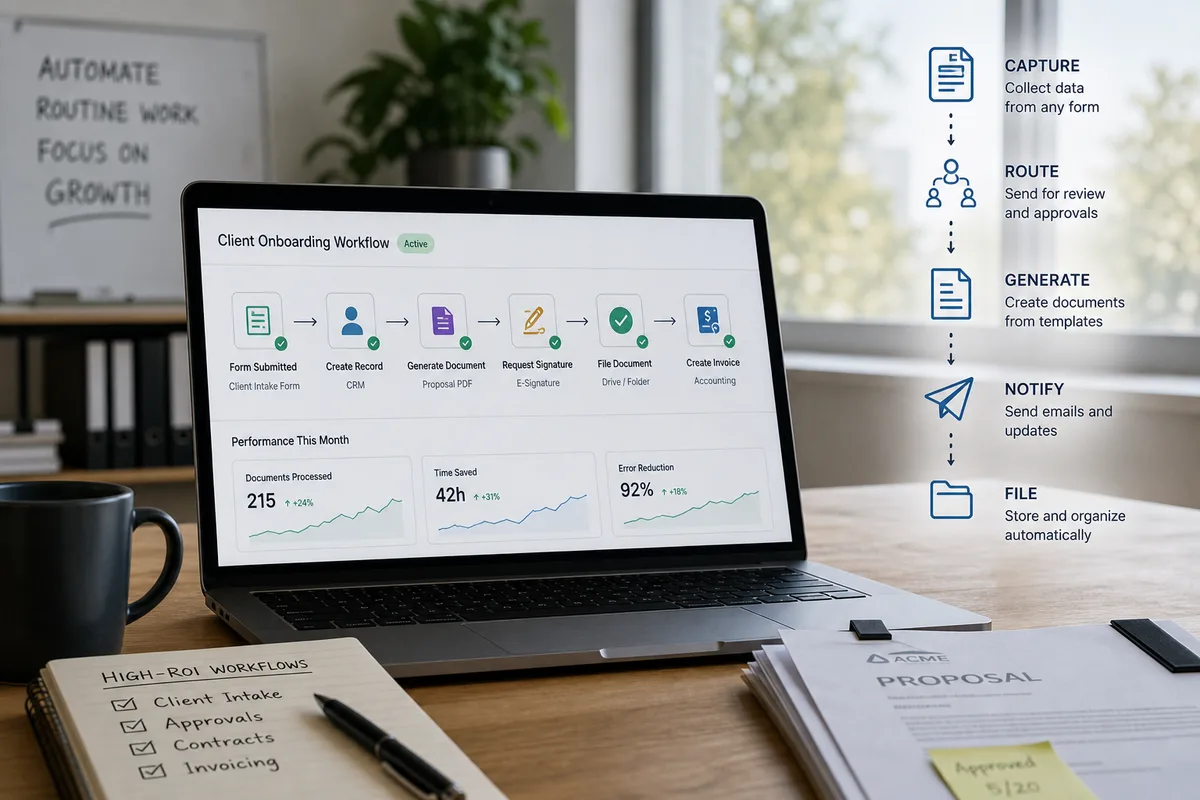
Document Workflow Automation for Small Business (2026 Guide)
Small businesses spend a substantial share of employee time on document tasks. Here's how document workflow automation works, which workflows to build first.