
Eliminate Phone Staff Costs with AI: The Full Cost Math
A single full-time phone employee can cost far more than the salary line once employer obligations, turnover, coverage gaps, and management time are counted. Modern AI voice systems can handle routine inbound call volume, covering appointment scheduling, FAQs, intake, and after-hours lead capture when the workflow is designed correctly.
A single receptionist costs far more than the salary line once benefits, turnover, and overhead are counted. AI voice can absorb routine call volume when the.
Epiphany Dynamics is an AI automation agency: we help businesses find and fix operational bottlenecks with AI receptionists, lead follow-up, and workflow automation.
Free 30-minute audit. We name at least 3 things you can automate, ranked by impact.
Book a free AI audit
Patrick Gibbs
A single full-time phone employee can cost far more than the salary line once employer obligations, turnover, coverage gaps, and management time are counted. Modern AI voice systems can handle routine inbound call volume, covering appointment scheduling, FAQs, intake, and after-hours lead capture when the workflow is designed correctly. This post lays out the cost categories and shows how to compare phone staff overhead with AI using your own numbers.
The Salary Is the Smallest Part of What Your Phone Staff Costs You
Most business owners think of their receptionist or phone agent as a salary line item. That number is incomplete. By the time you stack payroll taxes, health insurance, paid leave, workers’ comp, retirement matching, onboarding costs, and the management time spent on scheduling and performance monitoring, a single full-time phone employee costs much more than base compensation, and that’s before they quit.
See our AI receptionist vs human receptionist ROI breakdown for the full comparison. Turnover is the cost nobody puts in the spreadsheet. Replacing a departed agent costs real money when you account for recruiting, lost productivity during vacancy, and the ramp time for whoever fills the seat. For a business running multiple phone agents, those invisible friction costs compound on top of base compensation. The phone is ringing. Someone has to answer it. And that someone is expensive.
The True Annual Cost of a Phone Employee
Here’s what the full picture actually includes for a receptionist or inbound phone agent:
| Cost Component | What to Include |
|---|---|
| Base salary | Wages or salary for the staffed role |
| Payroll taxes | Employer payroll obligations tied to compensation |
| Benefits | Health insurance, retirement contributions, and other employer-paid benefits |
| Paid leave | Coverage cost when the person is out but the phones still need coverage |
| Insurance and compliance | Workers' comp, unemployment, and role-specific compliance burden |
| Training and onboarding | Recruiting, ramp time, documentation, shadowing, and quality review |
| Management overhead | Scheduling, coaching, performance management, and escalation support |
| True annual cost | Base compensation plus all employer, coverage, and management costs |
And for all of that, you still get staffed-hour coverage, one call at a time, with human variability baked in. The same agent who delivers excellent service on Monday morning may be having a bad day later in the week. Consistency is not a feature of human staffing: it’s the exception.
What Modern AI Voice Systems Actually Handle
Before getting into cost comparisons, it’s worth being precise about what AI voice can and cannot do. The vendor pitch often oversells it; the skeptic often undersells it. The honest answer sits in the middle and depends entirely on your call mix.
Across service businesses (medical offices, law firms, home services, restaurants, and retail), a consistent pattern emerges: most routine calls fall into a small set of repeating types. Appointment scheduling and confirmation. Basic FAQs (hours, pricing, location, availability). Status checks (order status, appointment reminders, claim updates). Lead intake (collecting contact info, answering pre-sales questions). After-hours coverage. These are exactly the call types that modern AI voice handles best.
Industry analysts project AI handling an ever-larger share of customer interactions that historically required human agents, and businesses deploying AI in customer service widely report meaningful reductions in cost-per-interaction. These aren’t theoretical projections anymore; they’re everyday outcomes from businesses that have already made the transition.
The Direct Cost Comparison: AI Voice vs. Human Agent
A production-ready AI voice deployment for a small-to-midsize service business depends on call volume, platform sophistication, and the depth of system integrations. Here’s what the comparison looks like against a single phone agent:
| Factor | Human Phone Agent | AI Voice System |
|---|---|---|
| Annual cost | Salary plus employer, coverage, and turnover costs | Platform, setup, usage, integration, and monitoring costs |
| Availability | Limited to staffed shifts unless more coverage is added | Can cover after-hours and overflow windows |
| Concurrent calls handled | One live conversation at a time | Can scale concurrent routine calls depending on platform limits |
| Answer speed | Depends on workload and staffing | Designed for immediate pickup on routed call types |
| Response consistency | Variable | Consistent when the knowledge base and workflows are maintained |
| Turnover risk | Recruiting and retraining repeat when staff leave | Vendor lock-in and model quality are the main continuity risks |
| Onboarding/ramp time | Depends on hiring, training, and business complexity | Depends on call-flow design, integrations, and testing |
| Language support | Limited by staff capability | Depends on platform language support and QA standards |
| Scales with volume spikes | No (adds headcount) | Yes (immediate) |
For a business with a high share of routine inquiry types, AI can absorb meaningful volume at a lower marginal cost than staffing every coverage gap. The math gets more compelling when you factor in after-hours calls that currently go to voicemail. The true cost of those missed calls is often larger than owners expect when lifetime value is factored in.
For another angle, see How to Integrate an AI Receptionist on a Mobile Phone in 2026.
What a Real Implementation Looks Like
The businesses that succeed with AI voice don’t flip a switch. They follow a structured transition process. Here’s what a competent deployment actually involves:
Step One: Call Audit
Before touching any technology, log and categorize inbound calls long enough to see the real pattern. Tag each call by type. You will almost certainly find that a small set of call categories accounts for most of your volume. These are your AI candidates: start here, not with your most complex calls.
Step Two: Conversation Flow Design
This is where implementations live or die. A generic AI voice deployment built on off-the-shelf prompts produces robotic, frustrating interactions that callers abandon. A well-designed, brand-specific conversation flow, written with your actual customer language, your specific scenarios, and your real business logic, produces interactions that callers find natural and efficient. The goal is that on a routine call, the caller should not be thinking about whether they’re talking to a person. They should be thinking about their answer.
Step Three: System Integration
An AI voice agent that can have a conversation but can’t take action is just an expensive voicemail box. The value is in the integration: your scheduling platform, your CRM, your EHR or practice management system, your inventory system. When the AI can actually book the appointment, pull the account balance, or confirm the delivery window in real time, that’s where the call handles fully without human involvement.
Step Four: Soft Launch with Fallback
Deploy initially on a forwarded number or your after-hours line. Collect real call data, review transcripts, identify failure modes. The first production calls are a tuning exercise, not a finished product. Do not go live on your primary line until you have real performance data. Most deployments need live tuning before they’re running cleanly.
Step Five: Gradual Call Routing Handoff
Once AI handles your routine call types with confidence, route those call types to AI-first. Keep human agents for escalations, complex issues, and high-value interactions. Most businesses should base staffing changes on proven absorbed call volume, not vendor promises.
Where AI Voice Falls Short, and Why That Matters
No technology evaluation is worth reading if it doesn’t cover limitations honestly. AI voice has real gaps, and building your deployment around them is the difference between a system that works and one that erodes customer trust.
- High-emotion calls: Callers in genuine distress, complex complaints involving significant financial stakes, or medical emergencies require human empathy that no current AI replicates authentically. Every AI deployment needs a clean, fast escalation path to a live person, and that path needs to work every time.
- Unusual edge cases: AI trained on your top call types will mishandle unusual requests with varying degrees of grace. The failure mode matters more than the success rate. A well-designed system acknowledges limits and transfers cleanly. A poorly designed one loops or confuses, and callers don’t come back.
- Complex multi-step problem-solving: If a call requires pulling real-time data from multiple systems, making a judgment call, or coordinating between departments in real time, AI is not ready to own that end-to-end. Use AI for intake and routing; use humans for resolution on complex cases.
- Demographic resistance: A meaningful segment of callers (often but not exclusively older adults) will disengage when they detect they’re talking to an automated system. Know your customer base. If a significant portion of your callers fall into this category, AI voice works best as a hybrid first-touch, not a full replacement.
The businesses that fail with AI voice try to remove all human contact. The ones that win use AI to absorb volume so their human staff can focus on work that actually requires judgment, empathy, and relationship-building. That’s not a consolation prize: it’s a better use of everyone involved.
ROI Calculation: Is It Worth It for Your Business?
Here’s a simple framework to run the numbers for your specific situation:
Step One. Calculate true staffing cost:
Base compensation + employer taxes and benefits + paid-leave coverage + recruiting and onboarding + management overhead = true annual cost per phone agent
Step Two. Audit your call mix:
Total call volume multiplied by the share that is routine and repeatable = AI-eligible call volume
Step Three. Estimate coverage:
AI-eligible calls divided by total calls = coverage ratio. A high coverage ratio means AI may reduce staffed coverage needs, but only after live testing confirms quality.
Step Four. Net savings:
True staffing cost attributable to routine call volume minus AI platform, setup, integration, and monitoring cost = estimated net savings
Example: A medical spa audits its call mix and finds that scheduling, confirmations, and FAQs dominate inbound volume. The owner calculates fully loaded front desk cost, estimates which routine calls AI can safely absorb, then subtracts the platform, setup, and monitoring cost. That business-specific estimate is more reliable than borrowed vendor math.
At that point, the question becomes concrete: does your call mix justify replacing routine coverage with AI while keeping humans for the calls that need them?
The Practical Takeaway
Phone staff costs aren’t just a budget line: they’re a compounding liability. Every hire adds benefits obligations, every departure adds replacement costs, and every hour after business closes adds missed opportunities. AI voice doesn’t replace the people who matter, the ones building relationships, handling complex situations, and closing business. It replaces the repetition: the repeated appointment confirmation, the after-hours “what are your hours?” call, the missed call that became a lost lead.
If your business takes meaningful inbound call volume with consistent call types, the ROI case is worth modeling. The variable isn’t whether AI can handle routine calls: it’s whether your implementation will be done well enough to actually earn caller trust. Firms like Epiphany Dynamics specialize in exactly this kind of deployment for service businesses, but regardless of who builds it, the fundamentals are the same: audit first, design carefully, integrate deeply, and tune before going fully live. See our AI front desk cost guide for current pricing-tier guidance and setup considerations. Done right, the economics are difficult to argue with.
Frequently Asked Questions
Q: What is the true fully loaded annual cost of a single full-time phone receptionist?
The true employer cost is base pay plus payroll taxes, benefits, paid time off coverage, workers’ compensation, retirement contributions, onboarding, and management overhead. For a business running multiple phone agents, those costs stack quickly before factoring in turnover that adds recurring replacement costs with every departure.
Q: What percentage of inbound business calls can AI voice systems typically handle without human involvement?
In most service businesses, the majority of calls are one of four or five repeating types: appointment scheduling, basic FAQs, status checks, lead intake, and after-hours coverage. These are exactly the call types AI voice handles with high reliability. Industry analysts project AI handling an ever-larger share of customer interactions that historically required human agents, with SMB operators reporting high deflection rates on well-defined call types.
Q: How does AI voice compare to human phone staff on cost per call?
Once wages, benefits, and overhead are counted, a human-handled inbound call costs many times what an AI-handled call costs in a production deployment, and the gap compounds at volume. AI cost structures do not scale steeply with call volume; human cost structures do.
Q: How should a business phase in AI voice to avoid disrupting existing operations?
Start with after-hours coverage: low disruption to current staff or workflows, with immediate wins from capturing missed after-hours calls. Then add overflow routing when all human agents are occupied. After you have enough real performance data, flip AI to first-contact for defined call categories while keeping humans for escalations. Use your own cost model to decide when the system has reached ROI breakeven.
Q: What types of calls should always be escalated to a human regardless of AI capability?
High-emotion calls involving genuine distress, complex complaints with significant financial stakes, and medical emergencies require human empathy that no current AI replicates authentically. Additionally, calls where a patient or customer is elderly and disengages when detecting automation, and situations requiring cross-system judgment outside trained parameters, should all route cleanly to a live agent. A fast, clean escalation path that works every time is not optional: it is a core component of any production AI voice deployment.
Patrick Gibbs
AI Automation Expert
Patrick Gibbs helps professional practices implement AI automation that captures more leads, books more appointments, and scales without adding overhead. He's the founder of Epiphany Dynamics and creator of the AI Front Desk system.
Related Solutions
Build this into a real workflow
Related Posts
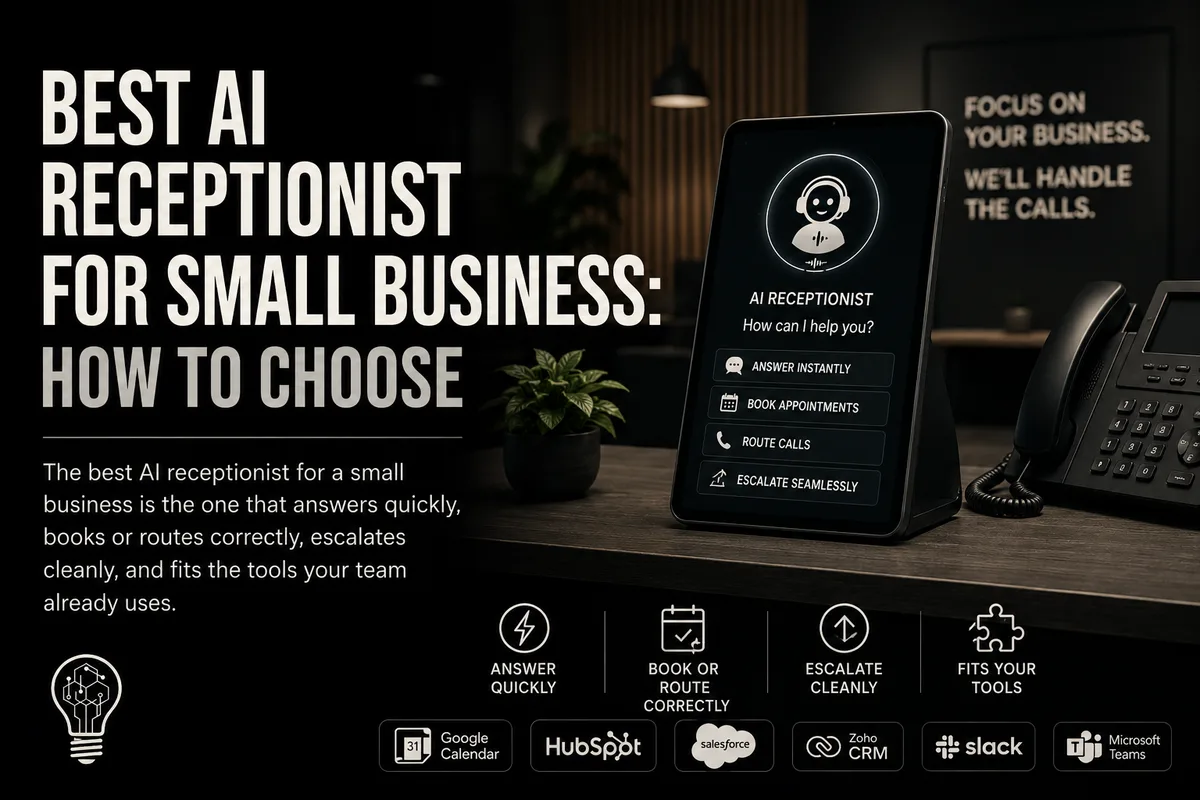
Best AI Receptionist for Small Business: How to Choose
The best AI receptionist for a small business is the one that answers quickly, books or routes correctly, escalates cleanly, and fits the tools your team.
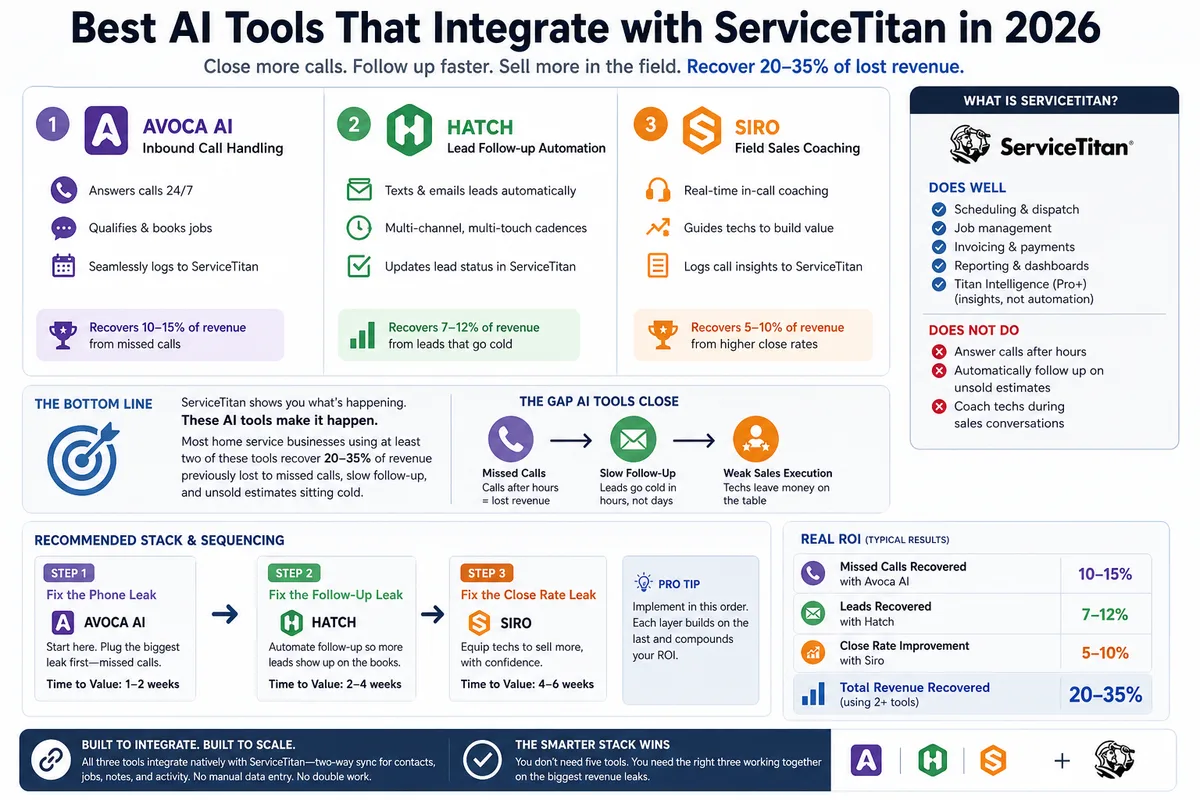
Best AI Tools That Integrate with ServiceTitan in 2026
Most ServiceTitan shops miss a meaningful share of inbound calls and leave most estimates unsold. These AI tools close those gaps inside ServiceTitan.
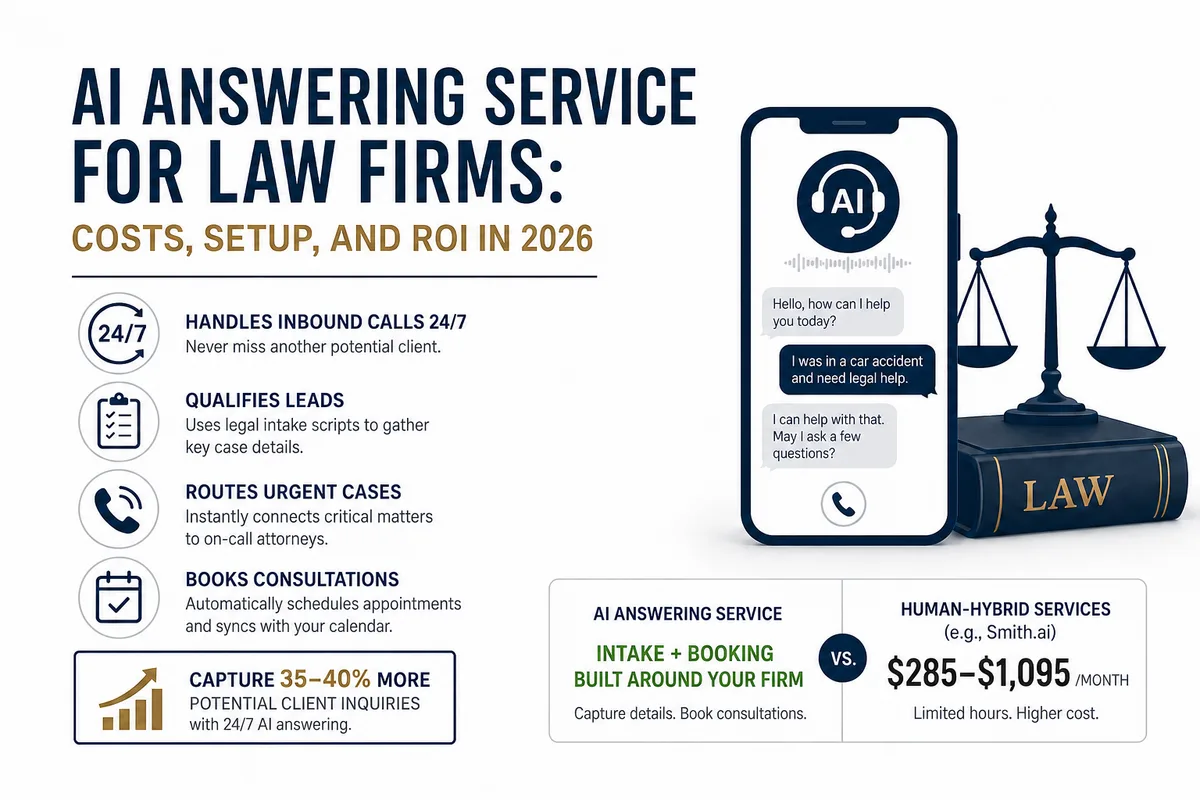
AI Answering Service for Law Firms: Costs, Setup, and ROI in 2026
Law firms miss a large share of inbound calls, most of them after hours. Here's what an AI answering service actually does, what it costs versus human.