
AI Automation Myths Small Business Owners Should Stop Believing
The biggest AI automation myths for small business owners include: AI will replace all jobs, automation costs too much to be worth it, AI is only for tech companies, automation is too complex to set up, AI makes customer service feel impersonal, and small businesses do not have enough data for AI to work. Every one of these myths is false.
Common AI automation myths for small business include 'AI will replace all jobs,' 'automation is too expensive,' and 'AI is only for tech companies.' This.
Epiphany Dynamics is an AI automation agency: we help businesses find and fix operational bottlenecks with AI receptionists, lead follow-up, and workflow automation.
Free 30-minute audit. We name at least 3 things you can automate, ranked by impact.
Book a free AI audit
Patrick Gibbs
The biggest AI automation myths for small business owners include: AI will replace all jobs, automation costs too much to be worth it, AI is only for tech companies, automation is too complex to set up, AI makes customer service feel impersonal, and small businesses do not have enough data for AI to work. Every one of these myths is false. Small businesses across every industry are using AI automation today to answer phones, book appointments, and follow up with customers without rebuilding their entire team.
AI automation myths persist because the technology changes fast and most information comes from vendors with something to sell or from scare stories that do not reflect real business use. This guide addresses the most common myths head-on with facts, examples, and practical context.
Myth 1: AI Automation Will Replace All Jobs
The Truth: AI automation replaces tasks, not jobs. The repetitive, high-volume administrative tasks that drain a small business team's focus are what get automated. Your receptionist stops spending so much time on manual appointment reminders and starts focusing on patient relationships and complex customer needs. Your sales team stops manually following up on every lead and starts closing deals.
In a healthy implementation, the team becomes more productive and less stressed because they are doing the work that requires human judgment rather than the work that drains their energy. Automation does not eliminate jobs. It eliminates drudgery.
Myth 2: AI Automation Is Too Expensive for Small Business
The Truth: AI automation cost depends on the workflow, the call or message volume, the number of integrations, and how much implementation support is required. A focused phone-answering or reminder workflow costs less than a full stack that includes scheduling, follow-ups, payment processing, and reporting. Compare the investment against the value of missed calls, no-shows, manual follow-up, and staff time currently lost to repetitive work.
Small businesses should evaluate ROI by comparing the monthly automation cost against the value of missed calls, no-shows, manual follow-up, and staff time currently lost to repetitive work. The math works best when the first automation targets a leak the owner can already measure. See our automation cost guide for detailed pricing.
Myth 3: AI Is Only for Tech Companies
The Truth: AI automation is most valuable for non-tech businesses. HVAC companies, dental practices, real estate agencies, plumbing contractors, insurance agents, and law firms are the businesses that benefit most because they rely on phone calls, appointments, and customer relationships. Tech companies already run on digital systems. Service businesses are the ones catching up.
The businesses that gain the biggest competitive advantage from AI are the ones where most competitors are still doing things manually. In home services, healthcare, and real estate, early automation adopters are capturing market share while competitors wonder whether AI is relevant to their industry. Read our home services automation guide for industry-specific examples.
Myth 4: AI Automation Is Too Complex to Set Up
The Truth: Most AI automation systems can be configured in phases with help from an implementation specialist. The setup process involves mapping your current workflows, configuring the AI to handle the common scenarios, connecting your existing tools, and testing before going live.
You do not need to write code or understand machine learning to deploy AI automation. The configuration is done through dashboards and conversation builders that let you define how the AI should handle different situations. Many providers handle the entire setup for you. See our agency selection guide for what to look for in an implementation partner.
Myth 5: AI Makes Customer Service Feel Impersonal
The Truth: AI automation makes customer service more responsive and consistent, which customers perceive positively. An AI that answers immediately and helps the customer is more personal than a voicemail greeting or a 15-minute hold time. The key is designing the AI to sound like your brand and to transfer to a human when the situation requires it.
Most customers would rather get an instant, useful answer than wait for a human, especially for simple tasks like checking hours, booking appointments, or getting a quote. The negative perception of AI comes from poorly designed systems that are hard to use or impossible to escalate. Good AI automation is designed to feel helpful, not robotic.
Myth 6: My Business Does Not Have Enough Data for AI to Work
The Truth: Modern AI automation does not require your business data to start working. The underlying AI models are pre-trained on vast datasets and can handle common business conversations out of the box. Your business data is used to customize the AI to your specific services, pricing, and workflows, not to train it from scratch.
A new plumbing company can deploy AI phone answering without years of historical call data. The AI comes pre-trained to handle scheduling, qualification, and common customer questions. The customization layer lets you add your specific services, service areas, and pricing. The AI improves over time as it handles more of your specific calls, but it does not require a giant internal dataset to start.
Myth 7: AI Automation Is Not Secure for Customer Data
The Truth: Reputable AI automation providers use enterprise-grade security: encryption in transit and at rest, SOC 2 compliance, access controls, and data processing agreements. Healthcare providers offer HIPAA-compliant infrastructure and sign BAAs. Financial services providers meet FINRA record-keeping requirements.
AI automation is not inherently less secure than any other cloud business tool. The security posture depends on the provider, not the technology. Use the same vendor evaluation criteria you would for any business software. See our AI automation safety guide for a complete evaluation framework.
Myth 8: I Can Just Use ChatGPT for Business Automation
The Truth: ChatGPT is a conversational AI, not a business automation system. It cannot answer your phone, schedule appointments in your calendar, update your CRM, or send automated follow-up messages. ChatGPT generates text responses. Business automation requires integration with your business systems, telephony infrastructure, and workflow logic.
ChatGPT can be a component of a business automation system, serving as the language understanding layer, but it is not a complete solution. You need a platform that combines AI conversation with action capabilities: making phone calls, sending texts, managing calendar events, and updating database records. Dedicated business automation platforms provide this integration.
FAQ: AI Automation Myths for Small Business
Is it too late to start using AI automation in my industry?
No. Many small-business categories still have room for early operators to build an advantage. In home services, healthcare, real estate, and professional services, plenty of competitors are still handling calls, reminders, follow-up, and intake manually. Businesses that start now can learn the workflow before automation becomes table stakes in their market.
Will AI automation make my business dependent on technology?
Your business is already dependent on technology: phones, internet, email, and probably a CRM or scheduling system. AI automation is one more layer. If the automation goes down, you fall back to your current manual processes. Good automation is designed with fallback procedures so your business keeps running regardless of technology availability.
Do I need to understand AI to use AI automation?
No. You need to understand your business workflows. The AI handles the technical complexity. Your role is to define what you want the AI to do and when it should hand off to a human. The implementation partner handles the configuration. You do not need to understand how the AI works any more than you need to understand how your CRM's database works.
What if AI automation makes mistakes?
AI automation will make mistakes, just as human employees do. The key is designing the system with error handling: clear escalation paths for situations the AI cannot handle, monitoring to catch mistakes quickly, and the ability to review and correct AI interactions. Good automation is designed to fail gracefully, transferring to a human when the AI is uncertain.
Next Steps
If you have been hesitating because of these myths, the best way to move forward is to test automation with a small, contained use case. Pick one task that takes up staff time and try automating it. Phone answering is a good starting point because the ROI is clear and measurable.
Review the how to test AI automation guide for a step-by-step approach, and book a consultation to discuss which myth might be holding you back from automating your business.
Patrick Gibbs
AI Automation Expert
Patrick Gibbs helps professional practices implement AI automation that captures more leads, books more appointments, and scales without adding overhead. He's the founder of Epiphany Dynamics and creator of the AI Front Desk system.
Related Solutions
Build this into a real workflow
Related Posts
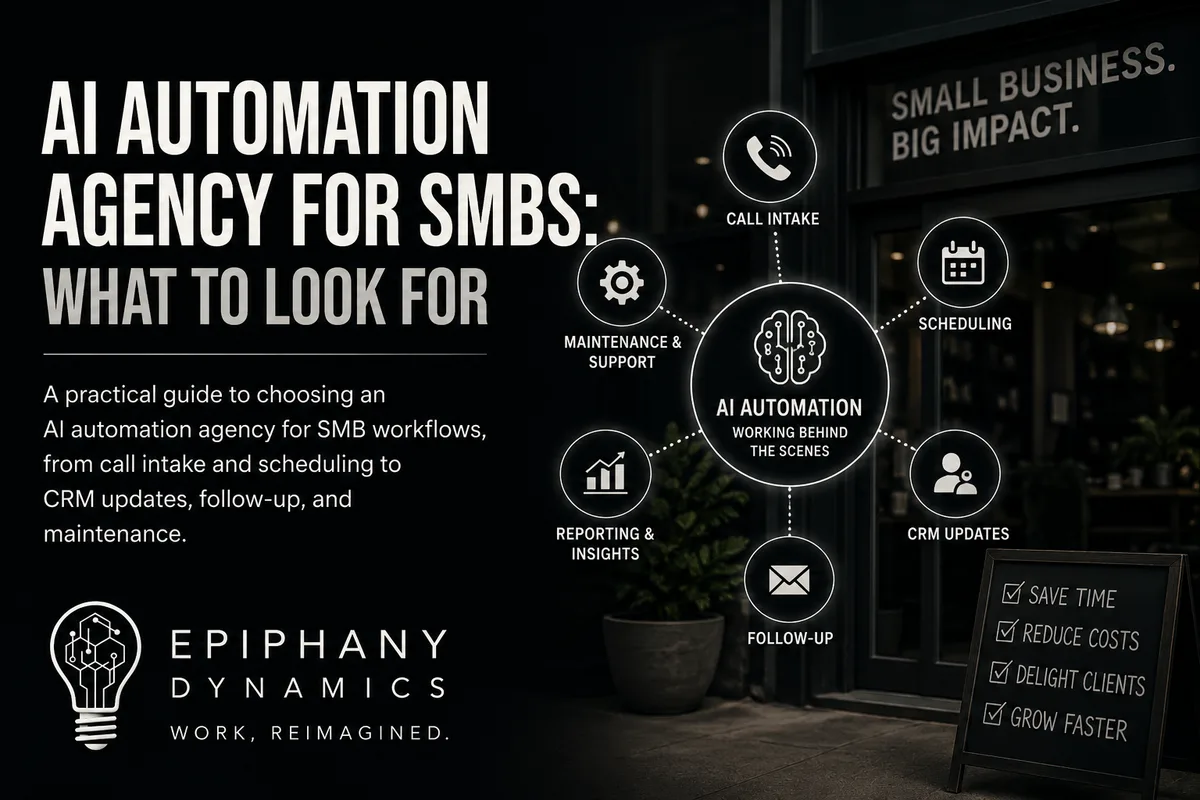
AI Automation Agency for SMBs: What to Look For
A practical guide to choosing an AI automation agency for SMB workflows, from call intake and scheduling to CRM updates, follow-up, and maintenance.

Appointment Reminder Automation for Small Business (2026 Guide)
For a service business with a meaningful no-show rate, the revenue leak is worth measuring. This guide covers how reminder automation works, which tools to.
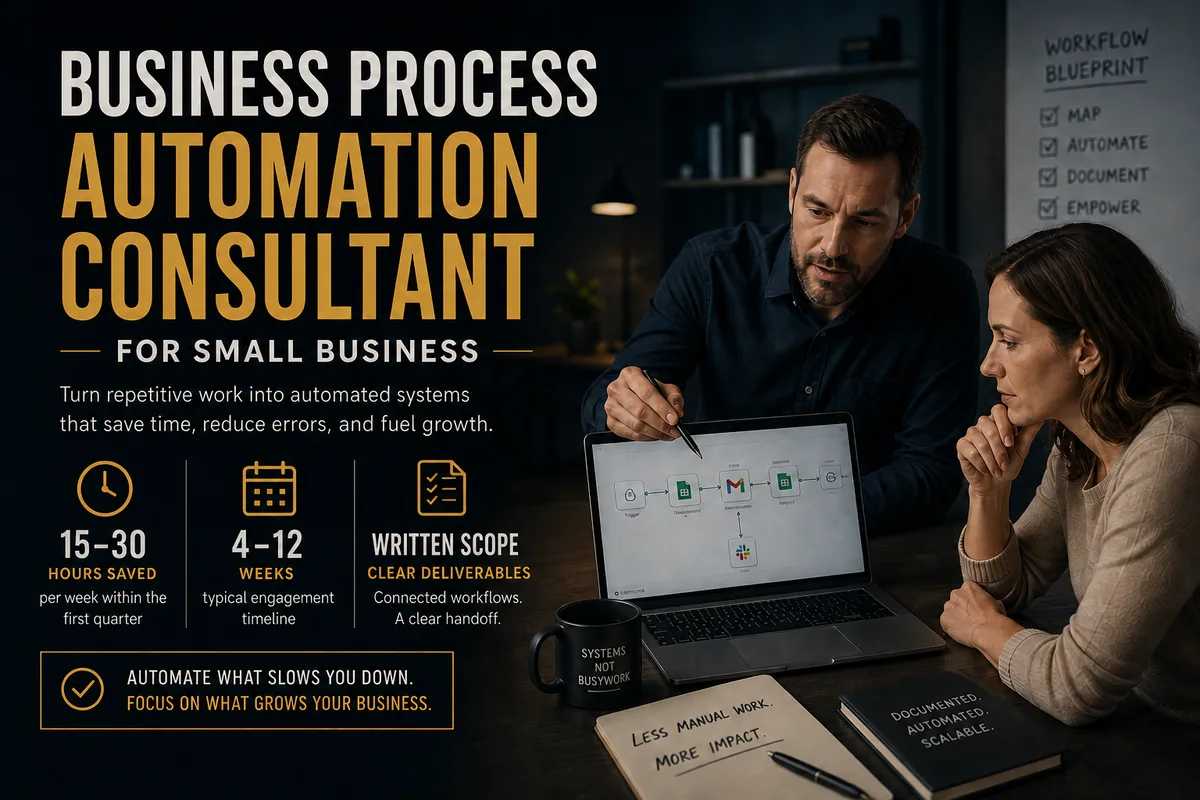
Business Process Automation Consultant for Small Business
Hiring the wrong automation consultant wastes thousands. Here's what small business owners need to know about process, cost, ROI, and how to vet the right one.