
AI Receptionist vs. Law Firm Front Desk: Costs, Gaps, and ROI
An AI receptionist can handle law firm intake calls after hours and during overflow, qualifying leads, collecting case facts, and scheduling consultations. This matters because many law firm calls arrive when the front desk is unavailable, and prospective clients in acute legal situations often keep calling until someone answers.
A large share of law firm calls go unanswered, especially after hours. A practical breakdown of what AI receptionists actually cover, miss, and change.
Epiphany Dynamics is an AI automation agency: we help businesses find and fix operational bottlenecks with AI receptionists, lead follow-up, and workflow automation.
Free 30-minute audit. We name at least 3 things you can automate, ranked by impact.
Book a free AI audit
Patrick Gibbs
An AI receptionist can handle law firm intake calls after hours and during overflow, qualifying leads, collecting case facts, and scheduling consultations. This matters because many law firm calls arrive when the front desk is unavailable, and prospective clients in acute legal situations often keep calling until someone answers. This article gives a practical breakdown of costs, coverage gaps, what AI receptionists can and cannot do, and how to calculate ROI for your firm size.
Many calls to small and mid-size law firms go unanswered. Not because lawyers are bad at their jobs, but because the phone rings after the receptionist has gone home. A prospective client with a time-sensitive legal issue calls several firms. The first ones go to voicemail. The firm that picks up gets the opportunity.
That third firm gets the case. For PI practices specifically, our guide to automated intake screening for personal injury attorneys covers how to qualify leads 24/7 without paralegal involvement.
This is the core operational tension law firms face right now: the client acquisition window is no longer limited to office hours, but most law firm front desks still are. AI receptionists entered this gap not as a futuristic experiment but as a practical fix to a measurable problem. This article breaks down, without hype, what each option costs, where each structurally fails, and what the decision looks like when you run it against your own call data. For a broader cost comparison applicable to any industry, our AI vs. human receptionist ROI breakdown covers the full picture.
The True Cost of a Human Front Desk
The advertised salary for a law firm receptionist is only the number on the job posting, not the number in your P&L. Once you account for payroll taxes, benefits, paid time off, workers’ comp, training, management, and replacement risk, the loaded cost of a single full-time receptionist is materially higher than base pay.
Then there’s turnover. Administrative roles in legal services can be hard to retain, and every replacement hire adds recruiting, onboarding, and lost-productivity costs on top of salary. If you cycle through a receptionist every few years, that replacement cost becomes part of your true staffing cost.
The coverage math is equally important. A full-time receptionist covers office hours, not evenings, weekends, lunch gaps, sick days, or simultaneous call spikes. In practice, effective phone coverage shrinks further once lunch gaps, sick days, and multiple inbound calls enter the picture.
The Coverage Problem: Where Human Receptionists Structurally Can’t Help
The after-hours problem is well-documented but still underestimated in its impact. A large share of inbound legal inquiries arrive outside standard business hours: evenings, weekends, early mornings. These aren’t casual browsers. Someone searching for a DUI attorney at 11 PM or a divorce lawyer on Saturday morning is typically in an acute situation, highly motivated, and actively comparing firms in real time.
Peak call volume creates a second, less-discussed structural failure. Many law firms see a large share of their daily call volume compressed into two or three hour windows, typically mid-morning and early afternoon. A single receptionist handling a complex intake call while three additional lines ring sends those callers to voicemail. In the legal field, prospective clients who reach voicemail on first contact convert at a fraction of the rate of those who speak to a live person immediately.
There’s also a consistency problem that gets glossed over in most discussions. A skilled receptionist who has been with your firm for four years knows your practice areas, your screening questions, and your intake workflow cold. The person you hired three weeks ago does not. Human performance varies with workload, tenure, time of day, and circumstances. When a prospective client calls your firm, they receive whatever version of that experience happens to be available at that moment, and that variance directly affects intake conversion rates.
What AI Receptionists Actually Do at a Law Firm
The term “AI receptionist” covers a wide range of capability levels. At the basic end, you have glorified voicemail bots with voice synthesis. At the functional end, you have voice AI systems that can conduct structured intake interviews, qualify leads by practice area, collect contact information and detailed case facts, schedule consultations directly into the firm’s calendar, transfer calls to an on-call attorney when the situation demands it, and send follow-up SMS messages with intake links or appointment confirmations.
For law firms specifically, the intake screening function is where AI earns its operational value. A well-configured AI receptionist can ask the same questions a paralegal would: What happened? When did it occur? Have you spoken with another attorney? Are there pending deadlines? Statute of limitations concerns? That information gets logged and routed before a single attorney hour is spent. Qualified leads get scheduled. Unqualified calls get triaged appropriately. The entire first-contact workflow runs without human involvement, at any hour.
What AI receptionists cannot do deserves equal honesty: they cannot exercise genuine judgment in complex, emotionally volatile situations; they cannot build the kind of rapport that sometimes seals a high-value retainer over the phone; they handle edge cases poorly when those cases fall outside their training configuration; and they cannot represent your firm’s culture with the nuance a long-tenured human employee brings. These are real limitations, not marketing disclaimers, and they matter when designing how you deploy the technology.
Head-to-Head: AI vs. Human Receptionist at a Law Firm
| Factor | Human Receptionist | AI Receptionist |
|---|---|---|
| Cost pattern | Payroll, benefits, training, management, and turnover | Platform, setup, usage, and ongoing tuning |
| Hours of coverage | Office hours and staffed windows | After-hours and overflow coverage |
| Simultaneous calls | Limited by staff availability | Unlimited concurrent |
| Intake consistency | Variable | Consistent every call |
| Emotional intelligence | High | Low–moderate |
| Complex judgment calls | Strong | Weak |
| Turnover cost | Recruiting, onboarding, training, and lost productivity | None |
| Scalability | Linear (hire more staff) | Immediate, no added cost |
| Distressed caller handling | Significantly better | Noticeably weaker |
For a detailed breakdown of what these systems cost at every tier, our AI front desk cost guide covers pricing models and setup timelines. The capability tradeoffs are clear: AI wins on coverage, consistency, and scale. Humans win on judgment, empathy, and managing situations that resist scripting.
Running the ROI Calculation
Here’s the math that actually drives the decision for most firms. Start with your own inbound call volume, unanswered-call rate, after-hours demand, consultation booking rate, and average revenue per retained client. Add the staff cost of handling routine intake and the opportunity cost of prospects who never reach a person.
The decision changes by practice area. A high-volume practice with lower matter value needs more recovered consultations to justify the system. A practice area where each retained client carries higher value may justify coverage with fewer recovered opportunities. The point is to build the model from your own intake data instead of importing a generic law-firm revenue example.
The Practical Decision Framework: Neither/Nor Is Rarely the Right Answer
The honest answer for most law firms isn’t “replace your receptionist with AI.” It’s “use AI to cover the hours and situations where a human isn’t available or isn’t effective.” The hybrid model is where most forward-thinking firms are moving, and it’s producing the clearest results.
The most effective implementation looks like this: AI handles after-hours and weekend calls. During business hours, AI answers overflow: calls that come in while your receptionist is occupied with another caller or task. The human receptionist focuses on high-stakes interactions: complex intake conversations, distressed or emotionally volatile callers, relationships with existing clients, and anything requiring real-time judgment. AI handles the volume. Humans handle the nuance.
Before evaluating any AI receptionist vendor, a law firm should map its current answered-call rate, after-hours call volume, and average revenue per new retained client with actual data, not guesses. Those inputs will tell you almost everything you need to know about whether the ROI is there, and how aggressive your implementation should be.
What to Look For When Evaluating AI Receptionist Solutions
Not all AI voice platforms are built for the legal environment. When evaluating options, prioritize these specific capabilities over feature lists:
- Legal intake templates: Does the platform offer pre-built intake flows for your practice areas (PI, family law, criminal defense), or will you be building from scratch?
- Calendar integration: Can it book directly into Clio, MyCase, Lawmatics, or whatever practice management software you use, or does it just collect information and hand off?
- Live transfer logic: Can you configure rules for when the AI escalates to a live person versus takes a message? This matters for urgent situations.
- Call recording and transcription: Every intake call should be logged with a transcript for review and quality control. This is table stakes.
- HIPAA/data handling: If you handle any healthcare-adjacent matters, confirm how call data is stored and whether the vendor can sign a BAA.
- Latency and voice quality: Test it live before you commit. Robotic voice or noticeable hesitation patterns will damage caller confidence in your firm.
Implementation requires initial configuration and call monitoring to tune the intake scripts and transfer logic to your firm’s specific needs. Budget time for that tuning phase. The platforms that work best at law firms are the ones that have been adjusted based on actual call transcripts, not just initial setup. For a structured comparison of the packaged, managed hybrid, and custom options against legal intake requirements, see our best AI receptionist for law firms guide.
For the numbers behind this, see AI Answering Service for Law Firms: Costs, Setup, and ROI in 2026.
The Bottom Line
The firms that are capturing market share in high-competition practice areas right now share one operational trait: they answer the phone. Not just during business hours: after hours, on weekends, during peak volume spikes, and when the front desk is handling something else. The technology to do that at a cost far below a second full-time hire exists today and has matured considerably in the past two years.
The question isn’t whether AI receptionists can replace a seasoned human front desk employee: they can’t, and the firms treating it as a full replacement are learning that the hard way. The question is whether your current coverage model is costing you cases you’ll never know you missed. For many practices, the answer is yes. The firms figuring that out first, and acting on it, are capturing clients from competitors who are still sending motivated prospects to voicemail after hours.
If you’re evaluating AI front desk solutions for a legal practice and want to work through the ROI calculation with your actual call volume numbers, firms like Epiphany Dynamics specialize in configuring and deploying AI voice intake systems for professional services businesses.
Frequently Asked Questions
Q: What percentage of law firm calls go unanswered?
At small and mid-size law firms, a meaningful share of calls simply go unanswered. Many legal inquiries arrive outside standard business hours, when receptionist coverage doesn’t exist. The result is that many highly motivated prospects, often in acute situations comparing firms in real time, never reach a human at the firm they called first.
Q: How much does an AI receptionist cost compared to a law firm human receptionist?
Compare the loaded cost of a human receptionist, including payroll, benefits, management, turnover, and coverage gaps, against the vendor quote, setup work, usage, and monitoring required for an AI receptionist. AI usually wins on coverage and consistency, while humans win on judgment, empathy, and complex intake nuance.
Q: What can an AI receptionist do for a law firm’s intake process?
AI receptionists can conduct structured intake interviews, collect contact information and case facts, qualify leads by practice area, schedule consultations directly into the firm’s calendar, transfer calls to on-call attorneys for urgent situations, and send follow-up SMS with intake links. The intake information is logged and routed before a single attorney hour is spent, dramatically improving how efficiently qualified leads reach the calendar.
Q: What are the limitations of AI receptionists at law firms?
AI receptionists cannot exercise genuine judgment in complex or emotionally volatile situations, cannot build the rapport that sometimes seals a high-value retainer, handle edge cases poorly when callers fall outside their training configuration, and cannot represent firm culture with the nuance a long-tenured human employee brings. High-stakes or emotionally charged calls should always route to a human quickly and without friction.
Q: How should a law firm decide between AI-only, hybrid, or human-only reception?
Map your current answered-call rate, after-hours call volume, and average revenue per retained client. Most practices find the hybrid model produces the best fit. AI handles after-hours and overflow calls, while a human receptionist focuses on high-stakes interactions, complex intake conversations, and existing client relationships.
Patrick Gibbs
AI Automation Expert
Patrick Gibbs helps professional practices implement AI automation that captures more leads, books more appointments, and scales without adding overhead. He's the founder of Epiphany Dynamics and creator of the AI Front Desk system.
Related Solutions
Build this into a real workflow
Related Posts
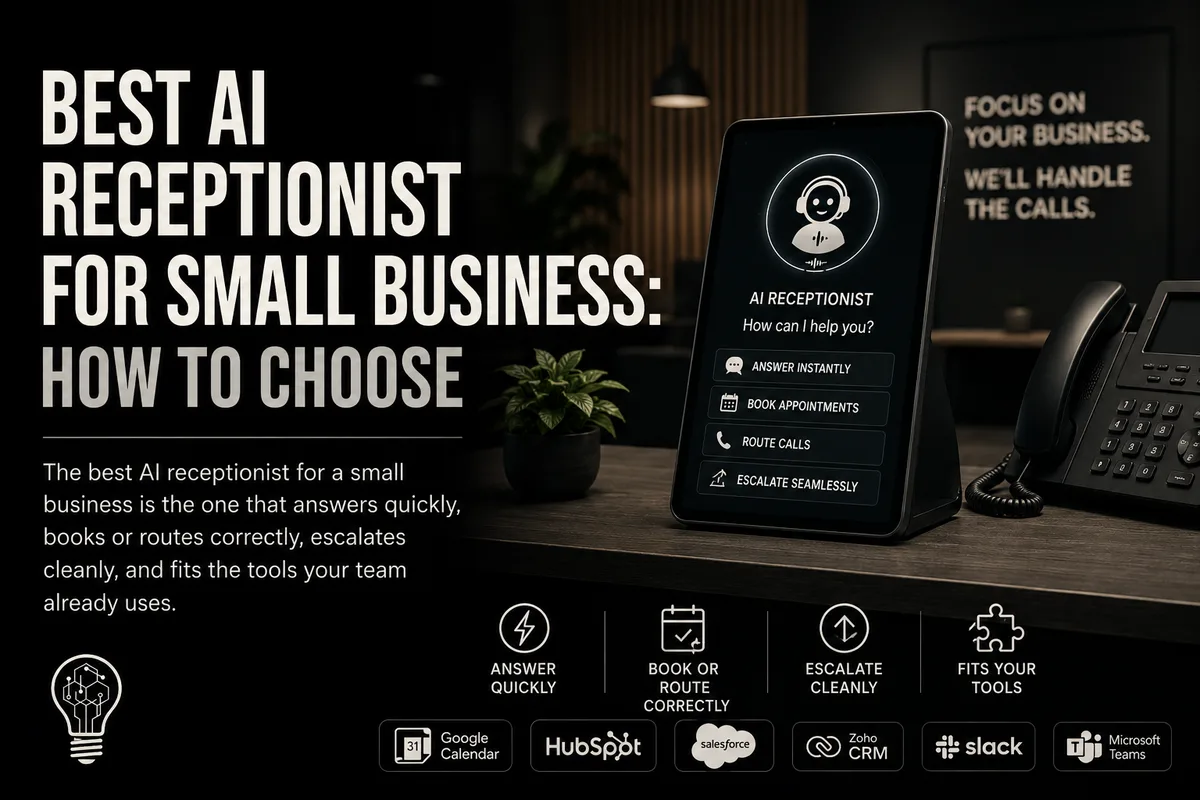
Best AI Receptionist for Small Business: How to Choose
The best AI receptionist for a small business is the one that answers quickly, books or routes correctly, escalates cleanly, and fits the tools your team.
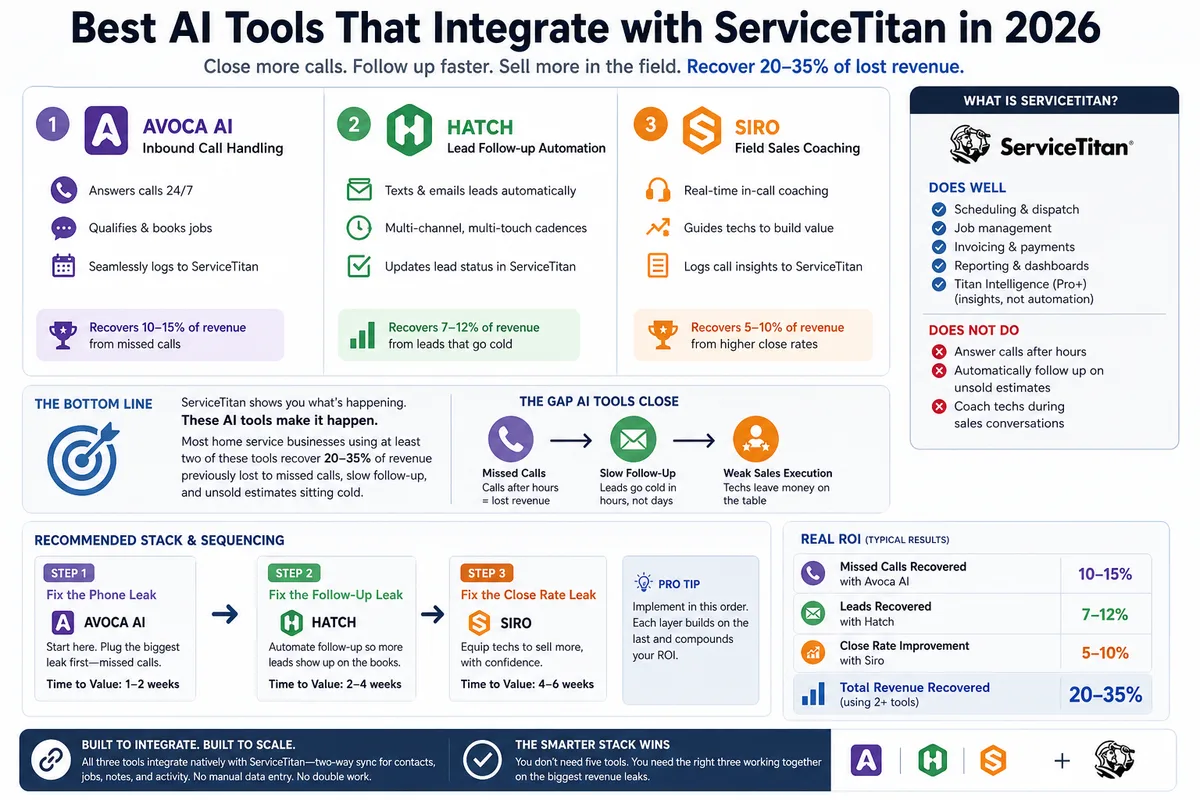
Best AI Tools That Integrate with ServiceTitan in 2026
Most ServiceTitan shops miss a meaningful share of inbound calls and leave most estimates unsold. These AI tools close those gaps inside ServiceTitan.
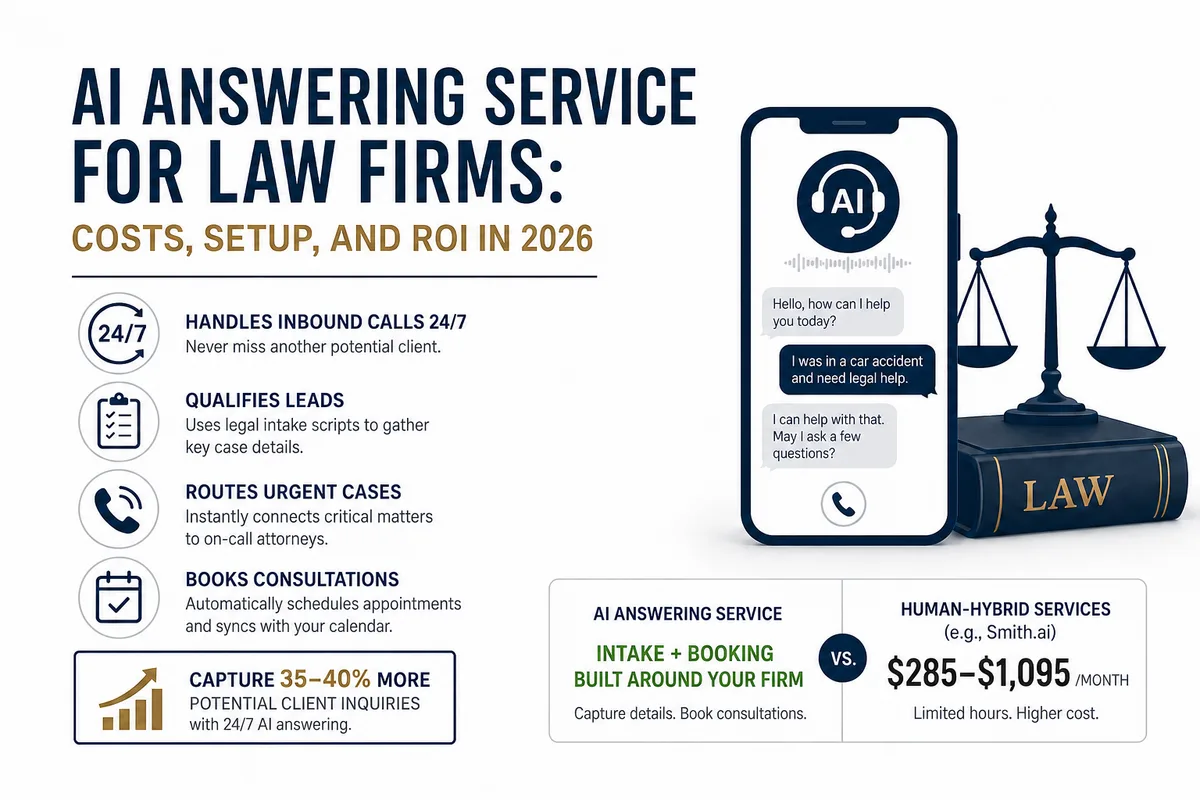
AI Answering Service for Law Firms: Costs, Setup, and ROI in 2026
Law firms miss a large share of inbound calls, most of them after hours. Here's what an AI answering service actually does, what it costs versus human.