
AI Voice Technology
Best AI Receptionist for Small Business: How to Choose
The best AI receptionist for a small business is the one that answers quickly, books or routes correctly, escalates cleanly, and fits the tools your team.
The free 30-minute AI Operations Audit is a conversation about a normal week in your business and where the work piles up. We find the one change that would give you the most time back and send you a plain-English plan for it. No forms and no pitch.
Book a free AI audit
Patrick Gibbs
The best AI receptionist for a small business is not the loudest demo or the cheapest phone bot. It is the system that answers quickly, understands the caller's intent, books or routes the request correctly, escalates when a human is needed, and leaves clean notes in the tools your team already uses.
Small businesses usually do not need a giant call center stack. They need fewer missed calls, fewer voicemail dead ends, better appointment capture, and less front-desk drag. The right AI receptionist should support that practical goal without creating a second system the team has to babysit.
What a Small Business AI Receptionist Must Do
A small business AI receptionist should handle the first layer of phone intake: answer, identify the caller's need, collect the details, book or route the request, and summarize the outcome for staff. Anything more advanced should be added only after the basic workflow is reliable.
| Need | What Good Looks Like | Warning Sign |
|---|---|---|
| Call answering | Fast pickup, clear greeting, caller intent captured early. | The caller has to repeat basic details after transfer. |
| Appointment booking | The system follows real calendar rules and confirms the next step. | It takes a message but cannot book or qualify. |
| Escalation | Urgent, angry, sensitive, or unclear calls route to a human. | The AI tries to handle every call the same way. |
| Follow-up | Staff receive a useful summary, not a mystery voicemail. | The team still has to reconstruct what happened. |
Best Fit by Business Type
For home service businesses, the receptionist must separate emergencies from routine estimate calls and connect with dispatch or scheduling. Start with the home services AI agency checklist if you run HVAC, plumbing, electrical, roofing, or similar operations.
For medical, dental, med spa, legal, and financial workflows, the receptionist needs stricter boundaries. The system should collect intake and route the call, not pretend to give clinical, legal, or financial advice. A human handoff path is mandatory in those categories.
For local service companies with simple scheduling needs, a packaged AI receptionist may be enough. For businesses where calls trigger CRM updates, estimates, dispatch, payment follow-up, review requests, and staff tasks, the better comparison is not tool versus tool. It is tool versus custom workflow.
Related reading: AI Voice Agent for Small Business: What It Does in 2026.
Packaged Tool or Custom Build?
Choose a packaged AI receptionist when the workflow is simple, the call types are predictable, and your team mainly needs faster pickup. Choose a custom build when the receptionist needs to connect calls, forms, calendars, CRM records, staff alerts, and follow-up in one operating process.
If you are replacing or comparing answering services, review the Abby Connect alternative, Ruby Receptionists alternative, and Smith.ai alternative pages. Those comparisons help clarify whether the buying decision is about live coverage, AI phone answering, or deeper workflow automation.
How Epiphany Dynamics Evaluates AI Receptionist Fit
Epiphany Dynamics starts with the workflow, not the software. We look at call types, missed-call patterns, booking rules, CRM or scheduling tools, staff handoffs, sensitive-call boundaries, and what should happen after the call ends. Then we decide whether the business needs a lightweight receptionist, a connected workflow, or no AI receptionist yet.
If the receptionist is only one piece of the operating system, see our AI automation agency for SMBs guide. If you want a workflow read before buying another phone tool, book a consultation.
Run the same six calls through every candidate
Use a test calendar and invented customer details. Ask each provider to handle a routine booking, a reschedule, an unavailable slot, a caller asking for a person, an unclear address, and a failed transfer. Keep the request identical so you're comparing the workflow rather than the salesperson's preferred demo.
For each call, record the requested action, the calendar entry actually created, the staff notification, and anything the caller was promised. A pleasant conversation with no appointment in the calendar is a failed booking. A transfer to an unanswered phone needs a defined fallback. Ask who owns each failure after launch.
For a more specific buying comparison, review Goodcall versus a custom workflow and Ruby versus a custom AI workflow. These are different operating choices; the same call trial makes their tradeoffs easier to assess.
FAQ: Best AI Receptionist for Small Business
What is the best AI receptionist for a small business?
The best option depends on call type, scheduling rules, staff availability, and integration needs. A simple tool can work for basic call capture. A custom workflow is better when the receptionist needs to route calls, update systems, trigger follow-up, and escalate edge cases.
Can an AI receptionist replace a human receptionist?
It can replace repetitive first-layer intake in some businesses, but it should not replace every human judgment call. The safest setup lets AI handle predictable calls and sends sensitive, urgent, unclear, or unhappy callers to staff.
How should a small business compare AI receptionist options?
Compare pickup speed, call quality, booking accuracy, escalation rules, integration access, staff summaries, and ongoing support. Do not buy from the demo alone. Test against your real call types.
Patrick Gibbs
AI Automation Expert
Patrick Gibbs helps professional practices implement AI automation that captures more leads, books more appointments, and scales without adding overhead. He's the founder of Epiphany Dynamics and creator of the AI Front Desk system.
Related Solutions
Build this into a real workflow
Related Posts
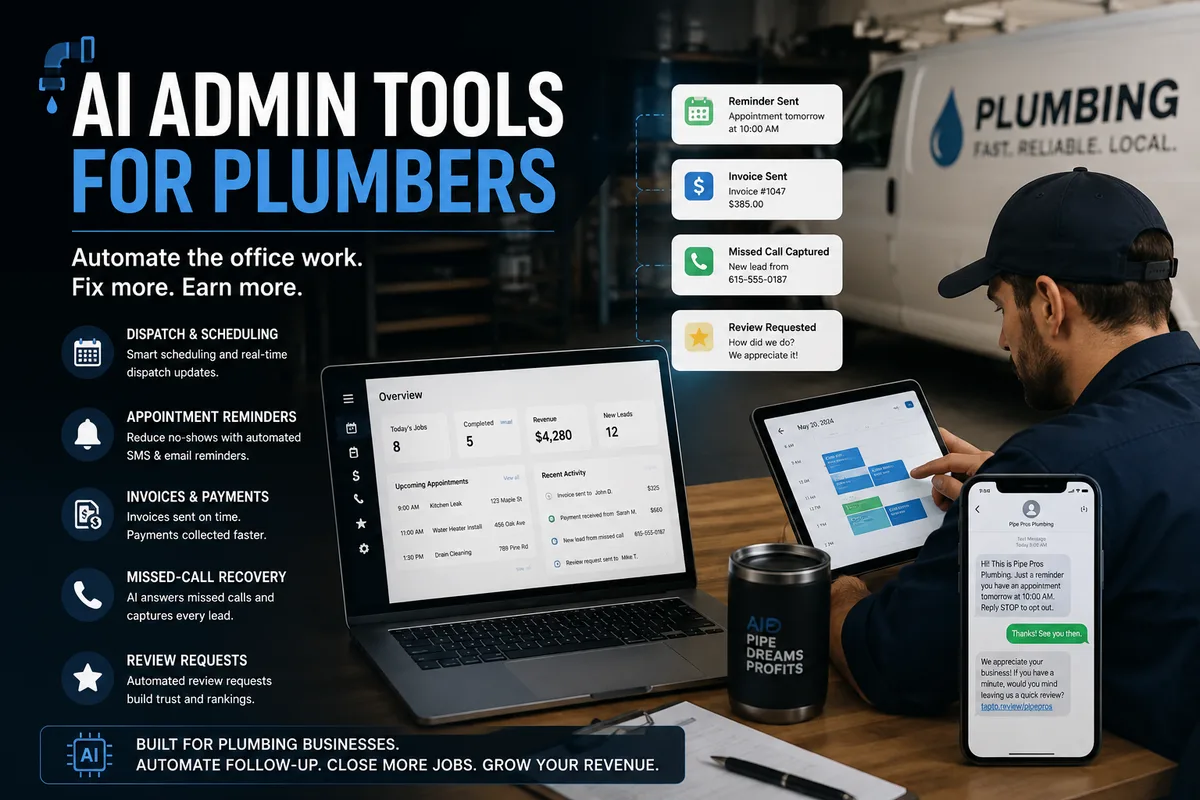
AI Admin Tools for Plumbers: What They Are and How to Choose
AI admin tools automate dispatch, reminders, invoicing follow-up, missed calls, and review requests for plumbers. What they do and how to choose.
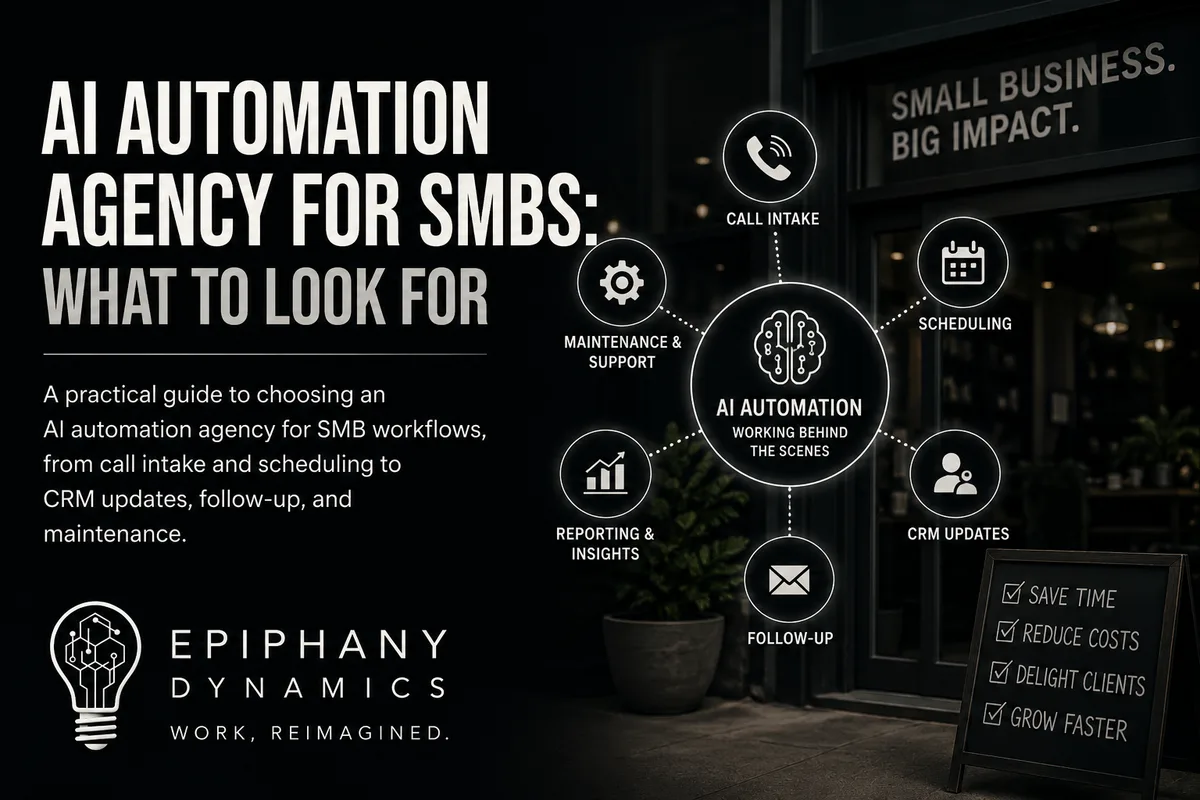
AI Automation Agency for SMBs: What to Look For
A practical guide to choosing an AI automation agency for SMB workflows, from call intake and scheduling to CRM updates, follow-up, and maintenance.
Appointment Reminder Automation for Small Business (2026 Guide)
For a service business with a meaningful no-show rate, the revenue leak is worth measuring. This guide covers how reminder automation works, which tools to.