
AI Answering Service for Law Firms: Costs, Setup, and ROI in 2026
An AI answering service for law firms handles inbound calls 24/7, qualifies leads with legal intake scripts, routes urgent cases to on-call attorneys, and books consultations automatically. Firms use 24/7 AI answering to reduce missed intake opportunities, but the cost case depends on call volume, escalation rules, CRM integration, compliance requirements, and whether the vendor charges by usage or flat subscription.
Law firms miss a large share of inbound calls, most of them after hours. Here's what an AI answering service actually does, what it costs versus human.
Epiphany Dynamics is an AI automation agency: we help businesses find and fix operational bottlenecks with AI receptionists, lead follow-up, and workflow automation.
Free 30-minute audit. We name at least 3 things you can automate, ranked by impact.
Book a free AI audit
Patrick Gibbs
An AI answering service for law firms handles inbound calls 24/7, qualifies leads with legal intake scripts, routes urgent cases to on-call attorneys, and books consultations automatically. Firms use 24/7 AI answering to reduce missed intake opportunities, but the cost case depends on call volume, escalation rules, CRM integration, compliance requirements, and whether the vendor charges by usage or flat subscription.
Check your missed call log on a Monday morning and do the math. Someone called Friday at 7 PM about a DUI arrest. They called two other firms before yours. By Saturday morning, they hired one of them. You will never know which case it was, or how many like it slipped through last month.
The missed-call problem in legal is documented, measurable, and consistently underestimated by the firms that have it. This piece breaks down what AI answering actually does for a law firm, what it costs compared to human alternatives, and what to get right before you deploy one.
The Scope of the Missed-Call Problem
Law firms miss a large share of inbound calls across personal injury, criminal defense, and family law practices. Most missed calls happen outside business hours and during court appearances, exactly when potential clients are most urgent. Many legal prospects who cannot reach a firm on first contact move on without calling back.
Personal injury and criminal defense firms carry the most exposure here. Their potential clients are often in time-sensitive, emotionally charged situations where urgency drives the hiring decision. Someone who just left the ER after a car accident is not leaving a voicemail and waiting two days for a callback. They call the next firm on the list, and if that firm answers, the case is gone.
The scale becomes clearer when you pull your own call logs. Count total inbound calls, after-hours calls, missed calls, qualified inquiries, and consultations booked from phone intake. For a personal injury or criminal defense firm, even a small number of lost intake opportunities can be worth more than a little attention.
The after-hours window is where much of the damage happens. Standard staffing leaves evenings, weekends, court appearances, and lunch breaks exposed. As the breakdown of AI receptionist costs versus law firm front desk staffing illustrates, those unattended windows can account for many missed intake opportunities.
What an AI Answering Service Actually Does
A law firm AI answering service answers every call within seconds, collects structured intake data (case type, incident date, injury status), routes urgent matters to on-call attorneys, and books consultations into the firm's calendar. It does not give legal advice, does not imply representation before a retainer is signed, and runs 24/7 with no overtime costs.
The term "answering service" undersells what the better systems actually do. A basic answering service takes a message and emails it to you. An AI system built for legal intake does something closer to what a trained intake coordinator does, without the salary, scheduling constraints, or variability. Here is how a properly configured workflow handles a call:
- The call comes in at any hour and gets answered immediately with your firm's name and a natural greeting
- The system collects intake data: caller name, case type, date of incident, injury status, whether a police report was filed, whether the caller has already spoken to insurance
- Based on those answers, it routes: urgent matters go to an on-call attorney via text or call; standard inquiries get booked for a consultation or logged for morning follow-up with your intake team
- The caller receives a confirmation text with appointment details and a clear statement of what happens next
What the system does not do is worth naming explicitly. It does not give legal advice. A properly configured AI declines to comment on case merits, avoids language that implies an attorney-client relationship exists, and redirects anything requiring judgment to a human. This is scripted and configurable, not something you are trusting the AI to handle correctly by instinct.
Setting up that workflow correctly is not complicated, but it does require thinking through your specific practice area and the edge cases your callers actually bring. If you want a step-by-step walkthrough of the configuration process, the guide on AI intake setup for law firms covers intake script structure, routing logic, and CRM connection in detail.
The Real Cost Comparison
The real cost comparison is not just "AI versus a receptionist." Compare salary and benefits, human answering-service retainers, usage-based billing, AI subscription costs, setup work, monitoring, and how each option handles urgent legal intake. The right choice depends on the firm's call volume, practice area, escalation needs, and missed-call baseline.
| Option | Cost Pattern | After-Hours Coverage | Structured Intake | Per-Minute Billing |
|---|---|---|---|---|
| Full-time receptionist | Salary, benefits, management, and coverage planning | Only during staffed hours unless coverage is added | Yes (during hours only) | No |
| Human-hybrid (Smith.ai) | Monthly service fee plus possible usage or overage charges | Depends on plan and escalation scope | Partial | Sometimes |
| AI-native system | Subscription plus setup, integration, monitoring, and script maintenance | Yes, when configured for 24/7 coverage | Yes (structured) | Rarely |
The per-minute billing model deserves particular attention. Services that charge by the minute are structurally incentivized to keep calls short. Distressed callers, callers with complicated situations, and callers who have trouble articulating their problem are often the ones with the strongest cases. You do not want your intake system financially motivated to hurry them off the line. Our comparison of Smith.ai alternatives in 2026 breaks down how pricing structures vary across the major options and what those differences actually cost you over a year.
Flat-rate AI systems do not have that structural problem. The call takes as long as it takes, and the cost stays predictable. The ROI case should be modeled from your firm's own intake data: missed calls, qualified inquiry rate, consultation rate, retained-client rate, average matter value, and total system cost. The calculation only holds if the system captures calls that would otherwise have been missed and routes sensitive matters correctly.
Ethics and Compliance: What You Actually Need to Configure
State bar rules on solicitation, confidentiality, and unauthorized practice of law apply to AI answering systems. The system cannot imply an attorney-client relationship before a retainer is signed, cannot give case-specific guidance, and must disclose call recording in two-party consent states. These are scripting requirements, not fundamental barriers, and any legal-focused vendor should already account for them.
This is where most law firms hesitate, and the concern is legitimate. Your intake system operates under your bar license. If it says something it should not, that is your professional responsibility issue, not the vendor's. The hesitation makes sense. The requirements themselves are manageable.
The practical configuration checklist covers four things:
- The system must decline to assess case merits and redirect those requests with something like "I cannot speak to the specifics of your situation, but I can get you scheduled with one of our attorneys." That is a scripted line, not AI improvisation.
- Language implying representation must be ruled out. Phrases like "we will take your case" or "you have a strong claim" are not appropriate before a retainer is signed. The system collects information and schedules a consultation, nothing more.
- Call recording disclosure is required in states with two-party consent laws. A single sentence at the start of the call covers this. It is a one-line configuration in any reputable system.
- Data collected during AI intake carries the same confidentiality obligations as any attorney-client communication, even before a retainer is signed. Your vendor's data storage, access controls, and retention policies are not a secondary consideration.
None of these are arguments against using AI answering. They are the configuration checklist you run before going live. A vendor who does not already know these requirements when you mention you run a law firm is a vendor you should not work with. For help evaluating implementation partners who understand legal ethics from the start, the guide on finding the best AI agency for law firms covers what separates a legal-specific implementation partner from a generic automation vendor.
See After Hours Answering Service Jobs: What's Changed in 2026 for more in this area.
How to Evaluate and Deploy
Evaluate AI answering services for law firms on legal-specific intake scripting, CRM integration (Clio, MyCase), escalation logic, pricing structure, and call recording compliance. Start with after-hours coverage if you want to reduce risk before routing daytime calls, then expand only after reviewing real intake logs and tuning the script.
The demo will always look perfect. Every vendor shows you a cooperative caller and a smooth handoff. What you actually want to see is what happens when the caller is distressed, when they do not know what kind of case they have, or when they ask the system directly whether they should accept a settlement offer. Run those scenarios before you sign anything. An AI that handles a clean call well but stumbles on a hard one is not ready for legal intake.
Five questions worth asking every vendor before you commit:
- Can I fully customize the intake script for my practice area, or am I working from a generic legal template?
- What triggers escalation to the on-call attorney, and how does that notification arrive?
- Which CRM does this connect to natively, and how exactly does intake data land in it?
- Where are call recordings stored, who can access them, and how long are they retained?
- Is pricing flat-rate or per-minute, and what happens when call volume spikes during a marketing push?
The deployment timeline depends on intake-script complexity, calendar and CRM access, escalation rules, and how much testing the firm requires before go-live. The standard approach is to go live after-hours only, review intake data from real calls, tune the script, and then decide whether to expand to overflow coverage during business hours. For a side-by-side comparison of the leading platforms before you decide, this breakdown of AI receptionists for law firms evaluates the major options by practice area and firm size.
The math on missed calls in legal is not subtle once it comes from your own call logs. If qualified inbound calls go unanswered, the cost of doing nothing may be higher than the cost of fixing it. AI answering systems are not speculative technology at this point. They are production tools for intake teams that need better coverage, tighter routing, and cleaner handoff data. Epiphany Dynamics builds and deploys these systems for law firms and service businesses, if you are looking for a starting point that already accounts for the compliance requirements above.
Patrick Gibbs
AI Automation Expert
Patrick Gibbs helps professional practices implement AI automation that captures more leads, books more appointments, and scales without adding overhead. He's the founder of Epiphany Dynamics and creator of the AI Front Desk system.
Related Solutions
Build this into a real workflow
Related Posts
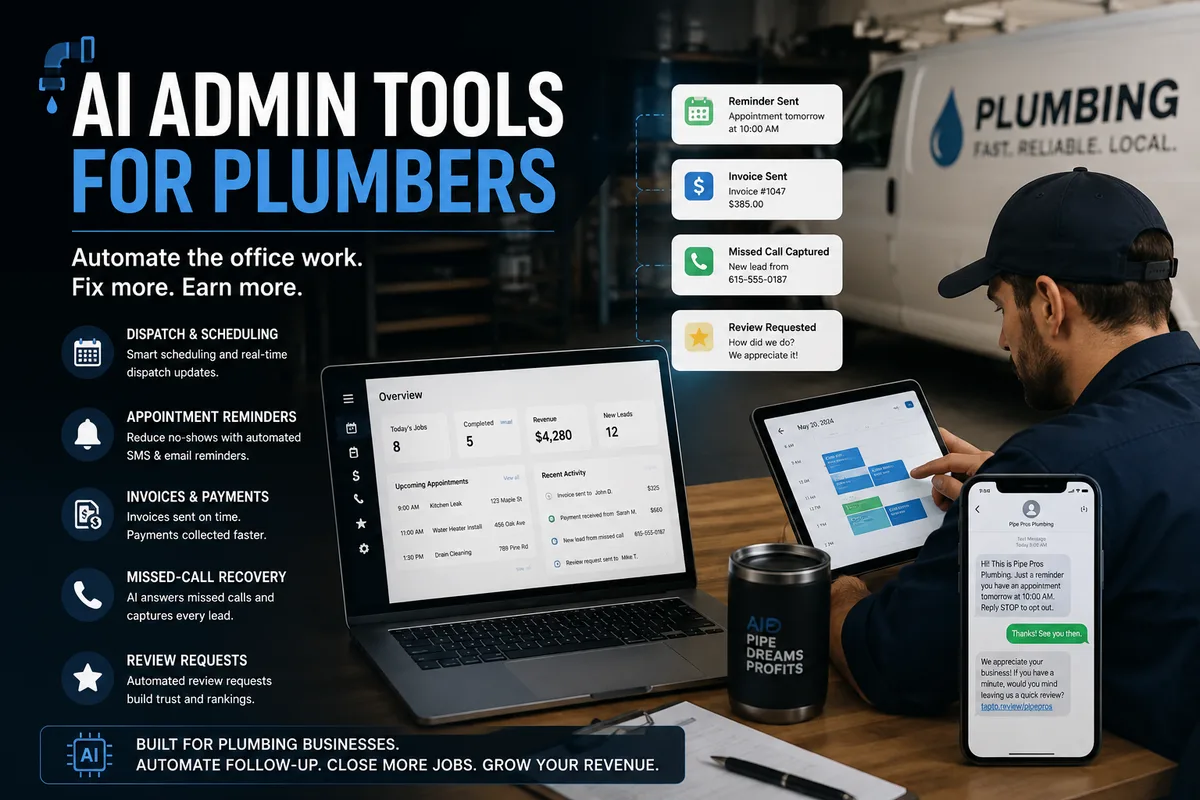
AI Admin Tools for Plumbers: What They Are and How to Choose
AI admin tools automate dispatch, reminders, invoicing follow-up, missed calls, and review requests for plumbers. What they do and how to choose.
Insurance Eligibility Automation for Physical Therapy Clinics
Eligibility automation for physical therapy clinics verifies benefits before the patient arrives, cuts front desk phone work, and can lower claim denial risk.
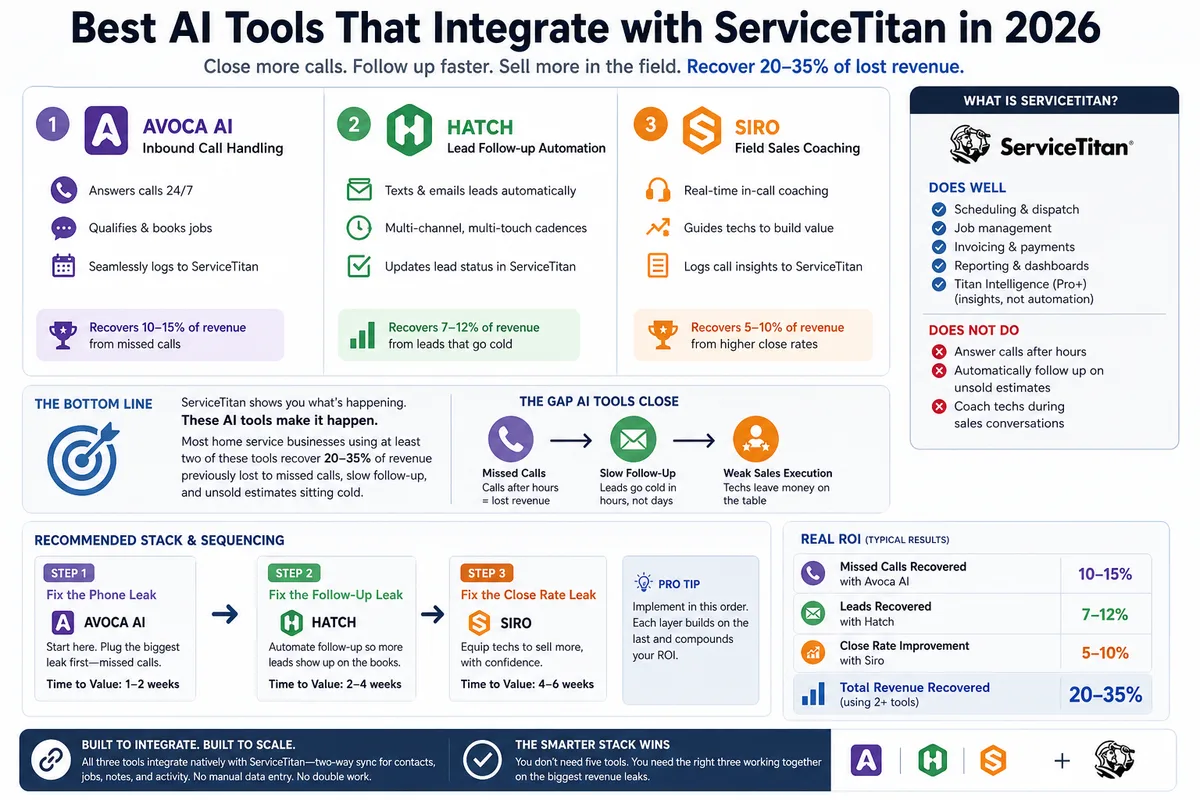
Best AI Tools That Integrate with ServiceTitan in 2026
Most ServiceTitan shops miss a meaningful share of inbound calls and leave most estimates unsold. These AI tools close those gaps inside ServiceTitan.