
AI Automation
Best AI Agent Platforms for Business: A Practical Buying Guide
For business workflows across several applications, n8n is a platform to evaluate; for agents using Microsoft-managed organizational systems, investigate Copilot Studio. A custom implementation becomes relevant when required integrations or controls need engineering.
Compare n8n, Copilot Studio, OpenAI Agent Builder, and custom implementation by business fit, ownership, operating costs, and support.
Epiphany Dynamics is an AI automation agency: we help businesses find and fix operational bottlenecks with AI receptionists, lead follow-up, and workflow automation.
For business workflows across several applications, n8n is a platform to evaluate; for agents using Microsoft-managed organizational systems, investigate Copilot Studio. A custom implementation becomes relevant when required integrations or controls need engineering. These are starting points for a shortlist, not benchmark winners: test the required actions in your own systems before choosing.
This guide compares buying decisions for business owners. For developers choosing libraries and state-management patterns, use our AI agent framework comparison.
Compare platforms by the job they’ll own
| Approach | Business fit to investigate | Operating responsibility | Main buying question |
|---|---|---|---|
| n8n | Agent decisions within workflows across business apps | Your team or partner owns workflow logic; hosting depends on your setup | Can it complete the required operations in our actual tools? |
| Microsoft Copilot Studio | Agents using organizational systems and knowledge | Your makers and administrators configure access, channels, and governance | Do our permissions and required connectors fit the deployment? |
| OpenAI Agent Builder | Existing deployments needing a transition plan | The owner must plan migration away from the visual builder | What replaces it before its scheduled shutdown? |
| Custom agency implementation | A defined job with integration or control requirements that need engineering | Responsibilities belong in the implementation and support agreement | Who owns the accounts, source, monitoring, and fixes? |
These are different ways to deliver an agent, not interchangeable subscriptions. A custom agency build can use n8n or another platform underneath. Epiphany Dynamics is the implementation team, not an additional platform in the table.
n8n: evaluate the business workflow first
n8n’s agent node lets a model choose connected tools. Our reason to shortlist it is the ability to place that decision inside a broader workflow: receive a request, fetch records, use an agent where interpretation helps, and validate the result before an update.
Require the implementer to show a failed tool call and its recovery path. Choose hosted or self-hosted operation deliberately. A self-hosted server needs someone responsible for backups, updates, and access. See the n8n AI agent builder guide for a concrete build sequence.
Copilot Studio: investigate organizational fit
Microsoft’s documentation describes a graphical builder for agents and workflows with prebuilt and custom connectors. That makes it a reasonable candidate when your organization already has people managing Microsoft accounts and business data.
Ask an administrator to validate the proposed access model. Don’t assume an existing Microsoft subscription includes every capability or channel you want. Evaluate the exact configuration and its ongoing licensing before approving the build.
OpenAI Agent Builder: account for its retirement
Source check, September 6, 2026: OpenAI’s Agent Builder documentation says the product is being deprecated and is scheduled to shut down on November 30, 2026. The documentation describes a visual workflow canvas and options to export code or embed workflows, but that doesn’t make it a durable choice for a new dependency.
For an existing workflow, ask for a migration plan with tested behavior on its replacement. For a new build using OpenAI models, evaluate the supported API and SDK route with the developer. A model provider and a workflow builder are separate decisions.
When to hire the implementation
Hire help when the work spans systems your team can’t confidently connect, when mistakes could disrupt customer service, or when nobody internally can own ongoing fixes. A proposal should name the starting workflow and its exclusions. “An agent that handles operations” is too broad to accept as a deliverable.
A useful first demonstration might classify an incoming service request, check an existing record, and prepare the next action for approval. Then test missing information and an unavailable destination system. The goal is to prove a repeatable job, not an impressive conversation.
Two delivered projects, two different platform needs
Our Private Second Brain case study describes local transcription for sensitive audio, routing into Asana and Google Drive, and daily, end-of-day, and weekly digests. Privacy and the owner’s existing tools shaped the system.
For Mano Swartz Furs, the work connected a custom SMS inbox, customer-photo appraisal support, draft replies for review, and offer follow-up. The fit question was how to keep customer communication and operating records connected.
These projects support a narrower conclusion than “one platform is best”: the required data path and staff workflow change what you need to buy. Neither case is a controlled comparison of the platforms in this article, and neither establishes a general cost saving.
Compare the full running cost
Ask each provider or implementer to separate platform charges, model usage, hosting, implementation, and maintenance. Include retry behavior and peak demand in the estimate. Avoid comparing a bare software subscription with a fully supported service as if they include the same work.
The comparison also needs an exit plan: what you can export, who owns the connected accounts, how the data is stored, and whether another engineer can maintain the system. A cheaper starting quote can be expensive if a change requires the original vendor every time.
Three buying situations that lead to different shortlists
These are illustrative selection exercises, not product benchmarks or client results. They show how the business requirement changes the decision.
A service company already works across several cloud applications. Its first agent must read an enquiry, find a customer, and prepare a follow-up task. Start by testing the exact connector operations in a workflow platform such as n8n. If the CRM uses custom objects, make that lookup the first demonstration. A familiar email integration does not prove the difficult CRM operation will work.
An organization already administers Microsoft accounts and business data. Its proposed agent answers internal questions and performs a limited action using organizational permissions. Copilot Studio deserves investigation, with the administrator involved from the beginning. The deciding demonstration is whether two users with different access receive appropriately different results. A convenient sign-in experience is not evidence that every data boundary is correct.
A business has a custom operations system with an unusual API. It needs a narrowly controlled update and a recovery process after interruptions. Commission a small integration proof before choosing the surrounding interface. A custom implementation may be appropriate, but the proposal should explain why a standard connector or simple workflow cannot cover the job. Custom should describe a justified requirement, not a premium label.
Compare proposals using one common worksheet
Send candidates the same fictional input, desired output, and failure scenarios. Otherwise, each can demonstrate the task its product handles best, and you will have no useful comparison.
| Item | Candidate A | Candidate B | Evidence required |
|---|---|---|---|
| Required read operation | Record result | Record result | Actual test record retrieved |
| Required write operation | Record result | Record result | Destination record and identifier |
| Approval boundary | Record result | Record result | Attempt cannot proceed without approval |
| Duplicate handling | Record result | Record result | Repeated input produces one action |
| Ongoing ownership | Name owner | Name owner | Account and support responsibilities |
| Exit process | Describe process | Describe process | Export, documentation, credential transfer |
Keep hard requirements separate from preferences. A nicer interface cannot compensate for an integration that cannot perform your required action. Conversely, do not reject a straightforward platform because it lacks an advanced feature the first workflow does not use.
Put numbers into the running-cost discussion
Consider a fictional workflow processing 1,000 requests a month. Suppose 150 need staff review averaging four minutes each. That is ten hours of review before you count support, failed runs, and changes to the workflow. These are example inputs, not expected performance figures.
A useful monthly estimate combines platform charges, model usage, hosting, review time, and maintenance. Ask what happens if request volume doubles or review takes twice as long. Separate one-time implementation from recurring operation. Record which numbers come from a provider quote and which are assumptions.
The cheapest subscription is not necessarily the cheapest completed task. Track cost per correctly completed request, including the staff time required to correct mistakes. A system that creates more cleanup than it removes needs a different scope or implementation.
What should make you pause before signing?
Pause when the proposal names “CRM integration” without naming the operations; when the demo never shows the destination record; or when nobody owns failed runs. Ask for clarification when accounts belong exclusively to the implementer or the exit process is undocumented.
A good proposal can acknowledge uncertainty. “We will first test whether this endpoint supports the required update” is more useful than a confident promise that all integrations are easy. The uncertainty should have a bounded investigation and a decision point, not an open-ended bill.
Frequently Asked Questions
Which is the best AI agent platform overall?
There isn’t a defensible universal winner. Choose a shortlist from your integration and ownership requirements, then run the same acceptance scenarios on each serious candidate.
Is a no-code builder enough for my business?
It may be. The deciding factor is whether it supports your workflow and failure handling. Our no-code platform guide focuses on evaluating visual builders without needing to compare developer libraries.
Can you help us choose and implement a platform?
Our AI agent service starts with the job, systems, and approval boundaries. We’ll use that scope to discuss a suitable implementation instead of asking you to choose a platform from a feature list.

Patrick Gibbs
AI Automation Expert
Patrick Gibbs helps professional practices implement AI automation that captures more leads, books more appointments, and scales without adding overhead. He's the founder of Epiphany Dynamics and creator of the AI Front Desk system.
Related Solutions
Build this into a real workflow
Related Posts

AI Agent Examples: Real Business Jobs from Observation to Action
See how agents can triage requests, resolve scheduling changes, find missing intake details, and prepare follow-up work, with explicit decisions and handoffs.

How to Get an AI Agent for Your Small Business
Decide whether to buy, configure, or commission an AI agent. Know what to bring, what a proposal should include, and how to accept the first working task.
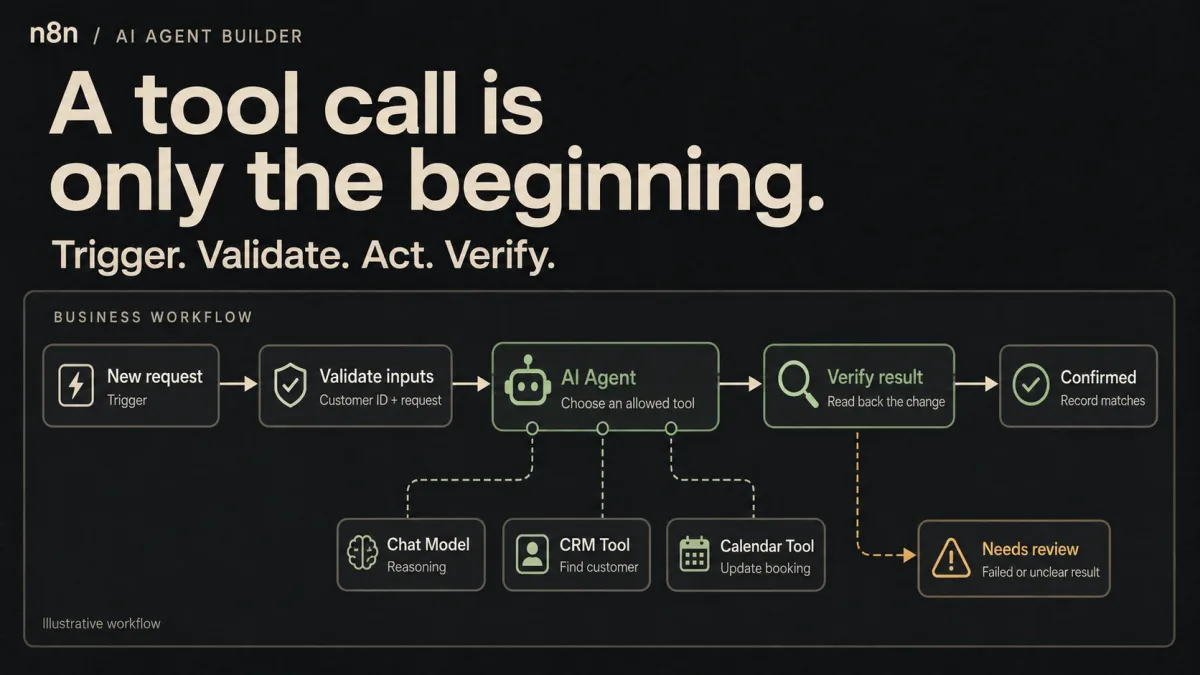
n8n AI Agent Builder: From a Tool Call to a Working Business Workflow
Build an n8n agent around a model and tools, then add validation, approvals, and failure handling. A practical walkthrough with a clear stopping point.