
AI Automation
How to Get an AI Agent for Your Small Business
To get an AI agent for your small business, choose a specific job, identify the systems it must use, and decide who will configure and maintain it. You can buy a product that already covers the job, configure a platform, or commission an implementation.
Decide whether to buy, configure, or commission an AI agent. Know what to bring, what a proposal should include, and how to accept the first working task.
Epiphany Dynamics is an AI automation agency: we help businesses find and fix operational bottlenecks with AI receptionists, lead follow-up, and workflow automation.
To get an AI agent for your small business, choose a specific job, identify the systems it must use, and decide who will configure and maintain it. You can buy a product that already covers the job, configure a platform, or commission an implementation. The right route depends on the fit, not on how many tasks a demo claims to handle.
If you’re asking “how do I get an AI agent?”, start with the work you want off your desk. “Sort service requests and prepare the next task” is a more useful starting point than “get an AI employee.”
Choose the buying route
| Route | Worth considering when | What you’re responsible for |
|---|---|---|
| Buy an existing product | Its supported workflow closely matches your task | Configuration, account access, and checking its limits |
| Configure an agent platform | The job needs several business tools connected | Workflow design, testing, and ongoing ownership |
| Hire an implementation team | Your integrations or approval rules need engineering | Clear requirements, access decisions, and acceptance of the result |
A subscription gives you access to software. It doesn’t necessarily include connecting your systems or handling failed runs. Ask what the seller will actually deliver before comparing prices.
Find a useful first job
Look for work that repeats, has recognizable inputs, and ends with a result you can check. Request triage, drafting follow-up tasks, or finding missing intake information can make manageable starting points. These are suggested patterns, not claims about results for a particular client.
Avoid starting with an agent that can change everything across the business. You need to see how it performs on a bounded job before expanding its authority. Our AI agent examples show how to define the decision, action, and handoff for different tasks.
Also consider whether the job needs AI at all. If every request follows the same rules, ordinary automation may be simpler to maintain. Interpretation is useful when the wording varies or the next step depends on context.
Bring these details to the first conversation
Bring sample inputs with private information removed, the names of the systems involved, and an example of a correctly completed task. Include an awkward case: a duplicate record, an incomplete request, or a customer who changes their mind.
Explain what the agent may do independently and what needs your team’s approval. Name the person who will review uncertain cases. Without that person, the agent can collect exceptions faster than anyone resolves them.
You don’t need a technical specification. A plain explanation of the current process is enough to begin. The implementer should turn it into a written scope you can understand.
What a proposal should include
A proposal should identify the first workflow, its input and output, the connected systems, and the excluded actions. It should separate setup work from ongoing software and maintenance charges. If a dependency is untested, it should say how that uncertainty will be resolved.
Ask who owns the accounts and configuration, how support works, and what happens if you change provider. Have the implementer describe a handover another competent person could use.
Be cautious about broad promises made before anyone inspects your tools. A vendor can’t confirm that a custom CRM integration works from a conversation about your goals alone.
A delivery result you can actually inspect
In our SG News engagement, a fallback for short source articles addressed items the publishing pipeline had previously skipped. The May 13, 2026 delivery record reports 13 articles published in under 90 seconds, with zero errors in that run.
That’s a useful acceptance result because it names the previously failing input class and the observable output: published articles. It’s one production run, not an average processing time, an editorial-quality score, or a promise that another project will perform the same way. Ask your implementer for that level of specificity when they say the build works.
Accept the work by watching it finish
Agree on representative acceptance scenarios before the build. For a service-request agent, that might include matching the right customer, assigning a permitted category, and creating one task in the correct queue. Inspect the destination system, not just the agent’s message saying it succeeded.
Then test missing information, duplicate requests, and unavailable tools. A good outcome can be a clear handoff to a person. The agent doesn’t have to act on every input to be useful.
After launch, compare completed work, correction effort, and unresolved exceptions with the original process. Expand only after the first job is dependable enough for your business.
What are the best AI agents for small business?
The most useful agent is the one that fits an actual recurring job and has someone responsible for it. A business with missed intake may need a very different setup from one struggling to reconcile customer records.
Compare AI agent platforms if you’re choosing the underlying software. If you’re building internally, the step-by-step creation guide covers implementation. This page is about buying and accepting the work, so you can make that decision without learning a framework first.
A completed first-project brief
Here is an illustrative brief a business owner could bring to an implementer. The names and records are fictional. Its value is the specificity: everyone can tell what belongs in the first project.
Business problem: Staff manually read service enquiries and create follow-up tasks. Requests sometimes wait because the correct team is unclear.
First job: Read a new enquiry, find the existing customer, and propose one follow-up task for staff approval.
Inputs: Request ID, customer email, message, and the permitted customer record.
Output: One task linked to the correct customer, with the original request and approved team assignment.
Allowed actions: Read selected customer fields and create a task after approval.
Excluded actions: Sending customer messages, quoting prices, changing bookings, merging records, and taking payments.
Exceptions: No customer match, multiple matches, unclear request, or unavailable CRM goes to the operations owner.
Acceptance: A clear request creates the correct task; a repeated request does not create another; an uncertain request remains visible for review.
Ownership: Business-owned accounts, documented configuration, and a named support contact.
Replace the task with your own. If your first draft says “handle all customer operations,” narrow it until you can write a similarly concrete output and a short list of exclusions.
What a useful proposal response looks like
A vague proposal says, “We will integrate AI with your CRM and streamline operations.” A useful response names the CRM operation, required access, initial test, deliverable, and acceptance procedure.
For the sample brief, the proposal might explain that customer matching is tested first; task creation follows approval; and duplicate prevention uses the request ID. It should name the unresolved dependencies. If the CRM cannot support the necessary lookup, the proposal should explain what decision happens next.
Ask the implementer to walk through one normal request and one awkward request. You are not testing whether they know technical terminology. You are testing whether they understand the work and can explain what staff will see when it does not finish normally.
A first-call agenda that keeps the conversation useful
- Show the current task from incoming request to completed work.
- Explain the point where staff must interpret information rather than follow a fixed rule.
- Show a correctly completed example and an exception.
- Identify systems, account owners, and access constraints.
- Agree on what the first demonstration should prove.
- Ask for a written scope, exclusions, ownership, and the next decision point.
Do not grant broad account access just to obtain an initial estimate. Start with sanitized examples and documentation. Provide the minimum access needed when the agreed investigation requires it.
How to accept the first delivery
Sit with the implementer and watch the destination system. Submit a test request, approve the proposed action, and inspect the resulting task. Submit the same request again. Then try an unmatched customer and an unavailable connection.
Record the outcome of each test as passed, failed, or unresolved. A verbal explanation of what the workflow would do is not the same as observing it. If a dependency prevents a test, keep that item unresolved rather than treating the absence of evidence as success.
The handover should leave you knowing who reviews exceptions, where errors appear, how to pause the workflow, and who can fix it. Those details are part of buying a usable system, not optional technical extras.
Frequently Asked Questions
Do I need to know how to code to get an AI agent?
No. You can buy a suitable product or hire someone to implement the workflow. You still need to explain the job, approve access, and decide whether the result is acceptable.
Should I buy or build?
Buy when an existing product fits your process and limits. Configure or commission a build when integration or workflow requirements justify the extra work. Prove the difficult part before committing to a broad project.
How do I start with Epiphany Dynamics?
Read about our AI agent service and bring one workflow to discuss. We start with the job and existing systems, then work out what should be built and how it will be maintained.

Patrick Gibbs
AI Automation Expert
Patrick Gibbs helps professional practices implement AI automation that captures more leads, books more appointments, and scales without adding overhead. He's the founder of Epiphany Dynamics and creator of the AI Front Desk system.
Related Solutions
Build this into a real workflow
Related Posts

AI Agent Examples: Real Business Jobs from Observation to Action
See how agents can triage requests, resolve scheduling changes, find missing intake details, and prepare follow-up work, with explicit decisions and handoffs.

Best AI Agent Platforms for Business: A Practical Buying Guide
Compare n8n, Copilot Studio, OpenAI Agent Builder, and custom implementation by business fit, ownership, operating costs, and support.
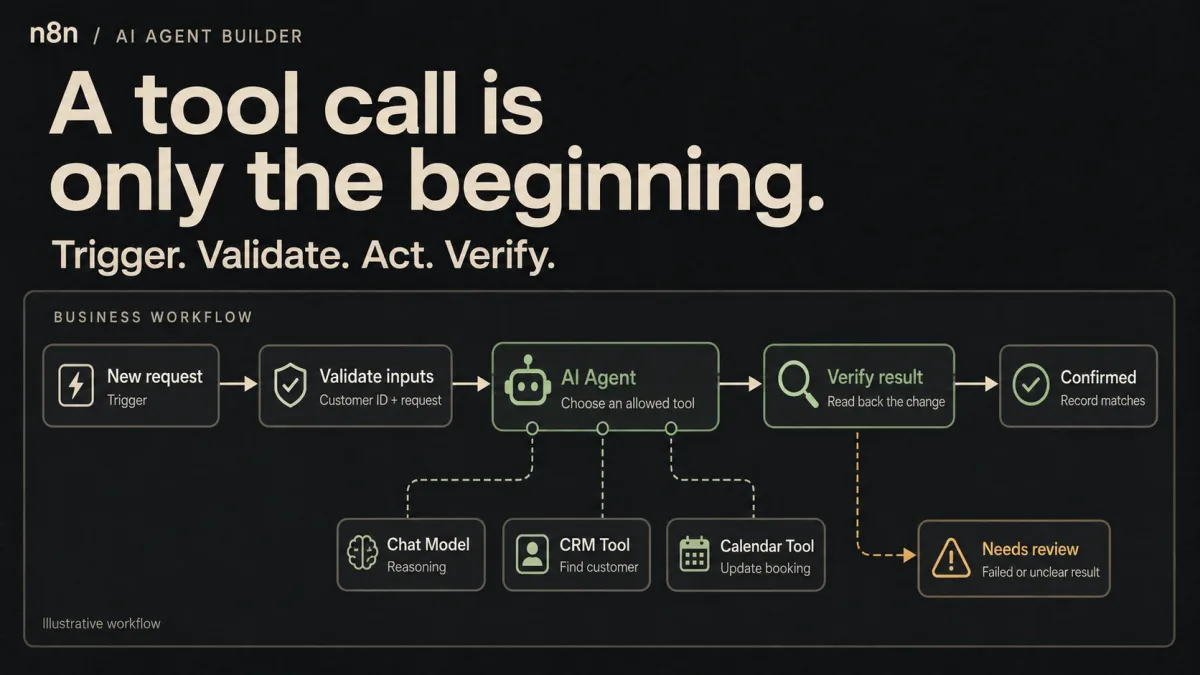
n8n AI Agent Builder: From a Tool Call to a Working Business Workflow
Build an n8n agent around a model and tools, then add validation, approvals, and failure handling. A practical walkthrough with a clear stopping point.