
AI Answering Service for Contractors: What to Compare in 2026
An AI answering service for contractors handles inbound calls, qualifies leads, books appointments, and routes urgent jobs without requiring a human to answer every phone call. The case is strongest when the system is compared against real missed-call logs, current staffing cost, and the value of jobs that currently disappear to voicemail.
Contractors miss inbound calls while working jobs on-site. Here's what AI answering services do, where they help, and how to model the ROI from your own call.
Epiphany Dynamics is an AI automation agency: we help businesses find and fix operational bottlenecks with AI receptionists, lead follow-up, and workflow automation.
Free 30-minute audit. We name at least 3 things you can automate, ranked by impact.
Book a free AI audit
Patrick Gibbs
An AI answering service for contractors handles inbound calls, qualifies leads, books appointments, and routes urgent jobs without requiring a human to answer every phone call. The case is strongest when the system is compared against real missed-call logs, current staffing cost, and the value of jobs that currently disappear to voicemail.
Why Contractors Lose Jobs Before Anyone Even Talks to Them
Contractors miss a large share of inbound calls during working hours because field work and phone answering are physically incompatible. A caller who doesn't reach you on the first try has already started dialing your competitor. Lead-response research consistently finds that customers tend to hire the first contractor to respond, not the best one.
When you're on a job site, you're not answering the phone. That's not a failure of process; it's physics. A plumber with their hands in a drain can't take a call, and a roofer 30 feet up isn't picking up their cell. The result is a default missed-call rate that most contractors never actually measure but are absolutely paying for.
The downstream effect is worse than most people realize. When someone has a water heater leak, a furnace out in January, or an electrical panel that's sparking, they're calling down a list. If you don't answer, they move to the next number. By the time you call back, they've often already booked with someone else and you never even knew the job existed.
The problem compounds after hours. A large share of home service calls come outside standard business hours, meaning before 8am, after 5pm, or on weekends. For most contracting businesses, that's a meaningful slice of potential revenue that goes straight to voicemail.
What an AI Answering Service Actually Does
An AI answering service uses voice AI to answer calls instantly, collect job details, assess urgency, and book directly into your dispatch calendar, all without a human staffer. The intake process integrates with field service platforms like ServiceTitan, Jobber, and Housecall Pro to confirm appointments in real time.
Here's how most of these systems work today: a caller dials your number, the AI picks up quickly, and holds a real back-and-forth conversation. The caller describes their problem, the AI asks follow-up questions to understand job type, location, and urgency, then either books the appointment directly or escalates emergencies to your cell phone. The caller gets a confirmation text. You get a job notification with the intake details attached.
This is not a phone tree. The "press for HVAC or plumbing" format loses callers because robotic prompts are frustrating. Modern AI answering uses conversational voice models that respond to natural language. A caller who says "my AC is making a noise and I think it might be the compressor" gets a different intake flow than someone calling for a routine tune-up. That routing intelligence is what makes these systems actually useful versus a fancier voicemail box.
For contractors who want to understand the underlying technology before buying anything, what an AI agent actually does in practice covers how these systems take real actions, booking, texting, routing, rather than just responding to inputs. That action capability is what separates modern AI answering from older chatbot-style tools.
The Real Cost: AI Answering vs. Front-Desk Coverage
The real comparison is not a single subscription price against a single salary. Front-desk coverage includes wages, payroll overhead, benefits, management time, turnover, and limited availability. AI answering includes platform cost, setup, usage, integration work, transcript review, and escalation coverage.
| Option | Cost Driver | Coverage Pattern | Missed-Call Risk | Direct Scheduling |
|---|---|---|---|---|
| No dedicated answering | No direct payroll, high opportunity cost | Only when the owner or crew can answer | Highest during job-site work and after hours | No |
| Full-time receptionist | Salary, benefits, taxes, and management | Strong during staffed hours | Still exposed after hours and during call spikes | Yes |
| Live answering service | Plan, usage, and message-relay limits | Broad coverage | Depends on whether they can book or only relay | Limited |
| AI answering service | Platform, setup, integration, and monitoring | Broad coverage for routine calls | Depends on call-flow design and escalation quality | Full integration |
The table shows the cost categories. What it doesn't capture is turnover risk. Replacing a front-desk employee costs time, recruiting attention, onboarding effort, and productivity while someone new gets up to speed. AI systems don't quit, don't call in sick, and don't need retraining every time your service area or pricing changes.
That said, AI isn't a wholesale replacement for human judgment in every situation. An upset caller who just had a contractor no-show needs different handling than a new inbound lead. Complex multi-trade estimates need human context. The practical model most contractors land on is AI handling routine inbound volume, initial calls, after-hours overflow, and peak-hour overflow, while an admin handles exceptions and outbound work.
What to Actually Look For When Comparing Services
The most important factor when evaluating AI answering services for contractors is direct integration with your existing scheduling software. A system that answers calls but can't write appointments to your dispatch calendar is expensive voicemail. After that, prioritize emergency escalation rules, post-call text automation, and full call transcript access.
Scheduling integration depth is the one that catches people off guard after they've already signed a contract. Ask every vendor the same question directly: does your system write appointments into your FSM platform natively, or does it send a notification that someone on your team reviews first? "We integrate with Zapier" is not the same as native integration. One requires a human step that breaks the 24/7 promise; the other doesn't.
Emergency routing matters just as much. After-hours urgent calls, a burst pipe at midnight or a heat outage in winter, need to reach a real person immediately, not get queued for morning. Any service without configurable emergency escalation isn't built for contracting work specifically. The question to ask: can you set routing rules by job type, time of day, and service area? That granularity separates platforms built for field service from generic answering tools that happen to work on phones.
Post-call automation and transparency are the two things most people skip in demos and then regret. Post-call automation means confirmation texts go out immediately and job reminders follow before the appointment. Transparency means you get full call recordings and transcripts so you can audit what the AI is actually saying to your customers. Both are non-negotiable. The AI phone answering tool evaluation guide covers the specific vendor questions worth asking before you commit to anything.
The ROI Math on AI Answering for Contractors
The ROI model for contractors should start with actual call logs: missed calls, after-hours calls, booked-call rate, average job value, and current answering cost. Generic examples look persuasive, but your own call history is the only defensible input.
Use this formula as a planning model:
Recovered revenue = missed bookable calls x booked-call rate x average job value
Then compare recovered revenue against platform cost, setup cost, integration work, and the time your team spends reviewing transcripts. The math gets more useful, not less, when you apply your own numbers.
What changes the calculation significantly is the after-hours multiplier. Jobs booked after hours tend to be higher-urgency, emergency repairs and immediate needs, and carry higher revenue per ticket than routine service calls. If you're capturing emergency calls you were previously losing entirely, the average job value on that recovered revenue is likely well above your business average. This is also where the competitive advantage compounds: if your competitors' phones go to voicemail at 9pm and yours doesn't, you're not competing with them for that job at all.
For contractors managing multiple crews or multiple trade categories, the complete guide to AI automation for home services shows how answering fits into the broader scheduling and dispatch workflow. Call answering is the entry point; where efficiency compounds is in what happens after the call is booked.
For more in this area, see AI Phone Answering for Contractors: Costs, Features, and ROI in 2026.
Before You Start Shopping
Before evaluating any AI answering platform, pull a recent set of call logs and calculate your actual missed-call rate. If the missed-call exposure is meaningful at your average job value, the shopping question becomes which platform integrates best with your existing tools, not whether you need the capability at all.
The decision isn't complicated once you measure it. Most contractors are surprised by how high the number is when they actually count the missed calls. A recent call-log sample, your average job value, and your booked-call rate gives you a defensible model. If the lost revenue is real, the cost of a well-fit AI answering service becomes easier to judge.
One thing to get right before you start demos: know exactly which field service management software you're running and get written confirmation of native integration before signing anything. "We work with Jobber" means different things to different vendors. The answering technology itself is largely solved across major platforms; integration depth is where the real differences still exist in 2026.
The best AI tools for general contractors in 2026 covers this from a broader perspective, including call answering alongside scheduling automation, follow-up workflows, and marketing tools. Worth reviewing before committing to any single platform, especially if call answering is one piece of a larger operational gap you're trying to close. And if you're already running a solid call-handling process and want to evaluate whether AI fits your specific trade, Epiphany Dynamics builds these workflows from scratch for service businesses.
Frequently Asked Questions
Q: How much can a contractor actually save by switching from a human receptionist to an AI answering service?
It depends on current staffing cost, missed-call exposure, call volume, and whether the AI can book directly into your dispatch system. Contractors should compare total front-desk cost against recovered booked calls and reduced admin workload, not rely on a generic savings number.
Q: How fast does an AI answering service respond compared to a contractor in the field?
An AI answering service responds immediately while contractors in the field may be unable to pick up at all. Since urgent customers often hire the first contractor who responds clearly, instant answering can help win leads before competitors do.
Q: Does an AI answering service just take messages, or can it actually book appointments?
Modern AI answering services book appointments directly into your dispatch software, collect job-specific details (address, service type, access instructions), and route emergency calls to your phone while handling routine scheduling automatically. This eliminates the callback lag and ensures leads are on your calendar within seconds of the initial call.
Q: What percentage of contractor calls come outside normal business hours?
A meaningful share of home service calls arrive before the office opens, after the workday, or on weekends. That is an after-hours opportunity that traditional voicemail leaves on the table. An AI answering service captures those calls, qualifies them, and books appointments even when you're unreachable.
``` Patrick Gibbs
AI Automation Expert
Patrick Gibbs helps professional practices implement AI automation that captures more leads, books more appointments, and scales without adding overhead. He's the founder of Epiphany Dynamics and creator of the AI Front Desk system.
Related Solutions
Build this into a real workflow
Related Posts
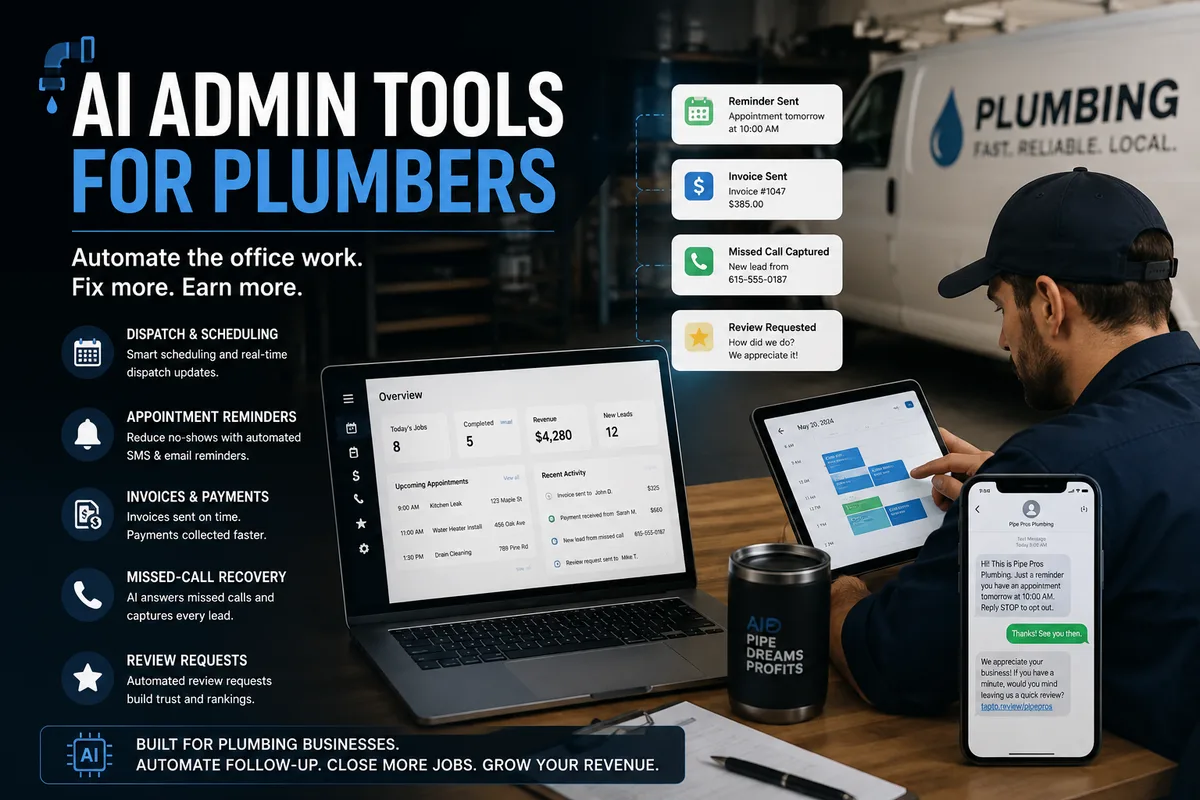
AI Admin Tools for Plumbers: What They Are and How to Choose
AI admin tools automate dispatch, reminders, invoicing follow-up, missed calls, and review requests for plumbers. What they do and how to choose.
Insurance Eligibility Automation for Physical Therapy Clinics
Eligibility automation for physical therapy clinics verifies benefits before the patient arrives, cuts front desk phone work, and can lower claim denial risk.
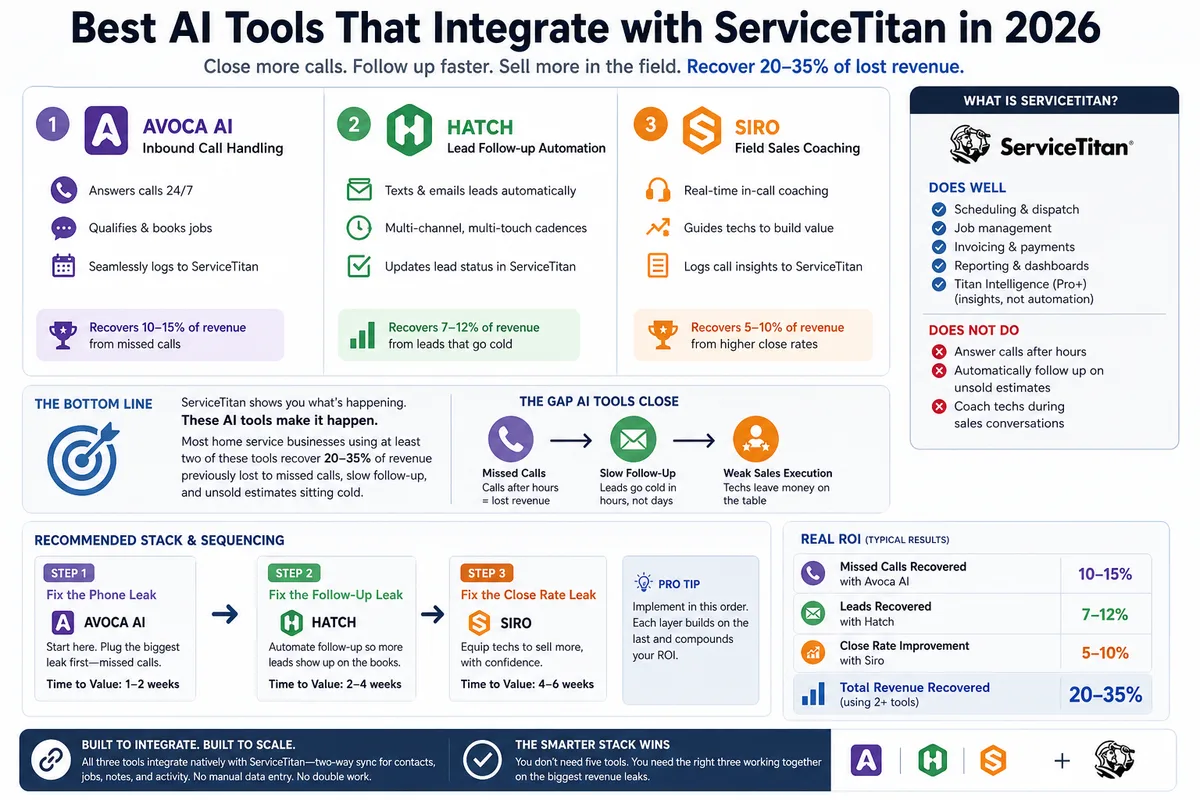
Best AI Tools That Integrate with ServiceTitan in 2026
Most ServiceTitan shops miss a meaningful share of inbound calls and leave most estimates unsold. These AI tools close those gaps inside ServiceTitan.