
AI Phone Answering for Contractors: Costs, Features, and ROI in 2026
An AI phone answering service for contractors is a software system that answers inbound calls automatically using conversational AI, screens callers, books appointments, and escalates emergencies without a human receptionist. These systems can provide around-the-clock coverage and integrate with scheduling tools like Jobber and ServiceTitan.
Contractors miss a large share of inbound calls while techs are on job sites. Here's how AI phone answering services work, what they cost, and when they.
Epiphany Dynamics is an AI automation agency: we help businesses find and fix operational bottlenecks with AI receptionists, lead follow-up, and workflow automation.
The free 30-minute AI Operations Audit is a conversation about a normal week in your business and where the work piles up. We find the one change that would give you the most time back and send you a plain-English plan for it. No forms and no pitch.
Book a free AI audit
Patrick Gibbs
An AI phone answering service for contractors is a software system that answers inbound calls automatically using conversational AI, screens callers, books appointments, and escalates emergencies without a human receptionist. These systems can provide around-the-clock coverage and integrate with scheduling tools like Jobber and ServiceTitan. For a trade business missing calls during jobs, after hours, or storm spikes, the business case depends on missed-call volume, job value, and how many calls the system can resolve without staff help.
Why Contractors Specifically Have a Phone Problem
Most trades businesses don't have a receptionist problem. They have a physics problem: one person can't simultaneously be on a roof, under a sink, and answering the phone. The result is that contractors miss a substantial share of inbound calls during business hours, not because they don't care, but because the people who know how to answer are the same people doing the work.
The downstream effect is worse than most owners realize. Most callers who reach voicemail won't leave a message. They hang up and call the next contractor on the list. You can see the full business-impact framework in this analysis of real costs and ROI of answering services for home service businesses.
After-hours calls compound the problem. For HVAC, plumbing, and electrical contractors handling emergency work, a large share of total call volume arrives when the office is closed. A homeowner with a burst pipe is not going to leave a voicemail and wait until morning. They're calling several companies in a row. The first one to pick up usually gets the conversation.
What AI Call Answering Actually Does (Specifically)
AI phone answering software picks up the call, holds a natural voice conversation with the caller, collects the key intake info (name, address, issue type, urgency), and either books the appointment directly into your calendar or routes the call based on rules you configure. It's not a phone tree. The caller talks normally, and the AI responds like a knowledgeable front desk person.
The core feature set that matters for contractors includes calendar integration with tools like Jobber, Housecall Pro, ServiceTitan, and Acuity. When a caller says "I need someone to look at my AC unit Tuesday afternoon," the system checks your tech's availability and confirms the slot. No back-and-forth. No double bookings from a staffer who forgot to update the schedule.
Emergency escalation is the feature that closes the deal for most HVAC and plumbing owners. You configure rules: if a caller says "pipe burst," "no heat," or "electrical fire," the system immediately texts your on-call tech and can transfer to an emergency line. Spanish language support is now standard on most platforms, which matters significantly in contractor markets across the Southwest, Florida, and major metro areas. If you're running an HVAC operation and losing emergency calls specifically, there's a detailed look at the problem in this piece on why HVAC companies lose after-hours emergency calls.
The Cost Comparison: AI vs. Every Other Option
AI answering services, traditional answering services, virtual receptionists, and in-house staff all have different cost patterns. AI pricing usually depends on call volume, integrations, support, and setup complexity. Human options depend on staffing hours, plan tiers, per-call usage, and whether the person can actually book appointments in your calendar.
| Option | Cost Pattern | After-Hours Coverage | Calendar Integration |
|---|---|---|---|
| AI answering service | Platform fee plus setup and integration scope | Yes | Yes (most platforms) |
| Traditional answering service (human) | Plan tier, usage, or per-call billing | Yes | Rarely |
| Virtual receptionist (offshore) | Staffing plan and coverage hours | Sometimes | Sometimes |
| Part-time in-house receptionist | Payroll, training, scheduling, and coverage limits | No | Yes |
| Full-time in-house receptionist | Payroll, benefits, management, and turnover risk | No | Yes |
The comparison that usually matters for owner-operators is not a universal payback claim. It is whether the calls you are currently missing include high-value service, replacement, or emergency opportunities. At that level of job value, the question isn't whether generic industry math looks good. The question is how many calls you were already losing before you installed it.
Traditional human answering services are worth comparing carefully. They answer calls in real time, which callers prefer, but they don't integrate with your scheduling software, they can't actually book the job, and they charge per call in ways that add up fast during storm season or a summer AC rush. If you want a head-to-head breakdown of the AI platforms themselves, this comparison of AI phone answering tools for service businesses covers the major options with pricing.
Which Contractor Trades Get the Most Out of This
HVAC, plumbing, and roofing contractors see the strongest fit because their call patterns are demand-driven and time-sensitive. A homeowner with no AC in July or a burst pipe in January is not comparison shopping casually. In trades with high emergency volume, speed of answer is the primary competitive variable.
HVAC businesses face extreme seasonal call spikes. During summer AC season and winter heating failures, call volume can overwhelm an office team that handles normal periods just fine. AI systems scale differently from human-staffed phones, which is the structural advantage that makes them worth evaluating. For electricians specifically, there's a full setup and ROI breakdown in this guide to AI receptionists for electricians.
Roofing contractors have a different problem: storm damage creates a short lead lifecycle. Homeowners hit by hail call in volume, then the market cools as jobs get booked. A roofing company that misses calls early in a storm window hands those jobs to competitors. General contractors handling larger project inquiries benefit differently: AI intake screens and qualifies callers before they reach a project manager, which is where the real time savings shows up.
For a broader view, see AI Lead Qualification for Contractors: What Works in 2026.
What to Look for When Evaluating These Systems
The features that separate useful AI answering systems from frustrating ones are calendar sync depth, emergency routing configurability, and how the AI handles calls it doesn't understand. A system that books confidently but fails on unusual requests and hangs up is worse than voicemail. Test with real-world scenarios before committing to a primary line.
Calendar integration quality varies more than vendors admit. "Integrates with Jobber" can mean full two-way sync or it can mean the AI reads your calendar and asks you to manually confirm. Ask specifically whether the AI can create a new appointment, check real-time tech availability, and send the customer a confirmation text. That's the minimum standard that actually removes work from your plate.
Multi-location routing matters once you have more than one service area or crew. If a caller is in a zip code you serve from a different dispatch hub, the system should route correctly without transferring twice. This sounds basic but is inconsistently handled across platforms. For a broader look at how AI tools fit into a contractor's operation beyond just call handling, the guide to best AI tools for general contractors in 2026 covers the full stack, and the AI automation ROI breakdown for construction contractors puts call handling in context with estimating, scheduling, and invoicing tools.
A Realistic Assessment: Where These Systems Fall Short
AI phone answering systems don't fully replace a skilled receptionist who knows your business, your customers, and your crew's schedules. For highly relationship-driven contractors where the owner's personal touch is a genuine selling point, an AI front-end can feel impersonal to certain callers. Know your customer base before deploying one on your main line.
Complex calls are still a weak point. A caller trying to describe an unusual electrical issue or negotiate an adjustment on an ongoing project will probably exhaust the AI's capability quickly. Good systems escalate gracefully and connect the caller to a human. Bad ones loop or disconnect. During your evaluation, call the demo line yourself and deliberately ask something hard. See what happens before signing anything.
The fit is clearest for contractors with high inbound volume, predictable call types (service requests, appointment booking, emergency dispatch), and a persistent problem with missed calls or after-hours gaps. If your phones are already well-staffed and your main issue is estimating or project management, call answering automation isn't where to start. The complete picture of where AI fits across a home services operation is in this complete guide to AI automation for home services.
Getting Started Without Overcomplicating It
Most contractors should start with a pilot on a secondary line or after-hours routing before making AI the primary call handler. This lets you hear real calls, identify gaps in the AI's responses, and refine intake scripts without risking live leads during setup. Configuration effort depends on scheduling integration, call scripts, and escalation rules.
Start with your after-hours line. That's where the clearest gap usually is. The calls are already going to voicemail, so any improvement is a net gain. Configure emergency escalation rules first, then appointment booking, then refine the intake questions based on what callers actually say early in the pilot. Most platforms let you update call scripts without involving support.
The contractors who get the most from these systems treat the AI like a first-year employee who needs coaching: feed it the right scripts, listen to a sample of calls weekly, and update the rules when something isn't working. That ongoing tuning is what separates a system that genuinely captures leads from one that technically answers the phone but creates friction. If you want help configuring the system and the intake workflows around it, rather than just buying software and hoping for the best, that's where working with a specialist like Epiphany Dynamics tends to make a difference.
Check service-area and dispatch limits in the trial
Prepare test calls for an address outside your service area, a fully booked day, an existing customer changing a job and a caller describing an urgent problem. Supply the dispatcher's approved wording and escalation contacts. The system should collect and route the request without inventing availability, diagnosing a hazard or promising a technician's arrival.
After each call, inspect the actual dispatch record and staff alert. Confirm the address, callback number, job type, agreed next step and person responsible. Test the fallback when dispatch software is unavailable: taking a message with a clear next step is different from confirming a booking.
For trade-specific detail, use the plumbing workflow page and plumbing receptionist setup guide.
Frequently Asked Questions
Q: How quickly does an AI answering service pay for itself for contractors?
It depends on missed-call volume, job value, platform cost, and how many calls the system can resolve or book without staff involvement. Contractors should model payback from their own call logs instead of relying on generic recovered-job math.
Q: What happens when a contractor's call goes to voicemail?
Most callers who reach voicemail don't leave a message. They hang up and call the next contractor on their list. This single pattern accounts for significant lost annual revenue for a typical trade business and is the primary reason after-hours coverage matters.
Q: Can AI answering services handle emergency calls outside of business hours?
Yes, these systems can provide around-the-clock coverage, which is critical because emergency service calls (HVAC, plumbing, electrical) often arrive outside standard office hours. Picking up that late-night burst-pipe call instead of sending it to voicemail can decide whether you get the conversation at all.
Q: Which job scheduling platforms integrate with AI answering services?
Leading systems like Jobber and ServiceTitan integrate directly with AI answering software, allowing real-time availability checks and automatic appointment booking. This eliminates manual handoff delays and reduces the gap between call answer and confirmed booking.
Patrick Gibbs
AI Automation Expert
Patrick Gibbs helps professional practices implement AI automation that captures more leads, books more appointments, and scales without adding overhead. He's the founder of Epiphany Dynamics and creator of the AI Front Desk system.
Related Solutions
Build this into a real workflow
Related Posts
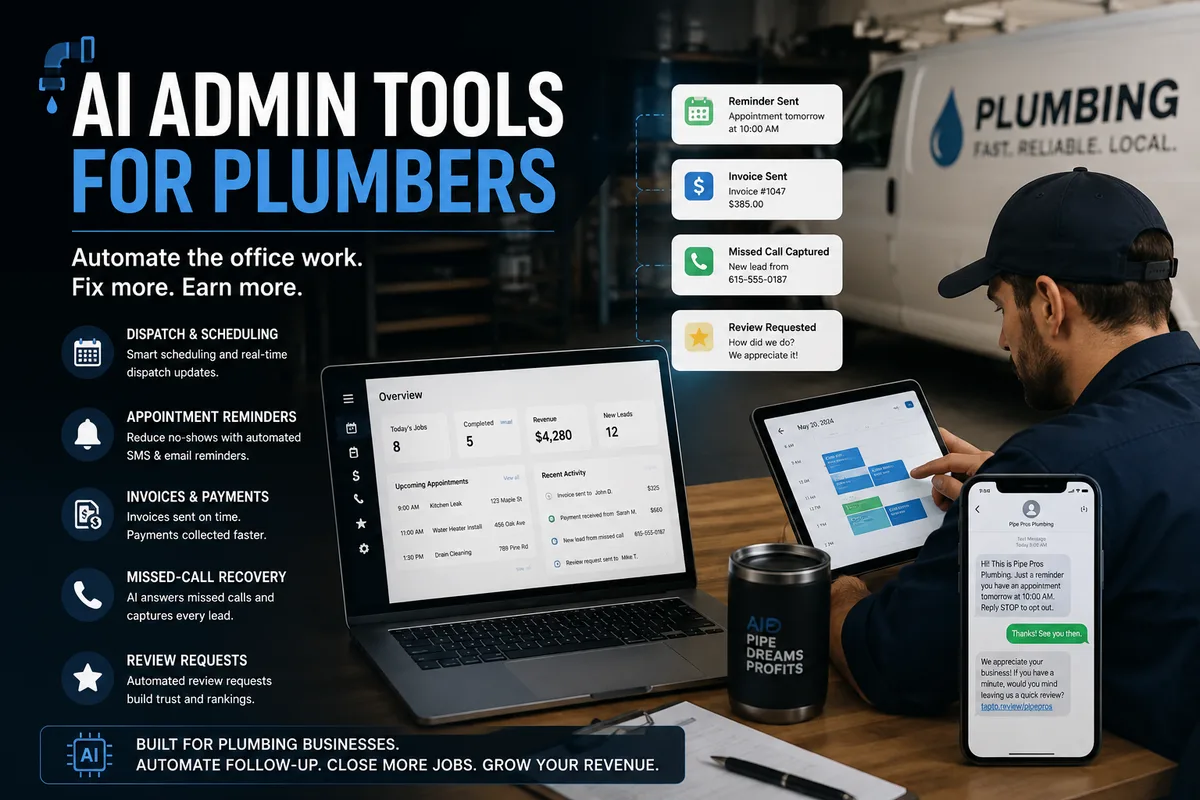
AI Admin Tools for Plumbers: What They Are and How to Choose
AI admin tools automate dispatch, reminders, invoicing follow-up, missed calls, and review requests for plumbers. What they do and how to choose.
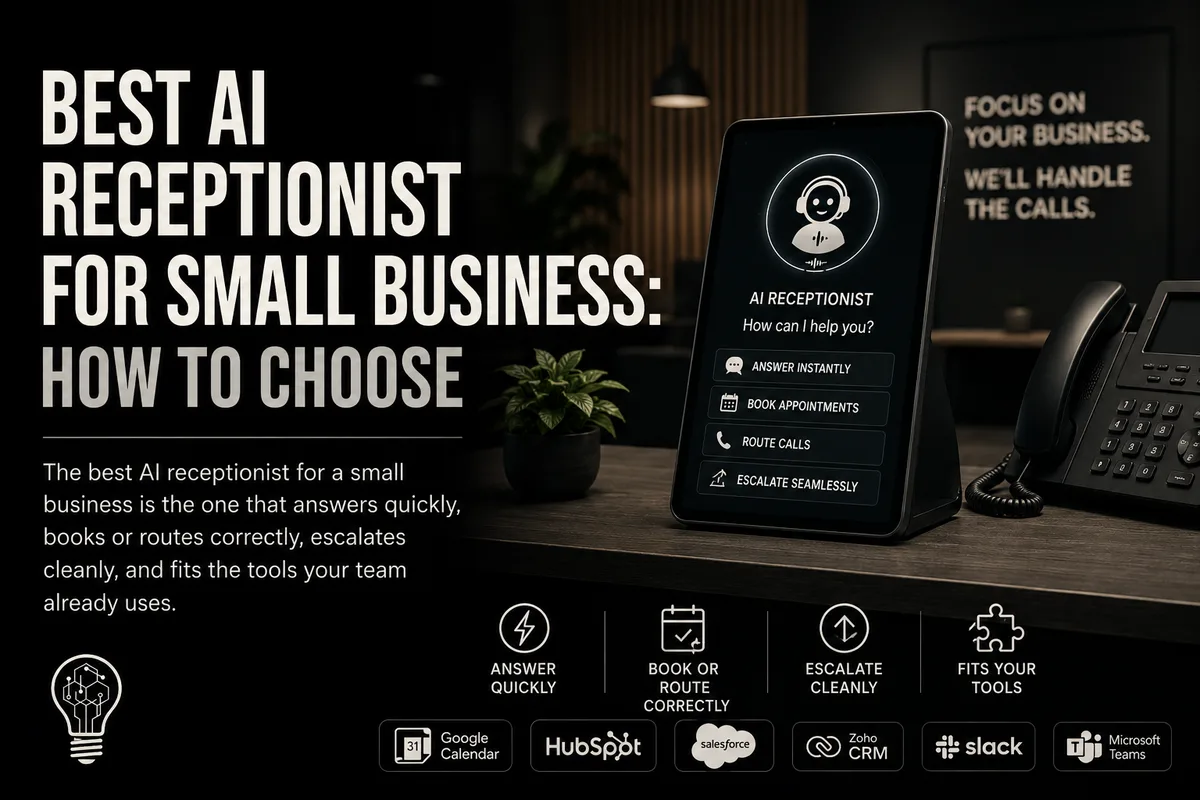
Best AI Receptionist for Small Business: How to Choose
The best AI receptionist for a small business is the one that answers quickly, books or routes correctly, escalates cleanly, and fits the tools your team.
Insurance Eligibility Automation for Physical Therapy Clinics
Eligibility automation for physical therapy clinics verifies benefits before the patient arrives, cuts front desk phone work, and can lower claim denial risk.