
AI Admin Tools for Plumbers: What They Are and How to Choose
AI admin tools for plumbers are software systems that handle the office work around a plumbing business: dispatch, appointment reminders, invoice and payment follow-up, missed-call recovery, and review requests. They are built for shops without a full-time office team, and they automate the follow-up loops that quietly leak jobs and revenue.
AI admin tools automate dispatch, reminders, invoicing follow-up, missed calls, and review requests for plumbers. What they do and how to choose.
Epiphany Dynamics is an AI automation agency: we help businesses find and fix operational bottlenecks with AI receptionists, lead follow-up, and workflow automation.
The free 30-minute AI Operations Audit is a conversation about a normal week in your business and where the work piles up. We find the one change that would give you the most time back and send you a plain-English plan for it. No forms and no pitch.
Book a free AI audit
Patrick Gibbs
AI admin tools for plumbers are software systems that handle the office work around a plumbing business: dispatch, appointment reminders, invoice and payment follow-up, missed-call recovery, and review requests. They are built for shops without a full-time office team, and they automate the follow-up loops that quietly leak jobs and revenue. This guide explains what these tools do, who they are for, and how to choose the right stack for your shop.
What Are AI Admin Tools for Plumbers?
An AI admin tool is a system that completes an administrative task end to end: it detects a trigger, decides the next action, sends the message or creates the record, and reports the result. For a plumbing company, the trigger is usually a call, a booking, a completed job, or an unpaid invoice.
Plumbing work splits into two halves. Field work is the visible half: the repairs, installations, drain cleaning, and water heater swaps that pay the bills. Admin work is the invisible half that decides whether that field work actually becomes a booked job and a paid invoice: which tech goes where, whether the customer shows up, whether a missed call gets answered, whether a finished job turns into a review and repeat work.
Most plumbing shops run that admin half with the owner's phone, a whiteboard, and whatever the field-service software tracks. That works until it doesn't: calls stack up during a busy morning, invoices go out late, customers ask "did you get my message," and reviews only come from people who remember to leave one. AI admin tools exist to close those loops automatically, using the same data the shop already has.
These tools are not the same as a chatbot that waits for a visitor to type something, and they are not a single reminder app. A useful admin tool works end to end on one workflow: it watches for the trigger, takes the next step on its own, and hands off cleanly when a human needs to decide.
Who These Tools Are For
AI admin tools fit plumbing companies where the owner is also the dispatcher, the bookkeeper, and the after-hours answering service. The typical profile is a shop with one to ten technicians, no full-time office staff, and a phone that rings most during the hours everyone is on a roof or under a sink.
You can tell the fit without a cost model. If you check voicemails in batches at the end of the day, if invoices go out a week after the job, if customers call back asking whether their appointment is still on, or if your review flow depends on memory, admin automation is addressing a real gap.
Larger shops with full office teams still use these tools, but the business case is different: they use them to cut the number of manual follow-ups per job, not to replace a missing function. The strongest case is almost always the small shop, because that is where each missed follow-up is a direct loss of a job the owner already paid to win.
The Five Admin Workflows AI Automates for Plumbers
Five loops carry most of the admin load in a plumbing business. Automating them in a sensible order is how a shop moves from constantly behind to running itself. If you want the full dispatch-to-invoice framework behind these workflows, our service business workflow automation guide walks through the sequence and the expected results of each stage.
Dispatch
Dispatch decides which tech takes which job and when. The admin load here is severity capture (is this a burst pipe emergency, a leak that can wait, or a quote?), location routing, and keeping the customer updated on arrival time. AI tools in this space classify incoming jobs, suggest the best tech and window, and send the status messages that stop "where is my plumber" calls. See our plumbing dispatch software breakdown for what to evaluate before buying.
Appointment Reminders
Plumbing appointments usually run as time windows, not exact times: "between 8 and 10." That makes reminders more valuable, because a window only holds if the customer is actually home for it. AI reminder tools confirm the window, send a reminder the day before, let the customer reply to reschedule, and flag no-shows early enough to refill the slot. The setup and free-tier options are covered in our automated appointment reminders guide.
Invoice and Payment Follow-Up
The job is done, the invoice is sent, and then the slow part begins. Payment follow-up is the workflow where small shops lose the most time per dollar collected: manual reminders, awkward calls, and the decision about when to escalate. AI tools send the invoice, follow up on schedule, accept replies, and escalate overdue balances to the owner at a set threshold. Our invoice and payment reminder automation post covers the mechanics and the data you should watch.
Missed-Call Recovery
When a call goes unanswered, the caller usually does not leave a voicemail and does not call back. Missed-call recovery sends an automated text to that caller immediately, while the problem is still in front of them, with a clear path back: a booking link, an estimated callback time, or a way to describe the issue. For plumbers this is the highest-leverage single workflow, because the calls are urgent and the caller is actively comparing competitors. See our missed call text back for plumbers guide for setup and measurement.
Review Requests
A finished plumbing job is a natural moment to ask for a review, but it is the easiest moment to forget. Review automation sends the same neutral public-review request to every customer after the job closes and follows up once or twice when needed. If a customer reports a problem, the tool can route that feedback to a private service-recovery channel so the shop can fix it, but that recovery path runs in parallel and never suppresses or replaces the public-review option: every customer still gets the same chance to leave a public review as everyone else. Our best AI tools for review management roundup compares the options.
AI Admin Tool Categories for Plumbing Companies
The tools that handle these workflows come in a few categories. Most plumbing companies end up with two or three, not one platform that does everything.
- Voice and call answering: AI receptionists that answer, qualify, and schedule calls, including after-hours emergency calls. These are the closest thing to hiring a receptionist, and the cost and ROI picture is covered in our AI voice receptionist for plumbers and AI receptionist setup cost and ROI posts. See how it fits a plumbing workflow on our AI receptionist for plumbers page.
- Dispatch and field-service software with AI: the job routing, scheduling, and status layer, sometimes built into the software you already run.
- Scheduling and reminder tools: appointment confirmation and no-show reduction, often sold as a standalone app or an add-on to your booking system.
- Invoicing and collections tools: invoice delivery, payment reminders, and payment links, usually integrated with QuickBooks or your field-service platform.
- Review and reputation tools: review requests, response management, and private resolution for unhappy customers.
- SMS follow-up tools: the text layer that powers missed-call recovery and job-completion follow-up across the other categories.
How to Choose AI Admin Tools
Start with the workflow, not the tool. Before comparing vendors, write down the trigger, the data you need, the handoff, the fallback, and the reporting requirement for the workflow you want to automate. A tool that looks weaker on a feature grid can be the better pick if it fits the process you actually run and the staff who will maintain it.
Then check the integration surface. Most plumbing shops already run a field-service platform, a calendar, and an accounting tool. The admin stack should read and write the same records, not create a second set of books. Ask each vendor to show the exact handoff and the failure path, not just the demo screen. For the vendor shortlist step, use our AI tools for plumbers evaluation guide: it lays out the checks to run before money changes hands.
Finally, start with one workflow. Pick the leak that hurts the most, usually missed calls or payment follow-up, run it on a real tool for one billing cycle, and measure booked jobs and collected balances before adding the next workflow. That measured start is the difference between an admin stack that pays for itself and a pile of subscriptions.
If you want help mapping these five workflows and choosing the stack, that is the kind of scoped work Epiphany Dynamics does: a free 30-minute AI Operations Audit. It's a conversation about a normal week in your business. We find the one change that gives you the most time back and send a plain-English plan for the systems that would handle it. The honest answer on savings depends on your call volume and current follow-up habits, so we build the case from your numbers instead of a generic promise.
Frequently Asked Questions
What are AI admin tools for plumbers?
AI admin tools are software systems that automate the office side of a plumbing business: dispatch, appointment reminders, invoice and payment follow-up, missed-call recovery, and review requests. They detect a trigger, take the next step automatically, and report the result, so the owner does not have to type each follow-up by hand.
How much do AI admin tools cost for a plumbing business?
Pricing varies by category. Reminder and SMS tools usually charge a monthly subscription, often per user or per volume. Voice and call-answering tools typically charge a monthly plan plus usage. Dispatch and field-service software usually bundles AI features into its existing pricing tiers. Custom workflow builds are scoped per project. Confirm current terms directly with each vendor, and treat any published number as a planning range rather than a quote.
Can AI admin tools work with Jobber or ServiceTitan?
Yes. Most admin tools integrate with the major field-service platforms, and some of those platforms now include native AI features. Before choosing, verify the specific integration: which records sync, whether the sync is two-way, and what happens when the integration fails. The evaluation guide covers the questions to ask each vendor.
What is the difference between AI admin tools and hiring an office manager?
An AI admin tool handles defined loops predictably and around the clock for a subscription cost. An office manager handles judgment, exceptions, and relationships, and can adapt to situations the software was never configured for. Many small shops start with the tools and add a person when volume justifies it, and a part-time office manager plus a solid admin stack can be a strong combination.
Do AI admin tools replace a receptionist?
For routine call handling, a voice and call-answering tool can take over the first-line role: answering, qualifying, and scheduling calls that would otherwise go to voicemail. For judgment-heavy calls, in-person front-desk work, and sensitive conversations, a person is still the right answer. Most shops treat the tools as coverage for the hours and call types that a receptionist cannot fully cover, not as a one-for-one replacement of every human in the office.
Patrick Gibbs
AI Automation Expert
Patrick Gibbs helps professional practices implement AI automation that captures more leads, books more appointments, and scales without adding overhead. He's the founder of Epiphany Dynamics and creator of the AI Front Desk system.
Related Solutions
Build this into a real workflow
Related Posts
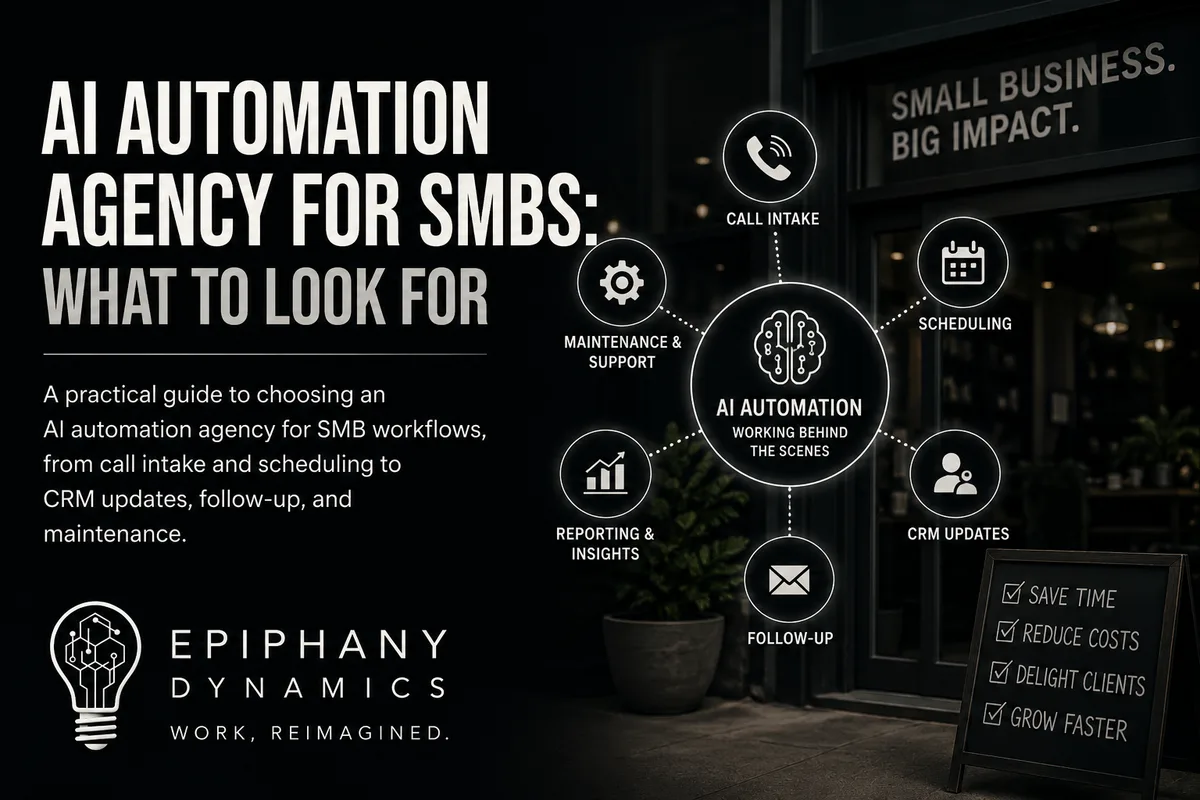
AI Automation Agency for SMBs: What to Look For
A practical guide to choosing an AI automation agency for SMB workflows, from call intake and scheduling to CRM updates, follow-up, and maintenance.
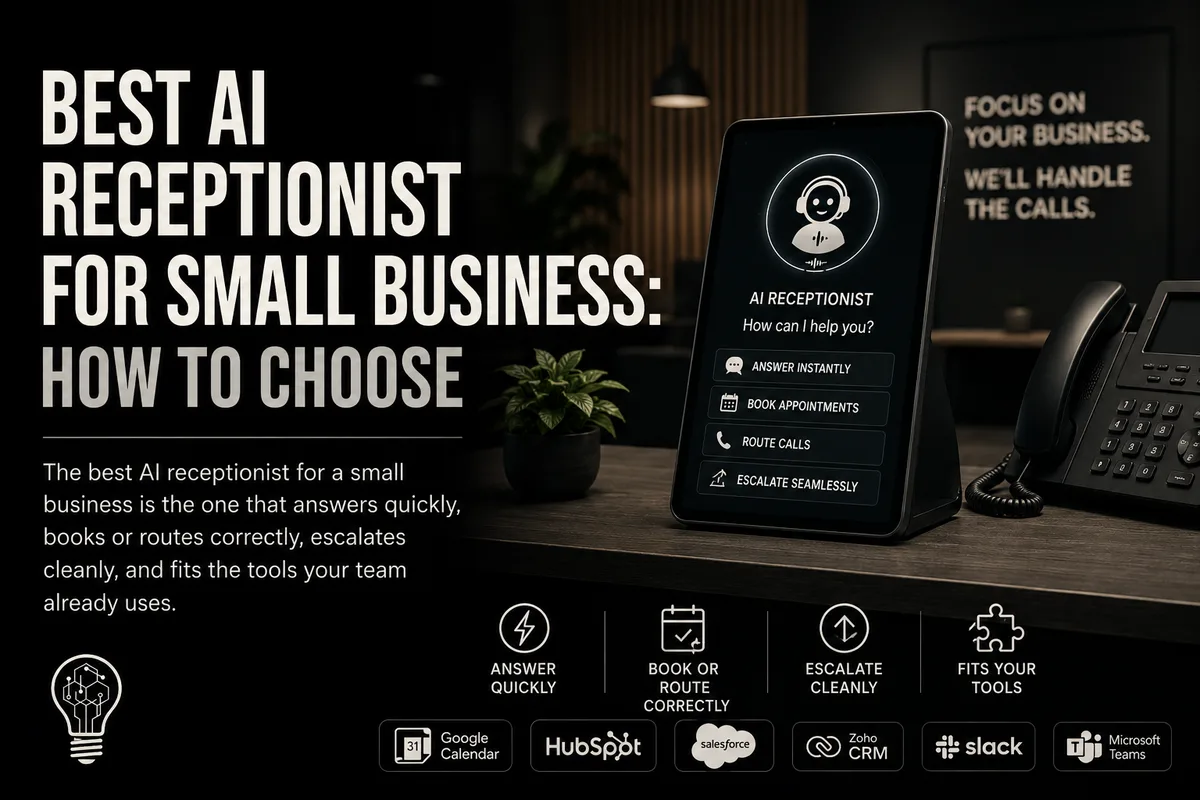
Best AI Receptionist for Small Business: How to Choose
The best AI receptionist for a small business is the one that answers quickly, books or routes correctly, escalates cleanly, and fits the tools your team.
Insurance Eligibility Automation for Physical Therapy Clinics
Eligibility automation for physical therapy clinics verifies benefits before the patient arrives, cuts front desk phone work, and can lower claim denial risk.