
AI Receptionist for Plumbers: Setup, Cost, and Real ROI in 2026
An AI receptionist for plumbers answers inbound calls 24/7, collects job details, schedules appointments, and escalates emergencies without a human picking up the phone. The business case depends on your missed-call volume, booking rate, average job value, and whether the system can actually write appointments into your scheduling workflow.
Plumbing businesses miss a large share of inbound calls when techs are in the field. Here's what an AI receptionist actually does, what it costs, and how to.
Epiphany Dynamics is an AI automation agency: we help businesses find and fix operational bottlenecks with AI receptionists, lead follow-up, and workflow automation.
Free 30-minute audit. We name at least 3 things you can automate, ranked by impact.
Book a free AI audit
Patrick Gibbs
An AI receptionist for plumbers answers inbound calls 24/7, collects job details, schedules appointments, and escalates emergencies without a human picking up the phone. The business case depends on your missed-call volume, booking rate, average job value, and whether the system can actually write appointments into your scheduling workflow.
Most plumbers aren't losing jobs because of bad work. They're losing them because nobody answered the phone. You're on a job, the phone rings, you can't get to it. The caller waits for voicemail, hangs up, and calls the next plumber on Google. No second chance, no callback. Just gone.
The math on this is uncomfortable once you pull your own call log. Every unanswered service-ready call has a chance of turning into work for the next plumber in the search results. An AI receptionist is built for that specific problem. This article covers what it actually does, what affects cost, and how to figure out whether the numbers make sense for your shop.
What an AI Receptionist Actually Does for a Plumbing Business
An AI receptionist answers calls using a natural-sounding voice model, walks the caller through structured intake questions covering problem type, address, and urgency, then either books the appointment directly into your scheduling software or triggers an emergency escalation. It is not a voicemail system, not a phone tree, and not a website chatbot.
The phrase gets used loosely, so it's worth being precise. A proper AI receptionist uses a voice AI model (typically built on a platform like Retell AI or Vapi) that picks up the call, talks to the customer, and takes action based on rules you set. There's no "press 1 for scheduling." It has a real conversation, and it holds up well enough that most callers don't realize they're talking to AI.
For a plumbing business, the standard intake flow looks like this: the caller describes the problem, the AI asks clarifying questions (is there active water damage? Residential or commercial property? What's the address?), checks your live calendar, and books the appointment. If the situation sounds like a burst pipe or sewage backup, it routes differently: it collects the caller's details and immediately fires an SMS or phone alert to your on-call tech. The whole exchange takes two to three minutes.
What it doesn't do: it won't give a quote, negotiate pricing, or handle billing disputes. Those require a human. The AI's job is intake and triage. Think of it as the person who answers the phone, understands what's needed, and gets the right appointment or the right person involved. That's the full scope, and staying within it is what makes these setups consistently reliable rather than a liability.
The Real Revenue Leak: Where Missed Calls Hit Hardest
Plumbing businesses miss a meaningful share of inbound calls during peak hours when techs are in the field. The revenue leak depends on average ticket value, how often missed callers would have booked, and how quickly competitors answer those same callers.
The missed-call problem isn't random. It clusters at specific times: mid-morning when the crew is mid-job, late afternoon before they wrap, and anything after 5PM. Those are also the times customers are most likely to call, because they're not at work themselves. You miss calls when your business is busiest. That's the worst possible time to miss them.
| Input | Why It Matters |
|---|---|
| Missed calls during active job hours | Shows how much demand disappears before intake starts |
| Average job value by service type | Prevents small repairs and emergency jobs from being modeled the same way |
| Booking rate from answered calls | Turns call coverage into a realistic recovered-work estimate |
| Callback success rate | Shows whether voicemail is actually recovering the missed opportunities |
Use your own call logs and booking data here. Borrowed close-rate assumptions make the math look precise without making it true.
A meaningful share of home service callers who reach voicemail never leave a message. That means even if you call back quickly, you've already lost most of those callers by the time you knew they called. This is the exact gap an AI receptionist closes: it picks up in the first place, so the voicemail math stops being relevant.
Emergency Calls vs. Routine Scheduling: How AI Handles Both
AI receptionists handle routine scheduling by booking directly into your calendar with no human involvement. For genuine emergencies like burst pipes, sewage backups, or active flooding, they follow a separate escalation path: collecting the caller's situation and address, then immediately alerting your on-call tech by text or call. Emergencies do not get queued as regular bookings.
This is where the configuration work matters most. You need to define what counts as an emergency before you go live, because the AI follows the rules you give it. A clogged bathroom drain is not the same as raw sewage backing up into a finished basement. A setup that treats them the same will either frustrate customers by over-escalating routine calls, or fail you by under-escalating the ones that matter.
Most setups handle this with a decision tree early in the call. The AI asks something like "Is there active water damage or flooding?" A yes branches to the emergency flow. A no goes to standard intake. You can also configure it to recognize specific phrases ("pipe burst," "no heat," "sewage smell") that trigger immediate escalation regardless of the question it just asked. If you operate across trades or handle any HVAC work, the AI receptionist setup for HVAC businesses uses the same emergency triage logic and is worth a read for how that decision tree gets structured in a dual-trade shop.
The cleaner your escalation rules, the better the system performs. Vague instructions produce vague results. "Route emergencies to the on-call tech" is not something the AI can act on without knowing what qualifies as an emergency. Being specific here is the difference between a system that runs itself and one that constantly needs a human to override it.
What to Set Up Before You Go Live
Before launching an AI receptionist, a plumbing business needs to define its service area, emergency criteria, on-call escalation contacts, and scheduling software integration. Without clear answers to these things, the AI will either book jobs outside your range or misroute urgent calls. Setup speed depends mostly on whether those decisions and credentials are ready.
The technical side is smaller than most people expect. Most AI receptionist platforms integrate directly with common scheduling tools like Jobber, ServiceTitan, or Google Calendar. What takes time is the decision-making, not the build. You have to know your own business rules before you can configure them into a system that acts on them correctly.
The questions you need answered before setup:
- What is your service area? (ZIP codes or a mile radius from your base)
- What counts as an emergency? (define it in plain language, not vague categories)
- Who gets the emergency alert and how? (SMS, phone call, or both?)
- Is your calendar current and accurate? (the AI books from whatever it sees)
- What do you charge for after-hours calls? (the AI can set expectations upfront)
- What calls do you not take? (commercial only, no oil boilers, out-of-area, etc.)
That last question is one most people skip, and it causes problems downstream. If the AI books a job type you don't handle, you waste either the customer's time or the tech's. Training the system on what you don't take is just as important as what you do. The step-by-step guide on building an AI receptionist for a service business walks through the full configuration process in detail, including how to structure intake scripts and connect to your dispatch workflow.
One thing that catches shop owners off guard: the AI needs to sound like it belongs at your business. Give it a name, a tone, and an opener that matches how your best receptionist would actually talk. Customers calling with a plumbing problem are already stressed. A voice that sounds robotic or overly corporate makes things worse before you've even confirmed the job.
Next on this subject: How Long Does AI Receptionist Setup Take in 2026?.
What It Costs vs. What It Returns
AI receptionist pricing for plumbing businesses depends on call volume, integrations, emergency routing, and post-launch support. To model ROI, multiply your missed calls by your booking rate and average ticket value, then compare that against the actual platform quote and monitoring effort.
| AI Receptionist | Full-Time Receptionist | |
|---|---|---|
| Cost shape | Platform, call volume, integrations, and support | Payroll, benefits, taxes, and management |
| Scaling behavior | Usage and configuration expand with call volume | Coverage expands by adding hours or people |
| After-hours coverage | Around the clock if configured | No |
| Simultaneous calls | Multiple, depending on platform capacity | 1 |
| Sick days / turnover risk | None | Yes |
| Emergency escalation | Rules-based, consistent | Depends on the person |
The cost comparison with a human receptionist is useful context, but the more direct ROI calculation is the missed-call recovery math. If you're missing three calls a day, model how many of those calls would book at your average ticket value, then compare the result against the monthly tool cost. For a detailed breakdown of how those numbers shift across different business sizes and call volumes, the full AI vs. human receptionist ROI analysis is worth reading before you commit either direction.
One benefit that doesn't show up cleanly in a spreadsheet: after-hours capture. Most plumbing emergencies don't happen at 2PM on a Tuesday. They happen at 10PM on a Saturday. A caller who reaches your AI at 10PM gets their information logged and, if the situation is urgent, your on-call tech gets a text. That's a customer who stays yours instead of going to the 24-hour operation down the road.
Is an AI Receptionist the Right Move for Your Shop?
An AI receptionist makes the most sense for plumbing businesses that are actively missing calls during job hours, losing after-hours emergencies to competitors, or paying for an answering service that takes messages but doesn't book jobs. It is not the right fit if your primary constraint is not enough leads, not enough techs to handle more work, or a call volume too low to justify setup time.
If you're running one to five trucks and the phone rings while your hands are inside a wall, this tool is built for that problem. The calls you're missing are not junk. They're people with a real problem, money to solve it, and a willingness to book today. The only thing standing between you and that job is whether someone picks up.
The same technology is running in HVAC shops, property management offices, and other service businesses where call coverage is the actual bottleneck. The specifics differ by trade, but the core math is the same: if you're missing calls, an AI receptionist should be evaluated against the value of the jobs it helps recover. If you want to understand how AI scheduling fits into a broader operational picture beyond just the phone, the guide on AI scheduling for home service contractors covers the full workflow from first call to booked job.
Epiphany Dynamics builds and deploys these systems for plumbing businesses and other service trades. If you'd rather see a working setup than read about one, the details are at the services page.
The Phoenix plumbing scenario is illustrative, not a measured client result. Use it to discuss call flow, then verify the assumptions against your own call and booking records.
Frequently Asked Questions
Q: How much does an AI receptionist cost for a plumbing business?
Pricing depends on call volume, integrations, escalation rules, and support. The payback depends on how many missed calls turn into booked work, so use your own call log and vendor quote rather than a generic monthly range.
Q: How many missed calls does it take for an AI receptionist to pay for itself?
The break-even model starts with recovered jobs. Replace every input with your own average ticket, booking rate, missed-call volume, and monthly software cost, then compare the result against your actual missed-call log.
Q: Can an AI receptionist integrate with my existing plumbing scheduling software?
Yes; platforms like Retell AI and Vapi can integrate with ServiceTitan, Housecall Pro, and other major plumbing software through API, native connectors, or workflow tools. Setup depends on credential access, scheduling rules, intake questions, and emergency escalation logic.
Q: Will customers know they're talking to an AI, and will that hurt my reputation?
Most callers don't notice they're speaking to AI during the intake conversation—they perceive a standard intake call—and your system immediately escalates emergencies (burst pipes, gas issues, flooding) directly to your phone without the customer waiting. The end result is faster emergency response and confirmed appointment details, which typically improves customer experience over a voicemail.
Patrick Gibbs
AI Automation Expert
Patrick Gibbs helps professional practices implement AI automation that captures more leads, books more appointments, and scales without adding overhead. He's the founder of Epiphany Dynamics and creator of the AI Front Desk system.
Related Solutions
Build this into a real workflow
Related Posts
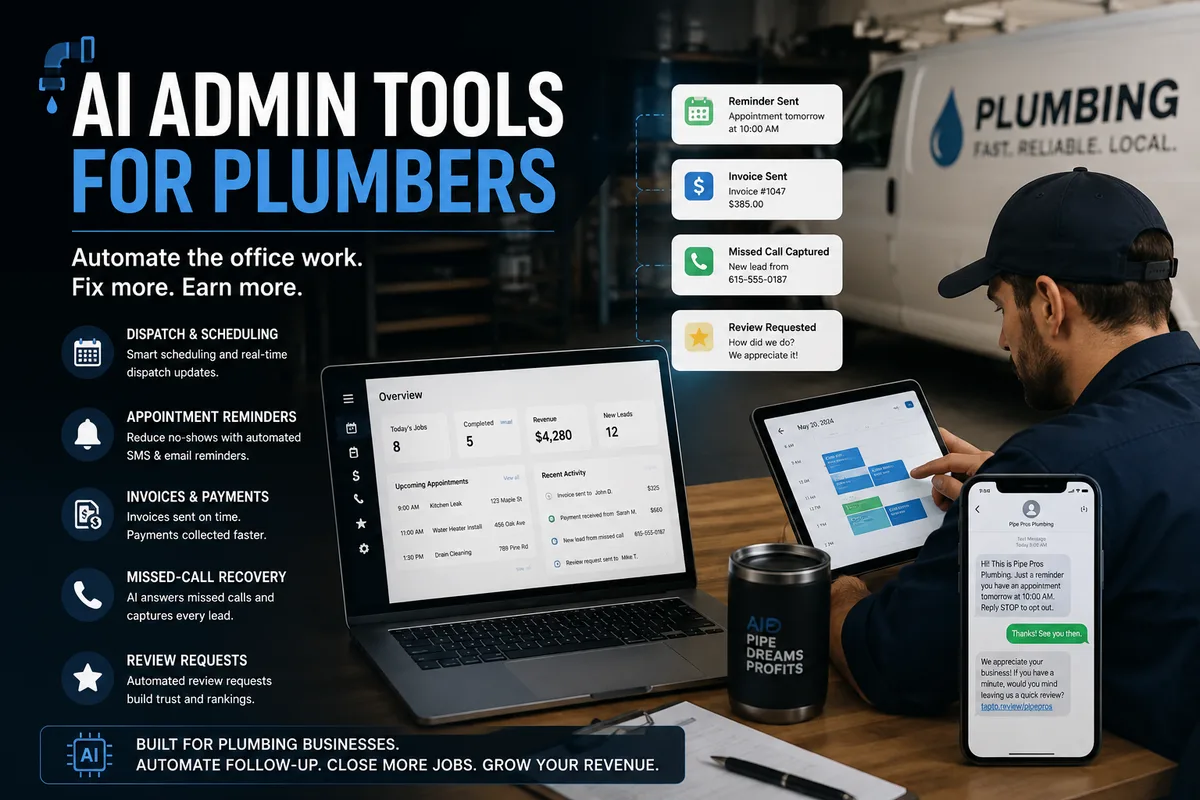
AI Admin Tools for Plumbers: What They Are and How to Choose
AI admin tools automate dispatch, reminders, invoicing follow-up, missed calls, and review requests for plumbers. What they do and how to choose.
AI Automation Agency for SMBs: What to Look For
A practical guide to choosing an AI automation agency for SMB workflows, from call intake and scheduling to CRM updates, follow-up, and maintenance.
Insurance Eligibility Automation for Physical Therapy Clinics
Eligibility automation for physical therapy clinics verifies benefits before the patient arrives, cuts front desk phone work, and can lower claim denial risk.