
n8n Workflow Automation Agency: What They Build, What It Costs (2026)
An n8n workflow automation agency designs, builds, and maintains automated workflows on n8n's open-source platform. They handle everything from initial scoping and deployment to ongoing error monitoring.
Zapier pricing drove you to n8n. Now you're wondering if hiring an agency to build it makes sense. Here's what they build, what projects cost, and how to.
Epiphany Dynamics is an AI automation agency: we help businesses find and fix operational bottlenecks with AI receptionists, lead follow-up, and workflow automation.
Free 30-minute audit. We name at least 3 things you can automate, ranked by impact.
Book a free AI audit
Patrick Gibbs
An n8n workflow automation agency designs, builds, and maintains automated workflows on n8n's open-source platform. They handle everything from initial scoping and deployment to ongoing error monitoring. Project cost and payback depend on workflow complexity, integration count, error handling, and the manual work being replaced.
Most business owners who find n8n have already been burned by task-based automation pricing. They hit a task cap, got the invoice, and started looking for something cheaper. n8n can solve part of the cost problem because it offers self-hosting and more flexible workflow execution. But free software and working software are not the same thing.
The catch is that n8n requires real technical knowledge to set up properly. You need a server, SSL certificates, database connections, and enough understanding of conditional logic to build a workflow that won't fail silently at 2 AM. Some business owners figure it out on their own. Most don't have the time, or they build something fragile that breaks the moment a vendor updates their API. That's the gap an agency fills.
What an n8n Workflow Automation Agency Actually Builds
n8n agencies build automated workflows that connect your existing tools without requiring a developer on staff. Common builds include CRM sync, lead routing, appointment reminders, invoice generation, and follow-up sequences. A properly scoped workflow should replace a measurable block of manual work on the specific task it automates.
The specific builds vary by industry, but the categories stay consistent. Service businesses most often automate lead capture and follow-up: a form submission triggers a CRM record, queues an SMS, sends an email sequence, and schedules a call on the owner's calendar, all without anyone touching a keyboard. E-commerce and B2B operations tend to automate order status updates, internal reporting, and invoice generation. Most of these workflows replace something someone was doing manually, at the end of a long day, with predictable errors.
What separates an agency build from a DIY attempt is error handling. Anyone can connect apps in n8n and make a happy-path demo work. Getting it to handle API timeouts, malformed data, missing required fields, and vendor changes requires knowing where workflows break before they do. A good agency builds retry logic, fallback branches, and failure alerts into every workflow before shipping. If someone shows you a workflow and it only has a happy path, it is not production-ready.
Before hiring anyone, it's worth understanding whether n8n is even the right tool for your situation. The n8n, Make, and Zapier comparison guide walks through when each platform makes sense based on task volume and complexity, and it's a useful reference before you start scoping work with anyone.
Why n8n Over Zapier or Make
n8n wins on flexibility and can win on cost at volume when it is implemented well. Self-hosting changes the cost structure, and native JavaScript inside nodes means agencies can build logic that simpler automation tools cannot replicate without workarounds or middleware.
| Platform | Cost Model | Volume Behavior | Custom code | Self-hosted option |
|---|---|---|---|---|
| Zapier | Task-based tiers | Can rise quickly at high task volume | No | No |
| Make | Operation-based tiers | Usually more flexible than task-only billing | Limited | No |
| n8n (cloud) | Workflow-execution tiers | Often attractive for higher-volume workflows | Yes (JS) | Yes |
| n8n (self-hosted) | Infrastructure plus maintenance | Sticker cost stays low; operations burden shifts to you | Yes (JS) | Yes |
The real cost of self-hosted n8n isn't the server bill, it's the setup and ongoing maintenance time. That's exactly why businesses hire agencies: they want the cost savings without managing the infrastructure themselves.
The JavaScript support is where n8n separates from both Zapier and Make in a way that matters for complex builds. You can write real logic inside any node: parse nested JSON, run calculations, build conditional branching based on data pulled from multiple sources. Make has limited code support and Zapier has almost none. If your workflow needs logic beyond drag-and-drop field mapping, n8n is the only one of these three that handles it natively.
For more in this area, see Document Workflow Automation for Small Business (2026 Guide).
What Projects Cost and How Long They Take
Simple n8n automations cost less than multi-branch workflows with conditional logic, error handling, and custom API work. Project timeline depends on scope, test data, credential access, and how quickly edge cases are identified before deployment.
| Project Type | Cost Driver | Timeline Driver | Example |
|---|---|---|---|
| Simple automation | Few systems, minimal branching | Fastest when credentials are ready | Form submission to CRM + email notification |
| Mid-complexity | Conditional logic and error handling | Depends on test data and approval loops | Lead routing + multi-step follow-up sequence |
| Complex build | Multi-branch workflows and custom APIs | Depends on integration complexity | Full intake, scheduling, and billing sync |
| Ongoing retainer | Monitoring, maintenance, and new workflow cadence | Ongoing | Monitoring, maintenance, and new workflows |
Timeline depends heavily on API access. Agencies can move fast when they have test credentials for every tool on day one. When you have to chase down API keys, get IT approval, or wait on a SaaS vendor's support team to enable webhook access, that's where projects stall. Any agency worth hiring sends you an access checklist before the kickoff call, not after.
Retainer pricing makes sense if you're planning to build more than one or two workflows. A monthly retainer covers monitoring, fixes when third-party integrations break after vendor updates, and adding new workflows as your needs evolve. One-time builds are cheaper upfront but leave you on your own when something changes on the vendor side, and those changes happen more often than most clients expect.
How to Calculate ROI Before You Commit
Calculate automation ROI with one formula: hours saved per week x fully loaded hourly labor cost x annualization period, minus build and maintenance costs. The workflow is worth building when the manual cost it removes is larger than the setup, hosting, monitoring, and maintenance required to keep it reliable.
Run that calculation for every workflow you're considering, including the small ones. A lead notification that saves a small amount of time every day can still be valuable because the savings repeat. Small, consistent wins like that accumulate faster than one large project, and they're easier to scope, easier to build, and easier to get buy-in on internally.
Speed is the other factor that doesn't show up in the hours-saved calculation but shows up clearly in revenue. A lead follow-up that fires immediately after a form submission is more useful than one sitting in someone's inbox. If your current process has a long lag on new inquiries, that's a revenue problem, not just a workflow inconvenience. Automation fixes the lag in a way that adding headcount alone cannot.
For a closer look at how this math plays out across different business types, the AI workflow automation guide for small businesses covers real implementation scenarios with cost breakdowns by vertical.
How to Vet an n8n Agency Before You Hire One
Ask for exportable workflow files, not screenshots. Confirm they build error handling and monitoring into every workflow, not just happy-path demos. Find out how they handle self-hosted infrastructure versus cloud deployment, what the handoff process looks like, and whether they offer post-launch support. An agency without clear answers to those questions hasn't shipped production systems.
A few questions that separate actual n8n experience from someone who set up an agency website after watching tutorials:
- How do you handle API rate limits when a workflow runs at high volume?
- What happens when a downstream API is unavailable? Walk me through your error path.
- Do you set up failure alerts, or will I only find out when a task goes missing?
- Can you show me a workflow that uses custom JavaScript logic, not just pre-built nodes?
- What's your process when a third-party integration breaks after a vendor updates their API?
A good agency answers those in specifics. A weak one gets vague or pivots to showing you tiny happy-path demos. The other thing to watch: does the agency ask you good questions before proposing anything? Any shop worth hiring wants to know your current tools, your data structure, and how your team actually works before they put numbers on paper. A proposal that arrives immediately after a first call, without those questions being asked, is guesswork dressed up as a quote.
If you're still deciding between an n8n specialist and a broader AI automation shop, reading about what AI automation agencies actually do day to day clarifies how the scope compares. And if you want to try building one workflow yourself before committing to anything, the practical n8n guide for small businesses covers the most common starting builds with enough detail to know whether you want to DIY or hand it off.
The n8n ecosystem has matured enough that good agencies exist and bad ones are easy to screen out if you know what to ask. The ROI math is simple, the vetting process is short, and the first workflow to automate is usually obvious once you map your own week on paper. If you want help identifying which process to tackle first, Epiphany Dynamics starts with a workflow audit before recommending any platform or build.
Frequently Asked Questions
Q: How much cheaper is n8n than Zapier for a typical workflow automation project?
n8n can be cheaper than task-based automation platforms at higher volume because its pricing model and self-hosting option change the cost structure. The ROI still depends on the manual work removed, the setup cost, the maintenance burden, and whether your team can keep the workflow reliable.
Q: When should you hire an n8n workflow automation agency instead of building it yourself?
Hire an agency if you lack DevOps experience or don't want to own debugging when vendor APIs change. Agencies handle scoping, deployment, error monitoring, and maintenance, preventing the silent failures that plague DIY workflows and ensuring your automation consistently delivers its promised time savings.
Q: How long does it typically take to deploy an n8n workflow through an agency?
Launch timing depends on complexity, integration count, credential access, test data, and approval speed. Lead routing and appointment reminders are usually faster than multi-step order sync or custom API integrations because fewer edge cases need to be tested before production.
Q: Which business workflows break even the fastest with n8n automation?
Lead routing, appointment reminders, invoice generation, and CRM sync often make strong starting points because the manual work is repetitive, measurable, and easy to compare against the build cost. Use your own hours saved, labor cost, and error reduction to decide which workflow breaks even fastest.
Patrick Gibbs
AI Automation Expert
Patrick Gibbs helps professional practices implement AI automation that captures more leads, books more appointments, and scales without adding overhead. He's the founder of Epiphany Dynamics and creator of the AI Front Desk system.
Related Solutions
Build this into a real workflow
Related Posts
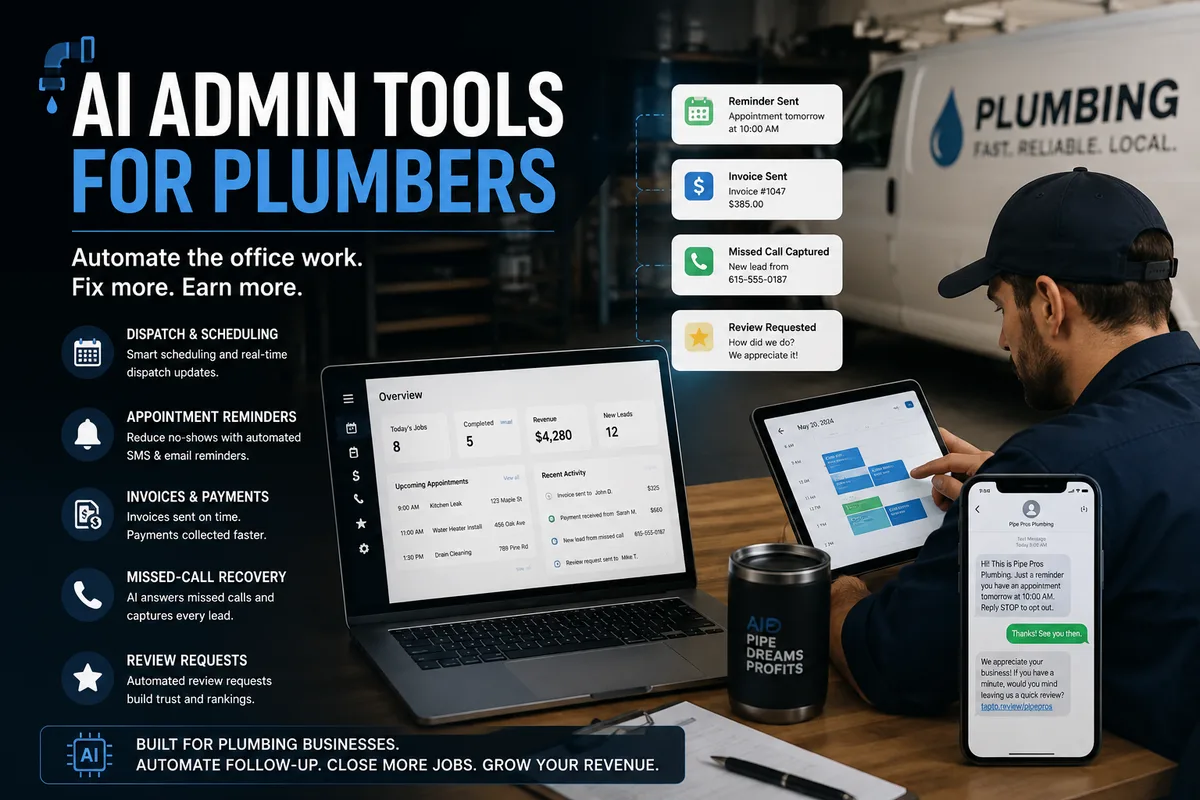
AI Admin Tools for Plumbers: What They Are and How to Choose
AI admin tools automate dispatch, reminders, invoicing follow-up, missed calls, and review requests for plumbers. What they do and how to choose.
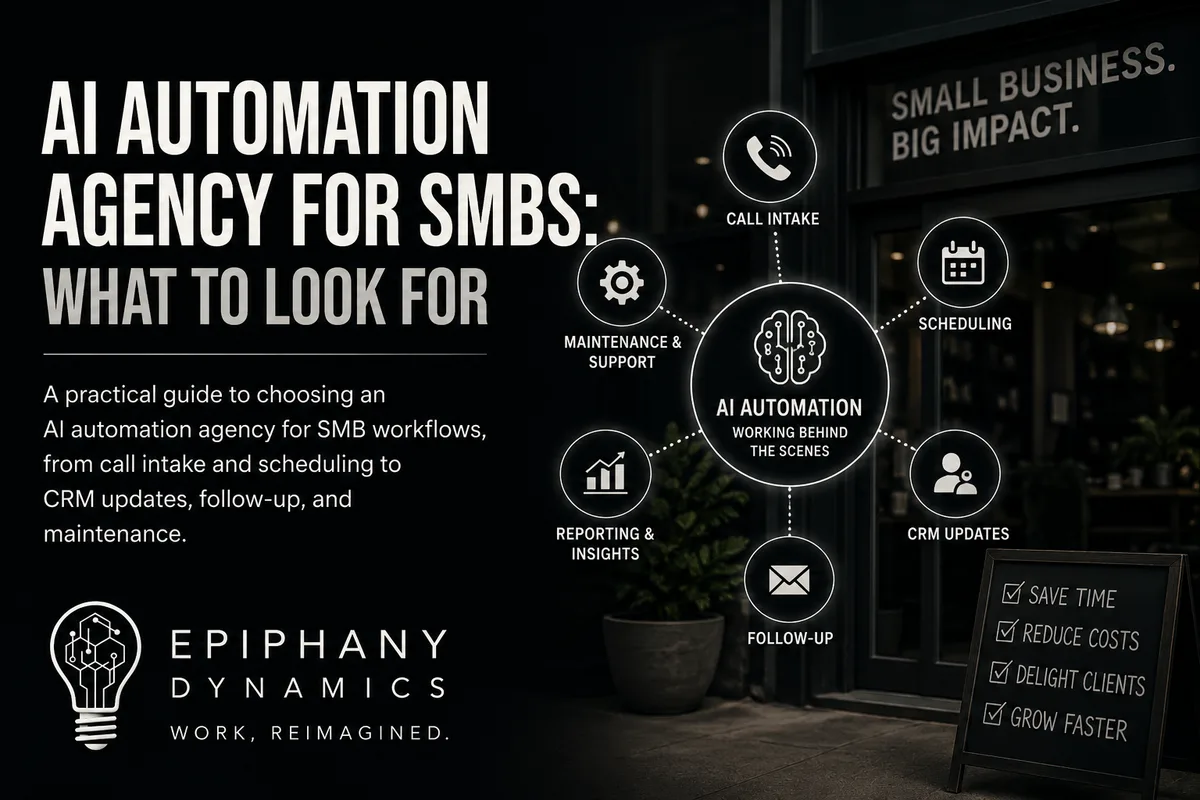
AI Automation Agency for SMBs: What to Look For
A practical guide to choosing an AI automation agency for SMB workflows, from call intake and scheduling to CRM updates, follow-up, and maintenance.
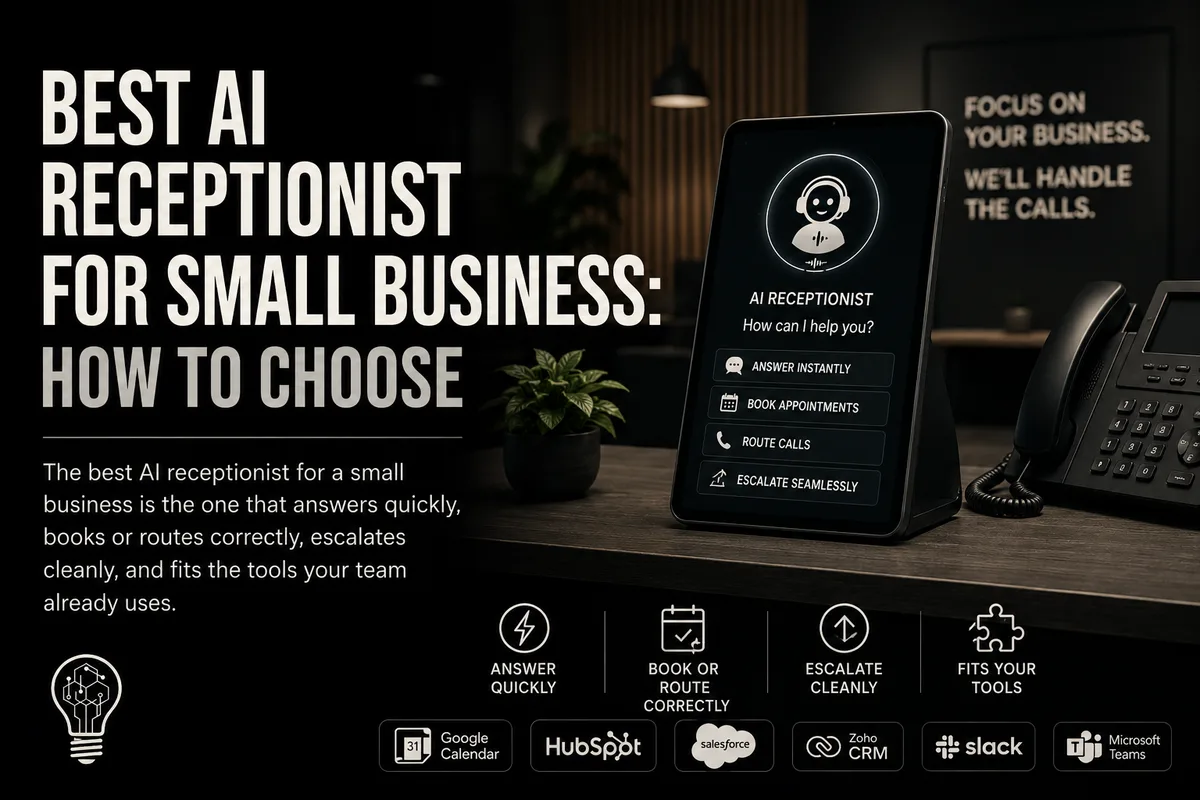
Best AI Receptionist for Small Business: How to Choose
The best AI receptionist for a small business is the one that answers quickly, books or routes correctly, escalates cleanly, and fits the tools your team.