
Too Many Missed Calls: What It's Costing Your Business Right Now
The average small service business misses a meaningful share of inbound calls, and since most callers hang up without leaving a voicemail, most of that lost revenue is invisible until you run the math. This guide shows you how to calculate your exact number and what to do about it.
Small service businesses miss a meaningful share of inbound calls. Even a few missed bookings add up. Here's how to calculate your number and fix it.
Epiphany Dynamics is an AI automation agency: we help businesses find and fix operational bottlenecks with AI receptionists, lead follow-up, and workflow automation.
Free 30-minute audit. We name at least 3 things you can automate, ranked by impact.
Book a free AI audit
Patrick Gibbs
The average small service business misses a meaningful share of inbound calls, and since most callers hang up without leaving a voicemail, most of that lost revenue is invisible until you run the math. This guide shows you how to calculate your exact number and what to do about it.
The Call That Got Away
Your phone rings while you are handling a job. You get back to your desk later and find a couple of voicemails, neither with a useful callback number. Several people called, got voicemail, and moved on. Most business owners read that scenario and think it is exaggerated. It isn’t. Our breakdown of the true cost of missed calls shows the multiplier effect goes far beyond the immediate lost job.
Call-tracking studies consistently find that small businesses miss a meaningful share of their inbound calls, and industries with fluctuating demand or lean front-desk staffing miss even more. The same studies find that most callers who reach voicemail hang up without leaving a message. The phone rang. They called. They wanted to buy something. And then they left.
Why Perception and Reality Are So Far Apart
Ask most business owners what share of calls they miss and they’ll say something like “we try to get to everyone.” The problem is that phones don’t ring in convenient patterns. They spike during lunch, at open, and before close. These are exactly the moments when front-desk staff are handling existing customers, eating at their desks, or managing the end-of-day backlog. The phone rings, drops to voicemail, and nobody registers it as a problem because nobody was watching.
After-hours calls make this worse. Depending on the industry, a large share of inbound call volume happens outside standard business hours. Someone searches for a plumber after their sink backs up. They find your business, see decent reviews, and call. They get voicemail. They call the next result. If that business has a live answer or even an AI option, you’ve lost a job without ever knowing there was one available. Callers with an immediate need have very little patience for voicemail.
Running the Revenue Math Most Owners Skip
Most business owners have never actually done this calculation. The arithmetic isn’t complicated, but the result is uncomfortable enough that it tends to change priorities fast.
Start with your own weekly inbound call volume. Multiply it by your missed-call rate, then by the share of missed callers who were likely ready to book, then by your average job value. That gives you a business-specific estimate instead of a borrowed industry example. Learn how to quantify the annual cost of missed calls for your specific business.
The numbers scale harder in high-value categories. A dental office that misses new-patient inquiries loses more than a callback task. A personal injury firm that misses consultation calls may lose cases that never come back. The table below shows which inputs matter across common service industries.
| Industry | Call Volume Input | Missed-Call Input | Customer Value Input | Value Driver |
|---|---|---|---|---|
| HVAC (Residential) | Seasonal inbound calls | Lunch, job-site, and after-hours gaps | Average booked service ticket | Missed emergency and replacement jobs |
| Dental (General Practice) | New-patient and recall calls | Front-desk overload and lunch gaps | First visit and lifetime patient value | Lost new-patient starts |
| Med Spa | Consultation and booking inquiries | Peak service and after-hours gaps | Average treatment or package value | Lost consults and missed rebooking |
| Plumbing / Emergency Services | Emergency and routine calls | Field-work and after-hours gaps | Average service call value | Missed emergency jobs |
| Personal Injury Law | Consultation requests | Intake and callback delays | Case value and qualification rate | Lost signed cases |
Use the table as an input checklist. Actual results vary by market, call quality, and the urgency of the caller.
When Calls Go Unanswered: The Predictable Dead Zones
Understanding exactly when calls get missed is what makes the solution manageable. You don’t need to solve every hour of the day. You need to solve the specific windows where coverage breaks most often.
The lunch gap is one of the most consistent dead zones across industries. Front desk staff take breaks. Nobody covers them. Call volume doesn’t drop to match. A business that’s diligent about phones in the morning often has a window where anything coming in hits voicemail automatically.
Peak demand periods break things even faster. During a cold snap, an HVAC company’s call volume can spike hard. The same phone coverage that handles a normal Tuesday can’t absorb a demand surge. Calls stack up. Voicemail fills. People stop leaving messages. The business misses the exact volume spike it was waiting for all year. This is a solvable problem, but not with the same staffing approach that handles normal weeks.
The Voicemail Trap
Voicemail is not a solution to too many missed calls. It’s a filter that removes the most impatient callers, who are often the most qualified ones. The person comfortable leaving a message is okay waiting. The person who needed an answer right now has already called someone else.
Beyond that, voicemail creates callback debt. Harvard Business Review research on lead response is still widely referenced because it shows how quickly qualification odds fall when follow-up is delayed. That data is about web leads. For callers who already made the effort to pick up the phone and dial, the tolerance for delay is shorter. A late callback is not equivalent to answering the call. The motivation is different. The urgency is gone.
The callback pile is also an operational mess. Here’s a detailed guide on how to recover revenue from missed calls that addresses this exact problem. Messages accumulate, get checked inconsistently, and often contain incomplete information. Staff who are already handling active customers don’t prioritize return calls. By end of day, you have a messy list and no certainty about which callers are still worth pursuing. This is how a missed call becomes a permanently lost customer.
Building a System That Actually Catches Calls
Businesses that consistently convert inbound calls have stopped treating this as a staffing problem and built actual systems around it. The approach breaks into a few steps.
Step one: get real data. Most owners don’t know their actual miss rate. Call tracking platforms like CallRail or Aircall give you this information quickly. Review enough actual call history to see the pattern before making any decisions. This step alone tends to shift priorities, because the number is almost always higher than people expect.
Step two: map the dead zones. When are calls going unanswered? Pull call volume by hour and stack it against your staffing calendar. For most businesses, the gap is concentrated in a few specific windows. Fixing those windows solves most of the problem.
Step three: match the right coverage tool to each window. For lunch-window gaps, a rotating coverage structure with a clear backup chain works well. For after-hours and weekends, AI-powered voice agents have become genuinely capable at answering questions, collecting information, and booking appointments. They’re not perfect replacements for a live person on complex calls, but they can recover a meaningful share of after-hours callers who would otherwise have left silently. That’s a direct lift in booked appointments without adding headcount.
Step four: measure callbacks as a separate metric. Some calls will always be missed. The question is what happens next. Fast callbacks perform closer to a live answer than delayed callbacks. Set a standard, make it visible, and hold the team to it.
The Culture Problem Underneath the System Problem
Sometimes the real issue isn’t coverage or technology. It’s that answering the phone has become nobody’s specific job. In small service businesses, “whoever’s available” usually means nobody, because everyone’s already handling something else. The front desk role is often the lowest-paid and highest-turnover position in the company, yet it’s the first point of contact for every potential new customer.
A few structural changes help here. Making call answer rate a visible metric changes behavior fast. Staff who know it’s tracked treat it differently than staff who don’t. Having an explicit escalation path when the primary person is unavailable, not a default drop to voicemail, keeps calls from falling through during predictable gaps.
“Sarah is on break, so calls go to voicemail” is not a policy. “Sarah is on break, so calls roll to the office manager’s cell” is. The difference is one line in a procedures document, and its value depends on your call volume.
Where to Start
The case for fixing this is almost always compelling once someone runs the actual numbers. The challenge is that most businesses have never done that calculation. They know they miss calls. They don’t know exactly how many, when, or what those callers represented in revenue.
Start with a representative slice of inbound call data. Get the actual miss rate. Map it against your staffing calendar. The gap will be obvious once it’s visible, and usually so is the fix. Most businesses find that solving a few specific coverage windows recovers the large majority of the revenue they’ve been leaking.
If you want a more systematic approach to building AI-assisted call handling, companies like Epiphany Dynamics specialize in that problem for service businesses. But the framework above applies regardless of what tools you use. Start with the data. The math takes care of the rest.
Frequently Asked Questions
Q: What percentage of calls does the average small service business miss?
Call-tracking studies consistently find that small service businesses miss a meaningful share of their inbound calls, and industries with fluctuating demand or lean front-desk staffing miss even more. Because most callers who reach voicemail hang up without leaving a message, missed calls are almost always permanently lost, not deferred.
Q: How do I calculate the revenue impact of missed calls on my specific business?
Multiply your weekly call volume by your miss rate, then by the share likely to book, then by your average customer value. Run this against your real call data: the result is almost always larger than expected and changes how urgently you prioritize fixing the gap.
Q: When are calls most likely to go unanswered at a service business?
The lunch gap is one of the most consistent dead zones across service industries: front desk staff take breaks without coverage. Peak demand periods like seasonal spikes create another major vulnerability: a normal phone team often can’t absorb a surge during a heat wave. After-hours and weekend volume is another consistent gap most businesses have simply accepted as unavoidable.
Q: Is voicemail a reasonable backup for missed calls?
No. Voicemail filters out the most impatient callers, who are often the most motivated buyers. Harvard Business Review research shows that delayed lead response reduces qualification odds. For callers who already made the effort to pick up the phone, the tolerance for delay is shorter. A late callback is not equivalent to answering the call: the urgency and motivation are gone.
Q: What is the most cost-effective way to stop missing calls for a small service business?
Map your specific dead zones using your own call data first: the gap is almost always concentrated in a few windows, not evenly distributed. For lunch-window gaps, a defined backup chain with a specific person responsible is often all that’s needed. For after-hours and overflow during demand spikes, AI voice agents can answer questions, collect information, and book appointments without adding a full-time front desk role.
Patrick Gibbs
AI Automation Expert
Patrick Gibbs helps professional practices implement AI automation that captures more leads, books more appointments, and scales without adding overhead. He's the founder of Epiphany Dynamics and creator of the AI Front Desk system.
Related Solutions
Build this into a real workflow
Related Posts
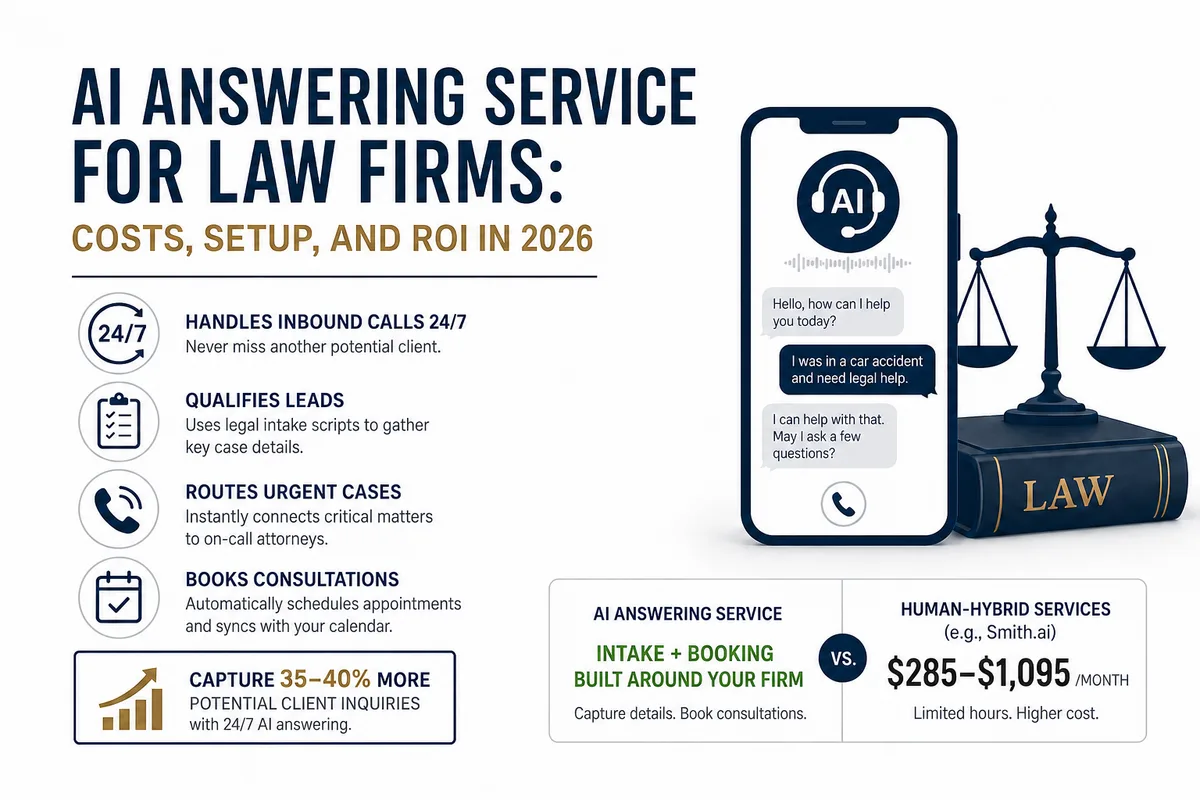
AI Answering Service for Law Firms: Costs, Setup, and ROI in 2026
Law firms miss a large share of inbound calls, most of them after hours. Here's what an AI answering service actually does, what it costs versus human.
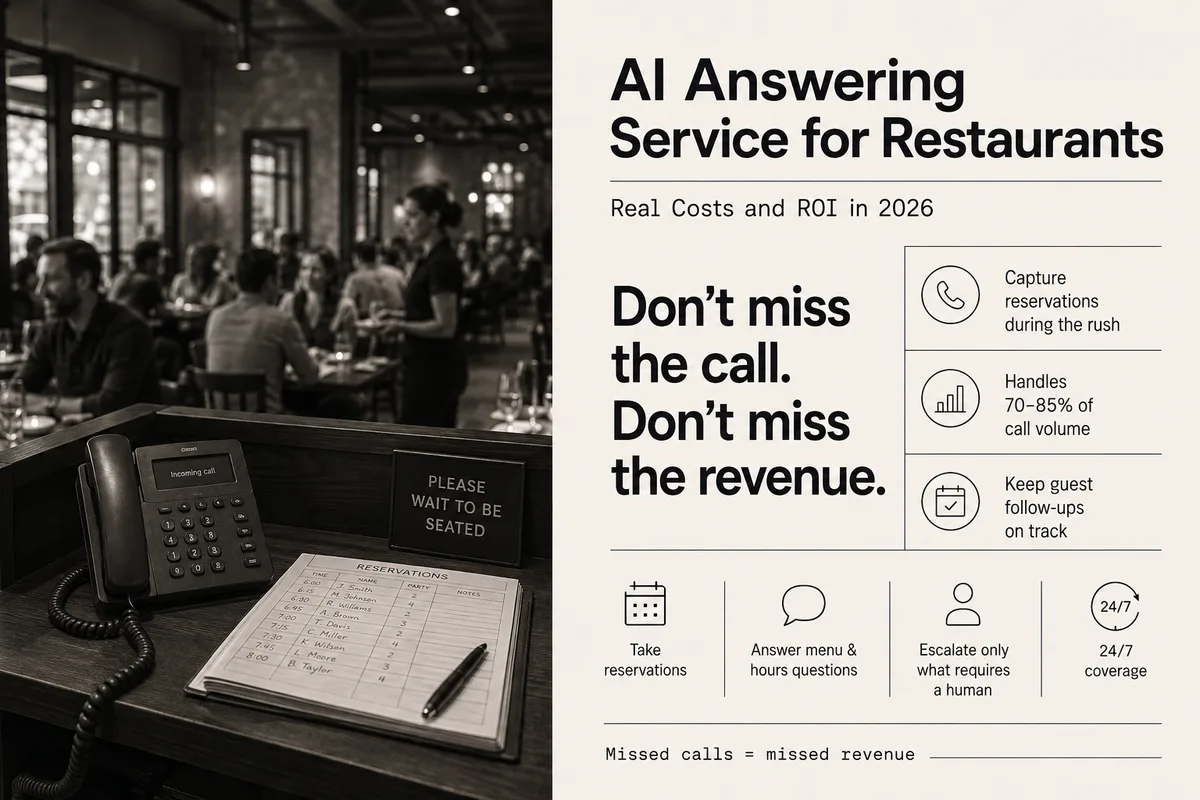
AI Answering Service for Restaurants: What to Compare in 2026
Restaurants miss calls during peak hours. An AI answering service can handle reservations, menu questions, and callbacks when staff are busy.
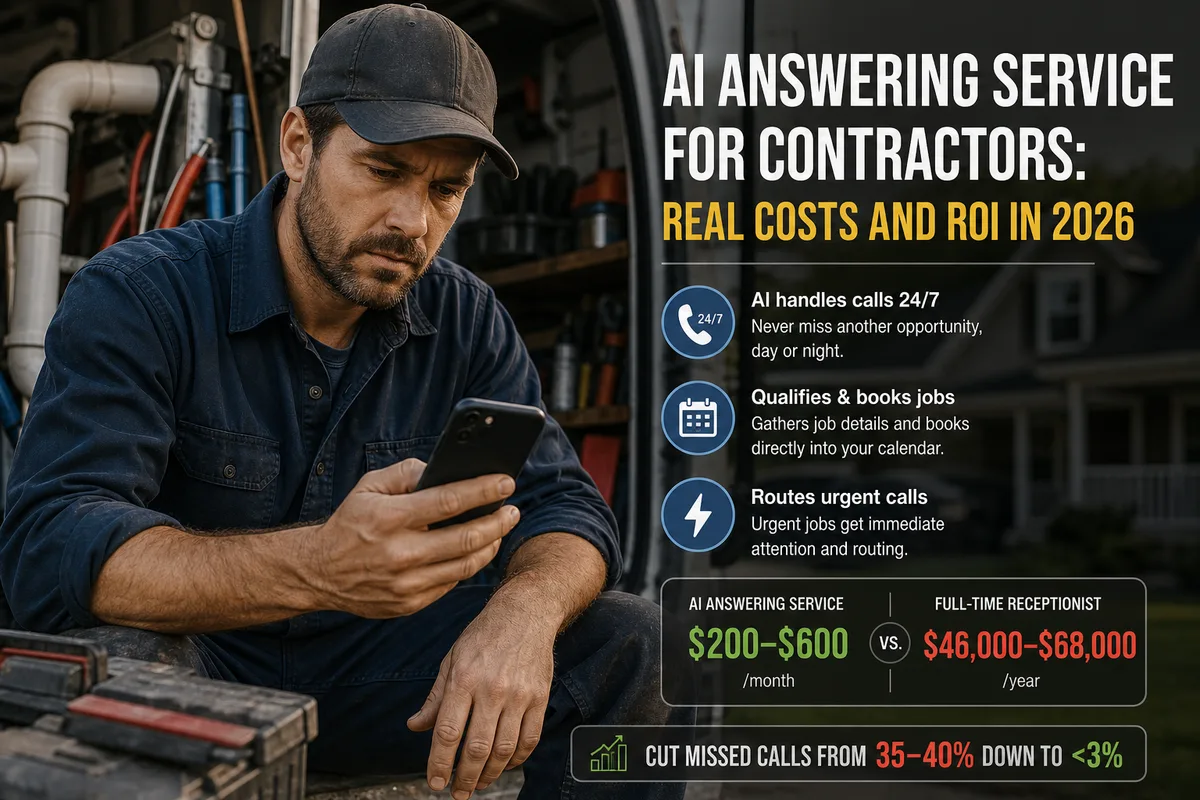
AI Answering Service for Contractors: What to Compare in 2026
Contractors miss inbound calls while working jobs on-site. Here's what AI answering services do, where they help, and how to model the ROI from your own call.