
AI Answering Service for Restaurants: What to Compare in 2026
An AI answering service for restaurants handles inbound calls, takes reservations, answers menu and hours questions, and escalates only what requires a human. The case is strongest when phone traffic is predictable, reservations are valuable, and staff are already stretched during the windows when callers need an immediate answer.
Restaurants miss calls during peak hours. An AI answering service can handle reservations, menu questions, and callbacks when staff are busy.
Epiphany Dynamics is an AI automation agency: we help businesses find and fix operational bottlenecks with AI receptionists, lead follow-up, and workflow automation.
Free 30-minute audit. We name at least 3 things you can automate, ranked by impact.
Book a free AI audit
Patrick Gibbs
An AI answering service for restaurants handles inbound calls, takes reservations, answers menu and hours questions, and escalates only what requires a human. The case is strongest when phone traffic is predictable, reservations are valuable, and staff are already stretched during the windows when callers need an immediate answer.
Restaurant phone traffic peaks exactly when your staff is least available to deal with it. The host stand is managing a waitlist, servers are in the weeds, and the phone keeps ringing. That's the real problem an AI answering service solves. Not automation for its own sake. A concrete gap between call volume and available human attention during the windows that matter most.
Why Restaurants Lose Revenue on the Phone
Restaurants miss inbound calls during peak service windows. A busy dinner service with unanswered reservation calls is not just a customer service problem. It is potential revenue walking to whichever restaurant answers first.
The math on missed calls is worse than most restaurant owners realize. Phone volume spikes exactly when staff attention is already maxed out. A party of four calling during the dinner rush gets a busy signal or rings out, decides the place is too hard to reach, and books somewhere else. That's not a recoverable situation. The guest is not waiting for a callback.
Phone calls remain a primary booking channel for full-service restaurants. And most consumers who can't reach a restaurant by phone don't keep trying. They book somewhere else. That is a conversion problem, not a staffing problem.
There's also the labor angle that rarely gets measured. Front-of-house staff spend real time per phone call when you factor in hold time, collecting reservation details, confirming via callback, and re-entering data into the reservation system. A restaurant with steady phone traffic can burn prime labor on calls that an AI system can often handle without pulling someone away from guests in the room.
What an AI Answering Service Actually Does for a Restaurant
A restaurant AI answering service picks up every call instantly, collects reservation details, confirms availability against a live calendar, texts a confirmation to the guest, and logs everything without staff involvement. It handles hours, menu questions, parking, dress code, and dietary accommodation inquiries without any human intervention needed.
The core function: the AI answers, identifies what the caller needs, and either resolves it completely or routes it to the right person. For a restaurant, that means the system needs to know your reservation windows, party size limits, available time slots, special event info, and basic menu details. Most modern platforms integrate directly with OpenTable, Resy, or SevenRooms and pull live availability, so the AI is not just taking a name and number but actually booking the reservation in real time.
What surprises most operators is how wide the range of calls the system fully handles. Guests call to ask about parking. They call to confirm their reservation time. They call to ask whether you accommodate a nut allergy or have outdoor seating. These are not complex interactions, but they consume staff time constantly. A trained AI handles all of them without escalation. For a broader view of how phone answering fits alongside reservation management and other operational improvements, the guide to using AI for restaurant operations covers the full picture well.
The escalation rules are where implementation quality separates good systems from expensive voicemail. A properly configured system escalates only when it genuinely cannot help: complex group event pricing, complaints that require a manager, or requests outside its knowledge base. A system that routes everything to voicemail is not an AI answering service. It's an answering machine with a higher monthly fee.
What It Costs and How the ROI Math Works
The ROI model depends on reservation value, missed-call volume, booking rate, staff time, and the AI system's actual setup and platform cost. Generic examples can be useful prompts, but the decision should come from your reservation logs and phone history.
| Option | Cost Driver | Availability | Call Handling |
|---|---|---|---|
| AI answering service | Platform, setup, integration, and monitoring | 24/7 | Routine calls when the knowledge base is strong |
| Part-time phone coordinator | Hourly wages, scheduling, training, and turnover | Limited to staffed shifts | Human judgment when available |
| Traditional answering service | Plan, usage, and message-relay limits | 24/7 (human relay) | Message relay, not always direct booking |
| Voicemail only | No direct cost, high opportunity cost | 24/7 | Callbacks required |
The ROI calculation runs like this:
Recovered reservation value = missed bookable calls x booking rate x average reservation value
The more honest version: not all missed calls are reservations. Some are complaints, some are vendors, some are guests asking if you're open on a holiday. That is why the model should separate bookable calls from non-revenue calls before comparing against platform and setup cost. Similar math for a different vertical appears in this AI answering service cost breakdown for service businesses, and the framework is useful even when the numbers must come from your own logs.
How to Set One Up (and Where the Real Work Is)
Setting up an AI answering service for a restaurant takes active configuration. The system needs your hours, reservation rules, menu basics, escalation paths, and a live calendar integration before going live. Most of the real work is building the knowledge base. The AI performs exactly as well as what you trained it on, nothing more.
Setup breaks into a few distinct phases. First is the calendar integration. If you're on OpenTable, Resy, or SevenRooms, most AI phone platforms support direct API connections. This is the piece that makes or breaks the experience. An AI that says "I'll take your name and number and have someone call you back" is not handling reservations. It's taking messages. Get the live calendar connection working before worrying about anything else.
Second is the knowledge base. This is where most restaurants underinvest. You need to document your hours including holiday exceptions, dress code, parking situation, accessibility info, private dining policies, and how you handle dietary accommodations. If a guest calls asking whether you have a gluten-free menu and the AI draws a blank, that's a failed interaction that damages trust. The practical framework in how to train an AI on your business walks through the knowledge base process in detail and applies directly to restaurant setups.
Third is writing clear escalation rules. Complaints almost always need a human. Large group inquiries typically need a real conversation about logistics and pricing. Anything involving a guest who is currently in the building definitely needs a human. Write these rules down explicitly before the system goes live. Testing matters too: run structured test calls through the system before opening it to real guests, and push the edge cases hard.
Related reading: How to Set Up AI Intake for Law Firm: Capture More Cases 24/7 (2026).
Where It Works and Where It Doesn't
AI answering services work best for high-volume, predictable call patterns: reservations, hours confirmations, menu questions, and callback scheduling. They break down on emotionally charged situations, complex group event negotiations, and anything requiring real-time judgment about what's happening on the floor. Knowing the limits before deployment prevents the worst outcomes.
A casual dining restaurant with consistent reservation volume is close to an ideal use case. Call types are predictable, questions repeat, and the cost of a missed reservation is measurable. An upscale tasting menu restaurant with low phone volume and most bookings through Tock is a much weaker fit. The math only works when call volume is high enough for the labor savings to be meaningful.
The failure mode worth watching: over-relying on the AI for calls that need nuance. A guest calling to discuss a bad experience the night before wants a human. An AI that handles that call with scripted responses turns a recoverable situation into a one-star review. The escalation rules need to catch these immediately and route them to someone with authority to make it right.
Multi-location groups face a different calculation. When each location has steady phone traffic, the labor savings compound significantly, and the configuration complexity does too. At that scale, the implementation and integration work is substantially more involved than a single-location setup, and it's worth looking at how an AI agency that specializes in restaurants approaches multi-location deployments before choosing a platform.
What to Take Away From All of This
An AI answering service pays for itself quickly for restaurants with consistent call volume. The technology is mature, the costs have dropped to a point where independent restaurants can access it, and the ROI math is straightforward. The implementation quality is what determines whether it's a good guest experience or a frustrating one.
Restaurant phone traffic is not declining. The expectation for an immediate response has gone up while staffing has gotten harder to maintain. The calls answered at 10:30 PM when your host stand is closed, the reservations booked during a Tuesday afternoon, the confirmations that go out automatically instead of sitting in a voicemail queue: that's where the value accumulates. If you're comparing platforms or figuring out where an AI answering service fits relative to other phone and automation tools, the overview of AI automation for restaurants covers the common use cases and integration paths worth knowing about. Epiphany Dynamics designs these systems for restaurants that want something built around how they actually operate, not a generic off-the-shelf setup.
Frequently Asked Questions
Q: How many restaurant reservations are lost due to missed phone calls?
Most customers who can't reach a restaurant by phone don't retry, so missed calls during peak service can turn into lost reservations. Since phone calls remain a primary booking channel for full-service restaurants, unanswered calls represent a direct revenue leak most owners don't quantify.
Q: Can AI answering services actually book reservations, or do they just take messages?
Most AI answering services can book reservations directly into your reservation system during the call; they don't just take messages and require follow-up. They handle menu questions, hours, dietary restriction inquiries, and calendar availability in real time, with only complex requests like special events or large private parties escalated to staff.
Q: How quickly does an AI answering service pay for itself?
That depends on reservation value, missed-call volume, booking rate, staff time, and the cost of setup and platform usage. Restaurants should model the answer from phone logs and reservation data rather than rely on a universal payback period.
Q: What percentage of restaurant calls can an AI system handle without human involvement?
Current AI answering services are best at routine call categories such as hours, menu questions, reservation changes, and simple booking requests. Calls involving unusual requests, complaints, or situations requiring human judgment should escalate to staff so the guest experience stays controlled.
Patrick Gibbs
AI Automation Expert
Patrick Gibbs helps professional practices implement AI automation that captures more leads, books more appointments, and scales without adding overhead. He's the founder of Epiphany Dynamics and creator of the AI Front Desk system.
Related Solutions
Build this into a real workflow
Related Posts
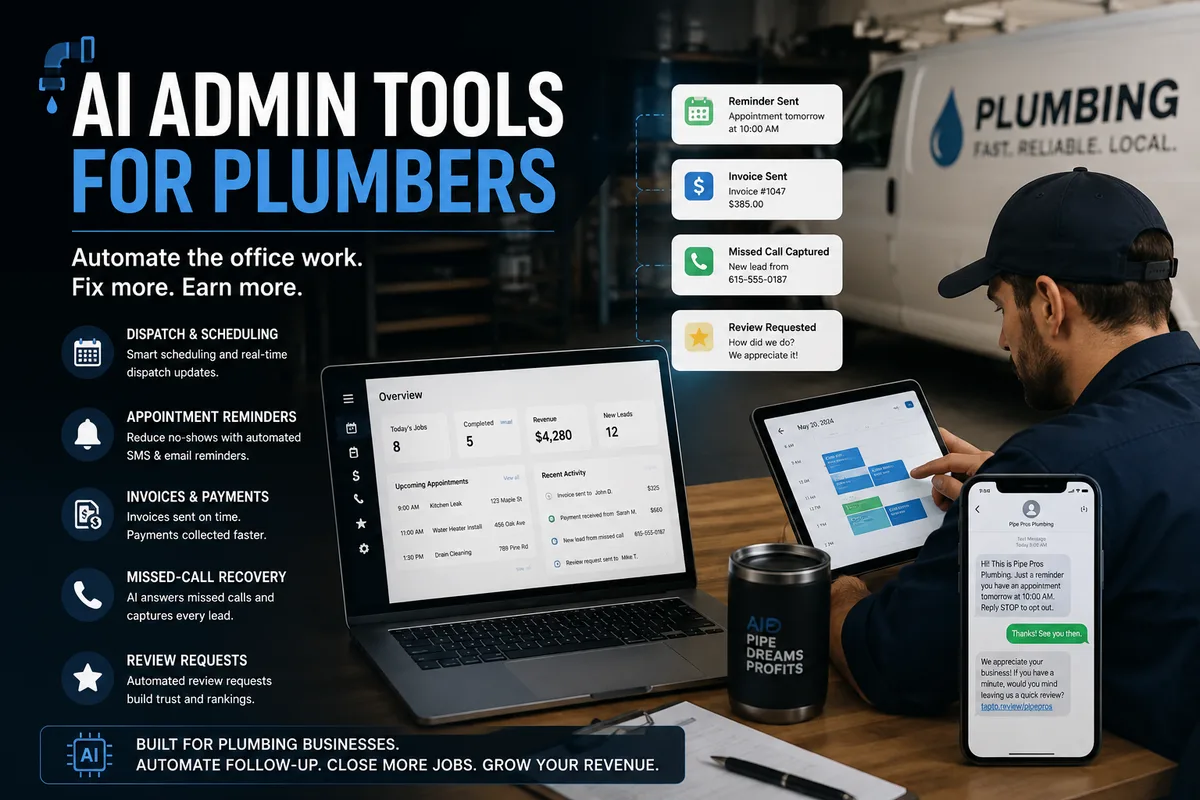
AI Admin Tools for Plumbers: What They Are and How to Choose
AI admin tools automate dispatch, reminders, invoicing follow-up, missed calls, and review requests for plumbers. What they do and how to choose.
Insurance Eligibility Automation for Physical Therapy Clinics
Eligibility automation for physical therapy clinics verifies benefits before the patient arrives, cuts front desk phone work, and can lower claim denial risk.
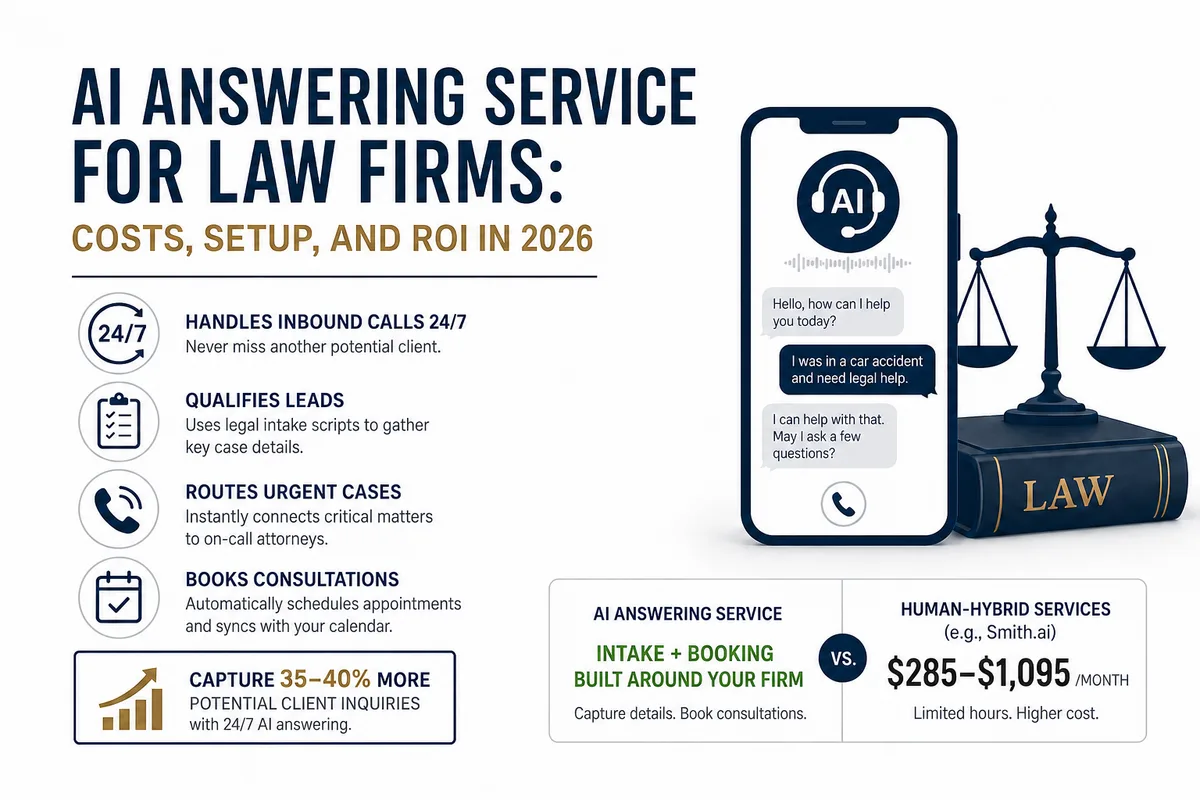
AI Answering Service for Law Firms: Costs, Setup, and ROI in 2026
Law firms miss a large share of inbound calls, most of them after hours. Here's what an AI answering service actually does, what it costs versus human.