
AI Answering Service for Salons: Cost, Setup, and Real ROI in 2026
An AI answering service for salons handles inbound calls around the clock, books appointments directly into scheduling software like Vagaro or Mindbody, answers service and pricing questions, and sends confirmation texts automatically. The cost case depends on your missed-call volume, booking value, integration needs, and how much routine call handling can move out of the front desk.
a large share of salon calls go unanswered during peak hours. Here's what an AI answering service actually does for a salon, what it costs compared to human.
Epiphany Dynamics is an AI automation agency: we help businesses find and fix operational bottlenecks with AI receptionists, lead follow-up, and workflow automation.
Free 30-minute audit. We name at least 3 things you can automate, ranked by impact.
Book a free AI audit
Patrick Gibbs
An AI answering service for salons handles inbound calls around the clock, books appointments directly into scheduling software like Vagaro or Mindbody, answers service and pricing questions, and sends confirmation texts automatically. The cost case depends on your missed-call volume, booking value, integration needs, and how much routine call handling can move out of the front desk.
The Real Cost of Unanswered Calls
Salons miss inbound calls during peak hours when stylists are on the floor and the front desk is stretched thin. Each missed booking can represent real chair revenue, and many callers who reach voicemail never call back. For a busy salon, that quietly becomes a recurring booking leak that does not show up in the normal appointment report.
The problem is mostly invisible. Your booking software shows what booked, not what didn't. When a caller hits voicemail during a Friday rush while your front desk is processing checkouts, that's a clean miss with no paper trail. Smaller shops feel it most because one person is often covering checkout, rebooking, walk-ins, and the phone at the same time.
Run the math on your own numbers instead of trusting a generic benchmark. Take your missed calls, estimate how many would have become bookings, multiply by your average ticket, and compare that against the system's monthly cost and setup effort. The detailed ROI breakdown in what an AI phone agent actually does for a salon walks through the inputs you should use for your own model.
What an AI Answering Service for Salons Actually Does
A properly trained AI answering service answers promptly, identifies the caller's intent (new booking, reschedule, cancellation, pricing question), executes the request inside your scheduling software, and sends a confirmation by text or email. It covers nights, weekends, and the gaps in the day when your staff is occupied with clients on the floor.
The core function is appointment handling. A caller wants to book a balayage on Saturday. The AI checks real-time availability in your scheduling system, offers open slots, collects the client's name and contact info, books the appointment, and sends a confirmation text. No hold time, no callback promise, no "let me check and get back to you."
Beyond bookings, the better platforms handle a fairly wide call surface: service menu questions, current pricing, parking and hours, whether you take walk-ins for a trim. For salons with large menus, this matters more than people initially realize. Stylists lose real chair time every week fielding phone questions from callers who don't end up booking. Routing those calls through an AI layer keeps the chair profitable and the stylist focused on the client in the seat.
One thing worth being clear about: an AI answering service is a coverage tool, not a receptionist replacement. For complex situations (an upset client, a rebooking with multiple service changes, a question about a chemical process), it should hand off cleanly to a human. The systems that handle escalation well are the ones worth paying for. If you want to understand the structural differences between AI platforms and traditional answering services before deciding, the comparison of AI receptionist vs. answering service options lays that out clearly.
AI Answering Service vs. Human Answering Service: The Cost Comparison
Human answering services and AI-native phone platforms usually have different cost patterns. Human services often price around agent time, call handling, and plan tiers; AI systems usually price around platform access, setup complexity, and integrations. Human services handle edge cases and sensitive calls better; AI wins on speed, coverage hours, and consistent execution for routine requests.
| Factor | Human Answering Service | AI Answering Service |
|---|---|---|
| Cost pattern | Plan tier plus usage sensitivity | Platform fee plus setup and integration scope |
| Per-minute billing | Common on most plans | No |
| Coverage pattern | Depends on contract and staffing model | Best for after-hours and overflow coverage |
| Appointment booking | Message-taking or limited integration | Direct calendar integration |
| Response consistency | Variable by agent | Consistent every call |
| Complex or sensitive calls | Handles well | Requires human escalation |
| Call transcripts | Not always included | Typically included |
| Setup effort | Vendor onboarding and scripting | Service-menu, calendar, and escalation training |
Human answering services aren't bad products. If your salon gets a lot of nuanced calls from long-term clients who want to talk through a color correction with a live person, a hybrid setup can make sense. But many inbound salon calls are routine requests: appointment bookings, reschedules and cancellations, pricing and service questions, and basic directions or hours. That routine volume is exactly what AI handles well, and exactly where usage-based billing on a staffed service can become uncomfortable.
Usage-sensitive billing on traditional answering services deserves more scrutiny than it usually gets. Routine booking calls can make the bill climb during promotions, busy seasons, or staffing gaps. AI platforms are often easier to forecast when they use a flatter pricing model, but you still need to include setup, integration, and ongoing tuning in the real cost.
Also covered on the blog: AI Answering Service for Dental Office: Cost, Setup, and ROI in 2026.
What to Look for Before You Sign Up
Before committing to an AI answering service for your salon, confirm it integrates natively with your scheduling software, can be trained on your specific services and pricing, accesses real-time calendar availability (not just static hours), provides full call transcripts, and has a reliable escalation path to a human. Run a live demo call using your actual service menu. That is the only real test.
The scheduling integration is non-negotiable. An AI that can talk but can't actually create a booking in your system is a more expensive voicemail. Confirm whether the platform has a native or API-based connection to your specific software. Vagaro, Mindbody, Booksy, Square Appointments, and GlossGenius cover most of the salon market. Some platforms claim "integration" when they mean they'll take a message and email it to you. That's not integration. Test a live booking during the demo, not a simulated walkthrough.
Call transcripts are underrated in the evaluation process. Every call should produce a readable log you can review. This catches training gaps during the early tuning period. If the AI misquotes your keratin treatment price or gives the wrong availability window, you need to catch that before clients do. The transcript shows you exactly where the breakdown happened. No transcripts means no real way to train the system properly over time.
A few other things worth checking: how it handles after-hours calls specifically, whether there's a dashboard for reviewing call activity, and what the contract structure looks like. Flexible terms are strongly preferable while you're still evaluating fit. For a structured framework on comparing platforms side by side, the AI phone answering tool evaluation guide covers the criteria that matter most for service businesses.
What the Setup Process Actually Looks Like
AI answering services for salons should be treated as a configuration project, not a switch you flip. Setup involves connecting your scheduling software, uploading your full service menu and current pricing, selecting a voice profile, scripting responses for common call scenarios, and running test calls before launch. The quality of the data you provide up front determines how the system performs once live calls start.
The first phase is mostly data collection. You'll hand over your service menu with current pricing, stylist schedules, booking policies, cancellation terms, and FAQ content covering the questions you field most often. The more complete this is upfront, the better the first live calls go. Gaps in the training data produce exactly the kind of AI responses that frustrate callers: vague, non-committal, "let me check on that for you" with no actual resolution.
The next phase is testing. Run every scenario you can construct: a new client booking their first appointment, an existing client rescheduling, someone asking about your balayage pricing, a same-day cancellation request. Push the edges. If the system gets confused by "I want to move my Thursday appointment to next week," you find that in a test call, not a live one with a real client on the line.
The early live period involves the most tuning, and you should expect to submit training corrections based on call transcripts. That's normal, not a sign something went wrong. The phone layer also connects to broader retention outcomes worth understanding. If you want to see how AI-assisted call coverage fits into rebooking rates and long-term client value, the breakdown of how salon automation increases client lifetime value shows where the answering layer fits in the larger picture.
The honest assessment of AI answering services for salons in 2026 is that the technology is genuinely good now in a way it wasn't two or three years ago. The booking integrations work reliably, the voices are natural enough that clients don't always realize they're talking to AI, and the configuration tools have gotten specific enough to handle a real service menu without producing generic, embarrassing responses. The barrier isn't the technology anymore. It's getting the setup right and training it properly on your specific business. For salons that want a configured system built for them rather than a DIY platform to figure out on their own, Epiphany Dynamics builds these setups specifically for service businesses.
Frequently Asked Questions
Q: How much does an AI answering service for salons cost compared to hiring a receptionist?
Compare the total platform fee, setup work, integration needs, contract terms, and expected call volume against the cost of staffing or outsourcing the phone. The best answer depends on how many booking calls are currently leaking and how much of that routine volume can be handled without a human.
Q: Will an AI answering service integrate directly with Vagaro, Mindbody, or my current booking software?
Yes, modern AI answering services integrate directly with major scheduling platforms like Vagaro and Mindbody, allowing the system to check availability and book appointments automatically without manual entry. Without this integration, the service simply transfers calls to your staff, defeating the purpose of always-on automation and appointment capture.
Q: How much revenue could an AI answering service recover if my salon misses calls?
Use your own call logs and average ticket instead of a generic benchmark. Estimate missed calls, likely booking rate, average service value, and how much of that volume the AI can resolve without staff help. That gives you a practical recovery range tied to your salon instead of a made-up industry average.
Q: Can an AI system really handle rescheduling and service questions, or does it transfer most calls to humans?
Well-configured AI systems can handle routine inbound calls independently, including rescheduling requests, pricing questions, and new bookings. Complex calls, like escalated complaints or unusual requests, transfer to your team, ensuring difficult situations get human attention while your front desk stays focused on in-salon work.
Patrick Gibbs
AI Automation Expert
Patrick Gibbs helps professional practices implement AI automation that captures more leads, books more appointments, and scales without adding overhead. He's the founder of Epiphany Dynamics and creator of the AI Front Desk system.
Related Solutions
Build this into a real workflow
Related Posts
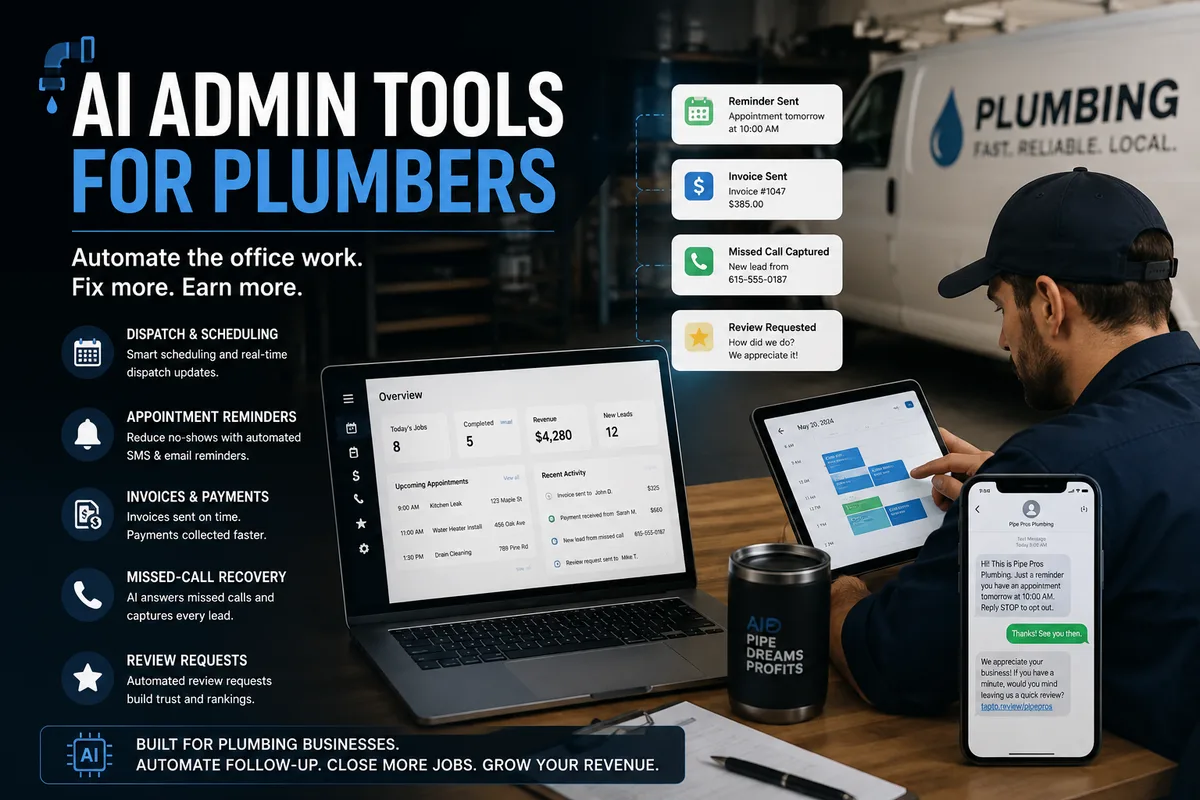
AI Admin Tools for Plumbers: What They Are and How to Choose
AI admin tools automate dispatch, reminders, invoicing follow-up, missed calls, and review requests for plumbers. What they do and how to choose.
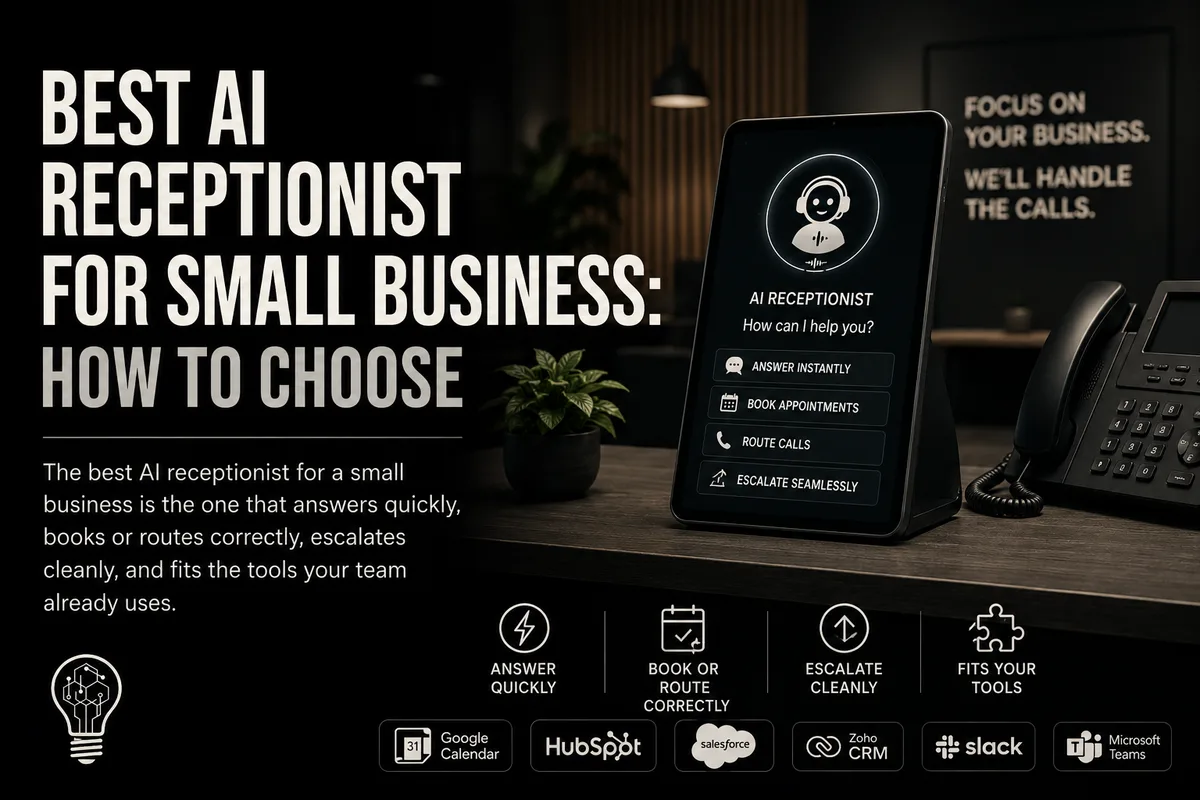
Best AI Receptionist for Small Business: How to Choose
The best AI receptionist for a small business is the one that answers quickly, books or routes correctly, escalates cleanly, and fits the tools your team.
Insurance Eligibility Automation for Physical Therapy Clinics
Eligibility automation for physical therapy clinics verifies benefits before the patient arrives, cuts front desk phone work, and can lower claim denial risk.