
After Hours Answering Service Jobs: What's Changed in 2026
After hours answering service jobs in 2026 fall into four categories: live call agents, dispatch coordinators, virtual receptionists, and AI oversight specialists. AI systems now handle much of the routine after-hours call work, while human roles concentrate around judgment, escalation, compliance, and quality control.
Unanswered after-hours calls quietly drain serious revenue from service businesses. This guide covers what the jobs pay, what AI has automated, and how to.
Epiphany Dynamics is an AI automation agency: we help businesses find and fix operational bottlenecks with AI receptionists, lead follow-up, and workflow automation.
Free 30-minute audit. We name at least 3 things you can automate, ranked by impact.
Book a free AI audit
Patrick Gibbs
After hours answering service jobs in 2026 fall into four categories: live call agents, dispatch coordinators, virtual receptionists, and AI oversight specialists. AI systems now handle much of the routine after-hours call work, while human roles concentrate around judgment, escalation, compliance, and quality control. Pay and business pricing vary by market, role, and call complexity, so current listings and vendor quotes matter more than stale benchmark ranges.
Missing an after-hours call isn't just an inconvenience, and understanding the real cost of those missed calls changes the math entirely. For a service business, it's often a lost job to a competitor who did pick up. The after hours answering service industry exists to close that gap, and in 2026 it looks very different from the call center operations that defined it a decade ago. AI has reshuffled both the worker side and the operator side of this market in ways that aren't immediately obvious from a simple Google search.
This article covers what after hours answering service jobs actually involve, what businesses pay for different tiers of coverage, how AI has changed the economics for both workers and business owners, and how to choose the right coverage for a real business with real stakes.
What After Hours Answering Services Actually Do
After hours answering services handle inbound calls when a business is closed, covering message-taking, appointment scheduling, emergency dispatch, and lead capture. Work complexity ranges from basic message relay to emergency dispatch for medical and plumbing practices. In 2026, AI handles routine call volume while human agents concentrate on complex, high-stakes, or emotionally sensitive calls.
The core function is straightforward: the phone gets answered. What happens next depends entirely on the industry. A plumbing company needs emergency dispatch logic, someone who can assess whether a burst pipe requires an immediate on-call response or can wait until morning. A medical practice needs HIPAA-compliant message capture and clinical triage. A law firm needs intake that qualifies whether an after-hours callback request is a genuine prospect. None of these are the same job, even though the job title might read the same on a hiring board.
This is why the after hours answering service market fragments into specialized verticals rather than consolidating into one generic service. Medical answering services operate under strict compliance frameworks. Legal answering services train agents on intake qualification scripts specific to practice areas. Home services dispatch coordinators learn the practical difference between "I smell gas" and "my faucet has been dripping for a week." The scripted empathy part is trainable. The industry judgment is harder.
Most established answering service companies maintain accounts across multiple industries simultaneously. A typical live agent switches between many business accounts per shift, moving from a dental practice protocol to a plumbing emergency dispatch script without much warning. That context-switching ability is what separates agents with low turnover from ones who wash out early.
The Real Cost of Missing After Hours Calls
A service business with steady after-hours call volume can leak significant revenue when those calls roll to voicemail. The right coverage choice depends on call complexity, average job value, escalation risk, and how quickly missed callers move to a competitor.
Most business owners underestimate this number because they only count the voicemails they know about, not the callers who hung up and called the next result on Google. Here's the formula worth running on your own numbers:
- After-hours calls missed
- Estimated booked-job rate if answered
- Average job value
- Missed-call exposure: missed calls x booked-job rate x average job value
- Compare that exposure against the vendor quote for after-hours coverage
That's a planning baseline. HVAC companies during a heat wave, water restoration companies fielding freeze calls in January, dental practices handling after-hours tooth pain: these businesses can see large overnight call spikes during peak season. The annual revenue loss at that scale is large enough to justify a dedicated coverage solution with room to spare.
Many small businesses still rely on voicemail because of cost uncertainty ("what if nobody calls?") or bad past experiences with answering services that delivered garbled messages or missed critical calls. Both concerns are real. But the cost structure has changed enough that the question is harder to dismiss. The right comparison is no longer "answering service or nothing." It is "coverage matched to call complexity, with human backup where failure would be expensive."
Jobs in the After Hours Answering Service Industry
After hours answering service jobs include live call agents, dispatch coordinators for industries like HVAC and medical, virtual receptionists, and AI oversight specialists managing automated systems. The work is remote-friendly, often part-time or overnight, and rarely requires a degree. AI has reduced some routine live-agent demand while creating new specialist roles in oversight, QA, and escalation management.
The live call agent role has been the backbone of this industry for decades. Pay reflects overnight hours, volume pressure, specialization, training, and certifications. The work itself is less glamorous than any job posting makes it sound. You're on a headset for long shifts, toggling between client accounts, reading from scripts, and making quick decisions about call urgency when everyone else is asleep. People who are good at it tend to be methodical, patient, and good at reading tone.
Dispatch coordinator is a genuinely different skill set. You're not just logging messages. You're making judgment calls: does this water leak qualify for emergency dispatch or morning service? Does this patient's symptom warrant waking the on-call physician? These roles pay more because the cost of getting it wrong is higher. They've been relatively resistant to AI displacement for exactly that reason.
| Role | Pay Profile | Core Skills | 2026 Trend |
|---|---|---|---|
| Live Call Agent | Entry-level; check current listings | Script adherence, multitasking, calm under volume | Declining |
| Dispatch Coordinator | Higher when dispatch judgment is required | Industry knowledge, urgency assessment | Stable |
| Virtual Receptionist | Varies with scheduling and CRM responsibility | Scheduling tools, CRM, appointment management | Stable |
| AI Oversight Specialist | Often higher than script-only call work | AI tools, QA processes, escalation handling | Growing fast |
The AI oversight specialist role is where actual hiring growth is happening right now. These workers review call transcripts, identify cases where the AI made a wrong routing decision, update scripts and knowledge bases, and handle escalations when callers refuse to engage with an automated system. Critically, it's asynchronous work, which makes it genuinely flexible in a way that live agent work never was. The pay premium reflects both the technical competency required and the fact that the pool of qualified candidates is still relatively small.
For more on this area, see AI Answering Service for Restaurants: What to Compare in 2026.
How AI Has Changed After Hours Coverage in 2026
AI voice agents in 2026 handle appointment scheduling, lead qualification, FAQ responses, and emergency keyword routing with high reliability on structured calls. Telephone operator work has shifted as automation absorbed routine call handling. AI coverage often prices differently from live human coverage, but still falls short on emotionally complex, clinically sensitive, or legally nuanced calls.
The improvement in AI voice quality has been significant enough to change the business case in ways that weren't plausible before. Early AI answering systems sounded robotic, stumbled over accents, and derailed when callers went off-script. Current systems handle natural conversation including interruptions, clarifying questions, and casual speech patterns without losing the thread. The gap between "talking to AI" and "talking to a human" on a routine call is now narrow enough that many callers don't notice or, frankly, don't care. They got their appointment booked and moved on with their night.
What AI handles well in 2026: message capture, lead information intake, appointment scheduling, pricing and hours FAQs, emergency keyword routing to on-call staff. Our guide on how voice AI handles after-hours emergency calls covers the triage architecture in detail. A well-configured AI voice agent can handle routine after-hours call volume for a home services company with limited human involvement. That share improves as these systems accumulate more call data specific to each business. It's genuinely impressive, and worth acknowledging that it's also changed the entry-level answering service labor market.
What AI still misses: callers who are upset or frightened, situations requiring empathy beyond scripted acknowledgment, complex clinical assessment, legal intake requiring case merit judgment. A plumber's emergency line can lean heavily on AI when escalation is clean. A crisis mental health line should not. The practical result for the industry is that entry-level live agent jobs have declined while specialized dispatch and oversight roles have held steady or grown. Workers who adapted toward technical oversight kept their place in the market. Workers who stayed purely in scripted live calling found fewer and fewer hours available.
Choosing the Right After Hours Coverage for Your Business
Call complexity, not call volume alone, should drive after-hours coverage decisions. Routine message-taking and appointment requests may be a fit for AI coverage. Medical, legal, and emergency dispatch workflows usually need live-agent backup or hybrid coverage. Any call type where a wrong answer carries serious consequences warrants human backup regardless of how rarely those calls come in.
The most common mistake when evaluating after hours services is treating them like a commodity purchase and comparing per-minute rates without thinking through what a failed call actually costs. Before committing to any service, pull recent voicemail records. Count how many after-hours calls came in, what share needed a real response versus basic information, and how many callers left no message at all. That last number is your invisible leak: calls that went completely unanswered, callers who moved on without a trace.
For most service businesses, an AI system with a clean human escalation option covers routine scenarios at a fraction of full live coverage cost. The escalation path is what separates a serviceable setup from a liability. If a caller explicitly asks for a human, or triggers a specific keyword (water damage, emergency, chest pain, lawyer), the system should route immediately to a live operator or on-call staff. An AI system with no escalation path will eventually fail a caller who needed more than it could give.
| Business Type | Call Complexity | Recommended Coverage | Cost Check |
|---|---|---|---|
| HVAC, plumbing, electrical | High (emergency dispatch) | AI + live escalation | Vendor quote based on escalation rules |
| Dental, optometry | Medium (urgent triage) | AI + on-call paging | Vendor quote based on urgent-call workflow |
| Law firm | High (sensitive intake) | Specialized live agent | Specialized service quote |
| Restaurant, retail | Low (hours, reservations) | AI only | Basic coverage quote |
| Medical practice | Very high (clinical triage) | Medical answering service | Compliance-aware service quote |
One underrated factor in this decision is what happens when the system gets it wrong. AI and live agents both make mistakes. The question is which type of failure is more recoverable for your specific business. A missed appointment confirmation is annoying but fixable. A delayed emergency dispatch can be a liability. Build your coverage tier around your highest-stakes call type, not your most common one. Those two things are often different.
The after hours answering service market in 2026 offers more options at better price points than at any point in its history. AI has compressed costs at the lower-complexity end, while specialized human services have held pricing for complex verticals where the stakes justify it. For a business owner seriously evaluating coverage options, the question is no longer whether coverage exists. It is whether the cost of staying uncovered is higher than a right-sized coverage plan. The 2026 voice AI adoption data shows service businesses are answering that question with their wallets. Companies like Epiphany Dynamics are building AI voice systems specifically for small service businesses that want this coverage without the overhead of traditional answering service contracts.
Explore how which AI tools replace phone reception fastest compares deployment timelines. See also our breakdown of AI front desk costs and how the technology works. For pricing details across platforms, check our AI secretary cost guide for 2026.Frequently Asked Questions
Q: How much do after hours answering service jobs pay in 2026?
Pay varies significantly by role and responsibility level. Live call agents are usually closer to entry-level call-center work, while dispatch coordinators, virtual receptionists, and AI oversight specialists tend to command more when they require industry judgment, scheduling software fluency, compliance awareness, or escalation responsibility. Use current job listings in your market for exact ranges.
Q: How much does it cost a business to outsource after hours call handling?
Cost depends on call complexity, expected volume, industry, escalation rules, and whether the service is AI-only, human-only, or hybrid. Routine message-taking and basic routing usually price differently from medical, legal, and emergency dispatch coverage. Get vendor quotes against your actual call logs instead of comparing generic package tiers.
Q: What's the difference between AI and human after hours answering services?
AI systems now handle a large share of routine after-hours call volume (basic message-taking, appointment scheduling, and call routing), while human agents focus on complex, high-stakes, or emotionally sensitive calls requiring judgment. Most service businesses use hybrid models that combine both, using AI to reduce costs while keeping human agents available for escalations and specialized handling.
Q: Which businesses benefit most from after hours answering services?
Medical practices, dental offices, plumbing companies, and emergency dispatch services rely most heavily on after-hours coverage because they handle time-sensitive calls that directly impact revenue and patient care. Any service business that loses customers when calls go unanswered, especially those handling emergency requests or appointment-critical workflows, should model after-hours answering against its actual call logs and average job value.
Patrick Gibbs
AI Automation Expert
Patrick Gibbs helps professional practices implement AI automation that captures more leads, books more appointments, and scales without adding overhead. He's the founder of Epiphany Dynamics and creator of the AI Front Desk system.
Related Solutions
Build this into a real workflow
Related Posts
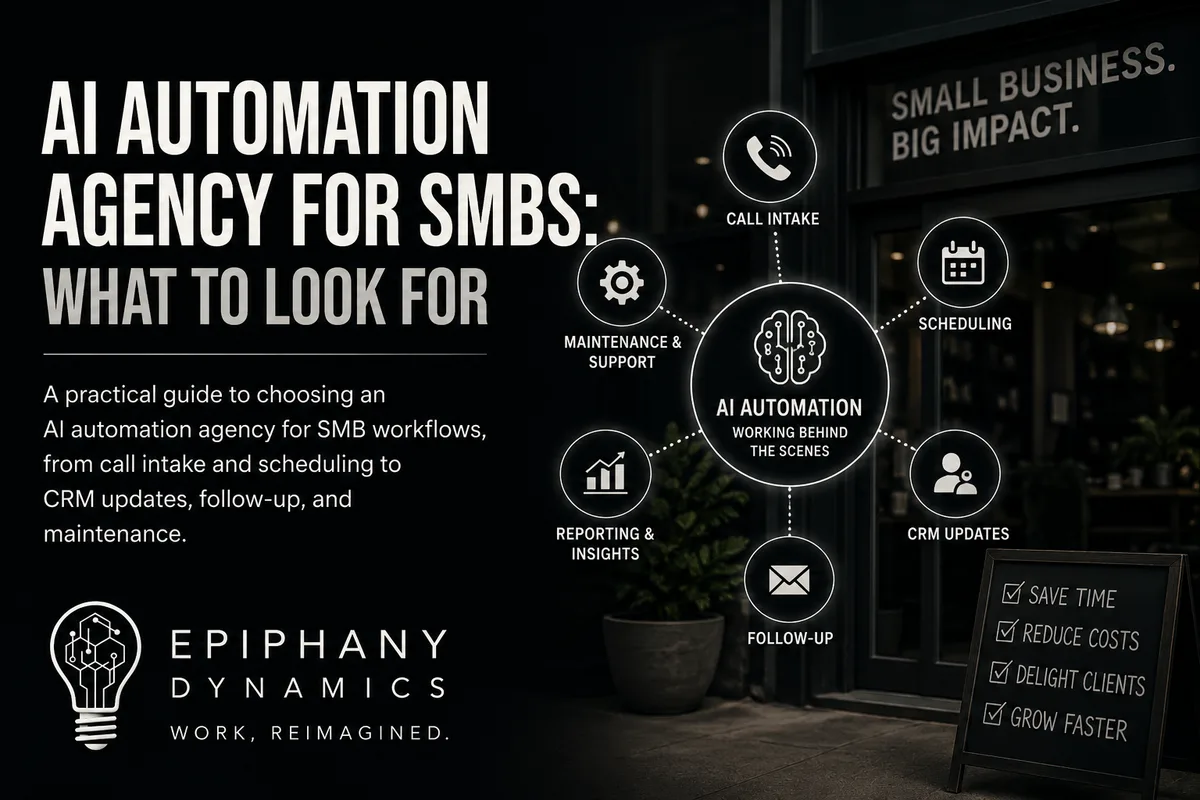
AI Automation Agency for SMBs: What to Look For
A practical guide to choosing an AI automation agency for SMB workflows, from call intake and scheduling to CRM updates, follow-up, and maintenance.
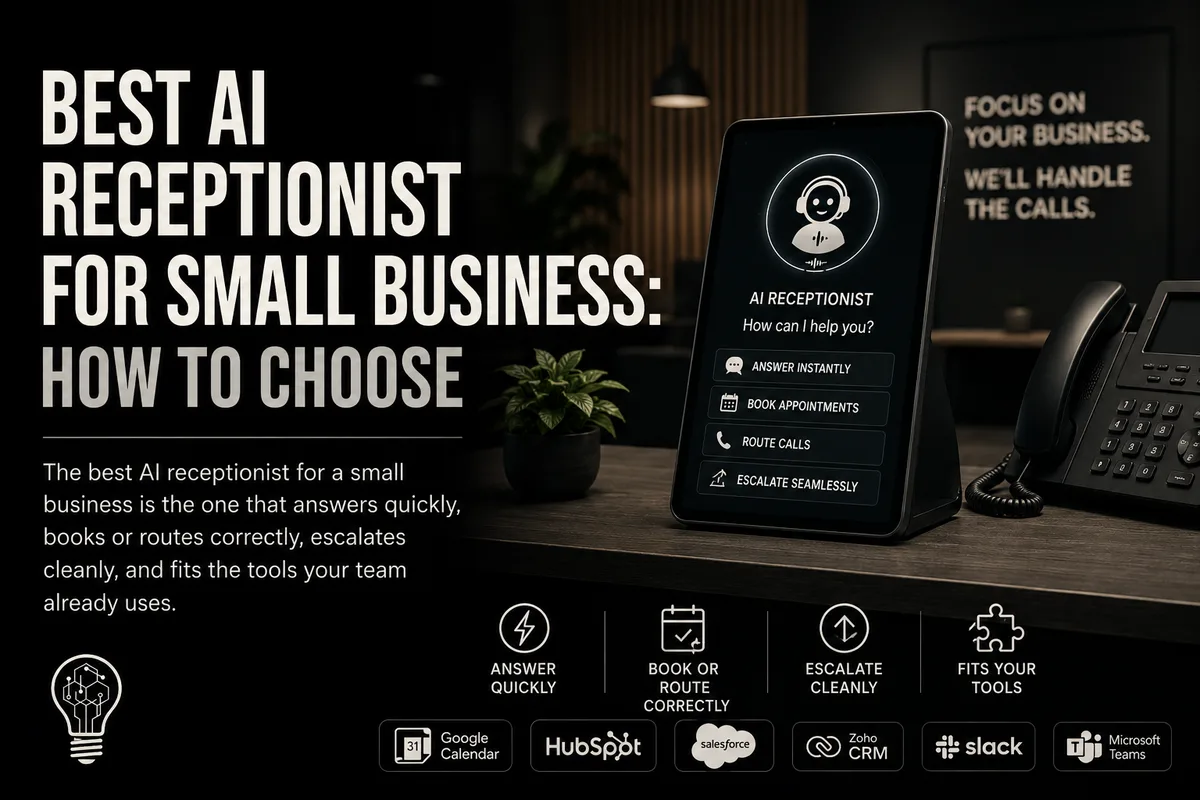
Best AI Receptionist for Small Business: How to Choose
The best AI receptionist for a small business is the one that answers quickly, books or routes correctly, escalates cleanly, and fits the tools your team.
Appointment Reminder Automation for Small Business (2026 Guide)
For a service business with a meaningful no-show rate, the revenue leak is worth measuring. This guide covers how reminder automation works, which tools to.