
Voice AI in 2026: The Real Adoption Pattern for Service Businesses
Small service businesses miss a large share of their inbound calls, and in 2026, voice AI has crossed the reliability threshold where operators can treat it as a practical coverage layer rather than a demo. The global conversational AI market is growing fast, but the more telling signal is that service businesses (HVAC, plumbing, dental, med spa) are leading SMB adoption because their call patterns are low-variance and the value case is direct.
A large share of calls to small service businesses goes unanswered. Voice AI is now reliable enough to fix that. Here's what adoption actually looks like in.
Epiphany Dynamics is an AI automation agency: we help businesses find and fix operational bottlenecks with AI receptionists, lead follow-up, and workflow automation.
Free 30-minute audit. We name at least 3 things you can automate, ranked by impact.
Book a free AI audit
Patrick Gibbs
Small service businesses miss a large share of their inbound calls, and in 2026, voice AI has crossed the reliability threshold where operators can treat it as a practical coverage layer rather than a demo. The global conversational AI market is growing fast, but the more telling signal is that service businesses (HVAC, plumbing, dental, med spa) are leading SMB adoption because their call patterns are low-variance and the value case is direct. This piece covers where the market stands in 2026, why service businesses are out front, and how to build the business case with your own call data.
Small service businesses miss a large share of their inbound calls. For a mid-size HVAC company, that gap isn’t an abstraction. It’s jobs going to whatever company picked up the phone.
Voice AI didn’t create this problem. In 2026, it’s finally cheap and reliable enough to address it at scale. Home service contractors are leading adoption because their call patterns and seasonality make the ROI impossible to ignore. The question most business owners are asking isn’t whether voice AI is growing. That’s obvious. The real question is why service businesses are leading adoption faster than almost any other sector, and whether the business case holds up once you put your own numbers on it.
Where the Market Stands in 2026
The global conversational AI market is a multibillion-dollar space that keeps growing quickly year over year. That’s a broad category covering enterprise chatbots, legacy IVR systems, voice assistants, and everything in between.
The more relevant slice is voice AI specifically deployed for inbound call handling at small-to-mid service businesses. That sub-market is harder to measure from the outside, but the vendor landscape tells the story: platforms like Synthflow, Bland AI, Retell AI, and vapi.ai are all building for this segment, and service businesses (HVAC, plumbing, dental, landscaping, med spa) make up a disproportionate share of the deployments they target relative to their overall size in the market.
Two things converged to make 2026 the inflection point. Response latency dropped to a usable threshold, so better platforms now feel much closer to natural conversation than the earlier generation of voice bots. Pricing also crossed a psychological line: voice AI stopped being framed as a technology experiment and started being evaluated against staff coverage, missed-call risk, and scheduling workload.
Why Service Businesses Are Leading Adoption
The reason service businesses are out front comes down to the nature of inbound calls. When someone calls an HVAC company, they’re doing one of a handful of things: scheduling service, reporting an emergency, asking about pricing, or following up on an existing job. The call has low variance. A voice AI trained on real service calls can handle routine intent without forcing every caller into a human queue.
Compare that to a law firm or financial advisory, where caller intent is highly variable, emotional stakes are high, and the wrong phrasing in the wrong context creates real liability. Voice AI will reach those industries. It isn’t production-ready for most of them today in a way that operators would stake their reputation on.
Service businesses also face a workforce problem that makes voice AI more compelling on a practical level. Finding reliable front desk and administrative staff is genuinely difficult in most markets. Turnover runs high, training costs time, and coverage gaps during evenings, weekends, and lunch windows leave money on the floor. Most callers won’t leave a voicemail if a call goes unanswered. For a landscaping company during spring quoting season, a missed call isn’t a callback opportunity. It’s a lost job.
The phone-level data on voice AI adoption in small businesses quantifies exactly how much revenue leaks through unanswered phones. After-hours call volume tends to be underestimated. A meaningful share of service business calls arrives outside standard business hours when no one is staffed to answer. That isn’t edge-case traffic. It’s a structural revenue leak that most businesses have simply accepted as unavoidable.
The Value Case
Front desk coverage at a service business includes salary, benefits, payroll taxes, onboarding time, PTO coverage, and management attention. It usually covers business hours, does not flex cleanly during call spikes, and leaves evenings or weekends exposed unless the business pays for additional coverage.
Voice AI should be evaluated against that full coverage problem, not just against a subscription line item. But the cost savings argument is not actually the most compelling part of the business case.
The stronger argument is incremental revenue from calls and appointments that would otherwise be lost. A dental practice can use its own appointment history, no-show patterns, and reminder workflow to estimate the value of better confirmation and rescheduling. Model the voice AI cost against your own schedule and call logs before accounting for new patient booking or any front desk labor savings.
| Business Type | Primary Voice AI Use | Primary Value Driver |
|---|---|---|
| HVAC Company | After-hours emergency booking | Urgent calls reach the booking workflow instead of voicemail |
| Dental Practice | Appointment reminders, rescheduling | More consistent confirmation and rescheduling follow-up |
| Med Spa (single location) | Inbound inquiry handling, booking | Routine booking questions move out of staff queues |
| Landscaping Company | Quote requests, seasonal scheduling | Seasonal quote requests get captured during peak demand |
Your actual numbers will vary based on call volume, average ticket size, and how well the AI is configured. The pattern across deployments is consistent: the primary value driver is after-hours call capture, followed by labor cost reduction.
Where Voice AI Works and Where It Doesn’t
“I need to schedule a carpet cleaning for next Thursday” is handled cleanly by any competent voice AI platform in 2026. “I want to understand whether my warranty covers the motor or just the drum assembly” is not. That distinction matters, and businesses that deploy without mapping their actual call mix end up with frustrated callers and reviews that say things like “why can’t I speak to a real person.”
The successful deployments share one characteristic: a clear call routing decision was made before launch. Identify the calls that are genuinely routine and map those to the AI. The rest should reach a human quickly and without friction. The failure mode is attempting to automate everything, discovering the hard way that some calls require judgment the AI doesn’t have, and then pulling the whole system after reviews deteriorate.
Demographics matter more than most businesses expect. Some callers have lower tolerance for automated voice systems regardless of quality. This is a spectrum, not a wall: plenty of older callers handle it fine. But if your customer base skews older (home care, certain medical practices, estate services), your transfer rate will be higher and needs to be built into your coverage model. The fix is straightforward: a low-friction human handoff option and a live person actually available when that happens.
On integration: most service businesses expect this requires a technical overhaul. It usually doesn’t. Major scheduling platforms including Acuity, Jane, ServiceTitan, Jobber, and Mindbody have API connections through the leading voice AI platforms. Clean integration is much easier when the call flow is documented before development starts. The time gets wasted when businesses start building without having recorded and analyzed their actual calls first.
For further reading, see Can AI Replace a Secretary? What Service Businesses Need to Know in 2026.
A Practical Implementation Approach
Start with outbound before you touch inbound. Appointment reminders and confirmation calls are the lowest-risk entry point for voice AI in any service business. Stakes are lower, the call flow is predictable, and the value shows up as cleaner scheduling data and fewer avoidable appointment gaps. Once you have real internal proof that the technology works, the decision to expand to inbound is much easier to make and easier to get buy-in for across your organization.
For a deeper look at what these systems can actually handle on business calls in 2026, the capabilities have advanced well past the demo stage. Record actual calls before you build anything. Most businesses skip this step and it costs them troubleshooting time after launch. Your call transcripts tell you exactly what phrases your specific callers use, which edge cases come up regularly, and where handoffs to humans actually need to happen. A voice AI trained on your real call data handles ambiguity better than one built from generic industry templates.
Track the right metrics from day one. Booking rate on AI-handled calls, transfer rate to live agents, and caller abandonment rate. “Did callers like it” is too vague to act on. Compare AI-handled calls against human-handled calls after the system has enough real call volume to show a pattern. If performance is weak, something specific in the call flow is broken and you need to find it. Common culprits are ambiguous date handling, missing fallback logic for services the AI wasn’t trained on, and integration gaps with the scheduling system.
Voice AI adoption in service businesses in 2026 is moving for straightforward reasons. The labor market for front desk and administrative roles hasn’t gotten easier. The technology has gotten better and cheaper. Those two curves crossed somewhere around 2025, and the businesses gaining ground right now aren’t necessarily larger or more sophisticated than their competitors. They’re just the ones that decided their missed-call rate was actually worth solving. If you’re running that same analysis for your operation, AI automation agencies that specialize in service business deployments, including Epiphany Dynamics, can significantly compress the time from decision to live system.
For a buying decision, use the small-business voice agent guide and receptionist acceptance checklist. Adoption trends don't establish whether a particular system can handle your calls.
Frequently Asked Questions
Q: What percentage of small service business calls go unanswered?
Small service businesses miss a large share of their inbound calls. After-hours and weekend calls make up much of that volume for most service businesses, and most callers who reach voicemail don’t leave a message.
Q: What made the recent inflection point for voice AI adoption in service businesses?
Two curves crossed simultaneously: response latency dropped close enough to human pacing that many callers no longer experience the tool as broken, and pricing moved into a range where the comparison becomes “voice AI versus part-time hire” rather than “technology experiment.” Those changes are why service businesses are taking the category seriously now.
Q: What is the strongest ROI case for voice AI in a specific service business vertical?
HVAC companies show the clearest ROI because emergency and after-hours calls often represent active buying intent. Dental practices show strong value through no-show reduction, confirmation calls, and new patient booking. In both cases, the strongest estimate comes from your own call logs and schedule data rather than a generic vertical benchmark.
Q: What percentage of calls should be handled by voice AI versus transferred to a human?
For most service businesses, a large share of inbound call intent is genuinely routine: scheduling, pricing, status checks, confirmations. These are AI-ready. The rest involve complaints, complex situations, or callers who explicitly want a human. The failure mode is attempting to automate everything, discovering the hard way that some calls require judgment the AI doesn’t have, and then pulling the whole system down. Design the human handoff before deployment, not after the first complaint.
Q: How should a service business implement voice AI to maximize results?
Start with outbound (appointment reminders and confirmation calls) before touching inbound: lower risk, simpler workflow, and faster internal proof that the technology works. Record actual inbound calls before building anything. Your transcripts tell you exactly what phrases your callers use, which edge cases appear regularly, and where human handoffs actually need to happen. Track booking rate on AI-handled calls versus human-handled calls as your primary success metric from day one.
Patrick Gibbs
AI Automation Expert
Patrick Gibbs helps professional practices implement AI automation that captures more leads, books more appointments, and scales without adding overhead. He's the founder of Epiphany Dynamics and creator of the AI Front Desk system.
Related Solutions
Build this into a real workflow
Related Posts
Best AI Receptionist for Small Business: How to Choose
The best AI receptionist for a small business is the one that answers quickly, books or routes correctly, escalates cleanly, and fits the tools your team.
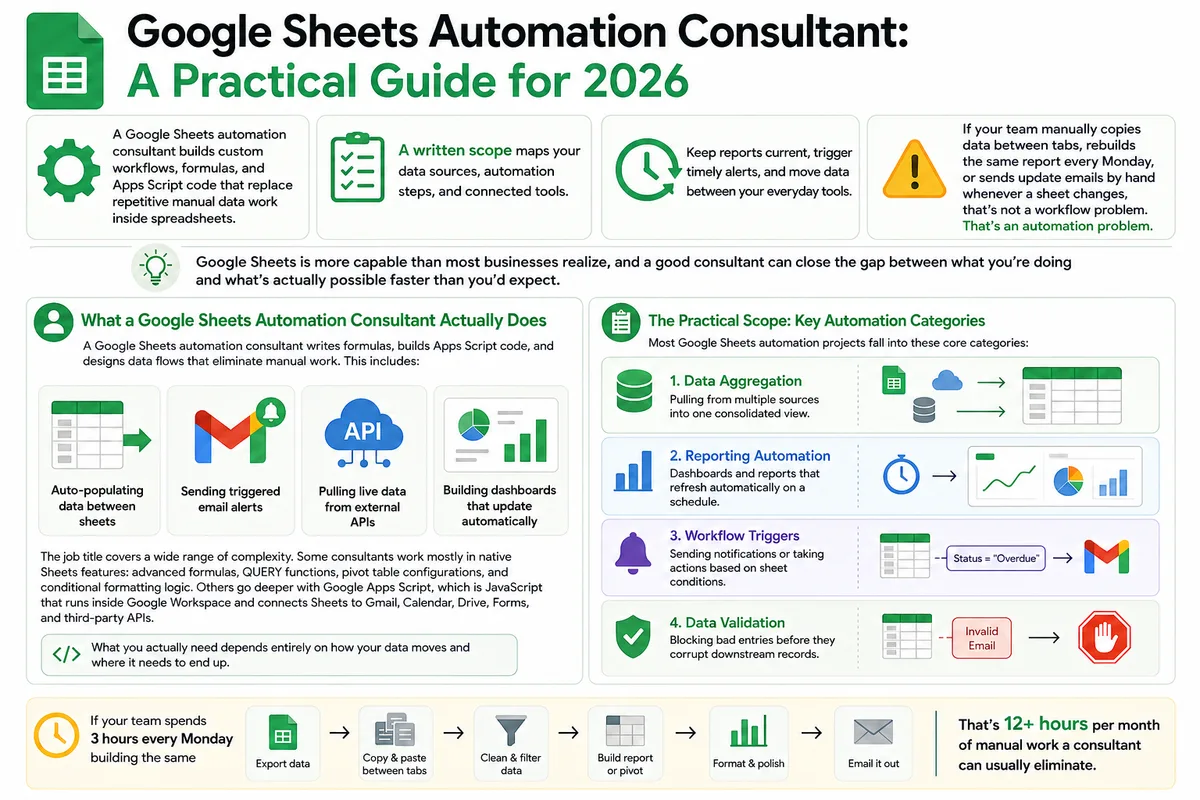
Google Sheets Automation Consultant: A Practical Guide for 2026
Most businesses don't track what spreadsheet work actually costs them. Here's what a Google Sheets automation consultant does in 2026, how to judge the value.
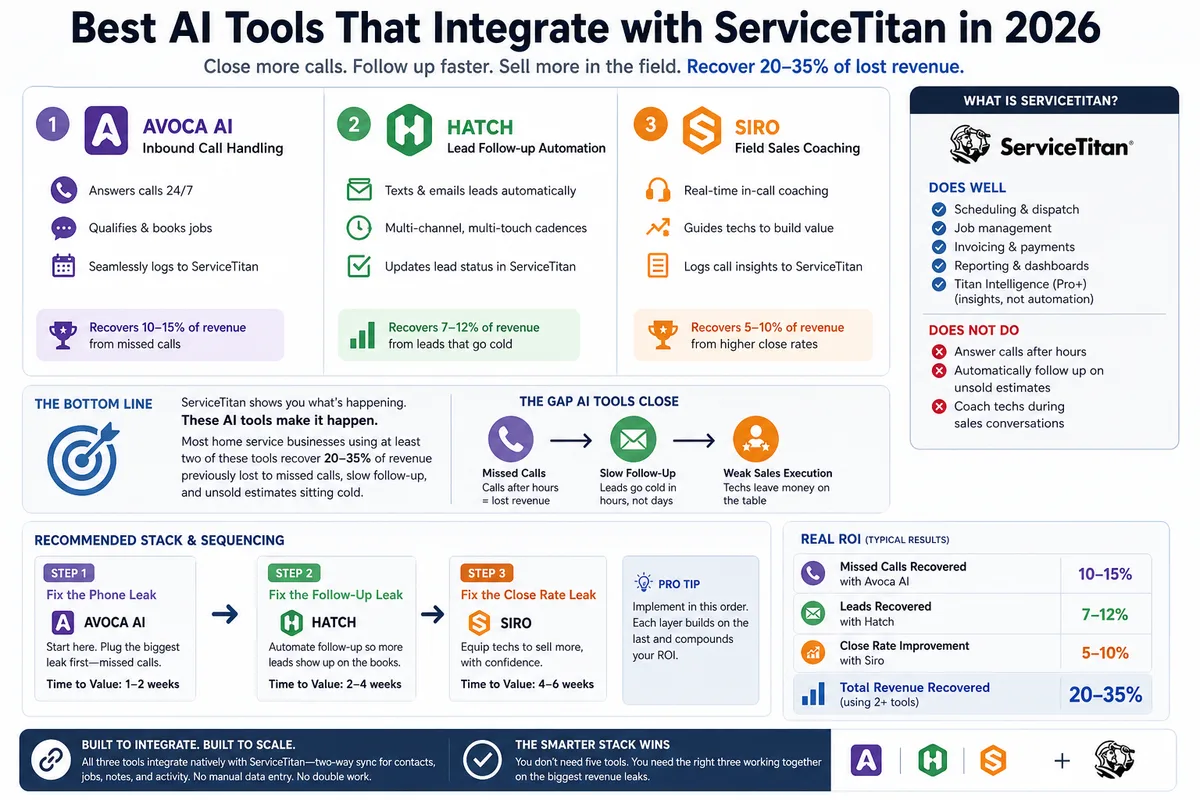
Best AI Tools That Integrate with ServiceTitan in 2026
Most ServiceTitan shops miss a meaningful share of inbound calls and leave most estimates unsold. These AI tools close those gaps inside ServiceTitan.