
Industry Guides
AI Automation for Insurance Agencies: Complete Guide
AI automation for insurance agencies helps agents respond to leads faster, handle policy inquiries, automate renewals, and reduce administrative work.
The free 30-minute AI Operations Audit is a conversation about a normal week in your business and where the work piles up. We find the one change that would give you the most time back and send you a plain-English plan for it. No forms and no pitch.
Book a free AI audit
Patrick Gibbs
AI automation for insurance agencies captures and responds to inbound leads quickly, handles routine policy service inquiries, sends renewal reminders, and reduces repetitive administrative work. Voice AI can answer calls around the clock, chatbots can qualify web leads, and automated workflows can route policy changes without forcing an agent to touch every request. The business case depends on lead volume, service workload, renewal process, and CRM integration depth.
Insurance agents spend a disproportionate amount of their time on administrative tasks: answering the same coverage questions repeatedly, processing policy changes, sending renewal reminders, and following up with leads. Each hour spent on these tasks is an hour not spent selling, building relationships, or growing the book of business. AI automation handles these repetitive tasks so agents can focus on what they do best.
Why Insurance Agencies Need AI Automation
The insurance industry runs on speed. When a prospect requests a quote, the agent who responds first often wins the business. Yet many agencies respond to web leads slowly, put callers on hold during busy periods, and leave existing clients waiting for policy changes because the service team is overwhelmed.
AI automation addresses all of these gaps. An AI phone system answers promptly, qualifies the lead, and either schedules a callback or transfers to an agent. A website chatbot captures quote requests after hours, collects the necessary information, and passes it to the right agent. Automated workflows process policy changes, endorsement requests, and ID card issuance without requiring a human to touch every routine step.
Agencies that implement these tools consistently report higher close rates, better client satisfaction scores, and reduced staff turnover because team members spend their time on meaningful work rather than repetitive tasks. See our AI receptionist for insurance page for more on how phone automation works specifically for agencies.
The Core Automation Stack for Insurance Agencies
AI Phone Answering and Call Routing
Voice AI handles inbound calls with your agency name, collects caller information, and identifies the purpose of the call. For new business calls, it captures lead details and schedules a callback with the appropriate agent. For service calls, it can process policy changes, issue ID cards, or transfer to a licensed service representative. After hours, it captures every call that would otherwise go to voicemail.
Lead Capture and Response Automation
Web leads, social media inquiries, and referral submissions trigger immediate automated responses. The system texts or emails the prospect, acknowledges their request, and provides next steps. If the prospect fills out a quote form, the AI can pre-qualify them and route to the right agent based on line of business, territory, or expertise.
Renewal and Retention Automation
Automated renewal reminders go out 60, 30, and 7 days before policy expiration via text, email, or phone call. Clients can confirm renewal, request changes, or ask questions through an automated conversation. Lapsed policies trigger re-engagement sequences designed to win back business before it is gone permanently.
Service Request Automation
Policy changes, endorsement requests, and billing inquiries are handled through self-service automation. Clients interact with an AI assistant that can process common requests, update contact information, issue proof of insurance, and answer coverage questions. Complex requests are escalated to the appropriate team member.
Real-World Example: How an Independent Agency Transformed Operations
An independent insurance agency in Tennessee was receiving heavy call volume during open enrollment periods. Their team could answer only part of that volume. The rest went to voicemail, and many callers never left a message. The agency could see from its phone logs that unanswered calls were turning into a real new-business leak.
After implementing an AI phone system integrated with their CRM, more callers reached a structured intake path instead of voicemail. The system captured personal lines and commercial quote requests, routed them to the appropriate agent based on expertise, and sent confirmation texts. The important measurement was not a generic benchmark; it was whether more qualified leads reached the right agent before the prospect moved on.
Tools to Build Your Insurance Automation Stack
AI Phone Systems: Voice AI platforms that integrate with insurance CRMs like Applied Epic, Sagitta, or AgencyBloc handle the call-answering layer. These systems can be trained on your specific products, coverage areas, and agency policies.
Lead Management: Automated lead response tools integrate with your website, Facebook, Google My Business, and other lead sources to capture and respond within seconds. Our best AI automation agencies page compares providers that specialize in insurance workflows.
Policy Service Automation: AI tools like best AI tools for insurance agents can handle policy changes, endorsement processing, and billing inquiries through natural language conversations, reducing the service team workload.
For a broader view, see Best AI Agency for Insurance in 2026.
Overcoming Common Objections
Will clients be comfortable talking to AI? Most clients care about speed and accuracy. In practice, many clients would rather get an instant, accurate answer from an AI than wait on hold for a human. The key is making the AI helpful and providing a clear path to a human agent when needed.
Is it compliant with insurance regulations? Reputable AI platforms for insurance are built with compliance in mind. They can be configured to follow state-specific regulations, record calls for compliance purposes, and restrict the AI from making coverage recommendations without agent involvement.
Can it handle complex commercial policies? For complex commercial lines, the AI focuses on lead qualification and service triage rather than trying to handle the full policy process. It collects the necessary information, identifies the prospect as a commercial account, and routes to the appropriate commercial lines agent.
FAQ: AI Automation for Insurance Agencies
How much does AI automation cost for an insurance agency?
Cost depends on agency size, call volume, CRM complexity, number of workflows, renewal process, and whether the system only handles phone answering or also supports service requests and lead routing. Small agencies should start with the narrowest workflow that has a measurable gap before paying for a full automation layer.
Will AI automation replace insurance agents?
No. Automation replaces administrative tasks, not the agent. The agent's role in building relationships, providing advice, and closing complex sales becomes more important, not less. Automation simply removes the friction that prevents agents from doing those things.
How long does implementation take?
Implementation time depends on CRM access, call-routing rules, renewal workflow complexity, service request handling, and how much testing the agency wants before going live. Start with phone answering or lead response, then expand once the first workflow is stable.
Can I try automation before committing to a full deployment?
Most AI automation providers offer pilot programs or phased rollouts. A common approach is to start with phone answering for a specific line of business or during specific hours, prove the concept, and then expand. See the industry automation guides for additional vertical specifics.
Next Steps
Start by measuring your current missed-call pattern, average lead response time, and the administrative tasks that consume staff attention. Those metrics define the automation opportunity. Once you have them, compare the gap against the cost of automation to build your business case.
See how we scope an automation project around your agency and book a consultation to discuss your specific agency setup. The right scope should be justified by your own call, lead, and service-request data.
Patrick Gibbs
AI Automation Expert
Patrick Gibbs helps professional practices implement AI automation that captures more leads, books more appointments, and scales without adding overhead. He's the founder of Epiphany Dynamics and creator of the AI Front Desk system.
Related Solutions
Build this into a real workflow
Related Posts

AI Automation for Healthcare: Complete Guide for Medical Practices
AI automation for healthcare helps medical practices answer patient calls 24/7, schedule appointments, send reminders, process intake forms, and reduce.

AI Automation for Home Services: Complete Guide for Contractors
AI automation for home services helps contractors answer more calls, book more jobs, and reduce administrative workload.
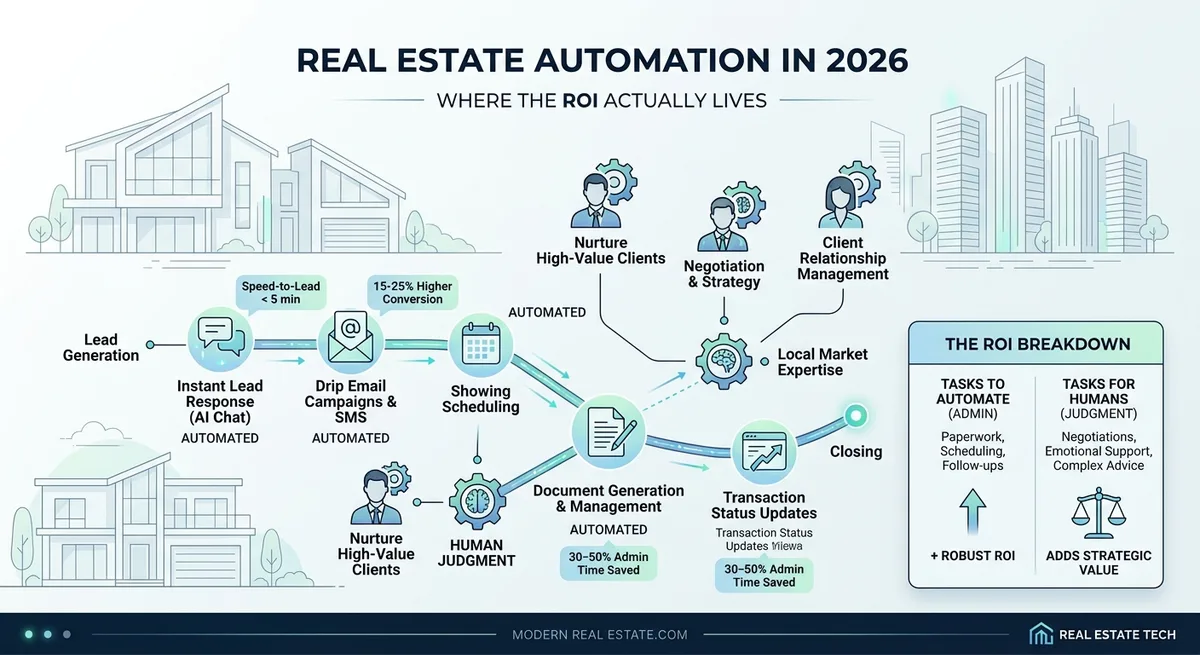
AI Automation for Real Estate: Complete Guide for Agents and Brokers
AI automation for real estate helps agents capture leads faster, nurture prospects automatically, schedule showings 24/7, and reduce administrative workload.