
Skip to content

/ AI Agent Deployment

AI agents for your business, chosen, deployed, and run for you.

An AI agent uses instructions and connected tools to work toward a defined goal, with permission limits and a handoff when it needs a decision. We choose and configure the system on accounts you own, with ongoing support scoped to your needs.

Book my free audit call

Free 30-minute audit. No obligation, no pitch.

/ Plain English first

What an AI agent actually is

An AI agent uses information and instructions to choose permitted actions toward a goal. Tools connect it to systems such as your calendar, inbox, or CRM. Stored state can preserve progress between steps; long-term conversational memory is optional and depends on the task.

A chatbot answers

A basic chatbot answers questions. When connected to tools, a chatbot can also perform agent tasks.

An automation follows a fixed script

It follows predefined rules and can handle complex branches. Use it when the next step can be specified in advance.

An agent decides and acts

It interprets context and chooses among permitted actions. Approval rules and result checks belong in the configured workflow.

What that looks like on a Tuesday night

  1. 1

    A customer texts at 9pm asking to reschedule.

  2. 2

    The agent checks the calendar, offers two open slots, and books the one they pick.

  3. 3

    It updates the CRM, sends the confirmation, and leaves you a summary to read in the morning.

Choose the job before the AI agent

Start with a recurring task and an outcome you can check: a request routed to the right person, an appointment changed correctly, or a complete intake packet ready for review. Define the systems involved and what needs your approval before choosing the software.

A useful first scope names the trigger, permitted actions, and human handoff. Acceptance means checking the result in your actual system, including what happens when information is missing or a connection fails.

Request and permitted context lead to a proposed step, permission check, tool action, and result verification. Uncertain requests go to a person.

Request and permitted context lead to a proposed step, permission check, tool action, and result verification. Uncertain requests go to a person.
Illustrative workflow. Hover over a step to explore its connections, or open the full diagram.

Work out which approach fits

/ The field, honestly

The agents everyone is asking about

Four names dominate the conversation right now. We build on and operate these inside our own company, so what follows is operator experience, not a summary of someone else's launch post.

Hermes Agent mark

Hermes Agent

Nous Research · MIT (open source)

Hermes Agent is an open-source assistant that lives inside the chat tools your team already uses. It keeps a persistent memory of past work, can browse the web, run scheduled jobs in plain language, and even writes and refines its own reusable skills as it works. We run Hermes Agent on our own server every day as the operations agent for Epiphany Dynamics.

Runs where
Your own computer or server: native apps for Mac, Windows, and Linux, plus Docker and cloud setups.
You talk to it through
Telegram, Discord, Slack, WhatsApp, Signal, email, terminal
Cost model
The software is free. You pay only for the AI model behind it, from a provider you choose.
Best for
An always-on back-office assistant living in your team chat, handling recurring research, reporting, and data shuffling.
Watch out for
It is a self-hosted install, and its safety controls (command approval, pairing rules, container isolation) are opt-in: someone has to turn them on deliberately. No public security incident surfaced in our research, which is not the same as none existing.

OpenClaw mark

OpenClaw

OpenClaw Foundation · MIT (open source)

OpenClaw is the open-source agent that kicked off the current wave of interest, created by Peter Steinberger and now stewarded by the nonprofit OpenClaw Foundation. It talks to you through dozens of messaging channels, can drive a web browser, read and write files, and remember what it learns. We run a private, network-locked OpenClaw instance for maintenance work on our own server.

Runs where
Your own machine or server: Mac, Windows, Linux, even a Raspberry Pi.
You talk to it through
WhatsApp, Telegram, Slack, Discord, Signal, iMessage
Cost model
The software is free. You pay only for the AI model behind it, from a provider you choose.
Best for
A chat-native assistant that operates your existing tools, when someone technical owns and secures it.
Watch out for
OpenClaw had a serious security episode in early 2026: security researchers reported a one-click remote code execution flaw, an interface that historically defaulted to authentication off, tens of thousands of publicly exposed instances, and a supply-chain campaign that pushed hundreds of malicious add-ons into its community registry. Run unsecured, it is a real risk; run locked down, it is the tool we trust with our own server. Details in the security section below.
Grok Bot mark

Grok Bot

xAI · Proprietary

Grok Bot is xAI's hosted "AI teammate," launched in August 2026. You teach it a workflow once by demonstrating it, and it runs multi-step jobs end to end while you are away, stopping to ask before anything consequential like sending, publishing, buying, or deleting. It connects through hundreds of plugins and works by signing into your existing business software with your credentials. It is the only one of these four a non-technical owner can simply buy and switch on.

Runs where
xAI's cloud. Each bot gets its own cloud computer with a browser, files, and a terminal, plus desktop and iOS apps.
You talk to it through
Its own app, Group chats
Cost model
Bundled with paid xAI and Cursor plans, as of August 2026. Enterprise access is waitlisted.
Best for
An owner who wants a hosted, no-server AI teammate and is comfortable giving it logins to their business systems.
Watch out for
The convenience has a price in risk: you hand it live credentials, passwords and two-factor codes must be entered manually, and multiple bots share one cloud computer and its files, and reporting on the launch described that shared-machine design as a real blast radius. That is a design decision to understand before you buy, not a reason to panic. Note: Grok Bot is not Grok Build, xAI's terminal coding tool for developers, which we also use.
Prime Agent mark

Prime Agent

Prime Intellect · MIT (open source)

Prime Agent is an open-source developer engine that Prime Intellect released in August 2026. It gives the AI model one persistent workspace and lets it write code to inspect data, call tools, and spin up helper agents, carrying its own instructions and skills across sessions. Being straight with you: this is not something we would hand to your front desk. It is the engine we use to build and maintain the agents and integrations behind your deployment, and we built and open-sourced Prime Desktop, a native Mac client for it (public at github.com/epiphany-dynamics/prime-desktop).

Runs where
Your Mac or Linux machine, in the terminal, with a background mode for long-running sessions.
You talk to it through
Terminal only
Cost model
The software is free. You pay only for the AI model behind it, from a provider you choose.
Best for
Developers and technical teams building and maintaining automations, integrations, and data pipelines.
Watch out for
It executes model-written code with your user permissions, and its own README says it is not a security sandbox. It belongs on trusted machines, run by technical people.

And the wider suite we build with

Underneath the headline names sit the frameworks we use for custom builds, alongside engines we already run daily like Claude Code, OpenAI Codex, and Grok Build.

  • Dify · A visual, low-code agent and workflow builder; the most owner-friendly of the developer frameworks.
  • LangGraph · The most-cited production framework for building multi-agent systems.
  • CrewAI · Role-based crews of agents that collaborate on a job.
  • Microsoft AutoGen · Microsoft's framework for agents that work through multi-step conversations.
  • OpenAI Agents SDK · OpenAI's own library for orchestrating agents.
  • Google ADK · Google's agent development kit.
  • Mastra · A TypeScript-native agent framework.

/ Side by side

Which one fits your business

Comparison of Hermes Agent, OpenClaw, Grok Bot, and Prime Agent across hosting, channels, model choice, and whether a technical owner is needed.
Agent Who hosts it Talks to you through Bring your own model Technical owner needed Typical fit
Hermes Agent Your server Telegram, Discord, Slack, WhatsApp, Signal, email, terminal Yes Yes Back-office ops inside team chat
OpenClaw Your server WhatsApp, Telegram, Slack, Discord, Signal, iMessage Yes Yes Chat-native operator for your existing tools
Grok Bot Vendor cloud (xAI) Its own app, Group chats No No Hosted, no-server AI teammate
Prime Agent Your machine Terminal only Yes Yes Developer engine behind the build

One honest note: most owners should not pick the agent themselves. Picking is the first thing we do for you, on the fit call, against your actual workflow.

/ The engagement

How we deploy one for you

1

Fit call and workflow map

We sit down with you and map the actual workflow the agent would take over: where requests come in, what systems they touch, and where a wrong move would hurt. You leave with the map in writing, whether or not we build anything.

2

Choose the agent and the model behind it

Based on the map, we pick the agent platform and the AI model that fits your channels, your budget, and your risk tolerance. Most owners should not have to make this call themselves; it is the first thing we do for you.

3

Set it up on your server or accounts

We install and configure the agent on infrastructure you own, then connect it to your channels (Telegram, WhatsApp, Slack, Discord, SMS, or email) and your tools (calendar, CRM, inbox, invoicing, phone). Everything runs in accounts and servers in your name, never inside ours.

4

Memory, guardrails, and approvals

We configure what the agent remembers, what it may do alone, and what it must ask about first. Routine lookups and bookings run on their own; anything that sends money, deletes data, or speaks for your business waits for your approval.

5

Go live, monitor, and refine

The agent goes live with logging and monitoring in place, and we watch the first real interactions closely. From there we refine prompts, permissions, and workflows as the agent meets the real world.

/ By vertical

What it looks like in your industry

Med spa

Answers questions about treatments and pricing, books consultations, and rebooks clients who are due for a follow-up.

Lives in SMS and your website chat.

Touches your booking calendar, CRM, and intake forms.

Dental

Handles new-patient inquiries, confirms and reschedules appointments, and chases down unscheduled treatment plans.

Lives in SMS and email.

Touches your practice calendar, patient records handoff, and reminder sequences.

Home services (HVAC and plumbing)

Takes after-hours service requests, qualifies the job, checks technician availability, and books the call.

Lives in SMS and phone follow-up.

Touches your scheduling board, CRM, and invoicing.

Professional services (law and accounting)

Screens inbound inquiries, collects intake details, books consultations, and keeps the follow-up moving between meetings.

Lives in email and your website.

Touches your calendar, intake forms, and document requests.

Restaurants

Answers reservation and hours questions, manages the waitlist, and handles catering inquiries that come in after close.

Lives in SMS and WhatsApp.

Touches your reservation book and event calendar.

E-commerce

Answers order and product questions, follows up on abandoned carts, and routes wholesale inquiries to a human.

Lives in email and website chat.

Touches your store platform, order data, and email list.

/ Security and ownership

The part most vendors skip

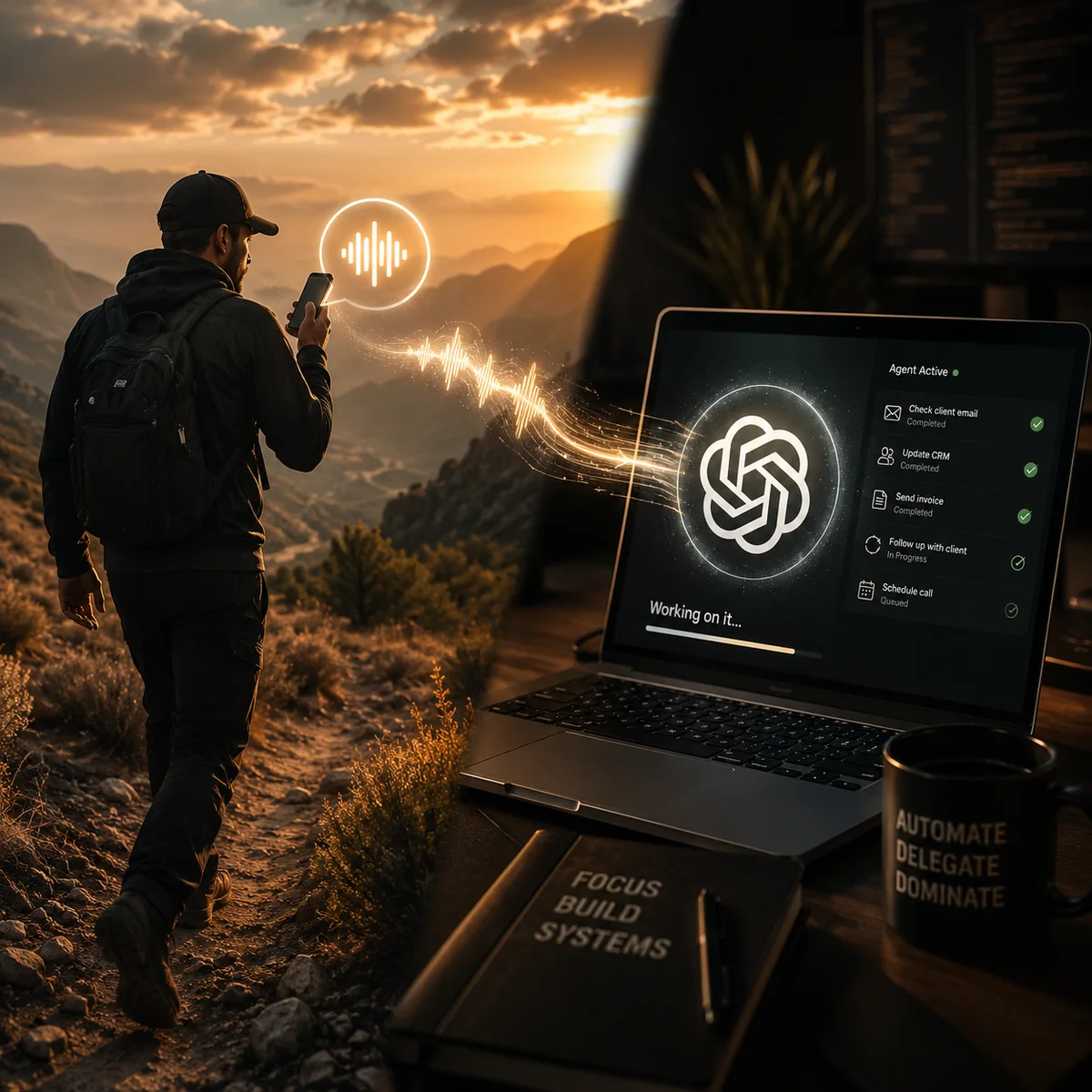
A business owner on a trail at dusk delegating work by voice while an AI agent completes email, CRM, and invoicing tasks on a laptop

The promise of an agent: you keep living your day while the work moves. The catch is the part this page is about: that laptop has your logins on it.

What happened to OpenClaw in early 2026

In early 2026, OpenClaw, the most popular self-hosted agent of the moment, had a serious security episode. Security researchers reported a one-click remote code execution flaw (tracked as CVE-2026-25253) that could let a malicious link steal an instance's token and run commands. They also reported that the web interface historically defaulted to authentication off, that tens of thousands of instances were publicly exposed, and that a supply-chain campaign known as ClawHavoc pushed hundreds of malicious add-ons into its community registry.

None of that makes OpenClaw a bad tool; we run one ourselves. It makes the setup the whole job. A self-hosted agent left open on the public internet with no authentication is a real risk, and that risk is exactly what a competent deployment removes.

Sources: ProArch on CVE-2026-25253 · Giskard on data leakage and prompt injection · The New Stack on the OpenClaw Foundation

What we do about it

  • Private by default

    Your agent runs on a private network or locked-down server, not exposed to the public internet. Authentication is on from the first boot, never left at a default.

  • Approvals for consequential actions

    Anything that sends money, publishes content, deletes data, or commits your business waits for a human yes. Routine lookups and bookings run on their own.

  • Credentials stay in your accounts

    The agent runs in the environment agreed with you. Your business controls its accounts, access, and credentials, with the deployment and handoff documented.

  • Vetted add-ons only

    Community skill and plugin registries are where supply-chain attacks happen. We install only what we have reviewed, and we pin versions.

If you choose a hosted agent like Grok Bot instead, the trade-off moves rather than disappears: you skip the server work, but you hand live logins to a vendor cloud where multiple bots share one computer and its files. For some owners that is the right call; it should be a decision you make with your eyes open, which is why we walk through it on the fit call.

/ Your first agent

Start with a job worth handing off

Start with one channel and the tools your team already uses. We map the workflow, set the agent's boundaries, and agree a fixed quote in writing after a free audit. Most first builds go live in 2 to 4 weeks.

The first agent

Built for your workflow

An agent with the tools, memory, and permissions to handle the workflow we agree together. We connect your core systems, test the handoffs, and put the scope in writing before work starts.

Optional ongoing support

Support when you need it

For teams that want us to keep running, monitoring, and refining the agent after it goes live.

Frequently Asked Questions

What is an AI agent?

+

An AI agent uses information and instructions to choose permitted actions toward a goal. Its tools connect it to systems such as a calendar or CRM. Stored state can preserve progress; long-term conversational memory depends on the task. Uncertain or restricted actions go to a person.

How is it different from a chatbot?

+

A basic chatbot answers questions; one connected to tools can also act as an agent. Traditional automation follows predefined rules. An agent interprets context to choose a permitted action, often inside a workflow that also uses fixed rules.

Do I need to be technical?

+

No. Choosing the platform, installing it, wiring it to your systems, and securing it is the work we do. You need to know your own business and be reachable when the agent needs a decision; the rest is on us.

Where does it run, and who owns it?

+

We agree on the hosting setup before deployment, with your business in control of the accounts and access. The handoff includes documentation so another developer can maintain the system if needed.

Which agent will you pick for me?

+

It depends on your channels, your tools, and your risk tolerance. Hermes Agent and OpenClaw are free, self-hosted agents that live in your team chat. Grok Bot is the hosted, no-server option. Prime Agent is the developer engine we build with, not something we hand to your front desk. Picking is the first thing we do for you, and most owners should not have to make that call alone.

What does it cost?

+

We scope the agent around the job you need done, the channels it uses, and the tools it connects to. After a free audit, you get a fixed quote in writing before work starts. Most first builds take 2 to 4 weeks. Ongoing support is optional and scoped with the build.

How long does it take?

+

Most agent builds run 2 to 4 weeks from kickoff to live. Simple, single-channel setups land at the fast end; agents that touch many systems take longer.

Is it safe to give an agent access to my systems?

+

Done carelessly, no: the OpenClaw security episode in early 2026 showed what an unsecured, publicly exposed agent can become. Done properly, the agent runs on a private network with authentication on, consequential actions require your approval, and credentials stay in your accounts. Security is the first thing we configure, not the last.

Can it text or WhatsApp my customers?

+

Yes. The agents we deploy talk through SMS, WhatsApp, Telegram, Slack, Discord, email, and website chat, depending on where your customers already are. We pick channels together during the workflow map, and outbound messaging follows your rules about when and what the agent may say.

What happens after it goes live?

+

We monitor the first real interactions closely and refine prompts, permissions, and workflows as the agent meets the real world. If you want us to keep monitoring and improving it after launch, we'll scope optional support around the system and the work you need.

Find out which agent fits your business.

Thirty minutes. We map your workflow, tell you which agent we would deploy and why, and you leave with the plan in writing, whether or not we build it.

Book my free audit call

Free 30-minute audit. No obligation, no pitch.