
AI Receptionist for Electricians: Setup, Cost, and Real ROI in 2026
An AI receptionist for electricians answers inbound calls 24/7, books service appointments, triages emergency situations, and routes urgent jobs to an on-call tech without any human staffing. For small electrical contractors, the ROI depends on how many calls currently go unanswered, how many of those callers would book, and the average ticket value of the recovered jobs.
Electrical contractors miss a large share of inbound calls while techs work job sites. Here's what an AI receptionist actually does for your shop, what it.
Epiphany Dynamics is an AI automation agency: we help businesses find and fix operational bottlenecks with AI receptionists, lead follow-up, and workflow automation.
Free 30-minute audit. We name at least 3 things you can automate, ranked by impact.
Book a free AI audit
Patrick Gibbs
An AI receptionist for electricians answers inbound calls 24/7, books service appointments, triages emergency situations, and routes urgent jobs to an on-call tech without any human staffing. For small electrical contractors, the ROI depends on how many calls currently go unanswered, how many of those callers would book, and the average ticket value of the recovered jobs.
An electrician mid-panel cannot answer the phone. You're in a crawl space, up a ladder, or both hands are inside a breaker that you really shouldn't step away from. The call goes to voicemail. The homeowner hangs up and calls the next contractor in Google. That's the entire story.
This isn't a customer service problem. It's a physics problem. The job requires your hands and your attention at the same time, and phone calls don't care about that. A human receptionist solves it with payroll and management overhead. An AI receptionist solves the same coverage problem with software, routing rules, and emergency escalation that can keep working after the office closes.
The Real Cost of Missed Calls for an Electrical Contractor
Electrical contractors miss a meaningful share of inbound calls during business hours because field techs cannot take calls on active job sites. Most callers who don't reach a business on the first attempt will move on to the next provider instead of trying again later. The exact loss depends on your call log, answer rate, booking rate, and average job value.
Run the math on your own shop. Pull a recent call log, count unanswered calls, estimate which callers were service-ready, and multiply booked opportunities by your own average ticket. That gives you a defensible missed-call baseline without importing someone else's conversion assumptions.
The repeat business angle makes the leak worse. A homeowner who books you once and has a good experience can turn into future service calls and referrals. A missed first call ends that relationship before it starts.
What an AI Receptionist Actually Does for an Electrical Business
For electrical contractors, an AI receptionist covers four jobs: it answers every inbound call, collects job details (address, problem type, urgency level), books appointments directly into your scheduling software, and escalates genuine emergencies to an on-call tech via text or live transfer. It handles voice, SMS, and web chat simultaneously without a separate tool for each channel.
People get this wrong by thinking of AI receptionists as phone trees. A phone tree says "press 1 for service, press 2 for billing." An AI receptionist has a real conversation. When a caller says "my kitchen outlets stopped working after a storm," it books a diagnostic. When a caller says "I smell burning from my electrical panel," it escalates immediately. The difference matters because electrical emergencies are real safety situations, not scheduling preferences.
Emergency triage is where this technology earns its price for electrical specifically. An AI receptionist can be configured with escalation logic: any mention of sparks, burning smells, buzzing combined with flickering, or anything involving water near electrical should trigger immediate escalation rather than a next-available appointment. That logic is not available from an answering service that takes messages. The approach mirrors how AI receptionist systems built for HVAC companies handle emergency dispatch routing, since both trades have calls that genuinely cannot wait until morning.
After-hours coverage fills in the remaining gap. Most electrical contractors see a large share of calls come in outside business hours. Without coverage, those go unanswered. A homeowner standing in the dark at 10 PM isn't leaving a voicemail. They're calling the next shop in the list.
What It Costs, and What You're Actually Comparing It To
AI receptionist pricing for electrical contractors depends on call volume, calendar integration, escalation rules, and how much support the provider includes after launch. Compare it against the loaded cost of payroll coverage and against answering services that take messages but do not schedule. The AI option is strongest when it covers nights and weekends while actually booking appointments.
| Option | Cost Shape | Books Appointments | 24/7 Coverage | Emergency Triage |
|---|---|---|---|---|
| Full-time receptionist | Payroll, benefits, taxes, and management | Yes | No | Depends on training |
| Live answering service | Monthly plan plus usage and overflow rules | Rarely | Yes | Rarely |
| AI receptionist | Platform, call volume, integrations, and support | Yes | Yes | Yes (configurable) |
| Voicemail | No subscription, but no active recovery | No | Passive only | No |
The live answering service comparison deserves a closer look. Most services in that category collect a name, a number, and a one-line message, then forward it to you via text or email. They don't have access to your scheduling calendar. They can't see that Tuesday afternoon is open. If you're paying for a service that doesn't book appointments, you're paying for documented missed calls, not converted ones. The comparison between AI-based tools and staffed answering services covers exactly where that line breaks down in practice.
The ROI Math, Worked Out Specifically
The ROI model starts with recovered booked jobs from calls you are currently missing. If the value of those recovered jobs exceeds the platform cost, setup effort, and monitoring time, the system has a business case. The right break-even number comes from your own average ticket and missed-call log.
Here's the calculation to run: missed calls multiplied by the share that would have booked, multiplied by your average electrical ticket, minus the monthly platform cost and internal oversight. The AI will not recover every missed opportunity, so model a conservative recovery rate and compare the result against actual booked jobs after launch.
This is exactly why the same ROI framework used for AI receptionists in plumbing businesses applies directly to electrical contractors. Both trades face the same core problem: field techs who are physically unavailable when the phone rings.
For the numbers behind this, see AI Receptionist for HVAC: Setup, Common Failure Modes, and Real ROI (2026).
Evaluating Options and Getting Set Up
The four non-negotiable capabilities for an electrical contractor evaluating AI receptionist tools are: direct calendar integration that books into your actual scheduling software (not just emails you a summary), configurable emergency escalation rules, live call transfer capability, and post-call summaries sent to your dispatcher. A system missing any of those four will create more admin work than it eliminates.
The calendar integration question is where most contractors get burned. A lot of AI tools will have a solid conversation with your caller, collect all the right job details, and then send you an email you have to manually enter into ServiceTitan or Jobber. That's not automation. That's a very expensive contact form. Ask the vendor specifically whether the system writes directly to your scheduling software, and ask to see a live demo of that integration before signing anything. Housecall Pro, ServiceTitan, and Jobber are standard for reputable providers. Less common platforms may need a custom build, which adds time and sometimes cost.
The escalation logic question matters just as much. Ask specifically: can I configure a rule that says if a caller mentions sparks or a burning smell, the call transfers to my cell immediately? If the answer is "that requires a custom build" or "that's not supported," that's a gap that will cost you eventually. A well-built AI receptionist should let you define escalation conditions without writing code. If you want to see how this kind of configuration works in practice, the AI voice receptionist setup process documented for plumbing operations walks through the same escalation and calendar integration steps, since the build structure is nearly identical for electrical.
Setup speed depends on how clean your business rules and scheduling access are. You'll need clear answers to: your service area, job types you handle, jobs you don't take, what constitutes an emergency for your business, and your on-call contact for transfers. Once live, review transcripts during the calibration period. You'll catch specific terminology the AI mishandles early, like confusing a main panel with a sub-panel or misclassifying permit-required work. After the calibration window, most shops drop to ad-hoc review. The system runs on its own.
For contractors who want a system built end-to-end rather than a DIY product to configure themselves, the AI receptionist and automation services page covers what a full implementation typically includes for field service businesses at different call volumes. Epiphany Dynamics handles that kind of build for electrical contractors who want the intake workflow, scheduling integration, and escalation logic handled as one designed system rather than assembled from separate tools.
Frequently Asked Questions
Q: How much does an AI receptionist cost for an electrical contractor?
Cost depends on call volume, integrations, escalation rules, and whether the provider includes setup and ongoing tuning. Compare the quote against payroll coverage, answering-service limitations, and the value of booked jobs that are currently leaking to voicemail.
Q: What's the actual ROI of an AI receptionist for a small electrical business?
The ROI depends on your current missed-call volume, booking rate, and average electrical ticket. Use your own call logs to estimate how many jobs are currently leaking to voicemail, then compare the value of even one recovered booked job against the monthly subscription cost.
Q: Can an AI receptionist handle emergency calls at 2 AM on weekends?
Yes. AI receptionists can answer around the clock without overtime costs, capturing emergency calls when homeowners' breakers trip outside business hours. For contractors offering emergency services, this availability routes urgent jobs directly to your on-call technician, turning calls that would go to voicemail into potential booked work.
Q: How does the system know whether to book an appointment or escalate to a technician?
AI receptionists use natural language processing to assess urgency, distinguishing routine maintenance questions from emergencies that need immediate attention. The system books standard appointments automatically into your calendar and routes critical calls directly to your on-call team, reducing manual triage delays while keeping safety-critical jobs from slipping through.
Patrick Gibbs
AI Automation Expert
Patrick Gibbs helps professional practices implement AI automation that captures more leads, books more appointments, and scales without adding overhead. He's the founder of Epiphany Dynamics and creator of the AI Front Desk system.
Related Solutions
Build this into a real workflow
Related Posts
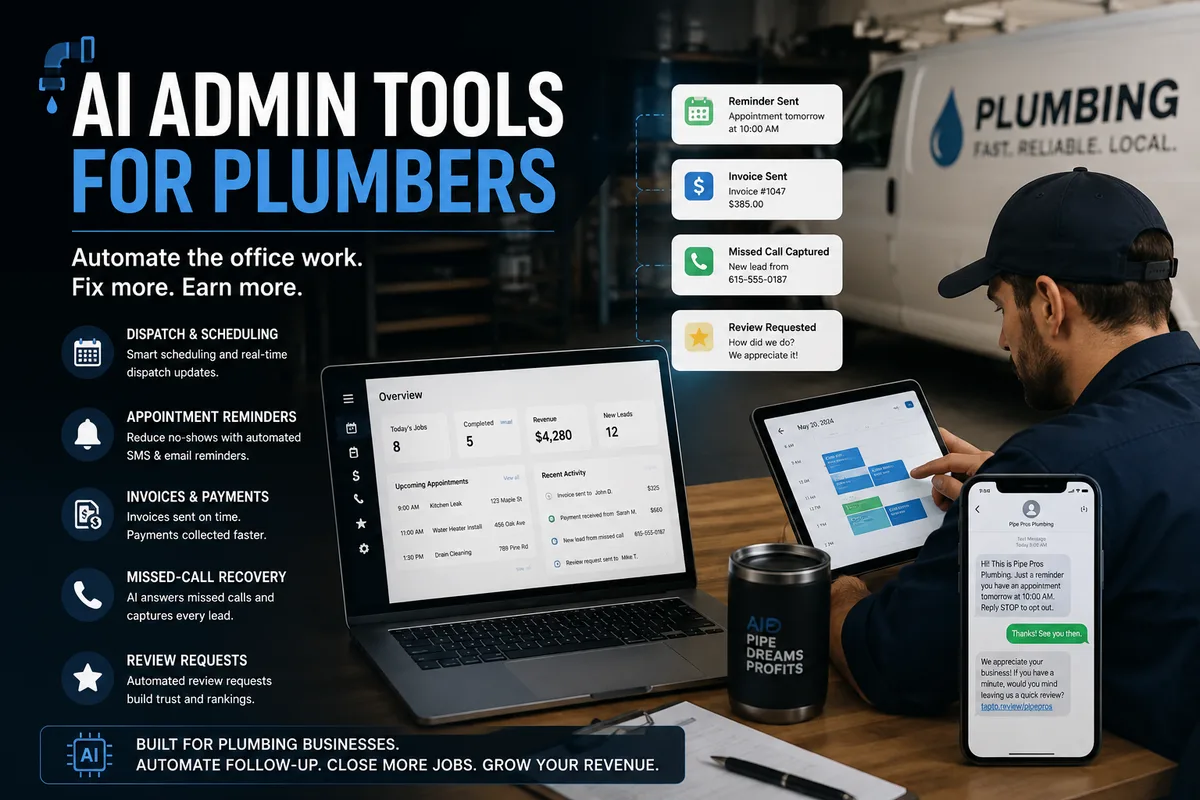
AI Admin Tools for Plumbers: What They Are and How to Choose
AI admin tools automate dispatch, reminders, invoicing follow-up, missed calls, and review requests for plumbers. What they do and how to choose.
Insurance Eligibility Automation for Physical Therapy Clinics
Eligibility automation for physical therapy clinics verifies benefits before the patient arrives, cuts front desk phone work, and can lower claim denial risk.
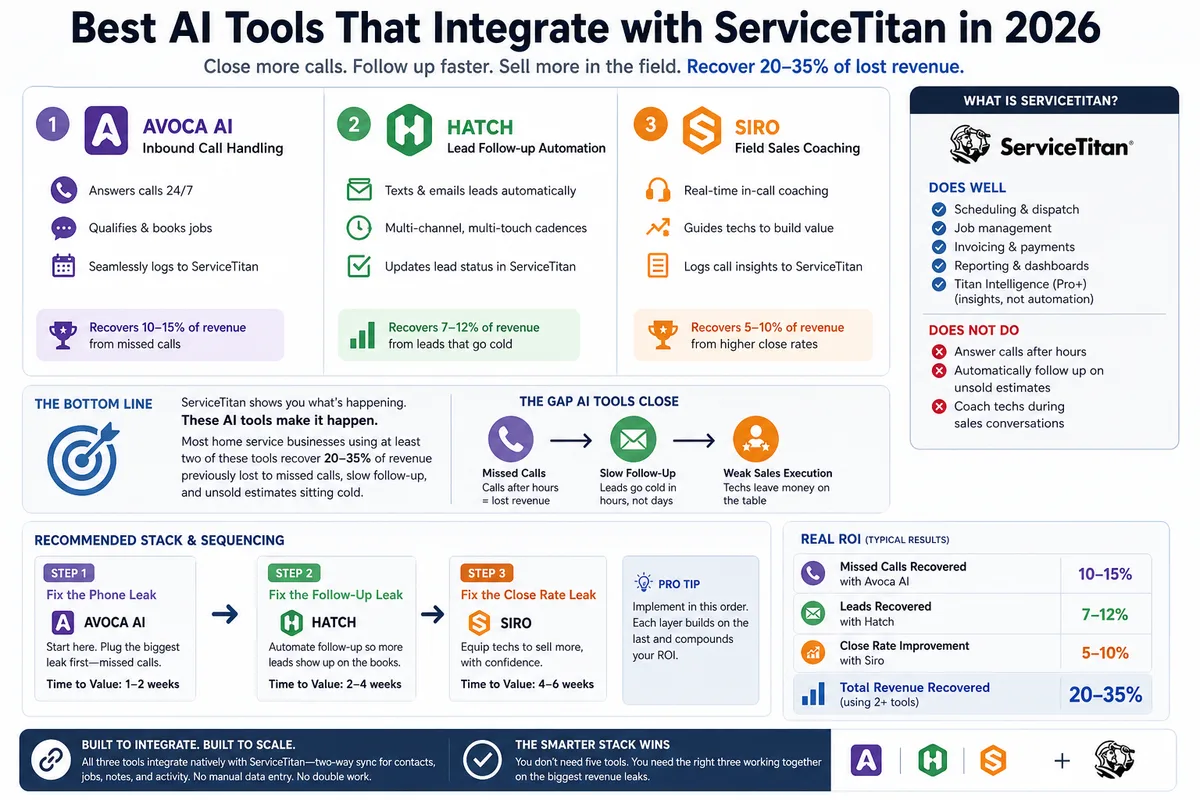
Best AI Tools That Integrate with ServiceTitan in 2026
Most ServiceTitan shops miss a meaningful share of inbound calls and leave most estimates unsold. These AI tools close those gaps inside ServiceTitan.