
AI Receptionist for HVAC: Setup, Common Failure Modes, and Real ROI (2026)
An AI receptionist for HVAC answers inbound calls around the clock, triages emergency requests like a downed AC or no-heat situation, captures caller details, and books service appointments when your team is unavailable. HVAC companies miss a large share of after-hours calls, and each one of those missed calls has a real dollar value attached to it.
HVAC companies miss a large share of after-hours calls. Here's what an AI receptionist actually does, how to evaluate ROI, and where these systems fall short.
Epiphany Dynamics is an AI automation agency: we help businesses find and fix operational bottlenecks with AI receptionists, lead follow-up, and workflow automation.
The free 30-minute AI Operations Audit is a conversation about a normal week in your business and where the work piles up. We find the one change that would give you the most time back and send you a plain-English plan for it. No forms and no pitch.
Book a free AI audit
Patrick Gibbs
An AI receptionist for HVAC answers inbound calls around the clock, triages emergency requests like a downed AC or no-heat situation, captures caller details, and books service appointments when your team is unavailable. HVAC companies miss a large share of after-hours calls, and each one of those missed calls has a real dollar value attached to it.
During a summer heat wave or a January cold snap, HVAC companies get overwhelmed fast. Your dispatcher is in the truck, your office staff clocked out for the day, and calls are hitting voicemail. Most of those callers aren't going to wait. They're dialing the next company on Google. That's the specific problem an AI receptionist is designed to solve, and for HVAC it solves it better than in almost any other service trade.
Why HVAC Businesses Lose More Calls Than They Realize
HVAC companies face a call-capture problem most service trades don't hit as hard. Seasonal demand spikes can overwhelm normal inbound capacity quickly, and a single dispatcher can't answer new calls while routing trucks and updating job statuses at the same time. The calls that go to voicemail during those windows tend to be permanent losses.
HVAC is time-sensitive in a way most service industries aren't. When someone's heat stops working late at night in January, they're not leaving a voicemail and waiting for morning. They're calling the next company on the list. A dental office can get away with a callback the next day. HVAC, during peak season, cannot.
The pattern is easy to observe. HVAC companies routinely miss calls outside business hours, and plenty more during business hours when dispatchers are overloaded on routing and job updates. Run the math on your own service ticket value, after-hours call volume, and missed-call rate. That is the potential revenue walking out the door before anyone even gets a chance to quote or book the work.
You also can't always hire your way out of this. Staffing a full-time receptionist just to cover seasonal spikes often doesn't make financial sense. That's the gap an AI system fills without the overhead of a permanent hire.
What an AI Receptionist Actually Does on an HVAC Call
An AI receptionist answers immediately, identifies whether the call is an emergency (no AC, no heat, suspected refrigerant leak) or a routine request, collects caller name, address, and system details, and either books an appointment or triggers an urgent callback alert. It handles this consistently whether the call comes in during business hours or after the office closes.
The core logic isn't complicated, but the execution has to be right. A well-built HVAC AI receptionist runs through a short triage sequence: Is this a system-down emergency or a scheduling request? If it's an emergency, who gets notified and how quickly? If it's a booking, what slots are currently open in the dispatch calendar? The AI handles the branching and captures the call details regardless of which path it takes.
The scheduling integration is where the real time savings live. Most platforms connect directly to field service software like ServiceTitan, Housecall Pro, or Jobber. When a customer calls to book a maintenance visit, the AI checks open slots in real time and confirms the appointment without a human touching it. This is similar to how AI receptionist systems work for plumbing companies, which face the same combination of high-urgency emergency calls and routine scheduling requests that need to be handled at all hours.
Even when the AI can't fully resolve a call (a complicated warranty question, a customer who wants a specific technician), it still captures the name, address, phone number, and a summary of the issue and pushes that to your CRM or dispatcher queue. Compared to a voicemail that may or may not get listened to before end of day, that's a real operational improvement even in the failure case.
The ROI Math for HVAC Specifically
For an HVAC operation with real after-hours demand, the ROI comparison should weigh AI receptionist cost against live answering service cost, missed-call value, dispatch load, and how many calls the system can capture that previously went to voicemail.
Here's the cost comparison laid out directly for a residential HVAC company evaluating coverage options:
| Coverage Option | Cost Pattern | Call Capture Pattern | Concurrent Call Handling |
|---|---|---|---|
| No after-hours coverage | No direct vendor cost, but lost opportunity cost | Limited to staffed hours | Voicemail only |
| Live answering service | Recurring service fee plus usage rules | Better coverage, but dependent on staffing and script quality | Limited by agent availability |
| AI receptionist | Software, setup, integration, and management cost | Consistent capture when routing and escalation are configured well | Unlimited simultaneous calls |
The live answering service cost surprises most people. A decent around-the-clock service that handles HVAC-specific triage, not just take-a-name-and-number, can get expensive quickly. And even at a higher tier, if simultaneous calls come in during a heat wave, someone may still sit on hold. The AI doesn't have that constraint.
Use your own model instead: additional captured calls multiplied by booking rate and average service ticket equals recovered revenue. Compare that with the monthly tool, setup, and management cost. For a more thorough look at how the staffing math compares across scenarios, this full ROI comparison between AI and human receptionists covers salary, benefits, turnover costs, and coverage gaps in detail.
For another angle, see How to Switch From an Answering Service to an AI Receptionist in 2026.
Where AI Falls Short (Read This Before You Buy Anything)
AI receptionists don't handle complex diagnostics, warranty disputes, or customers who are actively angry and want a supervisor. They also don't know your customer history unless it's in an integrated CRM. These aren't deal-breakers, but they mean every deployment needs clear escalation rules. Without them, you create worse experiences than a missed call would have.
The biggest limitation is that AI can't diagnose. A customer who says "my system is short-cycling and I replaced the capacitor last spring" needs a technician, not a bot. A well-built system recognizes when a conversation is outside its scope and escalates cleanly to a dispatcher callback. A poorly built one keeps trying and frustrates the customer into hanging up. The difference comes down almost entirely to how you set up the escalation logic before deployment, not which platform you're using.
Angry customers are the other common failure mode. If someone is calling because a technician no-showed and they've been without AC, they need a fast human escalation. The AI should take the name, acknowledge the situation, flag it as urgent, and push an immediate callback request to whoever handles escalations. What it should not do is route them into the standard scheduling flow. That's the kind of outcome that turns a bad service experience into a negative review.
There's a quieter issue worth naming too: the AI doesn't know your business history. It doesn't know that Mrs. Thompson gets a loyalty discount, or that the unit at the Riverside rental property is under an extended warranty you sold. That context has to live in your CRM with a working integration. For a detailed look at what a configured system handles by default, the AI receptionist page for HVAC companies breaks down the typical feature set. The honest takeaway: your CRM setup ends up mattering as much as the AI platform itself.
How to Set One Up Without Making It Worse
A proper AI receptionist deployment for an HVAC company involves defining emergency triage logic, integrating with your scheduling software, scripting responses for your most common call types, and testing against real scenarios before going live. Skipping any of those steps is how you end up with a system customers hate more than voicemail.
Start with your call types. For most HVAC shops the list looks like: emergency no-heat, emergency no-AC, maintenance scheduling, new customer quote request, follow-up on an existing job, billing question, warranty inquiry, technician callback request. Each needs its own response path. If you try to handle all of them with a single generic script, the AI will give vague answers that don't match what the caller actually needs.
Define your escalation rules before you write a single script. What counts as an emergency in your operation? At what hour does an emergency warrant an immediate callback versus a first-available morning slot? Who gets the notification, the on-call dispatcher, the owner, a shift lead? Write these down before building anything. They're genuinely hard to fix mid-deployment when calls are coming in during a heat event and you're realizing the alert is going to the wrong person.
Connect your scheduling software. This is the step most operators underestimate. The booking flow only works if the AI has real-time visibility into your calendar. If you're running a whiteboard or a paper schedule, the AI can still capture the lead and push it to you, but it can't complete the booking. That's still useful. You're just leaving the biggest operational gain on the table. If you want to see what the full build looks like from platform selection through go-live, the step-by-step AI receptionist build guide walks through the entire process in detail.
Then test it before you launch. Call your own number from a cell phone. Run through every scenario on your list. Try to confuse it. Call outside normal hours. Ask something off-script. You will find things to fix. That's normal and expected. Fix them before your customers find them for you.
One thing worth saying plainly: this tool doesn't fix a broken dispatch operation. If your field team is consistently overbooked or running behind, capturing more incoming calls just means more customers waiting on a business that can't serve them. This works best when the underlying operation is solid and the main problem is call capture and scheduling capacity during peaks and off-hours. That's a specific and common problem for HVAC companies, which is exactly why the ROI case here tends to be stronger than in most other service trades. If you want to see how a system like this gets designed and deployed for field service businesses, Epiphany Dynamics builds and manages these setups end-to-end.
Frequently Asked Questions
Q: How much revenue can an HVAC company lose from missed after-hours calls?
HVAC companies miss a large share of after-hours calls, and each missed call represents whatever that service opportunity would have been worth. Use your average service ticket, after-hours call volume, and missed-call rate to estimate the opportunity cost during peak season.
Q: Can an AI receptionist book emergency HVAC appointments directly, or just capture information?
Modern AI receptionists integrate with your scheduling system to book appointments in real-time during the initial call, capture critical details like address and symptoms, and immediately alert your dispatch team to emergency situations like no heat or no AC. This eliminates the callback delay where most callers contact a competitor instead.
Q: How long does an AI receptionist take to answer and triage an HVAC call?
An AI receptionist answers instantly and qualifies the call quickly, extracting symptoms, location, and availability. That speed matters because HVAC emergencies are time-sensitive. Unlike voicemail, which requires a callback during business hours, instant triage means your dispatcher gets actionable information while the caller is still engaged.
Q: What's the typical monthly cost for an AI receptionist system for HVAC?
Monthly cost depends on call volume, integrations, emergency triage rules, appointment booking depth, and whether the system is managed for you. The payback calculation should compare that cost with the value of calls that no longer go to voicemail during high-demand periods.
Patrick Gibbs
AI Automation Expert
Patrick Gibbs helps professional practices implement AI automation that captures more leads, books more appointments, and scales without adding overhead. He's the founder of Epiphany Dynamics and creator of the AI Front Desk system.
Related Solutions
Build this into a real workflow
Related Posts

What Should an AI Automation Agency Prove Before Taking Access?
Before an AI automation agency touches your systems, it should prove access boundaries, written scope, security practices, test evidence, and a clear ownership record.
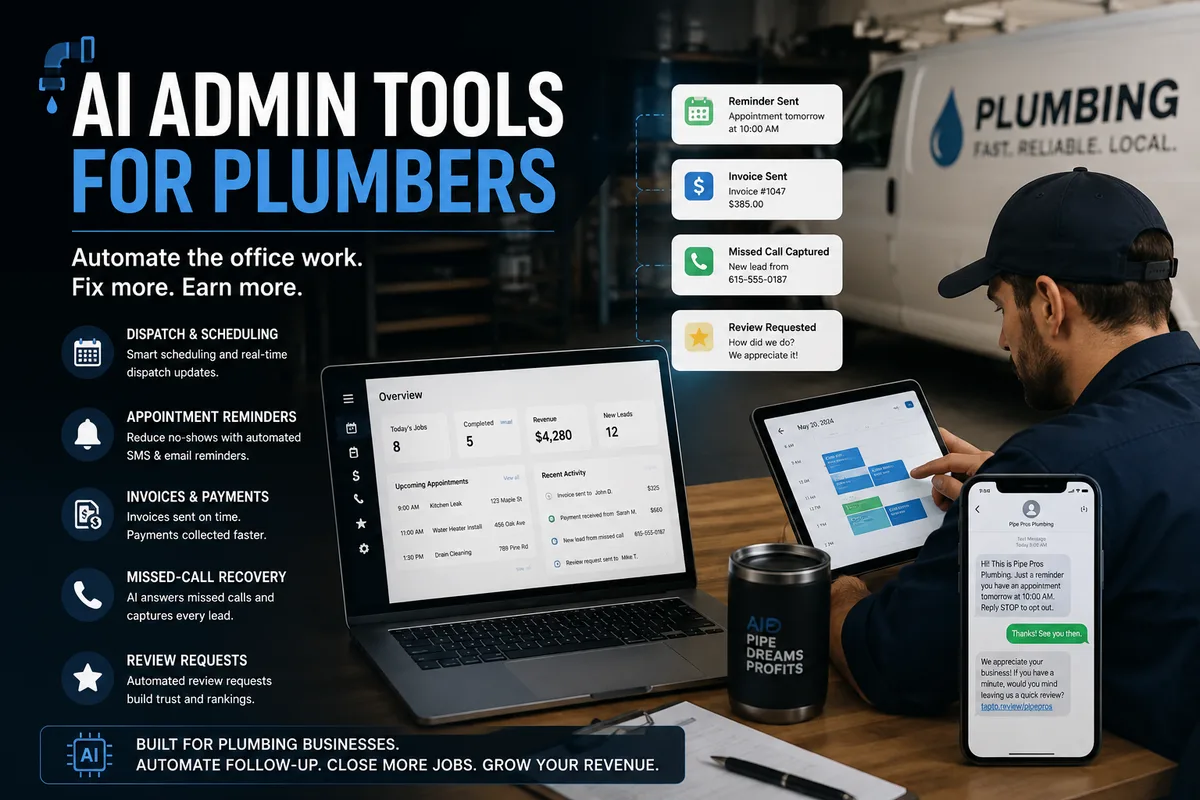
AI Admin Tools for Plumbers: What They Are and How to Choose
AI admin tools automate dispatch, reminders, invoicing follow-up, missed calls, and review requests for plumbers. What they do and how to choose.
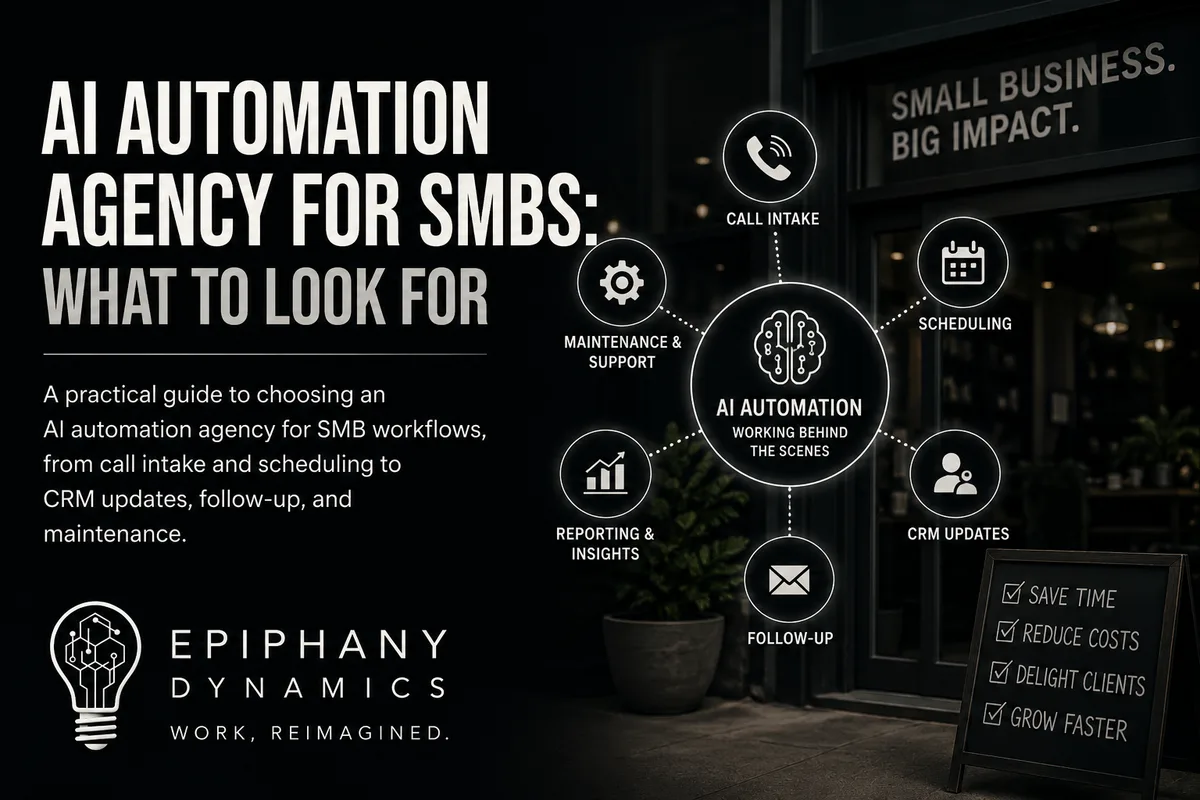
AI Automation Agency for SMBs: What to Look For
A practical guide to choosing an AI automation agency for SMB workflows, from call intake and scheduling to CRM updates, follow-up, and maintenance.