
AI Voice Receptionist for Plumbers: The Real Costs and ROI in 2026
An AI voice receptionist for plumbers is a phone automation system that answers inbound calls, classifies the caller as emergency or routine, and books jobs directly into dispatch software. The ROI depends on your missed-call volume, after-hours demand, booking rate, and average job value.
Plumbers miss a large share of inbound calls while working job sites. Here's what an AI voice receptionist actually does, what it costs, and the math on.
Epiphany Dynamics is an AI automation agency: we help businesses find and fix operational bottlenecks with AI receptionists, lead follow-up, and workflow automation.
Free 30-minute audit. We name at least 3 things you can automate, ranked by impact.
Book a free AI audit
Patrick Gibbs
An AI voice receptionist for plumbers is a phone automation system that answers inbound calls, classifies the caller as emergency or routine, and books jobs directly into dispatch software. The ROI depends on your missed-call volume, after-hours demand, booking rate, and average job value. For many shops, the business case starts with how many urgent callers currently hit voicemail and call the next plumber.
Plumbers don't sit at desks. They're in crawl spaces, mid-repair on a corroded shutoff valve, or under a sink when someone calls about a burst pipe across town. That call goes to voicemail. The caller, watching water spread across their kitchen floor, dials the next plumber on Google before your outgoing message even finishes.
Most callers who reach voicemail on a first attempt do not call back. In a trade where emergencies are common and callers have zero patience for a return call tomorrow, that should bother you. The full picture of how AI phone answering affects home service businesses is worth reading, but the short version is this: missed calls are a revenue problem that compounds, and most plumbers don't see how bad it is until they actually count.
Why Plumbers Have a Specific Phone Problem
Plumbers miss more inbound calls than most service trades because the work demands full physical attention. Technicians mid-job can't answer calls without stopping what they're doing, and many small plumbing shops don't employ dedicated office staff. The result is a gap between ring volume and answered calls that quietly costs real revenue.
The trades with the worst call answer rates share one trait: the work is physical, happens at customer sites, and can't be safely interrupted. A plumber mid-repair on a corroded main line can't pause to take a scheduling call without creating risk on the current job. So calls get missed. This isn't a systems problem or a discipline problem. It's just physics.
What makes plumbing worse than some other trades is the urgency factor on the caller's side. A homeowner with a slow drain might wait a day. Someone with water coming through their ceiling is calling you, then immediately calling the next name in the search results if you don't pick up. That dynamic destroys smaller shops in a way it doesn't affect a plumber who has the budget for full-time office staff.
Small plumbing operations are the most exposed. No admin staff, owner often in the field, and call volume spikes are unpredictable. The dedicated breakdown of AI receptionist solutions for plumbing companies covers the after-hours coverage gap specifically, which is where the biggest revenue loss tends to concentrate.
What an AI Voice Receptionist Actually Does on a Plumbing Call
An AI voice receptionist answers immediately, greets the caller by company name, asks about the issue, and routes based on urgency. Emergencies get a warm transfer to a live tech or dispatcher. Routine calls go through a booking flow, collect job details, and sync an appointment directly into scheduling software like Jobber or ServiceTitan.
Here's what a typical call looks like in practice. A homeowner calls after hours. Water is pooling on the floor around their water heater. The AI answers immediately, identifies itself as your company's answering service, and asks what's happening. The caller describes the issue. The AI classifies it as a potential emergency, asks for the address and a callback number, and either warm-transfers to whoever is on call or fires an immediate SMS alert to your dispatcher with the full call summary. No message to return tomorrow. The decision happens in real time.
For a non-emergency, the flow shifts. A caller reports a slow drain in their kitchen. The AI asks a few qualifying questions (single drain or multiple, any odor, when it started), collects the address and contact info, and offers appointment windows pulled live from your calendar. The customer picks a slot, gets an SMS confirmation, and the job populates in your dispatch queue. No human involved until a tech shows up at the door.
This is the actual gap between a real AI voice receptionist and a standard answering service. Answering services take messages. They don't make routing decisions, they don't book appointments, and they don't integrate with your scheduling software. The caller still waits for a callback. In plumbing, that callback window is usually when the job goes to someone else. If you want to understand the technical side of standing this up, the guide on creating an AI receptionist for your business in 2026 walks through the exact build process including dispatch integrations.
The Cost and Return Breakdown
The cost comparison depends on what each option actually does. An in-house receptionist can handle nuanced calls but usually covers business hours. A phone answering service can reduce silence but often stops at message capture. An AI voice receptionist can answer overflow, triage emergencies, and book routine jobs into dispatch software when the workflow is configured correctly.
| Option | Cost Pattern | Coverage Hours | Emergency Triage | Booking Integration |
|---|---|---|---|---|
| In-house receptionist | Payroll, benefits, training, and management | Business hours only | Yes (if trained) | Yes (if trained) |
| Phone answering service | Recurring service cost, often usage-based | After-hours and overflow | Message only | No |
| AI voice receptionist | Platform, setup, and ongoing tuning | After-hours and overflow | Yes, intelligent routing | Yes, native or API |
| Voicemail | No added vendor cost, but high missed-call risk | Always available but passive | None | None |
The ROI math isn't complicated, but it should use your own numbers. Start with missed calls, separate emergency from routine demand, estimate which missed callers were likely to book, and multiply by your average job value. Then compare that lost opportunity against the cost of the AI system, setup, and ongoing tuning. The gap between those numbers is the actual cost of leaving this unsolved.
The more nuanced comparison is against answering services, because a lot of plumbing shops already use one and assume the problem is handled. It usually isn't. Answering services create a callback loop. The caller still has to wait. In plumbing, that wait is often when the job goes to a competitor. The detailed cost breakdown comparing phone staff to AI systems runs through salary, benefits, turnover, and overhead figures that push the true cost of a human receptionist well past what most owners expect.
See also Missed Call Text Back for Plumbers: Setup Guide and ROI Model.
What to Look for Before You Commit to a System
Before committing to an AI voice receptionist, plumbing businesses should confirm the system handles true emergency triage with warm transfer (not just message capture), integrates natively with scheduling software like Jobber, ServiceTitan, or Housecall Pro, handles simultaneous calls without degraded quality, and can be customized for your specific service types, pricing, and coverage area.
Emergency routing is where most systems either earn their cost or prove they were oversold. A system that handles a burst pipe call the same way it handles a dripping faucet is a problem. Before signing anything, call the system yourself. Describe a gas smell. Describe active flooding. Describe a sewage backup. If it treats all of those as a routine scheduling request, the system isn't built for trades work and probably can't be tuned into one without significant effort from the vendor.
Scheduling integration is the other non-negotiable. An AI that collects job information but can't push it into your dispatch software is a more expensive voicemail. The booking needs to reflect your real-time calendar availability, not a static form the caller fills out while you're on a job. Ask specifically which platforms the system integrates with natively, and run a live test before you commit. "We support integrations" means nothing without seeing it work against your actual calendar.
Worth noting: the way the HVAC industry has approached AI receptionist deployment maps almost directly onto what plumbing needs. Emergency triage, dispatcher relief, after-hours call capture. The scripts differ because the service types differ, but the architecture, the evaluation criteria, and the failure modes are nearly identical. Reading how HVAC operators have implemented this gives a practical frame for what the actual rollout looks like inside a trades operation.
The technology at this point isn't speculative. AI voice receptionists in 2026 can actually route a call correctly, book a job without human input, and handle the emergency triage that plumbing specifically requires. The question for most shop owners isn't whether the technology works. It's whether the specific system they're looking at is configured for their business, not just for generic scheduling use cases. A system trained on dental appointments isn't going to route a burst pipe call correctly out of the box. Configuration is what separates a system that actually cuts missed revenue from one that just looks good on a pricing page. If you want to see what a plumbing-specific build looks like, the team at Epiphany Dynamics builds these for service businesses and can walk you through the call flow before any commitment.
Frequently Asked Questions
Q: How much could I be losing from missed calls right now?
Use your call log instead of an industry guess. Count missed calls, separate emergency and routine demand, estimate how many callers were likely to book, and multiply that by your average job value. The result is usually more useful than a generic benchmark because plumbing demand varies heavily by market, season, and coverage model.
Q: What's the actual difference between an AI voice receptionist and traditional voicemail?
Voicemail captures a message but leaves booking to the customer; an AI receptionist answers live, asks qualifying questions, and books appointments directly into your dispatch software. The customer's job can be scheduled before they hang up, with no callback loop needed.
Q: Will my AI receptionist integrate with my existing dispatch software?
Many enterprise AI voice systems connect to common plumbing platforms (Service Titan, Housecall Pro, Jobber, Zoho) through API integration. Ask the vendor to demonstrate the integration against your actual dispatch workflow before launch, including appointment creation, technician notes, and emergency routing.
Q: What happens if the AI misclassifies an emergency call as routine?
You control the emergency definition for calls like burst pipes, no hot water, sewage backups, or active flooding. Strong systems flag uncertain calls for human review and route high-risk calls straight to your phone instead of relying on a single rigid script.
Patrick Gibbs
AI Automation Expert
Patrick Gibbs helps professional practices implement AI automation that captures more leads, books more appointments, and scales without adding overhead. He's the founder of Epiphany Dynamics and creator of the AI Front Desk system.
Related Solutions
Build this into a real workflow
Related Posts
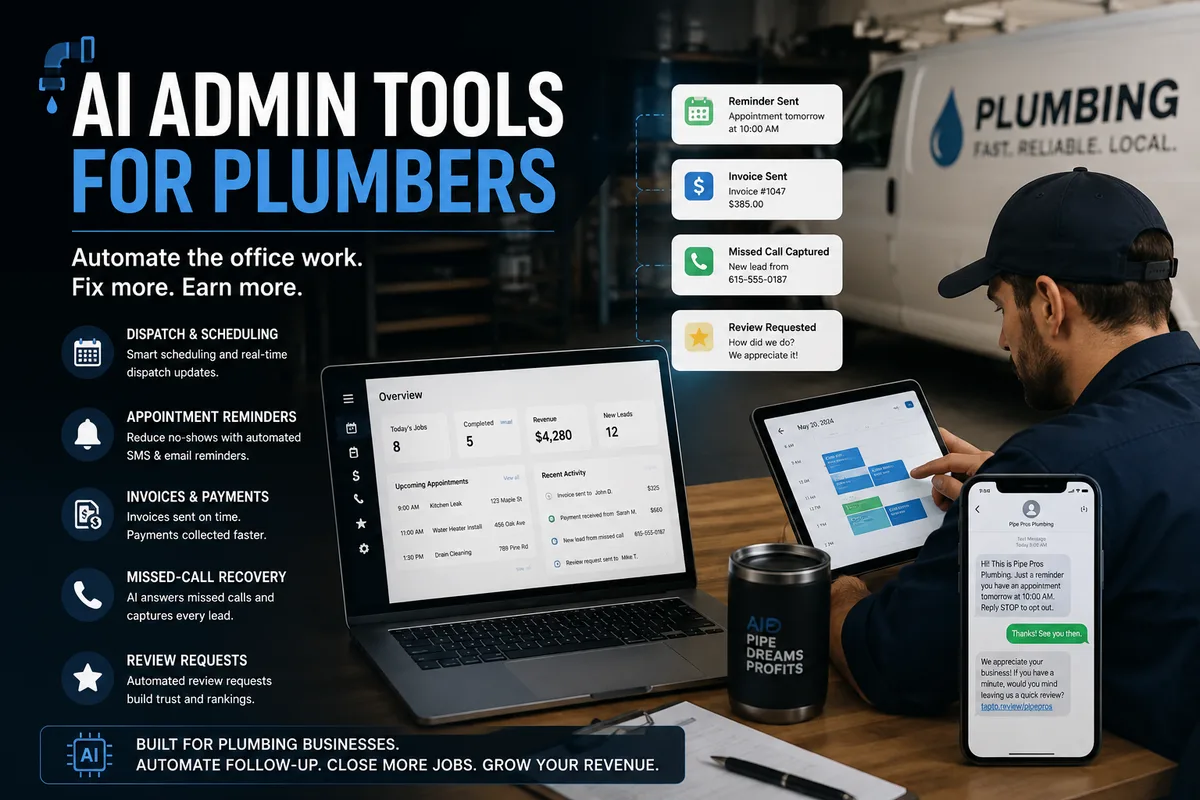
AI Admin Tools for Plumbers: What They Are and How to Choose
AI admin tools automate dispatch, reminders, invoicing follow-up, missed calls, and review requests for plumbers. What they do and how to choose.
Insurance Eligibility Automation for Physical Therapy Clinics
Eligibility automation for physical therapy clinics verifies benefits before the patient arrives, cuts front desk phone work, and can lower claim denial risk.

What Two-Way Sync Between AI and ServiceTitan Looks Like in Practice
Two-way sync between AI and ServiceTitan means data flows both directions: the AI reads live job and customer data from ServiceTitan, and writes new bookings.