
AI Voice Agent for Small Business: What It Does in 2026
An AI voice agent for small business is software that answers inbound calls, handles common questions, books appointments, and qualifies leads automatically. The value comes from coverage, consistency, and fewer missed opportunities, not from a generic payback promise.
Most small businesses lose inbound calls to voicemail or missed rings. AI voice agents answer calls, book appointments, qualify leads, and reduce front-desk.
Epiphany Dynamics is an AI automation agency: we help businesses find and fix operational bottlenecks with AI receptionists, lead follow-up, and workflow automation.
Free 30-minute audit. We name at least 3 things you can automate, ranked by impact.
Book a free AI audit
Patrick Gibbs
An AI voice agent for small business is software that answers inbound calls, handles common questions, books appointments, and qualifies leads automatically. The value comes from coverage, consistency, and fewer missed opportunities, not from a generic payback promise.
Phone calls are still how most service businesses get customers. For urgent services like plumbing, HVAC, or emergency locksmith work, the phone is usually the first move, and callers rarely bother with a contact form or live chat. Nobody with a burst pipe is filling out a contact form.
The problem is that most small businesses answer somewhere around most of their inbound calls on a normal day. After hours, that drops near zero. Every missed call is a warm lead that called your competitor next. AI voice agents close that gap, and in 2026, after several generations of model improvement, they've become good enough that most callers can't tell the difference.
What an AI Voice Agent Actually Does
An AI voice agent answers inbound calls without a human on the line. It understands natural speech, books appointments directly into your calendar, sends confirmation texts, and routes complex issues to a live person. The whole process mirrors the repeatable parts of trained reception work without adding another front-desk hire.
The key distinction from older IVR phone trees is that these agents handle open-ended questions, not just menu inputs. A caller can say "do you guys service older units?" or "what's your earliest opening next week?" and the agent reasons through the answer based on your actual business rules. It's not reading from a static FAQ list. For a clean breakdown of how this kind of autonomous reasoning works, the piece on what an AI agent actually is explains the mechanics without the marketing language.
What's happening behind the scenes is worth understanding. When someone calls to book an HVAC inspection, the agent checks your real-time calendar, confirms the address, creates the job record in your CRM, and fires a confirmation SMS before the caller hangs up. That's the same repeatable work a good receptionist does, minus the hold queue.
Where it still has limits: emotionally charged calls, complicated billing disputes, or callers who aren't sure what they need. Every responsible deployment includes a clean escalation path for exactly these situations. The goal is handling routine calls that follow a known pattern, not eliminating the human layer entirely.
The Real Cost Drivers
The cost comparison is not just "software versus salary." Reception coverage includes payroll, benefits, training, turnover, management time, and limited availability. AI voice agents shift the model toward platform, usage, setup, and integration costs, so the right comparison depends on your current call volume and missed-call exposure.
| Cost Item | Human Receptionist | AI Voice Agent |
|---|---|---|
| Core cost | Salary, taxes, benefits, and management time | Platform, usage, setup, and integration work |
| Coverage model | Limited by staffing schedule and breaks | Available after hours and during call spikes |
| Scalability | One caller at a time unless you add more staff | Can handle simultaneous routine calls |
| Ramp cost | Recruiting, onboarding, and training | Call-flow design, testing, and system setup |
| After-hours coverage | Requires extra staffing or an answering service | Built into the workflow when configured correctly |
| Quality control | Managed through training and supervision | Managed through transcript review and tuning |
| Best comparison metric | Cost per productive front-desk hour | Cost per resolved call or booked appointment |
The table makes the cost categories clearer. What it doesn't show is the capacity multiplier. An AI agent can handle simultaneous routine calls during a demand spike, while a single human receptionist has to put callers on hold or let some hit voicemail. That's where leads disappear.
If you're not replacing a receptionist but evaluating against an answering service, the same comparison applies. Many answering services relay messages but do not book appointments, sync to your CRM, or write structured call records directly. The AI phone answering breakdown for home service businesses walks through how that difference shows up for HVAC and plumbing specifically.
See also AI Answering Service for Small Business: A 2026 Guide.
Which Businesses Get the Most Out of It
Service businesses with high call volume and predictable booking flows see the clearest ROI from AI voice agents. HVAC, plumbing, dental practices, law firm intake, home cleaning, and real estate offices all fit this profile. Businesses with irregular or highly consultative needs tend to see less immediate benefit because the call flows are harder to design reliably.
The pattern holds because ROI scales with volume and repetition. If most inbound calls are variations of the same scheduling, qualification, or routing request, the agent can handle those and your team can focus on calls that actually need them. A high-volume service business benefits more clearly than a custom shop with low call volume and a different question every time.
Dental practices are a particularly instructive example. New patient intake, appointment reminders, insurance verification questions, and rescheduling requests follow tight, repeatable patterns. Several mid-sized dental groups have reported a large reductions in front-desk call volume after deploying voice AI, which either frees staff for in-office work or reduces the need to hire additional admin headcount. For a broader look at how this plays out across different verticals, real AI automation examples across HVAC, dental, real estate, and insurance covers case-level detail worth reviewing before you commit to a build.
How to Deploy One Without Wasting Money
The most expensive deployment mistake is going live without a designed call flow. Before picking a platform, map your most common call types, write expected dialogue for each, and define exactly what triggers escalation to a human. Teams that skip this step usually spend the launch period fixing preventable workflow problems.
The platform decision matters less than most people assume. Retell AI, Vapi, and Air AI are common options, and the capability gap between major voice platforms has narrowed. What separates good deployments from failed ones is almost entirely the pre-build work: call flow mapping, script writing, integration planning, and escalation design. A sharp script on a decent platform outperforms a mediocre script on the best one.
A workable deployment sequence: review recent call recordings and categorize every call type by frequency. Write scripts for the most common categories. Define hard escalation rules, meaning the exact triggers that send a call to a human immediately, not a judgment call the agent has to make in the moment. Connect your calendar and CRM before going live, not after. Run a controlled soft launch, review transcripts daily, and tune before full rollout. The complete guide to AI virtual receptionists for small business has a side-by-side platform comparison if you're still evaluating your options.
Where Most Deployments Go Wrong
Most AI voice agent failures aren't technical. They're deployment failures. Agents go live with no escalation path, scripts that don't reflect how real customers talk, and no early review of call transcripts. The technology works. The implementation shortcuts are what kill most deployments before they get a fair shot.
Voice and tone mismatches are more common than expected. If your business has a casual, local feel and your agent sounds like a corporate call center, callers notice. They don't always articulate why, but completion rates drop. Most platforms let you choose voice models and adjust phrasing. Take that part seriously during the build, not as an afterthought before launch.
Call duration also affects cost more than most operators budget for. Platforms with usage-based billing get more expensive when scripts are inefficient or callers get stuck in loops. Tight scripts that move conversations toward resolution are not just better caller experience. They are cheaper to run.
Post-call follow-up is where most businesses leave real money on the table. The agent booked the appointment. Did it send a reminder before the visit? Did it trigger a review request after the job closed? Building follow-up into the workflow from the start is how you go from "the AI answers calls" to "the AI drives measurable revenue." The AI workflow automation guide for small business covers how to connect these pieces into a system that does considerably more than pick up the phone.
The bar for deploying an AI voice agent is lower than most small business owners expect, and the cost of waiting keeps rising as more competitors add it. A missed call in 2026 isn't an inconvenience. It's a lead with somewhere else to go. The businesses seeing measurable ROI aren't necessarily the first movers. They're the ones who designed the deployment carefully. If you want an honest evaluation of whether the build makes sense for your specific situation, Epiphany Dynamics builds these systems for service businesses and will give you a straight answer without the sales pressure.
If you keep the business number on a mobile phone, review how mobile call routing connects to an AI receptionist. For a wider staffing assessment, use the front-desk workload guide.
Frequently Asked Questions
Q: How quickly does an AI voice agent pay for itself?
That depends on your current reception cost, missed-call volume, booking rate, and setup quality. The right way to model it is to compare current front-desk or answering-service spend against the value of calls the agent can answer, qualify, and book without manual follow-up.
Q: Can an AI voice agent actually book appointments directly into my calendar?
Yes—modern agents integrate with Google Calendar, Calendly, or industry-specific booking software and automatically send confirmation texts to customers. The agent checks real-time availability, prevents double-booking, and escalates to a human if your schedule is full or the request requires judgment.
Q: What happens when a customer asks something the AI voice agent doesn't understand?
Today's agents recognize when a question falls outside their knowledge and smoothly transfer the call to a team member or offer to collect the customer's number for a callback. The threshold for "I don't know—let me get someone" is much lower than it used to be, so customers rarely feel frustrated by the handoff.
Q: Which types of small businesses see the fastest ROI from an AI voice agent?
Service businesses with high call volume and appointment-based models - plumbing, HVAC, dental, auto repair - usually have the clearest case because the agent's core strengths are scheduling, qualification, routing, and after-hours capture. Businesses with low call volume or highly bespoke calls should model the workflow before buying.
Patrick Gibbs
AI Automation Expert
Patrick Gibbs helps professional practices implement AI automation that captures more leads, books more appointments, and scales without adding overhead. He's the founder of Epiphany Dynamics and creator of the AI Front Desk system.
Related Solutions
Build this into a real workflow
Related Posts
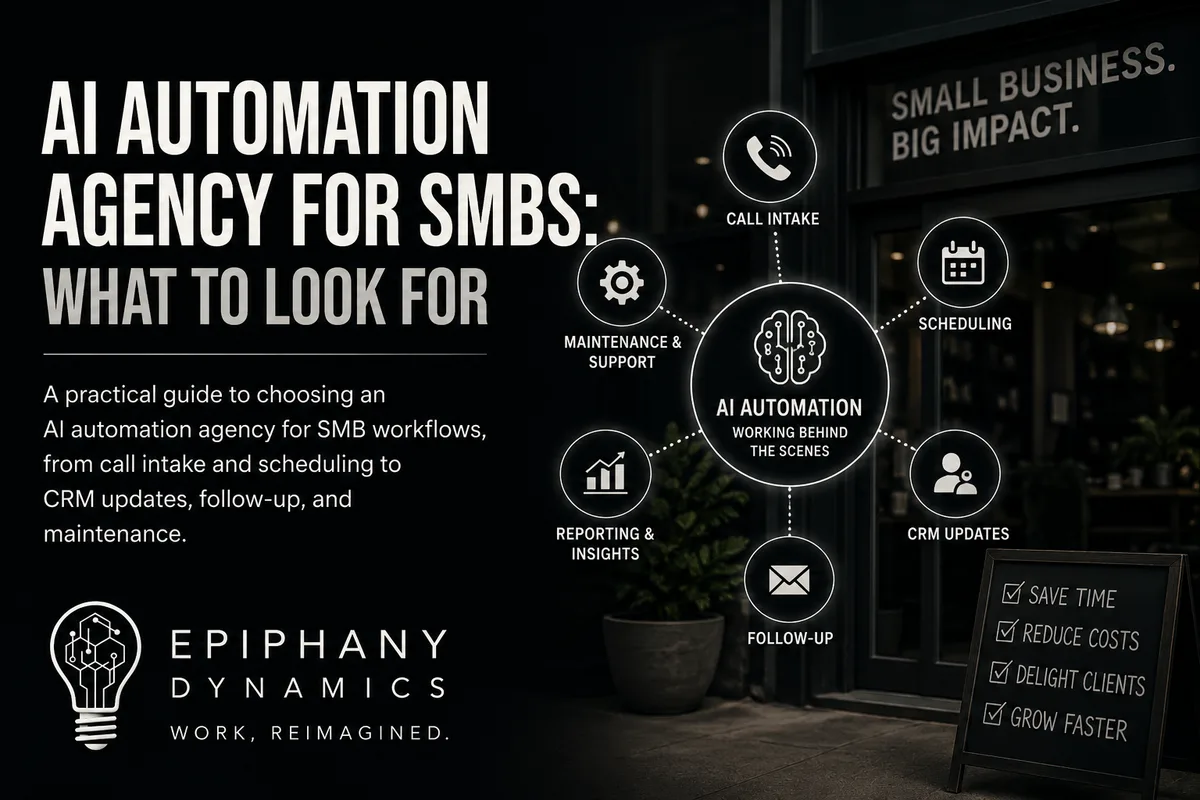
AI Automation Agency for SMBs: What to Look For
A practical guide to choosing an AI automation agency for SMB workflows, from call intake and scheduling to CRM updates, follow-up, and maintenance.
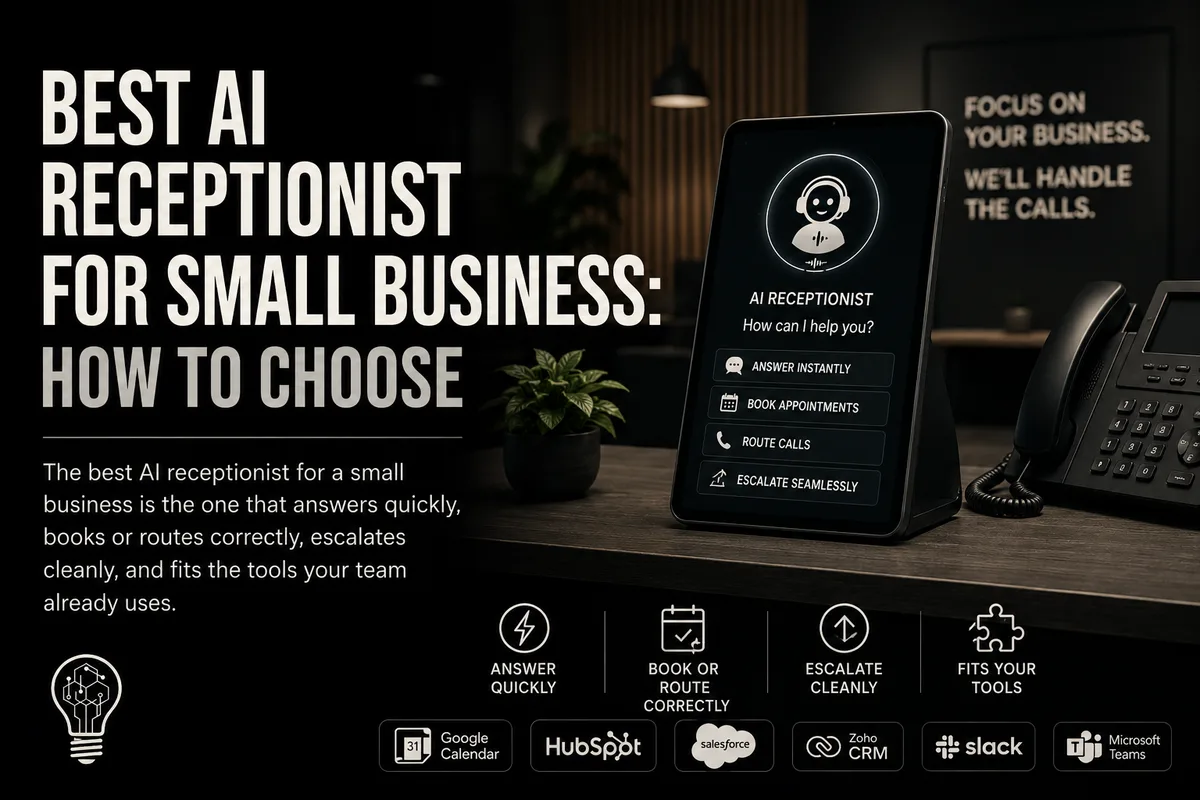
Best AI Receptionist for Small Business: How to Choose
The best AI receptionist for a small business is the one that answers quickly, books or routes correctly, escalates cleanly, and fits the tools your team.
Appointment Reminder Automation for Small Business (2026 Guide)
For a service business with a meaningful no-show rate, the revenue leak is worth measuring. This guide covers how reminder automation works, which tools to.