
Missed Call Text Back for Plumbers: Setup Guide and ROI Model
Missed call text back for plumbers is an automated system that sends an SMS to any caller who doesn't reach a live person. When set up with a specific message, a clear next step, and a fast reply workflow, it gives the caller a path back before they move on.
Plumbing companies miss valuable inbound calls during peak hours. Here's how missed call text back works, what to measure, and where most setups fall short.
Epiphany Dynamics is an AI automation agency: we help businesses find and fix operational bottlenecks with AI receptionists, lead follow-up, and workflow automation.
The free 30-minute AI Operations Audit is a conversation about a normal week in your business and where the work piles up. We find the one change that would give you the most time back and send you a plain-English plan for it. No forms and no pitch.
Book a free AI audit
Patrick Gibbs
Missed call text back for plumbers is an automated system that sends an SMS to any caller who doesn't reach a live person. When set up with a specific message, a clear next step, and a fast reply workflow, it gives the caller a path back before they move on. The message content and the speed of follow-up determine whether that missed call becomes a booked job.
Plumbers miss calls constantly. A technician elbow-deep in a pipe replacement isn't answering the phone. Neither is an owner managing a crew during a busy afternoon. Missing calls isn't a character flaw, it's physics. The question isn't whether calls get missed. It's what happens immediately after the caller hangs up.
Many callers don't leave voicemails. The ones who do leave a message often don't answer when you call back, because they've already moved on to the next result in Google. An automated text that lands quickly after a missed call is the intervention that can stop that process before it finishes.
What "Missed Call Text Back" Actually Does
Missed call text back detects when an inbound call goes unanswered and fires an automated SMS to that caller quickly. The speed of delivery is what creates the advantage: the message arrives while the problem is still active in the caller's mind.
The mechanism is simple. Your phone system monitors for calls that end without being answered. When one drops, it pulls the caller's number and pushes an outbound SMS automatically. No human involved, no delay, no decision required. The text arrives while the caller still has your business in front of them.
What makes this work for plumbing specifically is the urgency profile of the jobs. Someone calling about a backed-up main line or a water heater that stopped working isn't browsing options casually. They need help soon. If your automated text reaches them quickly with a clear path forward -- whether that's a booking link, an estimated callback time, or a way to describe the problem -- you stay in the conversation. Without it, you're out before you knew you were in.
This is meaningfully different from having a voicemail. Voicemail is passive. A text is active. If your recovery strategy depends on the other person listening to an audio clip and then calling you back, that strategy has a serious leak in it.
The Revenue Math: What Each Missed Call Actually Costs
A plumbing company with recurring missed calls loses more than the first job. The number grows when you factor in repeat business and referrals from customers who never got through the first time.
Use your own numbers instead of a generic benchmark:
| Input | Why It Matters |
|---|---|
| Missed calls by daypart | Shows when phone coverage fails |
| Average job value by call type | Separates routine work from emergency work |
| Reply and booking rate | Turns text responses into a booked-work model |
Inbound volume often peaks when technicians are moving between jobs and no one is watching the phone. That is why missed-call text back needs to be measured by daypart, not only by weekly total.
The lifetime value problem makes this worse than the first job shows. Residential plumbing customers can call again and refer their neighbors. Losing someone on their first call may cost future work, not just the immediate ticket. For a more detailed look at how to calculate your specific revenue exposure, the breakdown at Unanswered Business Calls: Calculating the True Revenue Cost walks through the full calculation with real inputs.
For another angle, see Missed Call Text Back Automation: Build It Right in 2026.
What the Text Message Should Actually Say
A strong missed call text for plumbers includes the company name, an acknowledgment that the call was missed, a specific next step such as a booking link or a defined callback window, and a way to reply by text. Plain language beats formal or vague templates.
Here's where most setups fail. The text gets sent, but it says something like: "Hi, we missed your call. We'll get back to you soon!" That message will get opened. It won't convert anyone. The caller is still in problem-solving mode and "we'll get back to you soon" tells them nothing useful. It doesn't stop them from calling the next plumber on the list.
Compare that to: "Hey, this is River City Plumbing. We missed your call. Book here: [link] or reply and tell us what's going on. We'll call you back as soon as a dispatcher is free." That message tells them who you are, gives them a self-serve option, and sets an expectation.
A few things that matter in the actual wording:
- Include your company name. Callers sometimes forget who they called, especially if they hit multiple numbers in a row.
- Set a specific callback expectation instead of saying "shortly" or "as soon as possible."
- Give them a way to respond by text. Many people, especially during the workday, won't take a call but will text back their situation quickly.
- Skip the sales pitch. An auto-text is not the place to mention your 5-star rating or years in business. Someone with a flooding bathroom doesn't care about that yet.
Where Missed Call Text Back Falls Short
Missed call text back captures intent but doesn't qualify jobs, collect location details, assess urgency, or book appointments. For plumbing companies with steady inbound volume, the text opens a door that still needs someone to walk through it. Without a fast, structured reply process, most of those text responses go cold before they become booked jobs.
This is the part most vendors selling text-back tools skip. Getting a reply is not booking a job. When someone texts back "yeah my water heater is leaking," that message lands somewhere. Who responds? How fast? With what next question? If the answer is "my office manager, when she gets to it," you've reduced the missed call problem while creating a new bottleneck three steps later.
A text reply that gets a human response the next morning isn't a recovery. It's just a slower version of being missed. If you're evaluating which tools actually handle the intake conversation and not just the first outbound message, the comparison in this evaluation guide for AI tools built for plumbing companies is worth reading before you commit to anything.
After-hours is where this problem sharpens. Emergency plumbing calls don't respect business hours. If no one handles that conversation until the next morning, the caller has probably found someone else. The AI receptionist setup built specifically for plumbing companies handles this by managing the reply conversation automatically, collecting job details, and either booking the appointment or escalating based on urgency. That's the gap a simple text-back tool can't cover.
Setting It Up: What Actually Matters
Setting up missed call text back for a plumbing company requires a VoIP or hosted phone system that exposes missed call events, an SMS-capable number, a tested message template, and a defined process for handling replies quickly. The reply handling is where most setups break down, not the initial send.
On the technical side, most modern phone platforms handle the core trigger natively. GoHighLevel, OpenPhone, and Dialpad all include missed call text-back features built in. If your current system doesn't support it, you can wire the same outcome through a workflow tool like Make or Zapier using a webhook from your phone provider into an SMS service like Twilio or Vonage. Setup depends on your phone provider, SMS sender, and who handles replies.
The harder part is the operational side. Decide in advance who handles incoming text replies, at what hours, and with what script for the follow-up conversation. If you're a solo operator, that's you until you add coverage. If you have office staff, the reply workflow needs to be a defined responsibility, not something that happens when someone notices their phone buzzing. A shared inbox where all text threads land is worth setting up early so nothing disappears into one person's device.
After-hours coverage is where this decision gets real. If emergency plumbing jobs are a meaningful part of your revenue mix, a text-back alone won't cut it after close. You need either a person on call, a live answering service, or AI handling the reply conversation around the clock. The options and tradeoffs for each are worth understanding before you scope the system. The full picture on how AI phone answering works for home service businesses covers this in detail, including what kinds of calls AI handles well versus when a human touch still matters.
Missed call text back is not a complete solution on its own. It's the first piece of a follow-up system, and a genuinely useful one when the rest of the pieces are in place. If you want to understand your actual revenue exposure before you scope anything, the missed calls cost calculator is a good place to start. Epiphany Dynamics builds these full systems for plumbing and other service businesses, if you end up wanting someone to put the pieces together for you.
Frequently Asked Questions
Q: What ROI can plumbers expect from missed call text back systems?
ROI depends on how many missed callers respond, how many responses turn into booked jobs, and how quickly your team or AI handles the reply. Track missed calls, text replies, booked appointments, and average job value before deciding whether the system is paying off.
Q: Why do customers respond to texts faster than voicemail callbacks?
Text messages arrive instantly while the plumbing emergency is still front-of-mind, whereas the customer has already moved on to the next Google result by the time you return a voicemail. The psychological urgency window is narrow; someone calling about a burst pipe won't wait around for a callback when competitors answer directly.
Q: How quickly must a missed-call text arrive to actually work?
The text should land quickly enough that the caller is still deciding who to hire. That is why automation matters: a human usually cannot notice the missed call, write the message, and send it before the caller moves on.
Q: Is missed call texting worth implementing for a solo plumber?
Yes, if the solo plumber has enough missed-call volume and a clear plan for handling replies. The text can start the recovery, but booked revenue still depends on how quickly the conversation turns into a scheduled job.
Patrick Gibbs
AI Automation Expert
Patrick Gibbs helps professional practices implement AI automation that captures more leads, books more appointments, and scales without adding overhead. He's the founder of Epiphany Dynamics and creator of the AI Front Desk system.
Related Solutions
Build this into a real workflow
Related Posts
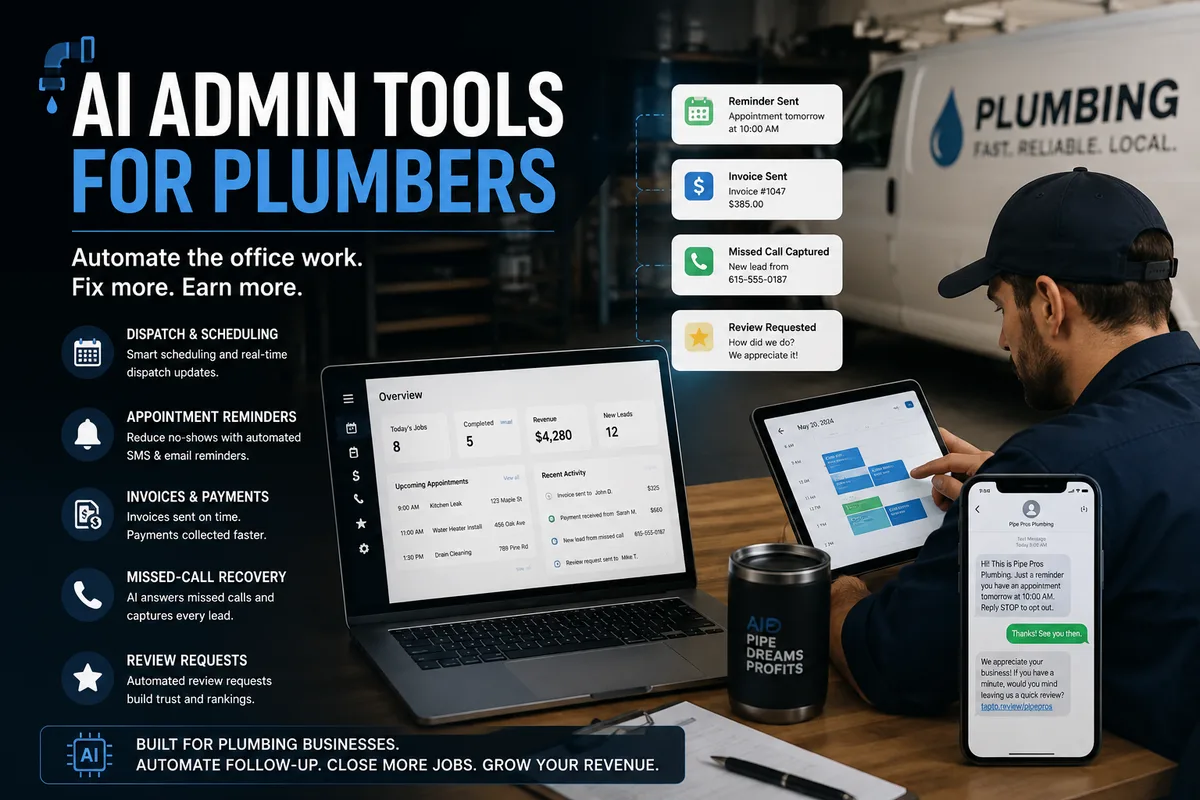
AI Admin Tools for Plumbers: What They Are and How to Choose
AI admin tools automate dispatch, reminders, invoicing follow-up, missed calls, and review requests for plumbers. What they do and how to choose.
Insurance Eligibility Automation for Physical Therapy Clinics
Eligibility automation for physical therapy clinics verifies benefits before the patient arrives, cuts front desk phone work, and can lower claim denial risk.
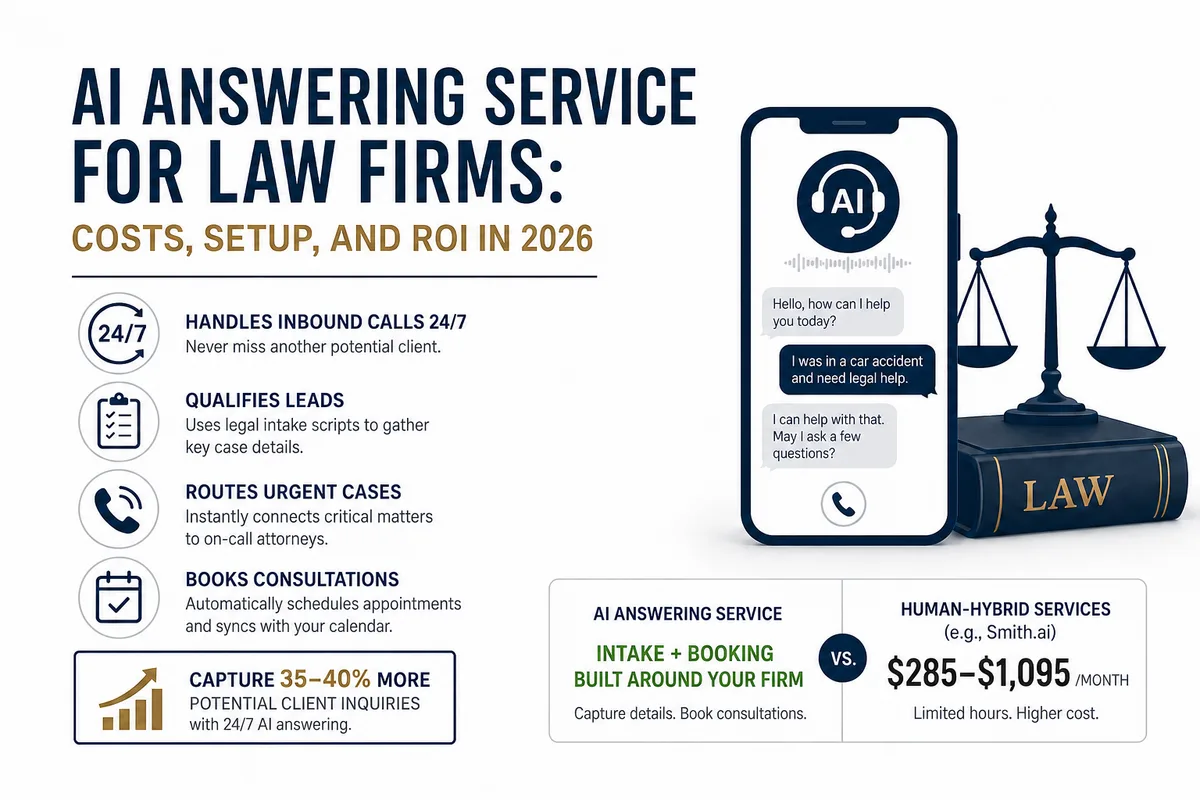
AI Answering Service for Law Firms: Costs, Setup, and ROI in 2026
Law firms miss a large share of inbound calls, most of them after hours. Here's what an AI answering service actually does, what it costs versus human.