
Best AI Tools for Ecommerce Stores in 2026
The best AI tools for ecommerce stores in 2026 include AI chatbots for customer support, AI product recommendation engines, automated abandoned cart recovery sequences, and AI-powered inventory forecasting. Top picks include Intercom or Zendesk AI for support, Nosto or Dynamic Yield for personalization, Klaviyo for email and SMS recovery, and Inventory Planner for demand forecasting.
The best AI tools for ecommerce stores automate customer support, product recommendations, abandoned cart recovery, and inventory management.
Epiphany Dynamics is an AI automation agency: we help businesses find and fix operational bottlenecks with AI receptionists, lead follow-up, and workflow automation.
The free 30-minute AI Operations Audit is a conversation about a normal week in your business and where the work piles up. We find the one change that would give you the most time back and send you a plain-English plan for it. No forms and no pitch.
Book a free AI audit
Patrick Gibbs
The best AI tools for ecommerce stores in 2026 include AI chatbots for customer support, AI product recommendation engines, automated abandoned cart recovery sequences, and AI-powered inventory forecasting. Top picks include Intercom or Zendesk AI for support, Nosto or Dynamic Yield for personalization, Klaviyo for email and SMS recovery, and Inventory Planner for demand forecasting. Ecommerce stores using a full AI stack can improve revenue when the tools are connected to real support, cart, personalization, and inventory workflows.
Why Ecommerce Stores Need AI Tools
Ecommerce operates on speed and personalization. Customers expect instant answers to product questions, personalized recommendations, and follow-up if they abandon their cart. Without AI, stores rely on manual support teams that cannot scale, generic email blasts that convert poorly, and inventory guesses that create stockouts or overstock. Each of these gaps directly reduces revenue per visitor and lifetime value per customer.
The numbers on customer experience are stark. Research across thousands of ecommerce stores shows that most customers will leave a site without buying if they cannot find a quick answer to a product question. Abandoned carts are common across ecommerce, and automated recovery sequences help stores reclaim revenue that would otherwise disappear. Product recommendation engines meaningfully increase average order value when properly configured.
Inventory management is the hidden cost. Stockouts cost ecommerce stores potential revenue, while overstock ties up capital that could fund growth. AI-powered demand forecasting reduces inventory costs significantly while maintaining or improving in-stock rates.
How We Evaluated the Best AI Tools for Ecommerce Stores
We evaluated each tool on 12 criteria: customer support automation, personalization depth, cart recovery capability, inventory accuracy, platform integration, pricing model, setup complexity, scalability, reporting quality, mobile optimization, ROI timeline, and verified store results.
Evaluation Criteria
- Support Automation - Can the AI handle product questions, order status, returns, and shipping inquiries autonomously
- Personalization - Product recommendation quality, homepage personalization, and email targeting capabilities
- Cart Recovery - Multi-channel (email, SMS, push) recovery sequences with timing optimization
- Inventory Forecasting - AI-based demand prediction, safety stock calculation, and replenishment timing
- Platform Integration - Native support for Shopify, WooCommerce, BigCommerce, Magento, and custom stores
- Pricing Model - Predictable costs without per-conversation or per-personalization fees
- Setup Time - Effort required to get the first automated workflow running on your store
- Scalability - Performance during high-volume periods like Black Friday or holiday surges
- Reporting - Attribution, revenue lift measurement, and A/B testing of automated flows
- Mobile Optimization - Mobile-friendly chat interfaces, SMS capabilities, and push notification support
- Payback Indicators - Signals that recovered carts, better support, and increased AOV can justify the tool
- User Reviews - Verified store owner feedback and aggregate rating across ecommerce-specific deployments
Best AI Tools for Ecommerce Stores Quick Reference
Best for Customer Support Automation
Intercom AI and Zendesk AI lead the customer support automation space with conversational chatbots that handle a large share of common inquiries without human intervention. They integrate with Shopify, WooCommerce, and BigCommerce to pull order data, tracking information, and product details in real time.
Best for Product Recommendations and Personalization
Nosto and Dynamic Yield provide AI-powered product recommendations, homepage personalization, and email targeting. Nosto is stronger for mid-market stores on Shopify and BigCommerce. Dynamic Yield handles enterprise complexity and multi-brand stores better.
Best for Abandoned Cart Recovery
Klaviyo is the gold standard for ecommerce email and SMS automation, with AI-optimized send times, personalized product blocks, and multi-step recovery sequences. Stores using Klaviyo's abandoned cart flows can recover carts that would otherwise be lost. Omnisend is a strong alternative for SMS-heavy recovery strategies.
If you want to understand the full agent model behind modern recovery, our AI agent for ecommerce cart recovery guide explains how agents trigger, personalize, and measure recovery across email and SMS, and how they differ from chatbots and static sequences.
Best for Inventory Management
Inventory Planner uses AI to forecast demand based on historical sales, seasonality, and marketing calendar events. It connects to major ecommerce platforms and recommends purchase quantities with confidence intervals.
Best for Review and Reputation Management
Automated review request sequences that send post-purchase emails or SMS messages asking for product reviews help stores build social proof at scale. AI can analyze review sentiment and flag negative reviews for immediate response.
For related material, see Best AI Agency for Ecommerce in 2026.
How to Choose the Right AI Tools for Your Ecommerce Store
Start with cart recovery automation because it is usually the simplest revenue workflow to measure. Add a customer support chatbot next to reduce support ticket volume. Layer in product recommendations once you have enough traffic to train the models. Inventory forecasting can follow when you have enough historical sales data to make demand patterns meaningful.
A smaller store should start with a basic stack that covers cart recovery and customer support chat. Larger stores usually need a fuller stack that includes chat, personalization, inventory planning, and deeper reporting. The ROI from recovered carts depends on abandoned-cart volume, average order value, and how much revenue the store currently loses after checkout intent.
Platform compatibility is the most common pitfall. Most AI tools integrate natively with Shopify. WooCommerce requires more configuration. Custom Magento or headless commerce setups may need API-level integration support.
Frequently Asked Questions
How much do AI tools for ecommerce increase revenue?
Stores using a complete AI stack (chat, personalization, cart recovery, inventory) can increase revenue when each tool is tied to a clear workflow and measured against a baseline. Cart recovery adds abandoned carts back to revenue, and personalization can improve average order value when recommendations are relevant.
Can AI handle complex customer service for ecommerce?
AI handles many common inquiries including order status, shipping questions, return policies, and product availability. Complex issues like damaged items, exchanges, or custom orders still need human agents. The AI should escalate automatically when it cannot resolve the issue.
What is the easiest AI tool to set up for an ecommerce store?
Abandoned cart recovery through Klaviyo or Omnisend is usually the easiest setup because the workflow is narrow and template-driven. AI chatbots require more setup time since they need product data and FAQ configuration.
Do AI tools work with my ecommerce platform?
Shopify has the broadest integration support, with most AI tools offering native connectors. WooCommerce requires third-party plugins or API setup for many tools. Always verify platform compatibility before subscribing.
For more on how AI supports ecommerce operations, see our workflow automation guide and our AI chatbot platform comparison. To discuss your store's specific automation needs, book a consultation.
Patrick Gibbs
AI Automation Expert
Patrick Gibbs helps professional practices implement AI automation that captures more leads, books more appointments, and scales without adding overhead. He's the founder of Epiphany Dynamics and creator of the AI Front Desk system.
Related Solutions
Build this into a real workflow
Related Posts
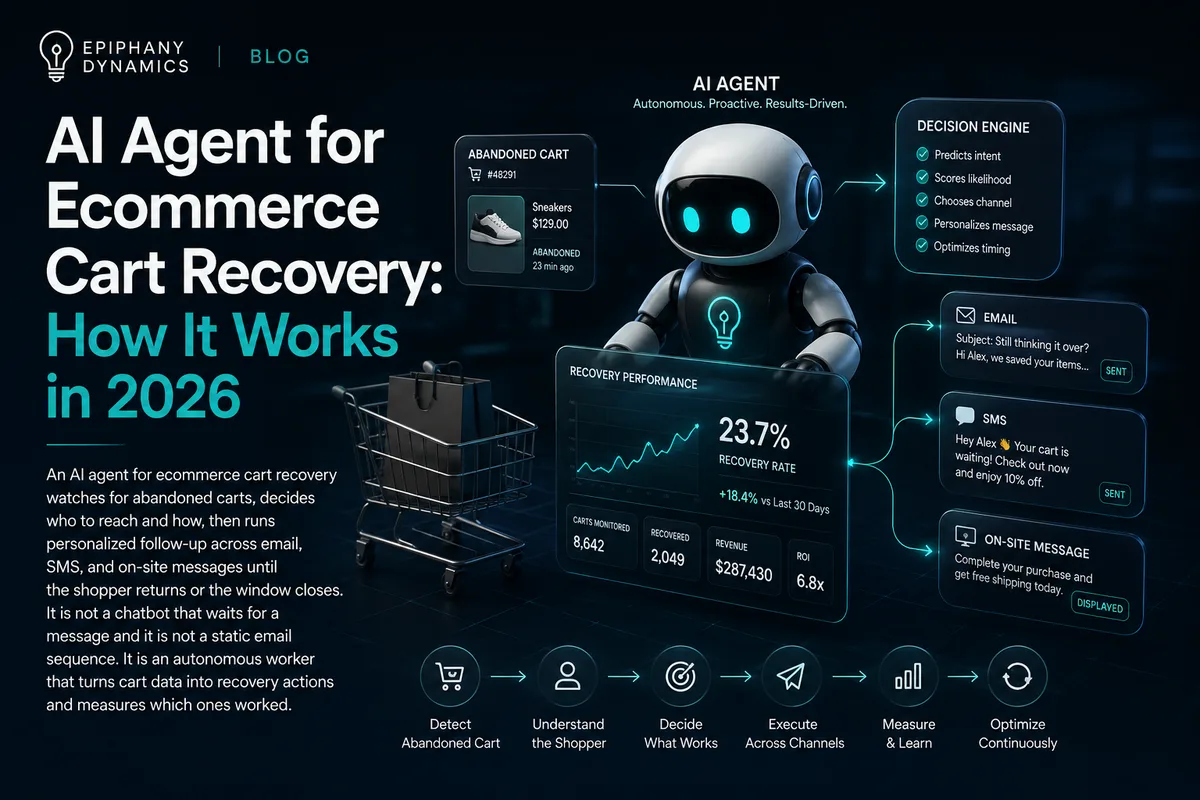
AI Agent for Ecommerce Cart Recovery: How It Works in 2026
AI agents recover abandoned ecommerce carts automatically. How they work across email and SMS, what they cost, and how to pick one for your store.

Ruby Receptionists Alternatives in 2026: What's Worth Switching To
Ruby's per-minute model can get painful at higher call volumes. Here's a straight comparison of the alternatives actually worth evaluating, including AI.

Best AI Agency for Ecommerce in 2026
The best AI agency for ecommerce understands cart abandonment, customer support volume at scale, and the difference between a product question and a shipping.