
Ruby Receptionists Alternatives in 2026: What's Worth Switching To
The top Ruby Receptionists alternatives in 2026 include Smith.ai, Abby Connect, PATLive, VoiceNation, and AI-native solutions. The right fit depends on your call volume, how complex your typical calls run, whether you need a human voice on every call, and whether missed calls are actually costing you revenue every month.
Ruby's per-minute model can get painful at higher call volumes. Here's a straight comparison of the alternatives actually worth evaluating, including AI.
Epiphany Dynamics is an AI automation agency: we help businesses find and fix operational bottlenecks with AI receptionists, lead follow-up, and workflow automation.
Free 30-minute audit. We name at least 3 things you can automate, ranked by impact.
Book a free AI audit
Patrick Gibbs
The top Ruby Receptionists alternatives in 2026 include Smith.ai, Abby Connect, PATLive, VoiceNation, and AI-native solutions. The right fit depends on your call volume, how complex your typical calls run, whether you need a human voice on every call, and whether missed calls are actually costing you revenue every month.
Ruby is one of the better-known names in live virtual receptionist services, and that reputation is earned. The receptionists are trained well, coverage is reliable, and the service has been around long enough to smooth out most of the operational rough edges. But "it works" and "it's the right service for your specific business" are two different answers. Some businesses are paying for a premium human service when a competing service, hybrid model, or purpose-built AI could handle the same call pattern more efficiently. This article breaks down the real alternatives, the cost model to compare, and how to make the decision without just trusting a sales demo.
What Ruby Receptionists Actually Costs (and Where the Math Gets Uncomfortable)
Ruby's model is built around included receptionist minutes, with higher tiers covering more usage and overage charges once you exceed the plan. That structure is easy to understand at low, steady call volume, but it can become uncomfortable when calls get longer, busier, or less predictable.
For a solo practitioner or boutique professional services firm taking a steady stream of short calls, Ruby can be easy to justify. You get a professional greeting, reliable coverage, message taking, and basic call routing. The cost-per-call stays manageable when usage is predictable. The pricing structure starts working against you when call volume climbs, or when your average call runs longer than expected.
| Plan Type | Cost Pattern | Usage Pattern | When It Gets Uncomfortable |
|---|---|---|---|
| Entry tier | Lowest base commitment | Short, predictable call handling | Busy months can push you into overage quickly |
| Small-business tier | Higher base commitment with more included usage | Steady reception coverage and message taking | Longer calls raise effective cost per handled issue |
| Growing-volume tier | More predictable for busier teams | Routine calls plus some routing and scheduling support | Still usage-based if call volume spikes |
| Larger-volume tier | Highest base commitment in the comparison set | Frequent live receptionist coverage | May be overkill if most calls are predictable and automatable |
The right question is not whether Ruby is expensive in the abstract. It is whether the calls being handled justify a premium human receptionist model. That may be true for high-trust professional services where every caller needs judgment and warmth. It is a different calculation for a plumbing or HVAC company where a significant portion of calls are service-area checks, appointment requests, or basic routing. The overage problem compounds this: blow past your usage bucket in a busy month and the economics start pushing you toward alternatives.
The Best Ruby Receptionists Alternatives in 2026
Smith.ai is the most direct Ruby competitor, offering comparable human coverage with a stronger integration library. Abby Connect leans into dedicated receptionist teams. PATLive suits price-sensitive operations that care more about coverage than boutique polish. AI-native solutions fit businesses with predictable call patterns that need routing, booking, and follow-up more than a live human on every call.
| Service | Cost Pattern | Type | Best Fit |
|---|---|---|---|
| Smith.ai | Human/hybrid service with usage-based packaging | Human + AI hybrid | Legal, medical, real estate |
| Abby Connect | Premium human receptionist model | Human, dedicated teams | Professional services, boutique firms |
| PATLive | Budget-conscious human coverage | Human | Home services, retail, higher volume |
| VoiceNation | Flat-rate oriented human coverage | Human | Businesses wanting flat-rate predictability |
| Moneypenny | Custom pricing | Human, dedicated model | Mid-size to larger SMB |
| AI-native build | Automation-first cost structure | AI | Service businesses with predictable, high-volume call patterns |
Smith.ai is the one that most directly overlaps with what Ruby offers. They run a hybrid model where an AI layer handles parts of each interaction and routes to a human for anything requiring real judgment. Their integration library (Clio, Salesforce, HubSpot, Zapier, and a long list of others) is more extensive than Ruby's, which matters considerably if you're trying to get call data into a CRM without double-entry. Pricing at similar volume is comparable to Ruby, but the integrations often tip the decision for businesses that need clean data flow.
PATLive is worth a serious look if you're budget-conscious and fielding higher call volumes. Their model tends to suit businesses that want reliable coverage and scheduling assistance more than a boutique experience. Quality is solid, not premium. Think of it as the practical mid-tier option for home services and field service businesses where coverage matters more than white-glove tone.
AI Receptionists vs. Human Virtual Receptionists: The Real Trade-Off
Human virtual receptionists handle judgment calls well. AI receptionists handle routine routing, appointment requests, and after-hours capture consistently. For businesses where most calls are predictable, AI with escalation paths built in often wins on economics and consistency. Complex calls, unhappy customers, and situations that require real judgment are where humans genuinely earn their fee.
Most business owners assume they need a human on the line because some calls are complicated. That's true, but it's worth logging real inbound calls and categorizing them before you build pricing around the assumption. In many service businesses, a large share of calls fall into predictable categories: appointment requests, service area questions, pricing inquiries, hours and availability. A well-built AI receptionist handles those cleanly and escalates anything outside scope. The complicated calls, the unhappy customers, the situations that need real judgment, that's the slice where a human is worth the usage-based rate.
In Smith.ai's hybrid model, the AI layer handles a meaningful share of calls without any human involvement at all. That directly reduces billable minutes on your account, which is a real cost difference at scale. The hybrid approach is arguably the most intellectually honest answer to the AI-vs-human debate: use AI for what it's genuinely good at, route everything else to a person. For a full breakdown of how these models compare for service businesses, the comparison between AI receptionists and traditional answering services covers where each model holds up and where it doesn't.
For regulated industries, medical or legal specifically, compliance filters this list quickly. Ruby is HIPAA-compliant. Smith.ai is HIPAA-compliant. A lot of the cheaper services are not, and you don't want to discover that during an audit. Custom AI builds can be designed for HIPAA compliance, but it takes intentional architecture. Off-the-shelf AI platforms vary widely on this, so if compliance is a real requirement, make it a pre-qualification filter before you get to features or pricing.
How to Compare These Services Without Getting Sold a Demo
Compare virtual receptionist services by calculating your effective cost-per-call with your own data: divide monthly spend by total calls handled, then compare that to your average missed-call cost. Run a real trial with edge-case scenarios, not just the easy calls. Treat integrations and compliance requirements as elimination criteria before you evaluate price or features.
The demo problem with virtual receptionist services is real. Every provider sounds excellent on a sales call. They show polished training materials, professional sample scripts, and responsive account managers. None of that tells you what actually happens when your real customers call with their real weird questions during a busy afternoon. What tells you is a trial or test period done honestly. Use it like a stress test, not a showcase. Call in yourself posing as a customer. Have someone else call with an off-script question. Try an after-hours call and see what the experience actually feels like.
Integrations deserve more weight in this decision than most people give them. If you run your business on Jobber, ServiceTitan, or another field service management platform, your answering service needs to connect to it or your team is going to spend real time on manual data entry. That time has a cost that rarely shows up in the "total cost of the service" calculation, but it should. For a structured framework for working through this comparison without getting overwhelmed, the AI receptionist tool evaluation guide gives you a scoring approach that applies across most of these services and cuts the decision time significantly.
For field service businesses specifically, the practical setup questions matter as much as pricing. How exactly does call data get into your scheduling tool? What happens when a caller asks something the receptionist script doesn't cover? How does the service handle a caller who wants to speak to someone in charge? Running through those specific scenarios during a trial period tells you more than any feature comparison chart.
Continue with AI Secretary Costs in 2026: What Drives Pricing.
The ROI Calculation Most Business Owners Skip
Figures in this section are illustrative planning assumptions, not measured industry data.
The ROI calculation is simple, but it needs your own numbers. Start with inbound call volume, first-contact close rate, average job value, and missed-call share. Then compare the value of recovered calls against the full cost of the answering service or AI receptionist workflow.
The conversation most businesses have when evaluating answering services is: "Is this monthly fee worth it?" That's the wrong frame. The right question is: "What does a missed call actually cost my business?" If your average job value and close rate make each missed call expensive, an answering service is not just a cost. It can be a margin-protection system.
For higher-ticket services the stakes get larger. Roofing companies, HVAC contractors, and electrical shops can lose serious money every time a call goes to voicemail during a high-intent moment. The detailed version of this calculation for roofing businesses is in the article on AI receptionist ROI for roofing companies, but the core logic applies across any service business where average job values are high and after-hours calls are common. For electrical contractors specifically, the decision framework is similar in the piece on AI receptionist setup and ROI for electrical businesses.
If you're leaning toward building something custom rather than buying a packaged subscription, the full process is covered in the guide to building an AI receptionist for your business. Custom builds require more upfront configuration work, but at higher call volumes they can reduce reliance on usage-based subscriptions while giving you control over the exact call flow, integrations, and escalation rules. Ruby is a solid service and earned its reputation, but the market in 2026 gives you more options across human, hybrid, and AI-native models. The math usually points to a clear answer once you know your actual call volume and what a missed call is worth to your business. If you want a custom AI build rather than a packaged service, Epiphany Dynamics designs those for service businesses and can connect them to whatever scheduling or CRM stack you're already running.
Frequently Asked Questions
Q: How much cheaper are Ruby Receptionists alternatives than Ruby's pricing?
Some alternatives can be cheaper than Ruby, but the real answer depends on call volume, call length, whether you need humans or AI, integrations, compliance requirements, and overage exposure. Compare the effective cost per handled call using your own usage history.
Q: At what call volume does Ruby Receptionists become too expensive?
Ruby starts feeling expensive when you regularly exceed your included usage, when calls run longer than expected, or when routine calls consume human receptionist minutes that automation could handle. Review your usage history before assuming you need a higher tier.
Q: Should I switch from Ruby Receptionists to an AI receptionist?
AI receptionists excel for simple call routing, appointment scheduling, and voicemail capture, but Ruby's human agents are better suited for complex client conversations, B2B calls requiring judgment, or industries where voice and personality matter to your brand.
Q: What's the most affordable Ruby Receptionists alternative for a small practice?
The most affordable option is usually an AI receptionist or a lower-cost human answering service, depending on whether your calls are routine or judgment-heavy. Small practices should compare not just the base fee, but call type, escalation quality, compliance support, and integration needs.
Patrick Gibbs
AI Automation Expert
Patrick Gibbs helps professional practices implement AI automation that captures more leads, books more appointments, and scales without adding overhead. He's the founder of Epiphany Dynamics and creator of the AI Front Desk system.
Related Solutions
Build this into a real workflow
Related Posts
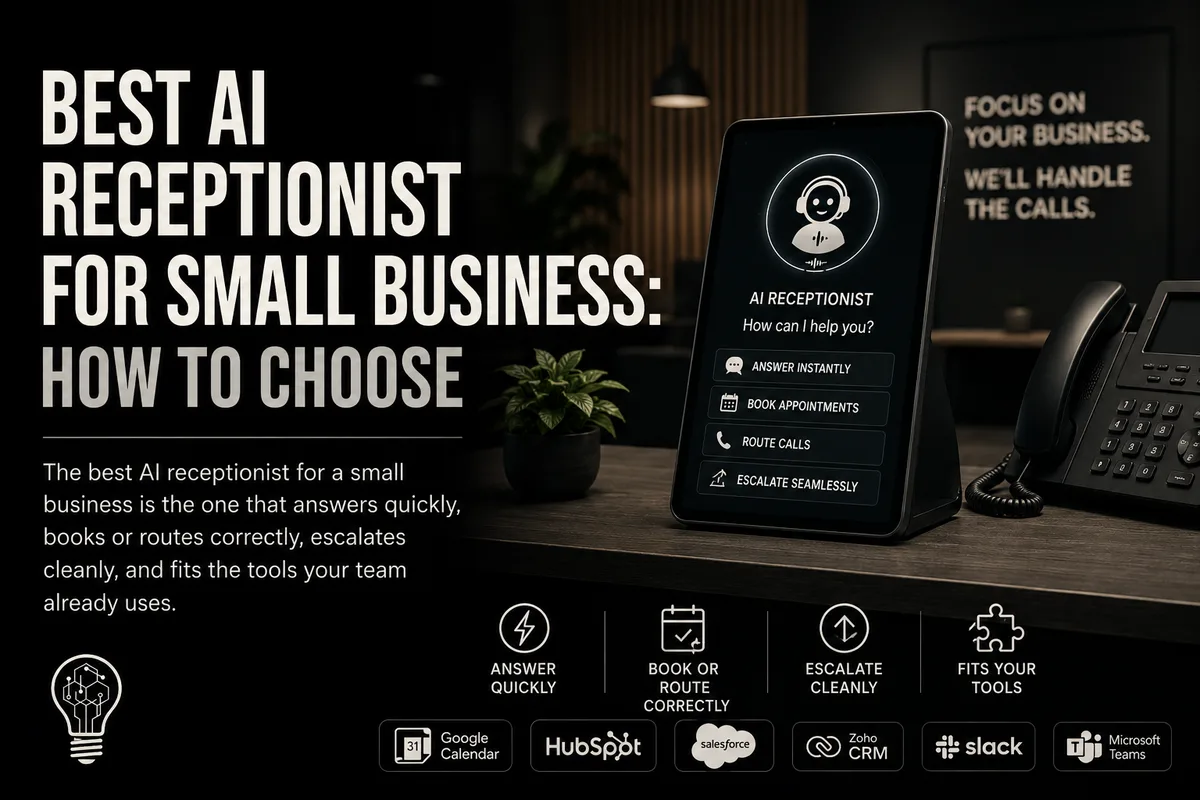
Best AI Receptionist for Small Business: How to Choose
The best AI receptionist for a small business is the one that answers quickly, books or routes correctly, escalates cleanly, and fits the tools your team.
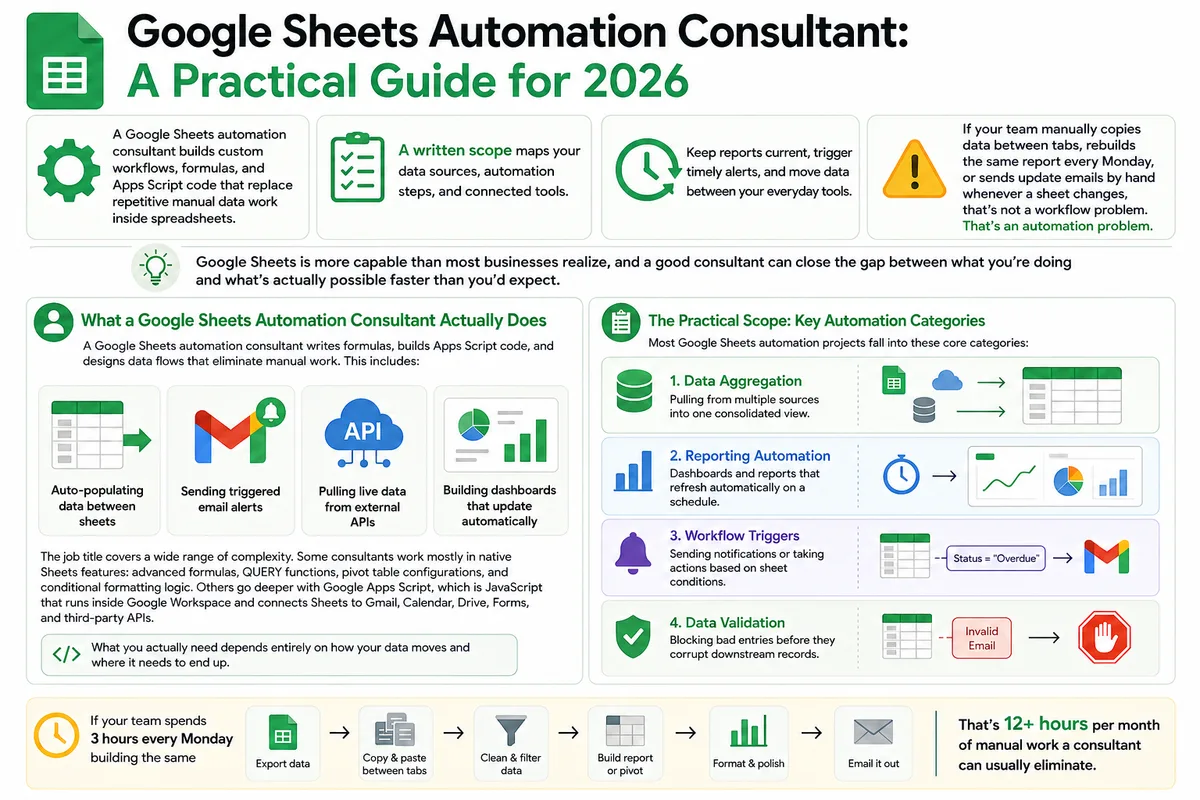
Google Sheets Automation Consultant: A Practical Guide for 2026
Most businesses don't track what spreadsheet work actually costs them. Here's what a Google Sheets automation consultant does in 2026, how to judge the value.
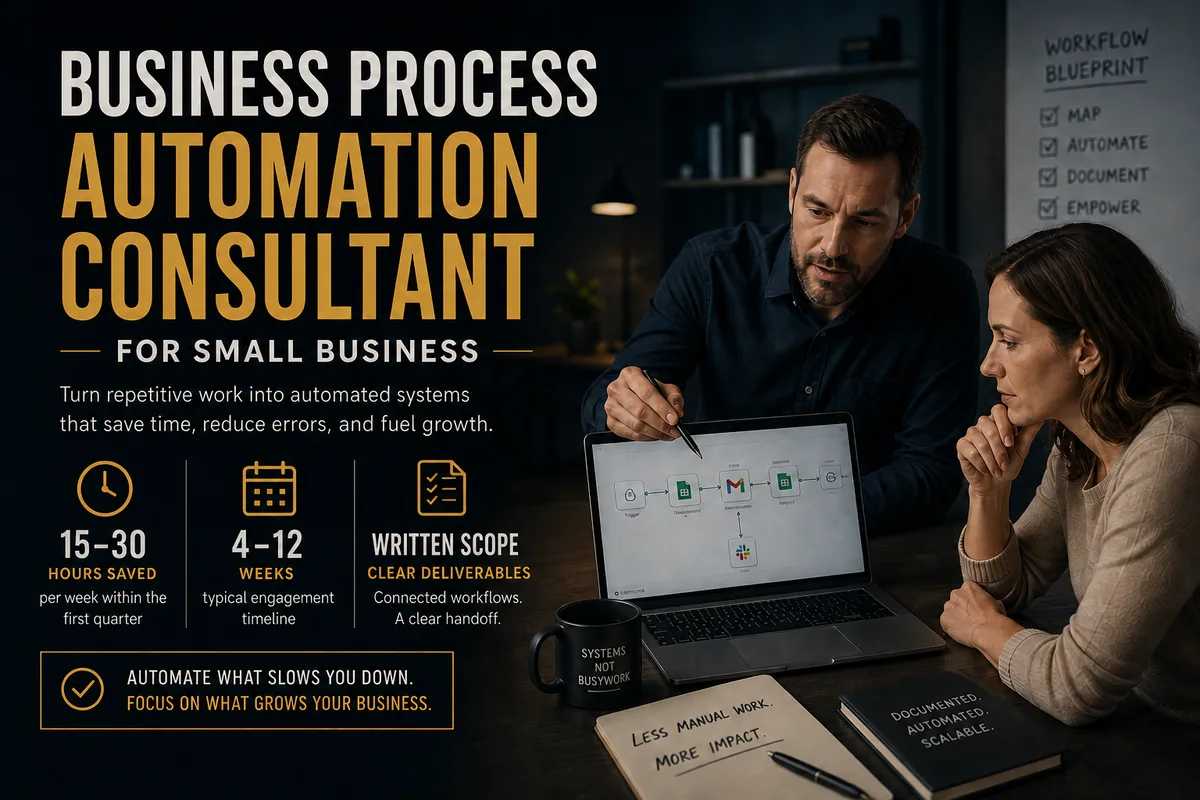
Business Process Automation Consultant for Small Business
Hiring the wrong automation consultant wastes thousands. Here's what small business owners need to know about process, cost, ROI, and how to vet the right one.