
Voice AI Adoption in Home Services: Where Contractors Stand in 2025
A large share of home service inquiries arrive outside business hours or when staff can’t answer, creating a structural revenue leak for contractors that still route overflow to voicemail. Overall adoption among single-location home service contractors remains uneven, meaning many competitors have not moved yet, but HVAC companies are leading because extreme seasonality and emergency call volume make phone coverage more urgent.
Most home service inquiries arrive outside business hours or when staff can't answer. Voice AI adoption is rising, but uneven.
Epiphany Dynamics is an AI automation agency: we help businesses find and fix operational bottlenecks with AI receptionists, lead follow-up, and workflow automation.
Free 30-minute audit. We name at least 3 things you can automate, ranked by impact.
Book a free AI audit
Patrick Gibbs
A large share of home service inquiries arrive outside business hours or when staff can’t answer, creating a structural revenue leak for contractors that still route overflow to voicemail. Overall adoption among single-location home service contractors remains uneven, meaning many competitors have not moved yet, but HVAC companies are leading because extreme seasonality and emergency call volume make phone coverage more urgent. This piece covers where adoption actually stands in 2025, the economics behind the decision, and which contractor types tend to have the clearest fit.
The Call Nobody Answered
A plumbing company in Phoenix ran a call audit and found that a large share of their inbound calls hit voicemail after the dispatcher had gone home. The homeowners with burst pipes had not stopped needing help. Based on their job mix, they estimated substantial potential revenue had walked to competitors who picked up. When they deployed voice AI to handle after-hours calls and book emergency jobs, the missed-call leak became easier to measure and address.
The math is not complicated: the real cost of missed calls adds up faster than most contractors realize. The technology, until recently, was. That combination is why voice AI adoption in home services is accelerating now, and why the contractors paying attention are moving earlier than they expected.
Where Adoption Actually Stands
Most home service contractors haven’t deployed voice AI yet. The operators who have moved skew heavily toward multi-location companies and franchise networks. Single-location owner-operators running HVAC, plumbing, electrical, and landscaping businesses are adopting at a lower rate.
The friction isn’t principally skepticism. Talk to contractors who’ve looked into it and you hear the same themes: integration complexity with existing dispatch software, concern about AI giving wrong pricing over the phone, and genuine worry that customers will hang up the moment they realize they’re not talking to a person. Those concerns are real. Several are also more manageable than contractors expect once they’re past the initial evaluation.
Adoption clusters heavily by vertical. HVAC companies lead by a clear margin: the combination of extreme seasonality and emergency call volume makes the phone-coverage problem obvious before you open a calculator. Pest control and home cleaning services follow closely because their call volume tends toward standardized inquiry types: pricing, availability, what’s included. Electrical and general contracting see lower adoption, where job complexity makes scripted AI responses feel genuinely inadequate.
The Economics Behind the Decision
| Factor | Human Receptionist | Voice AI |
|---|---|---|
| Monthly cost | Payroll, hiring, schedule coverage, and management overhead | Platform fee, setup, integration, and monitoring |
| Annual cost | Compounds with benefits, turnover, and seasonal coverage needs | Depends on call volume, workflow depth, and support model |
| After-hours availability | No | Yes |
| Average answer time | Depends on staff availability | Immediate when configured correctly |
| Simultaneous call capacity | Limited by available staff | Useful during call spikes |
The value of a missed HVAC or plumbing call depends on the job type, urgency, booking rate, and whether that customer would have returned for future work. A single missed call that ends with a booked competitor isn’t just that ticket: home service businesses retain customers at high rates when the first experience goes well. Lose someone on the initial call and the relationship is almost always gone permanently.
A large share of home service calls arrive outside traditional business hours or during active job time when staff simply can’t answer. If a meaningful share of inbound inquiry volume is hitting voicemail, the ceiling on recoverable revenue depends on first-party call logs and average job value. The 2026 voice AI adoption data for service businesses covers this recovery pattern in more detail.
What’s Working and What Isn’t
| Use Case | AI Fit | Notes |
|---|---|---|
| After-hours call capture | Strong | Core use case across all verticals |
| Appointment scheduling | Strong | Requires live dispatch system integration |
| Standard pricing inquiries | Moderate | Works best with flat-rate service models |
| Emergency triage | Moderate | Heavily dependent on escalation design |
| Complex troubleshooting | Low | Not a viable AI use case |
| Complaint handling | Very low | Should always escalate to a human |
The clearest wins come from a narrow set of use cases: after-hours call capture, scheduling for recurring services, and basic inquiry qualification. The gains show up as inquiries that previously required callbacks getting booked on the first call, where those callbacks frequently didn’t happen before the customer had already called someone else.
Where voice AI consistently underperforms: calls where the customer has already had a bad experience and wants a person immediately, pricing calls that require real judgment, and anything involving troubleshooting. The technology works as a triage and capture tool. Operators who deploy it expecting a full receptionist replacement, without any human fallback, tend to have worse outcomes and louder complaints. Our guide on how voice AI handles after-hours emergency calls covers the triage architecture that handles the handoff.
Escalation design separates the deployments contractors recommend from the ones they quietly turn off. Systems that can recognize frustration or explicit requests for a human, then smoothly transfer the call, perform dramatically better on customer satisfaction than systems with no clean escalation path. This is not a feature to treat as secondary when evaluating platforms.
Adoption Patterns by Vertical
| Vertical | Relative Adoption Pattern | Primary Driver |
|---|---|---|
| HVAC | Highest | Emergency volume, seasonal call spikes |
| Pest Control | High | High call volume, standardized inquiries |
| Home Cleaning | High | Recurring service scheduling |
| Plumbing | Moderate | After-hours emergency capture |
| Landscaping | Moderate | Seasonal inquiry management |
| Electrical | Lower | Lower volume, higher job complexity |
| General Contracting | Lower | Long sales cycle, complex scoping calls |
Franchise operators are moving faster than independents across every vertical. They have the resources to evaluate platforms at scale, negotiate volume pricing, and push deployment across their networks in a coordinated way. Independent contractors typically adopt in one of two scenarios: a peer showed them measurable ROI, or they hit a specific pain point hard enough to go looking. Word-of-mouth drives more technology adoption in home services than any trade publication or vendor outreach campaign.
The platform market is also consolidating in useful ways. Contractors interested in voice AI used to navigate a confusing mix of generic chatbot tools and niche field service products with limited overlap. The current market has clearer purpose-built options that integrate with scheduling platforms like ServiceTitan, Jobber, and Housecall Pro. That integration piece matters more than most contractors expect until they’ve tried using a voice AI that doesn’t connect to their actual scheduling system.
Related on the blog: AI Phone Answering for Contractors: Costs, Features, and ROI in 2026.
How to Evaluate Voice AI Before Committing
Contractors who get strong results from voice AI tend to follow a similar pre-deployment process. Skipping steps produces the failed deployments that generate the loudest skepticism in contractor forums and Facebook groups.
Start with a call audit. Pull a representative set of call records and categorize every inbound call: scheduling, pricing inquiry, status check, complaint, referral, other. That breakdown tells you exactly how much of your volume is AI-ready. Many contractors find their routine calls are the best automation candidates. That share is your baseline ROI case.
Define your escalation protocol before selecting a platform. Under what conditions does the AI hand off to a human? What happens when no human is available with a caller who has a flooding basement? What does that caller experience at that moment? These are policy questions that belong to the business owner, not the software vendor. If you can’t answer them before your first demo call, you’re not ready to buy.
Scope your integrations before anything else. Can the platform pull live availability from your scheduling system and actually confirm an appointment in real time? Can it push lead data into your CRM without requiring someone to manually process every booking afterward? A voice AI that captures calls but creates manual follow-up work for every interaction saves money at the front door and costs it at the back.
The honest reality is that this technology takes real thought to deploy well. Contractors who treat it as plug-and-play tend to get plug-and-play results, which is to say, mediocre. The ones who map their call flows first, test their escalation paths before going live, and track the right metrics see the outcomes that make other contractors ask what they’re doing differently. Before asking which platform to buy, the more useful question is: what specifically are you trying to solve, and how will you measure whether it’s actually working?
For service businesses working through this evaluation, AI implementation firms that specialize in field service operations, like Epiphany Dynamics, can help cut through the vendor noise and get to a working system faster than going it alone.
Frequently Asked Questions
Q: How widely are home service contractors using voice AI in 2025?
Most home service contractors haven’t deployed voice AI yet, and adoption skews heavily toward multi-location operators and franchise networks. Single-location owner-operators in HVAC, plumbing, and electrical are adopting at a much lower rate. HVAC companies lead all home service verticals, driven by emergency call volume and extreme seasonal demand spikes.
Q: Why does voice AI provide stronger ROI for HVAC companies than other contractors?
HVAC companies face predictable demand spikes (heat waves, cold snaps) where call volume rises faster than staffing. After-hours emergency calls for broken HVAC systems come from highly motivated callers who will immediately call the next company if they reach voicemail. The missed-call calculation is straightforward when a contractor uses its own job value, booking rate, and call logs.
Q: What voice AI use cases work best for home service contractors?
After-hours call capture, appointment scheduling, and standard pricing inquiries for flat-rate services all work well. Complex troubleshooting, complaint handling, and calls from callers who have already had a bad experience should always escalate to a human. The systems that succeed have a clear escalation path, not just a fallback to voicemail.
Q: How should a contractor evaluate voice AI platforms before committing?
Start with a representative call audit categorizing every inbound call: scheduling, pricing, status check, complaint, referral. That tells you how much volume is AI-ready. Define your escalation protocol before any demo: under what conditions does AI hand off, and what does a caller experience after hours with an emergency? Then scope integrations: can the platform pull live availability from ServiceTitan, Jobber, or Housecall Pro and actually confirm appointments in real time?
Q: What is the biggest mistake contractors make when deploying voice AI?
Treating it as plug-and-play. Contractors who map their call flows first, test escalation paths before going live, and track booking rate on AI-handled calls versus human-handled calls see the outcomes that make other contractors ask what they’re doing differently. Contractors who install and expect immediate results typically get mediocre performance and turn the system off before the tuning phase where systems improve significantly.
Patrick Gibbs
AI Automation Expert
Patrick Gibbs helps professional practices implement AI automation that captures more leads, books more appointments, and scales without adding overhead. He's the founder of Epiphany Dynamics and creator of the AI Front Desk system.
Related Solutions
Build this into a real workflow
Related Posts
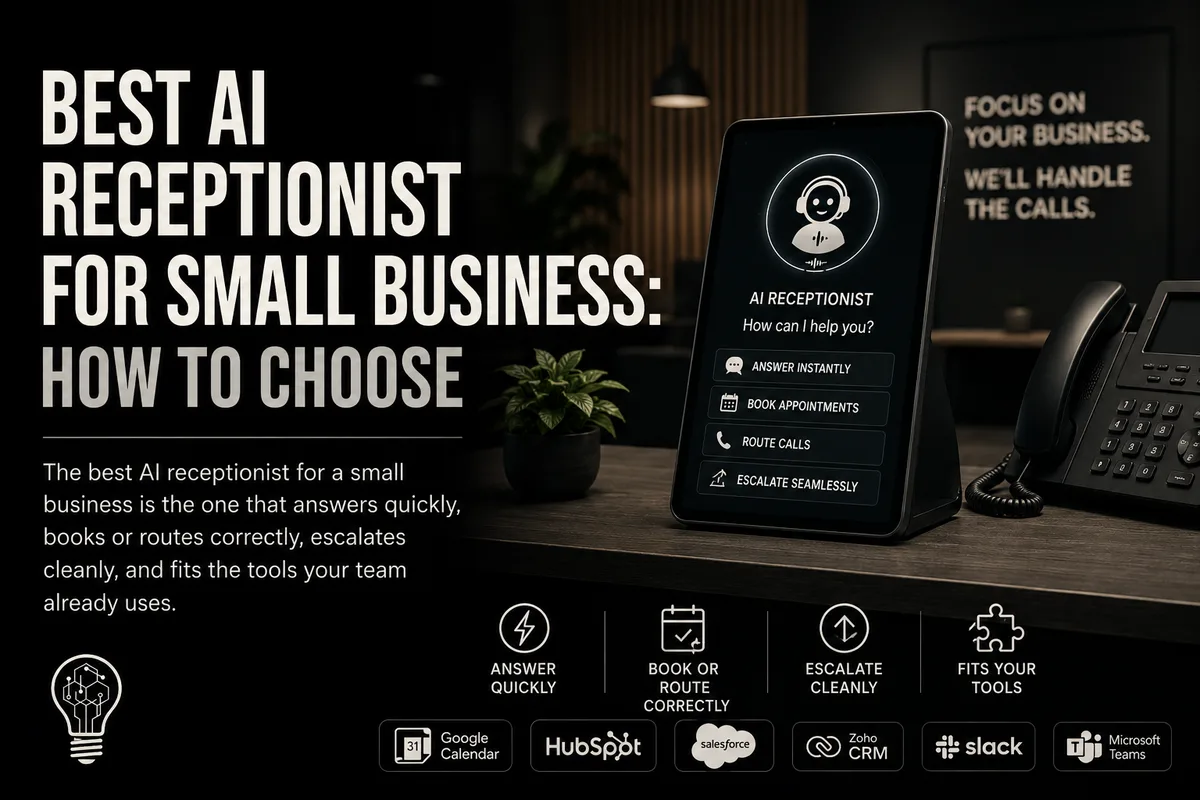
Best AI Receptionist for Small Business: How to Choose
The best AI receptionist for a small business is the one that answers quickly, books or routes correctly, escalates cleanly, and fits the tools your team.
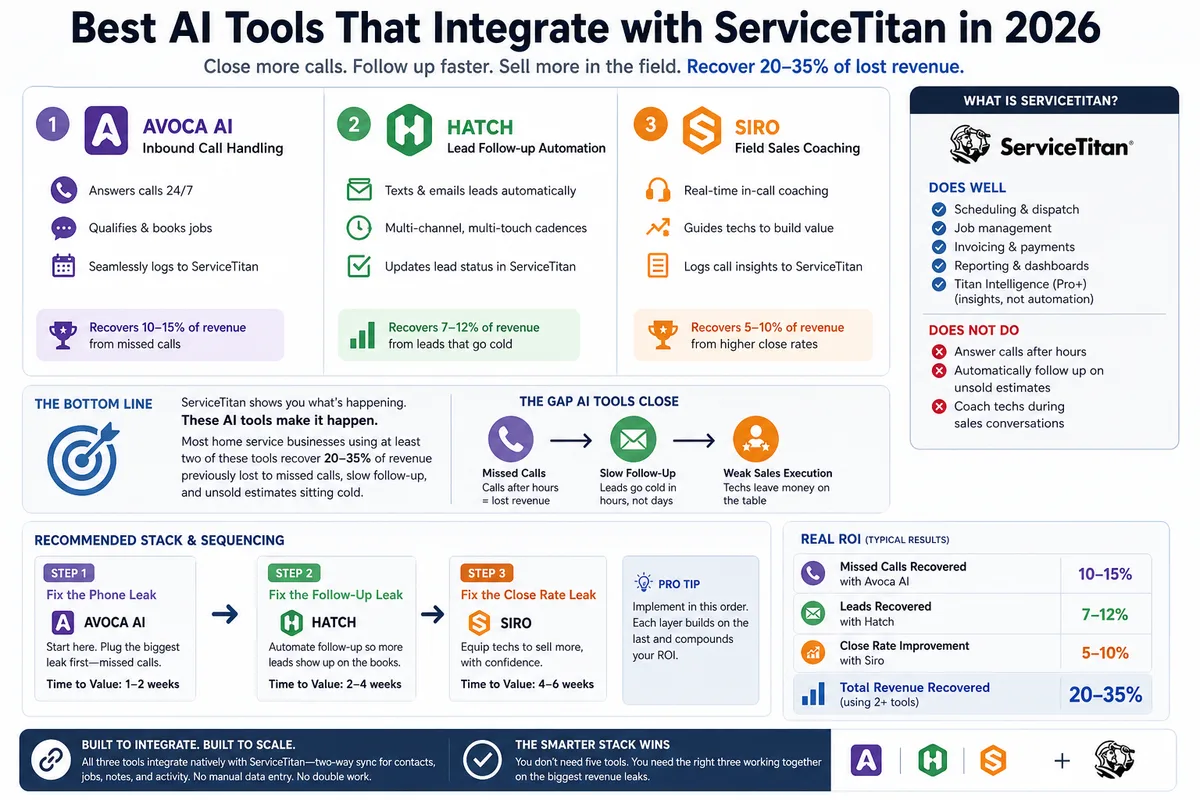
Best AI Tools That Integrate with ServiceTitan in 2026
Most ServiceTitan shops miss a meaningful share of inbound calls and leave most estimates unsold. These AI tools close those gaps inside ServiceTitan.
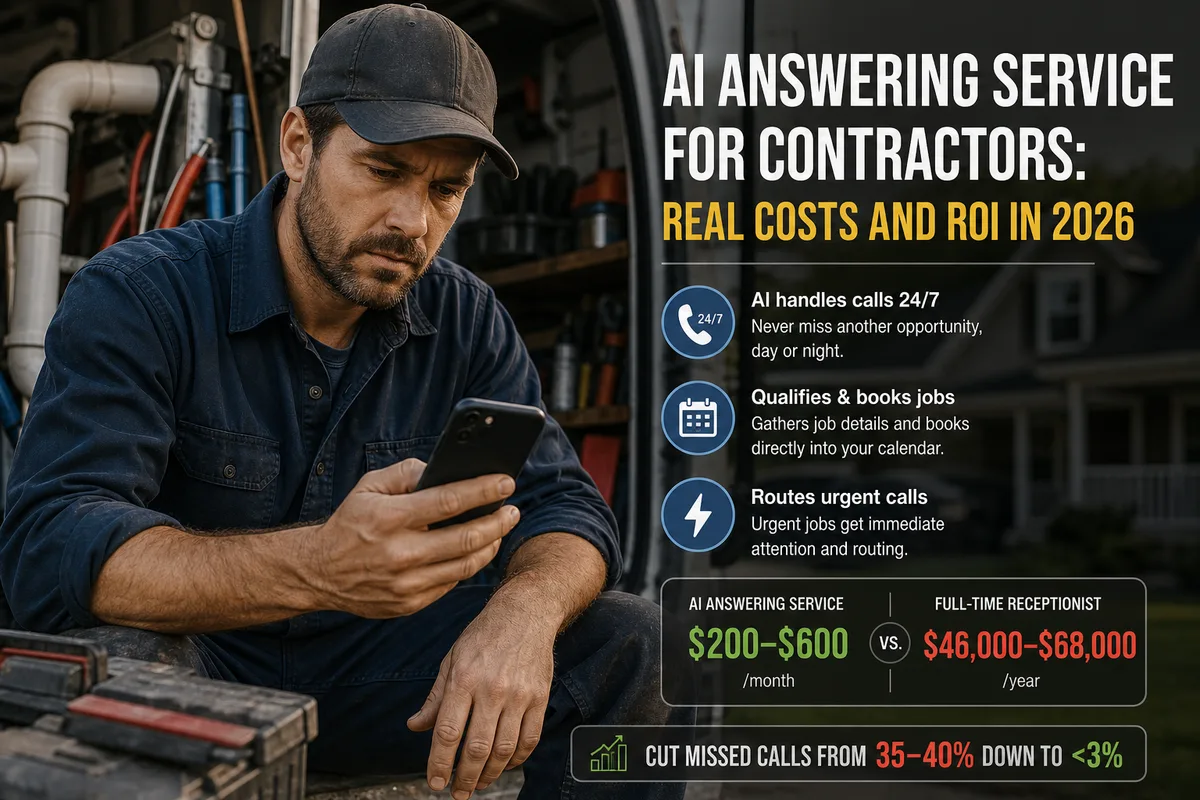
AI Answering Service for Contractors: What to Compare in 2026
Contractors miss inbound calls while working jobs on-site. Here's what AI answering services do, where they help, and how to model the ROI from your own call.