AI Voice Assistants in Healthcare: Transforming Patient Communication at Scale
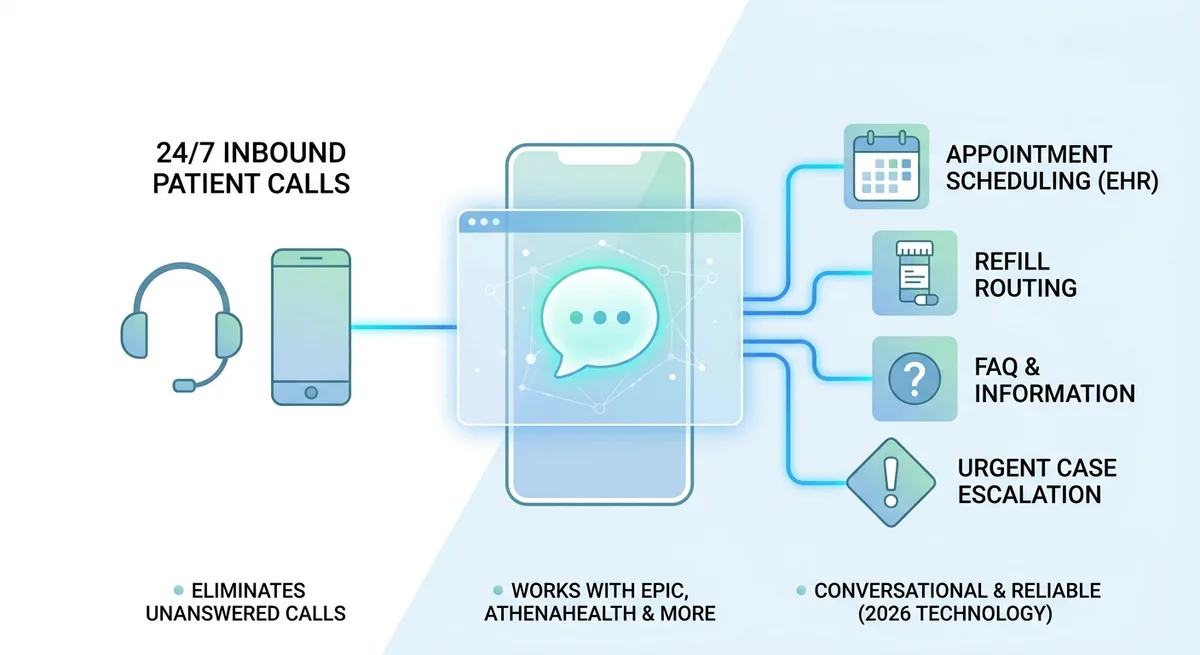
AI voice assistants in healthcare answer calls 24/7, handling appointment scheduling, prescription refill requests, and routine patient inquiries without staff involvement. Practices deploying AI voice can free up substantial staff phone time, reduce avoidable no-shows through better reminders, and create a more consistent first response for patients who need help.
Discover how healthcare providers are using AI voice assistants to reduce administrative burden, improve patient access, and deliver consistent, compassionate.
Epiphany Dynamics is an AI automation agency: we help businesses find and fix operational bottlenecks with AI receptionists, lead follow-up, and workflow automation.
The free 30-minute AI Operations Audit is a conversation about a normal week in your business and where the work piles up. We find the one change that would give you the most time back and send you a plain-English plan for it. No forms and no pitch.
Book a free AI audit
Patrick Gibbs
AI voice assistants in healthcare answer calls 24/7, handling appointment scheduling, prescription refill requests, and routine patient inquiries without staff involvement. Practices deploying AI voice can free up substantial staff phone time, reduce avoidable no-shows through better reminders, and create a more consistent first response for patients who need help.
The Healthcare Communication Crisis
Healthcare organizations face an unprecedented communication challenge. Patients expect instant, personalized service similar to what they receive from Amazon or their bank. Meanwhile, staff are overwhelmed by administrative tasks, phone tag, and coordination complexity.
The numbers tell a stark story:
- A large share of U.S. healthcare spending goes to administrative costs
- Medical practices receive heavy daily call volume per provider
- Healthcare staff spend substantial time on non-clinical tasks
- Patient no-shows create a major revenue and access problem, and practices that reduce front desk costs with AI redirect those savings into patient care
To understand the full picture, consider that AI can now handle phone calls with natural conversation quality that matches or exceeds scripted human agents. AI voice assistants are emerging as a powerful solution, handling routine communications autonomously while smoothly escalating complex situations to human staff.
What Are Healthcare AI Voice Assistants?
Healthcare AI voice assistants are conversational AI systems designed specifically for medical contexts. Unlike generic voice assistants, they understand:
- Medical terminology and insurance jargon
- HIPAA compliance requirements
- Healthcare workflows and urgency triage
- Compassionate communication with patients in vulnerable states
- Integration with EHRs, scheduling systems, and practice management platforms
Key Capabilities
| Capability | Description | Example |
|---|---|---|
| Appointment Scheduling | Handle booking, rescheduling, cancellations | ”I need to move my appointment to next week” |
| Pre-visit Intake | Collect symptoms, medications, history | ”What medications are you currently taking?” |
| Post-visit Follow-up | Check recovery, answer questions | ”How is your pain level on a scale of 1-10?” |
| Prescription Refills | Process refill requests, coordinate with pharmacies | ”I need a refill of my blood pressure medication” |
| Lab Results Delivery | Communicate results, schedule follow-ups | ”Your results are normal, no action needed” |
| Payment Processing | Handle billing questions, take payments | ”I’d like to pay my bill over the phone” |
High-Impact Use Cases
Use Case 1: Intelligent Patient Access
The Challenge: Patients struggle to reach their providers. Phones ring busy. Voicemails go unanswered. Online portals are confusing. The result: frustrated patients, missed appointments, and staff burnout from playing phone tag.
The AI Solution:
AI voice assistants serve as the first point of contact, handling the majority of routine requests while intelligently routing complex needs:
24/7 Availability:
- Answer every call immediately, any time of day
- Handle routine requests without human intervention
- Triage urgent matters to on-call providers
- Capture after-hours messages with full context
Intelligent Routing:
- Identify caller and pull up relevant records
- Understand request intent through natural conversation
- Route to appropriate department or staff member
- Provide estimated wait times for human assistance
Self-Service Capabilities:
- Appointment scheduling and rescheduling
- Prescription refill requests
- Lab result inquiries
- Billing and payment processing
- General information and directions
What Results Typically Look Like:
Practices that deploy an AI voice assistant for patient access typically see:
- The majority of routine calls resolved without human intervention
- Answer times dropping from minutes on hold to a few seconds
- Substantial staff phone time recovered every week
- Higher patient satisfaction as hold times disappear
- After-hours patient access improving dramatically, an outcome consistent with how AI front desk systems work and what they cost
Use Case 2: Automated Care Coordination
The Challenge: Coordinating care across multiple providers, specialties, and settings creates massive administrative burden. Referrals get lost. Test results aren’t communicated. Care gaps emerge.
The AI Solution:
Proactive voice outreach that keeps patients engaged and informed throughout their care journey:
Pre-Appointment Preparation:
- Confirm appointments 48 hours in advance
- Send preparation instructions (fasting, medication adjustments)
- Complete pre-visit registration
- Address common questions and concerns
Post-Visit Follow-up:
- Check medication adherence
- Monitor symptom progression
- Identify complications early
- Schedule necessary follow-ups
Chronic Disease Management:
- Regular check-in calls for diabetic, hypertensive patients
- Medication adherence monitoring
- Lifestyle coaching and support
- Early warning sign detection
Care Transition Management:
- Post-discharge follow-up within 48 hours
- Medication reconciliation verification
- Appointment scheduling with specialists
- Home care coordination
Typical outcomes:
- Fewer 30-day readmissions
- Meaningfully better medication adherence
- Less staff time spent on care coordination
- Earlier identification of deteriorating patients
Use Case 3: Clinical Documentation Assistant
The Challenge: Physicians spend hours on documentation for every hour of direct patient care. This contributes to burnout and reduces time available for patients.
The AI Solution:
Voice-activated documentation that captures encounters in real-time:
Ambient Documentation:
- Listens to patient encounters (with consent)
- Structures clinical notes automatically
- Extracts relevant billing codes
- Suggests follow-up actions
Voice-Activated EHR:
- Navigate EHR hands-free during exams
- Retrieve patient history through voice commands
- Order tests and prescriptions verbally
- Dictate notes with AI-powered formatting
Typical outcomes:
- Substantially less time spent on documentation
- Improved note completeness and quality
- More eye contact and patient engagement during visits
- Reduced physician burnout scores
Implementation Considerations
HIPAA Compliance and Security
Healthcare AI voice assistants must meet strict security requirements:
Essential Security Measures:
- End-to-end encryption for all communications
- Business Associate Agreement (BAA) with vendors
- Audit logging of all system interactions
- Access controls and authentication
- Data retention and deletion policies
- Regular security assessments
Questions to Ask Vendors:
- Is your platform HIPAA-compliant?
- Do you sign BAAs?
- Where is data stored and processed?
- What encryption standards do you use?
- How do you handle voice biometric data?
Integration Requirements
Effective voice assistants integrate smoothly with existing systems:
| System | Integration Purpose | Data Exchange |
|---|---|---|
| EHR | Patient identification, documentation | Demographics, appointments, clinical data |
| Practice Management | Scheduling, billing | Availability, insurance verification |
| Patient Portal | Account access, results delivery | Lab values, visit summaries |
| Pharmacy Systems | Prescription management | Refill status, medication history |
| Lab Systems | Result communication | Test results, reference ranges |
Voice Design Best Practices
Healthcare conversations require special attention to tone and approach:
Compassionate Communication:
- Warm, empathetic voice persona
- Acknowledgment of patient concerns
- Clear, jargon-free explanations
- Patience with repetition and clarification
Safety-First Design:
- Conservative escalation protocols
- Clear identification as AI
- Easy access to human help
- Redundancy for critical information
Accessibility:
- Support for multiple languages
- Accommodation for hearing impairments
- Clear speech rate and enunciation
- Alternative communication channels
Platform Options
Healthcare-Specific Solutions
| Platform | Strengths | Best For |
|---|---|---|
| Orbita | Healthcare-focused, strong clinical workflows | Health systems, hospitals |
| Hyro | Natural language, easy deployment | Medical practices, clinics |
| Babylon Health | Comprehensive AI health platform | Integrated health systems |
| Kore.ai | Enterprise scalability, security | Large health systems |
General-Purpose with Healthcare Extensions
| Platform | Strengths | Considerations |
|---|---|---|
| Amazon Lex + HealthLake | AWS integration, scalable | Requires technical expertise |
| Google Dialogflow | Strong NLP, affordable | HIPAA compliance configuration needed |
| Microsoft Health Bot | Azure tool stack, healthcare templates | Best for Microsoft-centric organizations |
Measuring Success
Track these metrics to ensure your AI voice assistant investment delivers value:
Operational Metrics
| Metric | Target | Measurement |
|---|---|---|
| Call containment rate | Improve over baseline | Calls resolved by AI divided by total calls |
| Average answer speed | Faster than current phone handling | Time from call to first response |
| First call resolution | Improve over baseline | Issues resolved in initial contact |
| Abandonment rate | Lower than current baseline | Calls hung up before resolution |
Patient Experience Metrics
| Metric | Target | Measurement |
|---|---|---|
| Patient satisfaction (AI interactions) | Hold steady or improve | Post-interaction surveys |
| Net Promoter Score | Hold steady or improve | Standard NPS methodology |
| Complaint rate | Lower than current baseline | Complaints divided by total interactions |
| Callback rate | Lower than current baseline | Patients calling back for same issue |
Financial Metrics
| Metric | Typical Impact | Calculation |
|---|---|---|
| Staff time savings | Meaningful reduction | Hours saved multiplied by fully loaded cost |
| No-show reduction | Fewer avoidable no-shows | Reduced no-shows multiplied by revenue per visit |
| After-hours capture | More appointments scheduled outside office hours | Additional appointments scheduled |
| Collection improvement | Better billing follow-through | Revenue from AI-assisted billing |
Clinical Metrics
| Metric | Target | Measurement |
|---|---|---|
| Appointment adherence | Improve over baseline | Kept appointments divided by scheduled appointments |
| Medication adherence | Improvement over baseline | Pharmacy refill data |
| Care gap closure | Improvement over baseline | Preventive care completion rates |
| Patient activation measure | Improvement over baseline | Standard PAM surveys |
Implementation Roadmap
Phase 1: Planning (Weeks 1-3)
Use Case Prioritization:
- Identify highest-volume call types
- Map current workflows and pain points
- Define success metrics and targets
- Select initial use cases for deployment
Vendor Selection:
- Evaluate 3-5 healthcare voice platforms
- Conduct pilot tests with real scenarios
- Assess integration requirements
- Negotiate contracts and BAAs
Change Management:
- Communicate vision to staff
- Address concerns about job displacement
- Define new roles for augmented staff
- Plan training programs
Phase 2: Pilot Deployment (Weeks 4-8)
Limited Scope Launch:
- Deploy for one or two use cases
- Handle non-urgent, low-complexity interactions
- Monitor closely for quality and safety
- Gather patient and staff feedback
Continuous Improvement:
- Analyze conversation transcripts
- Identify failure patterns
- Refine responses and routing
- Expand knowledge base
Phase 3: Expansion (Weeks 9-16)
Additional Use Cases:
- Roll out to additional interaction types
- Expand to after-hours coverage
- Deploy multilingual capabilities
- Integrate with additional systems
Optimization:
- Fine-tune AI models based on production data
- Optimize conversation flows
- Enhance personalization
- Improve escalation handling
Phase 4: Mature Operation (Ongoing)
Advanced Capabilities:
- Predictive outreach based on clinical protocols
- Personalized health coaching
- Integration with remote monitoring devices
- Population health management support
The Future of Voice in Healthcare
Emerging developments will further transform patient communication:
- Emotion AI: Detecting patient distress and adjusting responses
- Voice Biometrics: Secure, frictionless patient identification
- Multimodal Interactions: Combining voice, text, and visual interfaces
- Ambient Clinical Intelligence: Passive documentation during encounters
- Predictive Outreach: AI-initiated contact based on risk stratification
Conclusion
AI voice assistants aren’t replacing human connection in healthcare; they’re preserving it. By handling routine communications, they free clinicians to focus on the complex, nuanced interactions that require human judgment and empathy.
For healthcare organizations struggling with access, efficiency, and staff burnout, AI voice technology offers a proven path forward. The question isn’t whether to adopt it, but how quickly you can implement it to serve your patients and support your team.
The 2026 adoption data for voice AI in healthcare shows which specialties are moving fastest and what separates successful deployments from expensive failures. Your patients are calling. Will AI help you answer?
Frequently Asked Questions
Q: Are AI voice assistants in healthcare HIPAA compliant?
Reputable healthcare AI voice platforms are built to meet HIPAA requirements, including end-to-end encryption, Business Associate Agreement (BAA) availability, audit logging, and access controls. Before deploying any AI voice system, verify that the vendor will sign a BAA, confirm where patient data is stored and processed, and ensure the platform holds SOC 2 Type II certification. Never deploy a consumer-grade voice assistant like Alexa or Google Assistant for patient communications without dedicated HIPAA compliance infrastructure.
Q: What percentage of healthcare calls can an AI voice assistant handle without human intervention?
Well-configured healthcare AI voice assistants can handle routine inbound calls autonomously when the workflow is administrative rather than clinical. Appointment scheduling, prescription refill routing, lab result inquiries, and billing questions are strong candidates for automation. Clinical urgency assessment, complex scheduling with multiple constraints, and emotionally distressed patients should be routed to trained human staff.
Q: How do AI voice assistants handle after-hours patient emergencies?
Healthcare AI systems are configured with conservative escalation protocols that immediately transfer potential emergencies to on-call providers. The AI uses keyword detection and symptom severity assessment to identify urgent situations (chest pain, difficulty breathing, acute injury) and routes them directly to emergency contacts rather than attempting to handle them autonomously. Clear identification as AI is required, and the system must always provide a direct path to human assistance for any health concern.
Q: Will patients accept talking to an AI for healthcare scheduling and questions?
Patient acceptance is higher than most healthcare organizations expect, particularly for routine administrative interactions. Patient satisfaction with AI-handled scheduling and FAQ calls typically matches human-handled calls when the AI responds quickly, speaks naturally, and escalates smoothly when needed. Satisfaction drops when AI attempts to handle clinical questions beyond its scope or fails to provide a clear path to a human. Transparency about AI identity, rather than hiding it, actually increases patient trust.
Q: How much does a healthcare AI voice assistant cost for a medical practice?
Healthcare-specific AI voice pricing depends on call volume, workflow complexity, integration depth, compliance requirements, and whether the vendor provides ongoing optimization. For a practice receiving heavy daily call volume with significant after-hours demand, ROI should be modeled from reduced staff phone time, better appointment intake, and fewer avoidable no-shows using the practice’s own baseline data. Get current vendor quotes before treating any price range as reliable.
Patrick Gibbs
AI Automation Expert
Patrick Gibbs helps professional practices implement AI automation that captures more leads, books more appointments, and scales without adding overhead. He's the founder of Epiphany Dynamics and creator of the AI Front Desk system.
Related Solutions