
AI Phone Agent for Healthcare: What Actually Works in 2026
An AI phone agent for healthcare is software that handles inbound patient calls, booking appointments, answering FAQs, routing urgent cases, and sending confirmations without a human on every routine call. Many medical practices see calls go unanswered when front desk staff is occupied.
Medical practices miss inbound calls when front desk staff is occupied. An AI phone agent handles scheduling, triage routing, and patient FAQs while escalating.
Epiphany Dynamics is an AI automation agency: we help businesses find and fix operational bottlenecks with AI receptionists, lead follow-up, and workflow automation.
The free 30-minute AI Operations Audit is a conversation about a normal week in your business and where the work piles up. We find the one change that would give you the most time back and send you a plain-English plan for it. No forms and no pitch.
Book a free AI audit
Patrick Gibbs
An AI phone agent for healthcare is software that handles inbound patient calls, booking appointments, answering FAQs, routing urgent cases, and sending confirmations without a human on every routine call. Many medical practices see calls go unanswered when front desk staff is occupied. AI agents help close that access gap while preserving human escalation for clinical judgment, distressed patients, and complex care coordination.
What an AI Phone Agent Actually Does in a Healthcare Setting
An AI phone agent in a healthcare setting handles inbound scheduling, appointment confirmations, prescription refill routing, after-hours triage, and common patient FAQs. Integrated with EHR systems like Epic, Athenahealth, or Kareo, it books and cancels appointments in real time without staff involvement, while escalating anything that requires human judgment based on protocols you define in advance.
The term "AI phone agent" covers a wide range of technology, so being specific matters. This is not a phone tree. It is not a voicemail transcription service. An AI phone agent holds a real conversation, understands what the patient wants, and takes action based on that intent. Someone calling to book a follow-up gets a live calendar view, picks a slot, and receives a confirmation text. Someone describing chest pain gets transferred to a nurse line or told to call 911, depending on the escalation rules you set up in advance.
The more capable platforms handle multi-turn conversations without breaking. A patient who says "actually, Wednesday doesn't work, what about Friday?" gets a real response rather than a system error. That is where older IVR systems consistently broke down. The newer generation of AI voice is genuinely conversational, and the gap between "early demo quality" and "production-ready" closed considerably between 2024 and 2026.
For practices on Epic or Athenahealth, the EHR integration layer is where meaningful differences between platforms show up. When the agent connects directly to your scheduling module, it pulls available slots in real time and writes confirmed bookings back automatically, no staff handoff required. If you're evaluating vendors, integration depth is the first question to ask. Voice quality is mostly a commodity now. Understanding what an AI agent actually is at the technical level helps set realistic expectations before those vendor conversations start.
The Real Cost of Unanswered Patient Calls
The cost of unanswered patient calls depends on call volume, specialty, appointment value, booking conversion, and how many callers abandon the practice when they reach voicemail. A medical practice should model the opportunity with its own phone logs, appointment data, and staff workload before treating any AI phone agent as a clear ROI win.
Front desk staff can only handle one call at a time. When a patient calls and no one picks up, many don't leave a voicemail. They call the next practice on their list. That behavior is especially pronounced in specialist and elective care markets where patients have genuine options. Here's the audit most practice managers should run explicitly:
| Practice Type | Data To Pull | Why It Matters |
|---|---|---|
| Solo GP | Unanswered calls by hour, appointment types, callback outcomes | Shows whether the access gap is occasional or structural |
| Specialty practice | New-patient inquiries, referral calls, appointment value, voicemail abandonment | Connects missed calls to revenue-sensitive scheduling demand |
| Multi-provider group | Peak-hour call queues, routing categories, staff handoff volume | Identifies where automation should handle overflow versus escalation |
Not every missed call is a permanently lost patient. Some call back. Some book online. But improving coverage for missed contacts changes the financial picture. The hidden cost that rarely appears in these calculations is staff time. A front desk coordinator answering "what's your address," "do you accept my insurance," and "can I reschedule my appointment" is not doing the work that actually requires a trained human: prior authorization follow-up, in-office patient care coordination, insurance dispute resolution. AI handles the volume. That redirects the human toward the judgment work. The complete AI automation guide for medical practices walks through where each type of automation fits across the full administrative stack.
See AI Answering Service for Medical Offices: What to Know in 2026 for more in this area.
HIPAA Compliance and AI Phone Agents
AI phone agents for healthcare must comply with HIPAA through a signed Business Associate Agreement (BAA), encrypted storage of any PHI collected during calls, minimal data collection by design, and accessible audit logs. The platform provides the compliance infrastructure, but configuration determines actual compliance. What data the agent collects, how long recordings are retained, and who has access matters as much as the BAA itself.
HIPAA is the issue that stalls healthcare AI deployments most often, and it tends to get treated as either a permanent blocker or a checkbox afterthought. Neither is right. The compliance question deserves real attention, but it is solvable with the right vendor, a signed BAA, and a proper implementation review. Most enterprise AI voice platforms offer BAAs at this point. Several are purpose-built for healthcare use cases specifically.
Before signing with any vendor, check these five things specifically:
- Do they provide a signed Business Associate Agreement? Not a "HIPAA-aware" marketing statement, an actual BAA.
- Where is PHI stored? US-based servers versus offshore matters for compliance programs that extend beyond HIPAA.
- What is the default call recording retention period? Some platforms default to indefinite storage. That is a liability you don't want.
- Can you control what the agent collects? A system that asks for date of birth and insurance ID on every routine call is collecting more PHI than the interaction requires.
- What do the audit logs capture? In a HIPAA investigation, you need to show who accessed what data and when.
The practices that get this right design the data flow to be minimal from the start. An AI phone agent does not need a patient's full medical record. It needs available appointment slots, a callback number, and sometimes an insurance carrier name. Keep the data surface small and the compliance review stays manageable. How healthcare providers are structuring AI voice systems covers the compliance architecture in more depth, including how leading practices are handling after-hours triage without running into PHI collection issues.
What an AI Phone Agent Costs vs. What It Replaces
The cost comparison is not simply "AI versus a receptionist." A human receptionist provides judgment, empathy, in-office coordination, and trust. An AI phone agent provides overflow coverage, after-hours intake, routine scheduling, and consistent routing. The useful comparison is which tasks truly need a person and which tasks can move to a configured phone agent.
| Cost Category | Full-Time Receptionist | AI Phone Agent |
|---|---|---|
| Annual base cost | Salary, benefits, hiring, management, and coverage limits | Platform fee, setup, integration, tuning, and monitoring |
| Benefits and employer overhead | Applies to staffed roles | Not applicable, but vendor and support costs still matter |
| Hiring and turnover cost | Recruiting, training, schedule coverage, and replacement risk | Vendor onboarding and workflow maintenance |
| After-hours coverage | Overtime or missed calls | Included |
| Simultaneous call capacity | Limited by staff availability | Useful for overflow and after-hours spikes |
| Best fit | Complex patients, clinical judgment, sensitive conversations | Routine scheduling, FAQs, confirmations, routing, overflow |
This is not an argument against employing humans. A well-run practice needs staff for complex care coordination, emotionally sensitive conversations, and judgment calls that no protocol can anticipate. The point is that many phone tasks are repeatable: answering schedule questions, confirming appointments, routing refill requests, taking messages after hours. That is a resource allocation problem, and most practice managers know it.
Practices with high-value services, like surgical consultations, specialty diagnostics, or elective procedures, should model after-hours and overflow booking value carefully. Lower-margin primary care settings may care more about access, staff relief, and routing efficiency than direct revenue recovery. The comparison of AI receptionist options for medical offices breaks down current platforms by practice size and specialty if you're actively evaluating your options.
How to Implement an AI Phone Agent Without Breaking Your Workflow
Implementing an AI phone agent in a healthcare practice should be treated as a staged rollout. The work covers call flow mapping, scheduling system integration, escalation rule configuration, voice model training on your specific protocols, HIPAA configuration review, and testing that catches edge cases before the system goes fully live on your main line.
First phase: map call flows and connect your scheduling system. Write down the most common reasons patients call your practice. For each, define what a complete resolution looks like. Booking an appointment is a clear outcome. "I have a question about my bill" is not one call flow; it breaks into several depending on what the patient actually needs. The scheduling integration tends to be the longest part of this phase, particularly if your EHR uses a non-standard API. Most major AI voice platforms have pre-built connectors for Epic, Athenahealth, and Kareo. Anything outside that list may need custom integration work, which should factor into your vendor timeline.
Second phase: configure escalation rules, train the model, and stage the rollout. Define specifically what triggers a live transfer: symptom descriptions that suggest urgency, patients expressing distress, billing disputes above an internal threshold, anything your staff has flagged as "do not let automation handle this." Then load the system with your FAQ content, provider names, office locations, and accepted insurance list. Before going fully live, run the agent on a secondary line while your main line stays staffed. Route selected call types to the AI during peak hours and monitor transcripts closely. You will find edge cases you did not anticipate. Fix them before flipping the full line over.
The most common implementation failure is rushing to go live with an under-configured system. An AI agent that repeatedly says "I'm sorry, I didn't understand that" before dropping a patient into hold music is worse for your practice than no AI at all. If you want to see how this fits into a broader AI rollout across intake, reminders, and follow-up workflows, the step-by-step guide to using AI in your medical practice covers the full picture from scheduling through post-visit follow-up.
AI phone agents are not a future-state vision for healthcare. They are a working solution to an operational problem most practices already live with: too many calls, not enough staff to answer them, and patients who go somewhere else when no one picks up. The economics depend on your call mix, the compliance path is navigable, and implementation is a defined process when you scope it correctly. If your practice is still losing calls during peak hours or going quiet after close, that is the gap worth closing first. Epiphany Dynamics builds these systems for medical and specialty practices, but the framework in this article gives you everything you need to evaluate any option intelligently.
Frequently Asked Questions
Q: How long does it take an AI phone agent to reduce missed calls and no-shows?
Improvement depends on how many calls the practice currently misses, how much after-hours volume exists, and whether the AI can safely confirm appointments without staff intervention. Track missed calls, booked appointments, escalations, and patient complaints before judging ROI.
Q: What percentage of calls can the agent handle without transferring to a staff member?
AI agents are best for routine scheduling, confirmations, refill routing, and FAQ calls. Medical questions, complex cases, and calls requiring clinical judgment should automatically escalate to the appropriate staff member. The system is designed to recognize when human judgment is needed rather than loop endlessly.
Q: Does the AI agent require modifications to my existing EHR system?
No. Many platforms offer direct integrations with Epic, Athenahealth, and Kareo without requiring EHR changes. Setup complexity depends on calendar access, testing, escalation rules, and the practice's internal approval process.
Q: Which types of calls do AI phone agents struggle with most?
Agents commonly struggle with calls containing heavy accents or poor audio quality, complex multi-step requests requiring back-and-forth with clinical staff, and patients who insist on speaking to a human. The best systems recognize these situations quickly and transfer the caller rather than attempting to force a resolution, preserving patient satisfaction.
Patrick Gibbs
AI Automation Expert
Patrick Gibbs helps professional practices implement AI automation that captures more leads, books more appointments, and scales without adding overhead. He's the founder of Epiphany Dynamics and creator of the AI Front Desk system.
Related Solutions
Build this into a real workflow
Related Posts
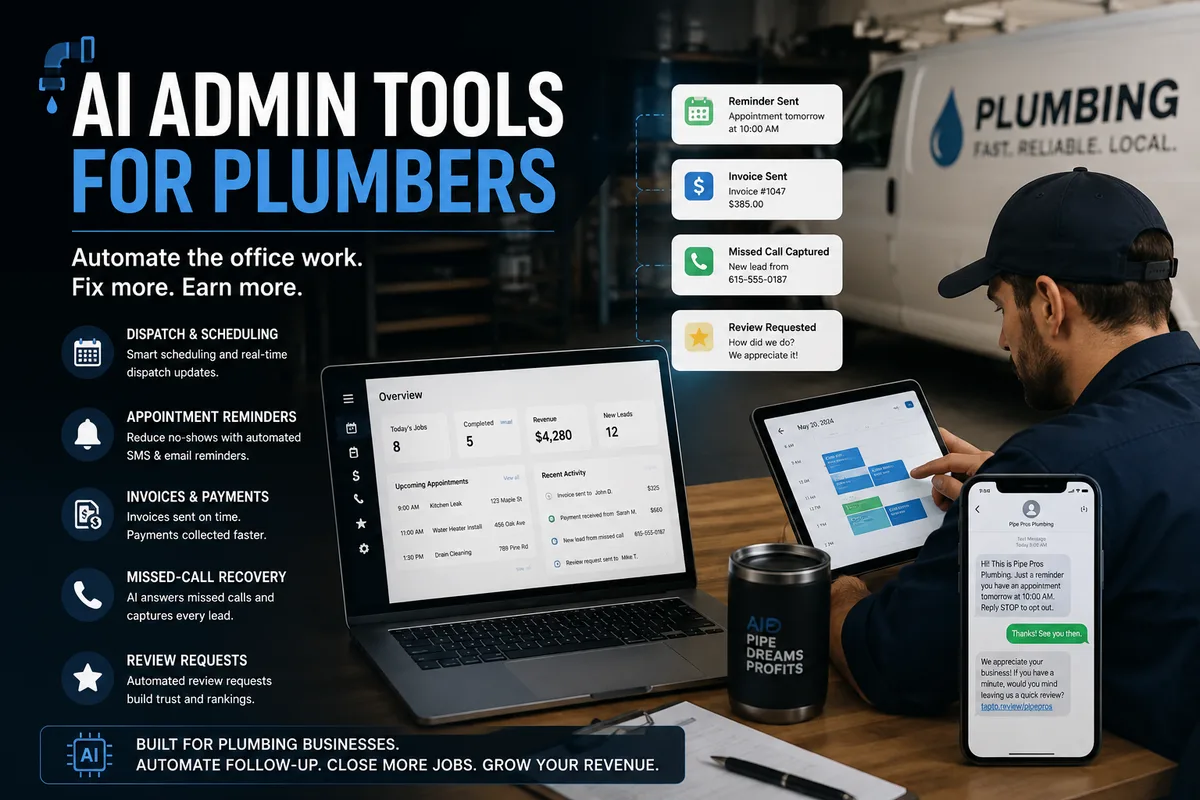
AI Admin Tools for Plumbers: What They Are and How to Choose
AI admin tools automate dispatch, reminders, invoicing follow-up, missed calls, and review requests for plumbers. What they do and how to choose.
Insurance Eligibility Automation for Physical Therapy Clinics
Eligibility automation for physical therapy clinics verifies benefits before the patient arrives, cuts front desk phone work, and can lower claim denial risk.
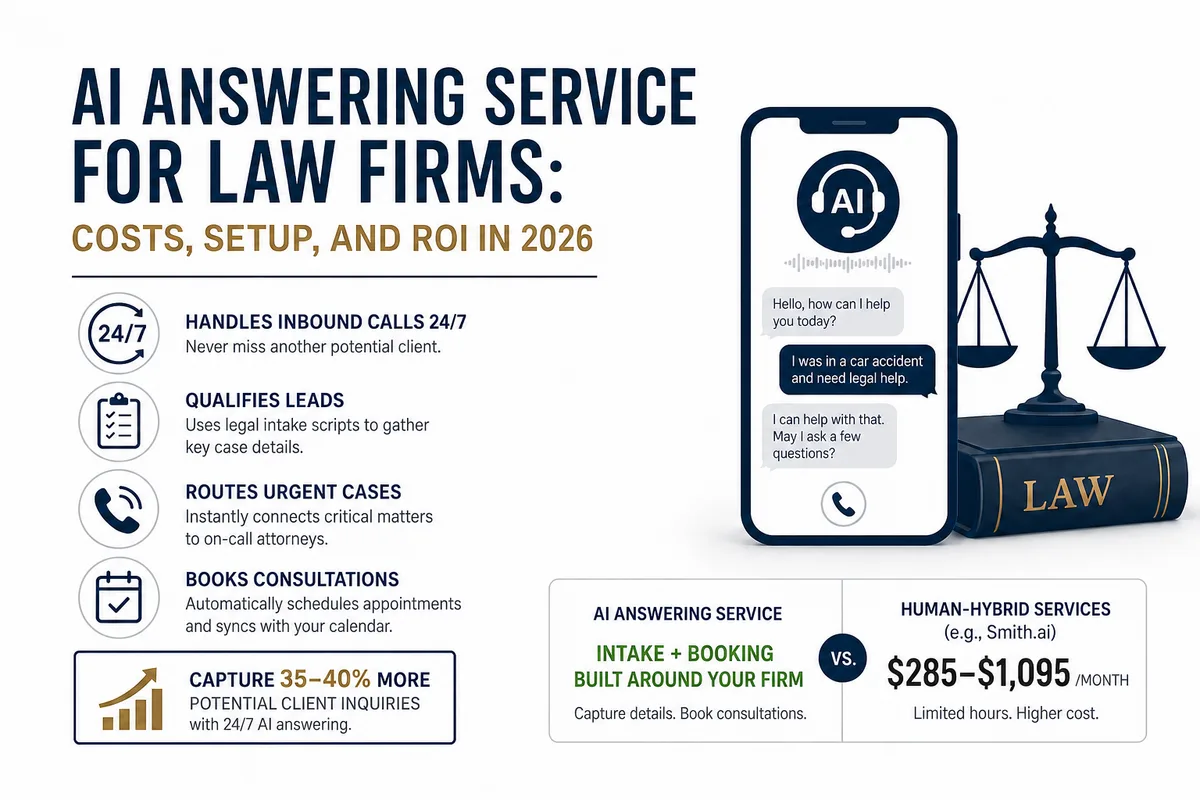
AI Answering Service for Law Firms: Costs, Setup, and ROI in 2026
Law firms miss a large share of inbound calls, most of them after hours. Here's what an AI answering service actually does, what it costs versus human.