
Conversational AI Adoption Trends: What Service Industries Actually Show
A majority of service organizations now report deploying AI chatbots, but the gap between nominal and functional deployment is wide: many “deployed” tools are inactive installs rather than live systems. Home services has the fastest SMB momentum right now due to after-hours emergency call capture, while healthcare and dental adopted earliest because appointment scheduling ROI is immediate and easy to calculate.
Most service organizations now report deploying AI chatbots, but a significant portion of those deployments are inactive or abandoned.
Epiphany Dynamics is an AI automation agency: we help businesses find and fix operational bottlenecks with AI receptionists, lead follow-up, and workflow automation.
Free 30-minute audit. We name at least 3 things you can automate, ranked by impact.
Book a free AI audit
Patrick Gibbs
A majority of service organizations now report deploying AI chatbots, but the gap between nominal and functional deployment is wide: many “deployed” tools are inactive installs rather than live systems. Home services has the fastest SMB momentum right now due to after-hours emergency call capture, while healthcare and dental adopted earliest because appointment scheduling ROI is immediate and easy to calculate. This analysis covers which industries are actually moving, what real deployment costs and returns, and what explains the persistent adoption gap despite years of hype.
Service businesses spent 2022 and 2023 reading about conversational AI. In 2024 and into 2025, a meaningful number of them actually deployed it. That shift matters more than most coverage acknowledges, because the gap between “we’re exploring this” and “we have a system answering questions at 11pm while we sleep” is enormous.
The question worth asking now isn’t whether this technology works. It does, within real limits. The better questions are which industries are adopting it fastest, what deployment actually costs and returns, and where the barriers are that explain why adoption remains uneven despite years of hype. The 2026 voice AI adoption data for service businesses provides the most current numbers across every vertical.
Where Adoption Actually Stands
Enterprise service surveys in recent years have found broad chatbot deployment, with adoption climbing steadily. But those numbers flatten significant variance. “Service organization” in enterprise survey methodology often skews toward companies with dedicated IT teams and existing CRM infrastructure. For the median independent service business, the picture looks quite different.
Technology adoption data from software review platforms and SMB research firms consistently shows a pattern worth noting: a large share of businesses that report “deploying” AI chat tools are describing an install they made and then mostly ignored, rather than an active, maintained system. There’s a meaningful difference between a chatbot widget someone added to a website in 2023 and a conversational AI system that’s actively routing leads, answering questions, and booking appointments today. The gap between nominal deployment and functional deployment is substantial, and it varies by segment.
The technology itself has also changed faster than most commentary acknowledges. First-generation chatbots were essentially decision trees, useful for narrow and predictable queries, embarrassing on anything else. Large language model-based systems operate at a genuinely different level. They handle nuance, context, and off-script questions in ways that make real-world deployment viable for service use cases the previous generation couldn’t touch.
Which Industries Are Moving and Why
Healthcare and dental practices adopted conversational AI earlier than most service verticals because appointment scheduling and reminders are easy to connect to real business outcomes. A practice can compare call logs, appointment requests, no-shows, and recall follow-up before and after deployment without needing a complicated attribution model.
Home services (HVAC, plumbing, pest control, electrical) have the fastest momentum right now among SMBs. The economics are straightforward: these businesses get inbound calls at unpredictable hours, their technicians are in the field and unavailable to answer, and a missed emergency call typically means a customer who called a competitor. After-hours AI intake has one of the cleanest value cases in this segment. Our analysis of voice AI adoption among home service contractors breaks down the pattern by vertical.
Legal intake is growing but moving slowly due to regulatory caution around advice-giving. Most deployment in legal services focuses on qualifying leads and scheduling consultations, not answering substantive legal questions. Fitness, wellness, and aesthetic service businesses are also seeing real momentum, driven by high appointment volume and the need to handle booking outside staffed hours.
| Industry | Primary Use Case | Adoption Stage | Main ROI Driver |
|---|---|---|---|
| Healthcare / Dental | Scheduling, reminders, no-show follow-up | Established | No-show reduction, after-hours booking |
| Home Services | After-hours intake, emergency lead capture | Early growth | Missed call prevention |
| Restaurants | Reservations, FAQ handling | Early growth | Staff workload reduction, consistency |
| Legal Services | Lead qualification, intake screening | Early adopter | Attorney time protection |
| Real Estate | Lead nurture, showing scheduling | Established | High lead volume, async follow-up |
| Fitness / Wellness | Class booking, membership inquiries | Early growth | Off-hours volume, staff redeployment |
What the Value Actually Looks Like
Once you account for agent time, overhead, and infrastructure, a human-handled customer service phone interaction is more expensive than a well-configured chatbot conversation once the system is built and running. That’s a real difference. But cost-per-interaction is the wrong frame for most small service businesses. The more useful frame is missed revenue recovery and labor cost avoidance.
Here’s the practical version. An HVAC company may handle calls well during business hours but lose after-hours and weekend demand to voicemail. If the company pulls call logs, marks which callers were new opportunities, and compares that against booked jobs, the value of after-hours intake becomes obvious without borrowing an industry benchmark.
| Scenario | Before AI | After AI | Value Signal |
|---|---|---|---|
| HVAC after-hours intake | After-hours calls route to voicemail | AI captures caller intent and routes urgent jobs | More qualified calls reach the booking workflow |
| Dental no-show reduction | Reminder follow-up depends on staff bandwidth | Automated reminders and rescheduling prompts run consistently | Fewer avoidable gaps in the schedule |
| Gym FAQ deflection | Staff repeat the same membership answers | AI handles routine questions and routes exceptions | More staff attention stays on in-person members |
The labor-reduction frame is harder to calculate cleanly but shows up in an important way: businesses that deploy conversational AI for routine inquiry handling typically report that front desk staff spend significantly less time on repetitive phone calls. That’s not headcount reduction in most cases. It’s redeployment of attention toward higher-value interactions, which is harder to put a dollar figure on but genuinely real.
Where Adoption Actually Stalls
The biggest barrier isn’t cost or technology quality. It’s integration friction. Most small service businesses run on a patchwork of scheduling software, CRM tools, and communication platforms that don’t connect cleanly. A conversational AI that can answer questions but can’t actually book into the existing system is half as useful as it should be. Getting integrations right takes time and sometimes technical help the average operator simply doesn’t have in-house. This is where promising deployments die most often.
Staff resistance is a real factor too, though it rarely surfaces in vendor-sponsored industry surveys. The front desk person who has handled scheduling for three years has natural skepticism toward a system that takes over part of their role. Businesses that treat deployment as a team conversation, involving staff in setup and giving them visibility into what the AI is doing, tend to see better adoption and better-tuned systems. Those that install something unilaterally and expect adaptation usually struggle.
The “good enough” problem is underappreciated. The first month after deployment often includes awkward AI responses, confused customers, and visible gaps in the system’s knowledge. Operators who treat early deployment as a learning phase stick with it and see real improvement by month two. Those who expect a polished system on day one often abandon tools that would have become genuinely useful with a few more weeks of tuning. That’s a management expectation problem, not a technology failure, and it’s responsible for a significant portion of the deployments that get written off as “not worth it.”
Further reading: AI vs. Machine Learning: What’s Actually Different in 2026.
A Practical Entry Framework
Pick one use case before deploying anything. Not “we’ll handle all customer inquiries.” Pick something specific: after-hours lead capture, appointment reminder follow-up, or FAQ deflection. Solve that one use case well, measure it, then expand. Trying to automate everything simultaneously is how deployments get bloated and fail to do anything particularly well.
Establish a baseline before you start. If you want to evaluate whether after-hours AI intake is working, you need to know how many after-hours contacts went unanswered before you deployed. Without a baseline, you’re guessing at ROI and you have no way to make a confident decision about expanding or killing the deployment. This is the step most businesses skip, which is also why most businesses can’t tell you whether their AI is actually performing.
Build a review cycle into the plan from the start. Pull transcripts after the system has handled real conversations and find where the AI confused customers or failed to escalate properly. Fix the obvious gaps. The follow-up review usually looks noticeably better than the first, and that improvement cycle is how the system earns its ongoing cost. Conversational AI isn’t a one-time install; it’s a system that gets better as it gets tuned.
Don’t hide that it’s AI. Customers increasingly expect AI to be part of service interactions, and businesses that try to pass their chatbot off as a human lose credibility fast when the illusion breaks. It always breaks. A well-designed AI front desk that’s clear about what it is gets better engagement than one pretending to be “Sarah from the front desk.”
The Realistic Picture
Conversational AI in service industries is past the proof-of-concept stage. The technology works. The ROI is real in the right use cases. What’s still developing is the deployment competency required to go from “installed” to “actually functioning well,” and that gap is where most small businesses currently fail.
The operators who’ll have an advantage in two years are the ones deploying now, learning from early friction, and building internal familiarity while competitors are still deciding whether to try. For help selecting the right tools, our roundup of the best AI tools for service companies covers each category with realistic ROI expectations. That window isn’t closed yet, but it’s narrowing. A year from now, “we’re still evaluating AI tools” is going to sound a lot like “we’re still evaluating whether to have a website” did in 2005.
If you’re a service business operator working through where to start, AI automation agencies like Epiphany Dynamics specialize in helping service businesses deploy conversational AI that actually integrates with existing systems. But the framework above will get you through the scoping process regardless of who you work with, or whether you do it yourself.
Frequently Asked Questions
Q: What percentage of service businesses have deployed conversational AI?
Enterprise surveys find that many service organizations report deploying AI chatbots, but that figure skews heavily toward larger companies with dedicated IT teams. For independent service businesses, adoption is far lower. The gap between “nominal deployment” (installed and ignored) and “functional deployment” (actively working) is substantial.
Q: Which service industries are adopting conversational AI fastest?
Healthcare and dental practices adopted earliest due to the clear value of appointment scheduling and reminder automation. Home services (HVAC, plumbing, pest control) have the fastest momentum right now among SMBs because after-hours emergency lead capture has a clean business case. Fitness, wellness, and aesthetics see growing momentum. Legal services are moving slowly due to regulatory caution around advice-giving.
Q: How should a home service business estimate conversational AI ROI?
Start with your own after-hours call logs, missed-call reports, booked-job history, and average job value. Then estimate how many qualified callers never reached the booking workflow. That business-specific gap is more useful than a generic industry ROI claim.
Q: What is the biggest barrier to conversational AI adoption in service businesses?
Integration friction is the primary barrier, not cost or technology quality. Most small service businesses run on a patchwork of scheduling software, CRM tools, and communication platforms that don’t connect cleanly. A conversational AI that can answer questions but can’t book into the existing scheduling system is half as useful as it should be. Staff resistance and unrealistic day-one expectations are close seconds.
Q: What is the right way to start deploying conversational AI in a service business?
Pick one specific use case before deploying anything: after-hours lead capture, appointment reminder follow-up, or FAQ deflection. Establish a baseline metric before launch so you can measure actual impact. Build a review cycle into the plan from day one and pull transcripts to find where the AI confused callers or failed to escalate. First deployments almost always need tuning before they work well.
Patrick Gibbs
AI Automation Expert
Patrick Gibbs helps professional practices implement AI automation that captures more leads, books more appointments, and scales without adding overhead. He's the founder of Epiphany Dynamics and creator of the AI Front Desk system.
Related Solutions
Build this into a real workflow
Related Posts
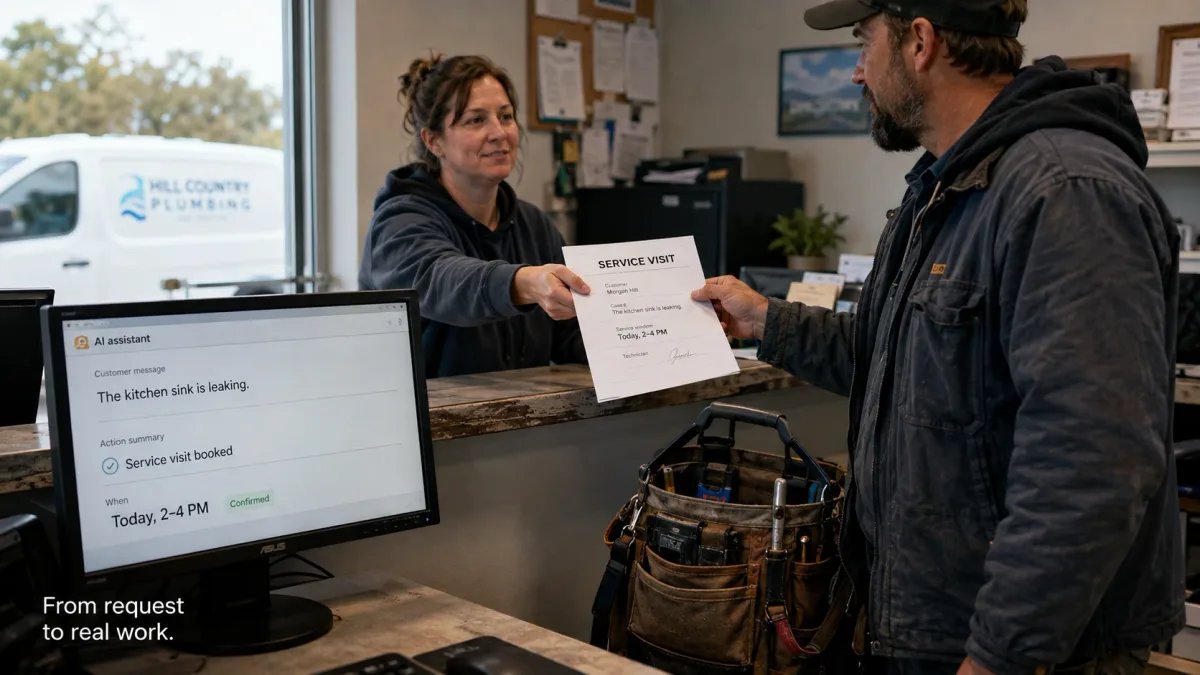
AI Agent Examples: Real Business Jobs from Observation to Action
See how agents can triage requests, resolve scheduling changes, find missing intake details, and prepare follow-up work, with explicit decisions and handoffs.
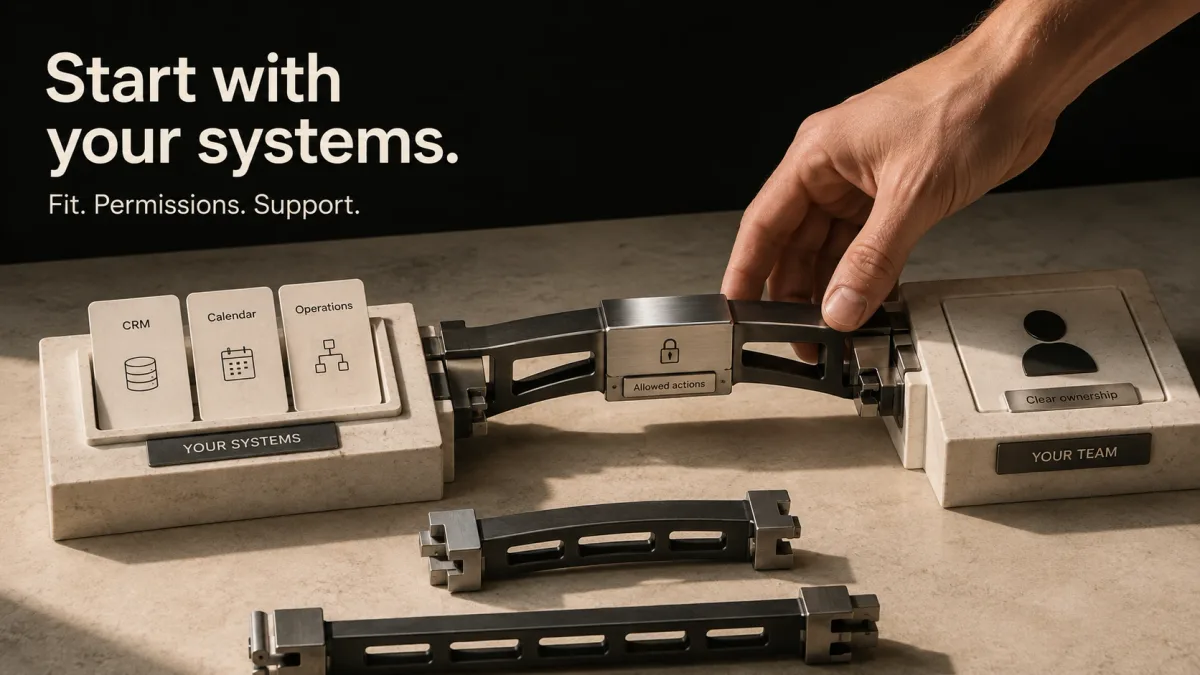
Best AI Agent Platforms for Business: A Practical Buying Guide
Compare n8n, Copilot Studio, OpenAI Agent Builder, and custom implementation by business fit, ownership, operating costs, and support.
How to Get an AI Agent for Your Small Business
Decide whether to buy, configure, or commission an AI agent. Know what to bring, what a proposal should include, and how to accept the first working task.