
AI vs. Machine Learning: What's Actually Different in 2026
AI and machine learning are not the same thing. AI is the broader field covering any system designed to perform tasks that typically require human reasoning.
Most business owners use AI and ML as synonyms. They're not the same, and confusing them costs real money. Here's the actual difference, with a comparison.
Epiphany Dynamics is an AI automation agency: we help businesses find and fix operational bottlenecks with AI receptionists, lead follow-up, and workflow automation.
The free 30-minute AI Operations Audit is a conversation about a normal week in your business and where the work piles up. We find the one change that would give you the most time back and send you a plain-English plan for it. No forms and no pitch.
Book a free AI audit
Patrick Gibbs
AI and machine learning are not the same thing. AI is the broader field covering any system designed to perform tasks that typically require human reasoning. Machine learning is a specific method within AI where systems learn patterns from data rather than following pre-written rules. The terms cover different scopes, different costs, and different maintenance requirements.
If you've sat through a vendor pitch in the past two years, you've heard both terms used interchangeably. Sometimes in the same sentence. That's not an accident. Calling everything "AI" sounds better in a slide deck than explaining which statistical technique the product uses under the hood. But if you're a business owner making purchasing decisions, the distinction matters more than the marketing does.
Here's the actual breakdown, with no hand-waving.
What AI Actually Covers
Artificial intelligence describes any computational system designed to simulate human cognitive tasks: reasoning, problem-solving, language understanding, visual recognition, or decision-making. The field dates to the 1950s and includes rule-based expert systems, search algorithms, and modern large language models. Not all AI learns from data, which is the key point most explanations skip entirely.
IBM's Deep Blue beat Garry Kasparov at chess in 1997. That was AI by any reasonable definition: a machine performing a task that requires strategic human reasoning. What it wasn't is a learning machine. Deep Blue evaluated positions using hand-crafted rules and scoring functions written by programmers. No training data. No neural networks. Explicit, predetermined logic.
That category of AI is still everywhere in business today. An IVR phone system that routes callers based on keypad inputs is AI. A chatbot that pattern-matches your message against a list of triggers and returns a scripted response is AI. An email system that flags messages containing the word "refund" and routes them to billing is AI. None of those systems learn from experience. They do exactly what a programmer told them to do, and they'll keep doing it until someone changes the code.
The label "AI" covers an enormous range of systems, which is part of why it has become nearly useless as a purchasing category. When evaluating tools for your business, the more useful question is: does this system learn, or does it follow rules?
What Machine Learning Does Differently
Machine learning is AI that improves through exposure to data. Instead of following pre-written rules, an ML system identifies statistical patterns in training examples, builds a mathematical model of those patterns, and applies that model to classify or predict new inputs. A fraud detection system trained on historical transaction patterns is ML. A fixed transaction-threshold rule is not.
The practical difference shows up in what breaks. A rule-based system fails when reality doesn't match the rules someone wrote. An ML system fails when the data it sees in production stops resembling its training data. This is called model drift, and it is one of the real maintenance costs of using ML that vendors rarely mention early. An old spam filter needs retraining to catch newer phishing tactics. That's not a flaw in the technology. It's a structural feature of how learning systems work, and it comes with an ongoing operational cost.
ML covers a range of specific techniques: supervised learning (learning from labeled examples), unsupervised learning (finding structure in unlabeled data), reinforcement learning (learning from feedback and rewards), gradient boosting, neural networks, and transformer-based large language models. The recommendation engine that suggests your next Netflix show is ML. A voice assistant that transcribes customer calls is ML. The machine learning models used for financial forecasting in mid-market companies are ML. They all share one property: they learn from examples rather than executing predetermined logic.
Industry surveys consistently find that a majority of organizations now use ML in at least one business function, up sharply from just a couple of years ago. That adoption is happening fast, and a lot of it is in businesses where the owners couldn't tell you the technical difference between what they bought and a rule-based alternative that would have cost half as much.
AI vs. Machine Learning: A Direct Comparison
The clearest way to separate AI from ML is by asking two questions: does the system learn from data, and does it improve over time without human reprogramming? If yes to both, it's ML. If no, it's rule-based AI. Most business software is a hybrid, using ML for the hard pattern-recognition work and rules for simple routing logic around it.
| Aspect | Rule-Based AI | Machine Learning |
|---|---|---|
| How it works | Follows explicit logic written by humans | Learns patterns from training data |
| Requires training data | No | Yes, usually enough examples to represent the real variation in the task |
| Improves over time | Only if a human updates the rules | Yes, through periodic retraining |
| Fails when | Reality doesn't match the rules | Production data drifts from training data |
| Typical deployment cost | Lower, faster to build and launch | Higher, needs data infrastructure and pipelines |
| Ongoing maintenance | Update rules manually as logic changes | Monitor for drift, retrain on fresh data |
| Best for | Defined decisions with consistent inputs | Variable inputs, complex pattern recognition |
| Business examples | Call routing, email triggers, workflow steps | Lead scoring, fraud detection, churn prediction |
The table is a simplification, because in practice most production systems blend both. A customer service platform might use ML to classify the intent of an inbound message and rule-based logic to decide what happens next based on that classification. That's not a contradiction. It's engineering. Understanding which layer is which lets you diagnose failures and set realistic expectations for what the system can handle on its own.
Why Mixing Up the Terms Gets Expensive
Buying ML when you need rules wastes money. Buying rules when you need ML hits a hard accuracy ceiling. Businesses that deploy ML tools for simple binary decisions often pay for unnecessary setup and maintenance. Businesses that use rule-based tools for complex variable tasks like lead scoring or demand forecasting eventually hit a performance plateau.
This is where vendor conversations go sideways. A SaaS platform tells you its product uses "AI-powered" scheduling or "AI-driven" lead routing. What they often mean is a set of if/then conditions behind a clean interface. That's not inherently a problem. Rule-based automation is reliable, auditable, and cheap to maintain. But if you're paying ML-tier pricing for rule-based behavior, you're overpaying for a label.
The flip side happens when a small business owner reads about ML predicting customer churn and decides to build something custom before they have the data volume to train anything useful. Most supervised learning approaches need enough labeled examples to outperform a decent heuristic. A small service business with limited history may get more out of a simple rule based on inactivity than a custom churn model. That's not settling for less. That's the right tool for the data available.
If you look at the broader state of AI adoption in U.S. small businesses in 2026, the pattern holds: the highest ROI goes to businesses that match the technology to the actual complexity of the problem, not to the most sophisticated tool on the market. Sophistication isn't the goal. Results are.
Which One Does Your Business Actually Need?
For most small and mid-sized businesses, the right sequence is rule-based AI first, ML second when the data justifies it. Automate defined logic before chasing complex pattern recognition. Businesses that start with workflow automation and call handling usually reach measurable operational value faster than businesses that begin with custom ML models and heavy data preparation.
A practical test: if you can draw the decision as a flowchart, rule-based AI handles it. If the right answer depends on evaluating many variables simultaneously and shifts based on subtle context, that's where ML earns its cost. Most service businesses have far more of the first type than the second, which is worth knowing before any budget conversation with a vendor.
The practical starting point for most businesses is AI workflow automation: automating scheduling, intake, follow-ups, and call handling through logic-based systems. That's where quick wins live. Once you've captured that value and accumulated enough operational data, the case for ML in specific applications like lead scoring or appointment prediction gets much stronger and much easier to justify financially.
Call handling is a useful concrete example. A business that deploys an AI phone system for after-hours calls isn't using ML to understand caller intent from scratch. It's using a combination of speech recognition (ML, built by the vendor) and scripted decision trees (rules, configured by you) to route people correctly. The ML part was already built by the vendor on broad voice data. The rules part is what you configure for your business. Understanding the split tells you what you can customize and what you're just purchasing as-is. For anyone evaluating that category, there's a detailed breakdown in the AI receptionist vs. call center comparison that gets into the mechanics.
The honest bottom line: the AI vs. ML distinction matters most when you're buying, building, or troubleshooting something. For day-to-day operations, the label is less important than whether the system does what you need at a cost that makes sense. But the confusion is expensive when it pushes businesses toward over-engineered solutions for simple problems, or toward underbuilt tools when something that actually learns is what the task requires.
Most of the AI automation deployments that show real revenue results start with clear problem definition, not tool selection. Know what decision you're automating, know how much variation exists in the inputs, and the right category becomes obvious. Whether the vendor calls it AI or ML matters a lot less than whether it fits your actual use case. If you want help working through that mapping for your specific business, Epiphany Dynamics does exactly that kind of evaluation before recommending anything.
Frequently Asked Questions
Q: Is machine learning the same thing as artificial intelligence?
No. AI is the broader category covering any system designed to perform tasks requiring human reasoning, including rule-based expert systems and decision trees. Machine learning is a specific subset of AI where systems learn patterns from data rather than following pre-written rules.
Q: Can you build AI without using machine learning?
Yes. IBM's Deep Blue defeated Garry Kasparov in 1997 using hand-coded rules with no machine learning or neural networks. Many business systems today operate this way: email spam filters, chatbots that match inputs to scripted responses, and IVR phone systems all qualify as AI because they perform reasoning tasks, just without learning from data.
Q: What's an example of rule-based AI versus machine learning in practice?
A fraud detection system using machine learning analyzes historical transaction patterns and automatically flags anomalies as it learns. A rule-based AI system flags transactions from unusual locations or against predefined thresholds. The ML system adapts to new fraud tactics, while the rule-based system requires manual reprogramming when fraudsters evolve their methods.
Q: Why does the AI versus machine learning distinction matter for business purchasing decisions?
The difference directly affects cost, maintenance burden, and capability expectations: machine learning requires ongoing data collection and model retraining, while rule-based AI needs manual updates to its logic. If your business problem is stable and well-defined, rule-based AI may be cheaper to deploy and maintain. If your problem changes frequently or involves unpredictable patterns, machine learning's ability to adapt automatically often justifies the higher operational cost.
Patrick Gibbs
AI Automation Expert
Patrick Gibbs helps professional practices implement AI automation that captures more leads, books more appointments, and scales without adding overhead. He's the founder of Epiphany Dynamics and creator of the AI Front Desk system.
Related Solutions
Build this into a real workflow
Related Posts
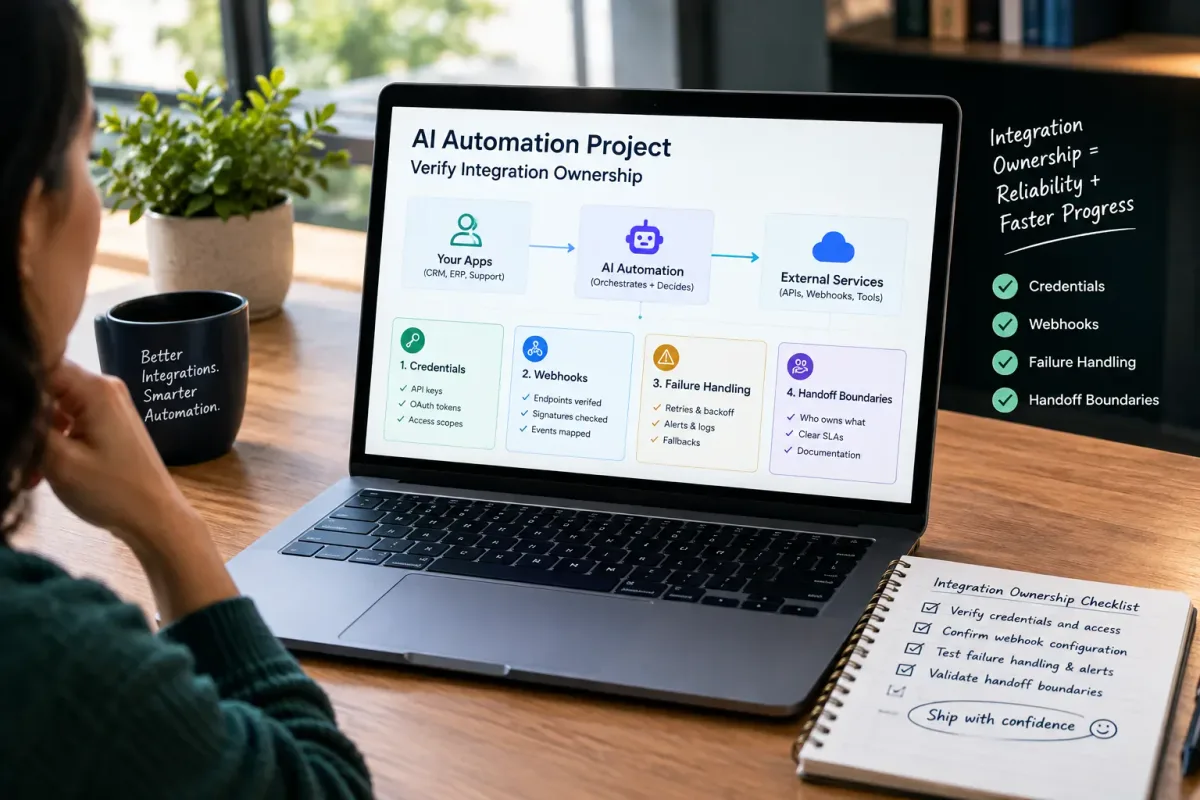
How Do I Verify Integration Ownership in an AI Automation Project?
Learn how to verify integration ownership in an AI automation project, including credentials, webhooks, failure handling, and handoff boundaries.
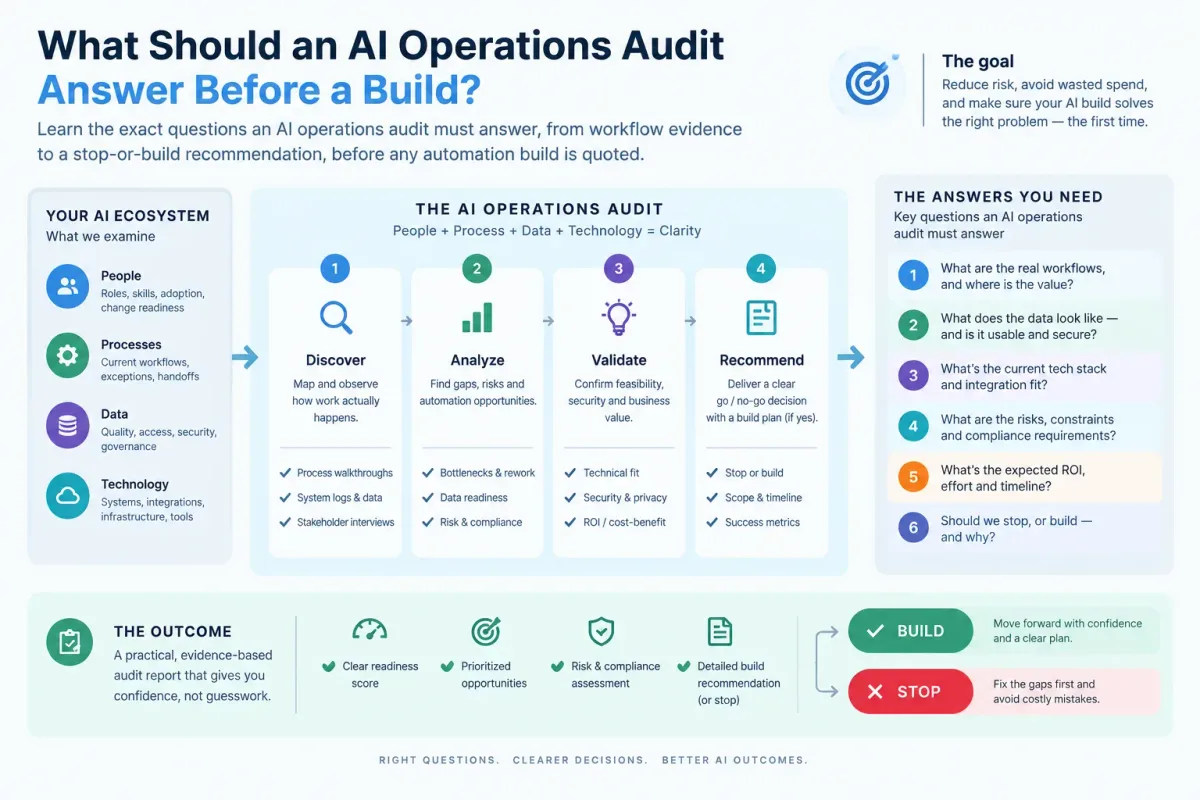
What Should an AI Operations Audit Answer Before a Build?
Learn the exact questions an AI operations audit must answer, from workflow evidence to a stop-or-build recommendation, before any automation build is quoted.

Who Is Patrick Gibbs and What Does Epiphany Dynamics Build?
Patrick Gibbs founded Epiphany Dynamics to help small and midsize businesses replace missed opportunities and manual busywork with practical AI automation.