
How to Switch From an Answering Service to an AI Receptionist in 2026
Switching from a traditional answering service to an AI receptionist works best as a controlled transition, not a sudden cutover. Audit your current call types, build the AI's knowledge base, configure your scheduling integration, run both systems in parallel, then cancel the old service after validation.
Traditional answering services often leave callers in a callback queue. Here's how to switch to an AI receptionist with a parallel test period and fewer.
Epiphany Dynamics is an AI automation agency: we help businesses find and fix operational bottlenecks with AI receptionists, lead follow-up, and workflow automation.
The free 30-minute AI Operations Audit is a conversation about a normal week in your business and where the work piles up. We find the one change that would give you the most time back and send you a plain-English plan for it. No forms and no pitch.
Book a free AI audit
Patrick Gibbs
Switching from a traditional answering service to an AI receptionist works best as a controlled transition, not a sudden cutover. Audit your current call types, build the AI's knowledge base, configure your scheduling integration, run both systems in parallel, then cancel the old service after validation. Done right, the new system is tested before real callers depend on it.
Most businesses that finally decide to make this switch have been sitting on the fence for at least a year. The answering service isn't working and they know it. Callers get put on hold. Messages come back wrong. Nothing gets booked without a callback. But switching feels risky when the alternative is still unfamiliar territory.
Those concerns are real and worth taking seriously. They're also solvable, with the right transition structure. Here's the exact process for moving off a traditional answering service without dropping calls, losing leads, or catching your customers off guard.
What You're Actually Paying for With a Traditional Answering Service
Traditional answering services usually bill by the minute, by package tier, or by flat monthly coverage. Per-minute billing means every hold, pause, and transfer directly adds to your invoice before a single useful thing happens.
The pricing model is worth understanding before you switch, because it shapes exactly what you're replacing. A caller who waits on hold before a rep picks up can add cost before the conversation even starts. That's not a minor inefficiency. It's a structural tax on every inbound call.
Beyond cost, the capability ceiling is low. Human receptionists reading from a script can take a message, page someone, or transfer a call. They can't access your scheduling software, check service area coverage in real time, or route calls based on urgency rules you've defined. Every non-standard question becomes "I'll have someone call you back," which converts inbound interest into a callback queue that may or may not get worked the same day.
The average service business misses a large share of inbound calls when staff is unavailable. An answering service patches the coverage gap, but it doesn't solve the workflow problem. The caller still can't book an appointment at 9pm on a Tuesday. That's a structural limitation, not a staffing issue.
How AI Receptionists Handle the Same Calls Differently
AI receptionists answer without hold queues, operate whenever callers need help, and connect directly to your scheduling and CRM software. They book appointments, answer FAQs, triage emergencies, and route calls based on rules you define. The difference isn't the voice. It's that the AI completes transactions instead of taking messages.
The comparison isn't really "human vs. AI." It's more like "scripted relay vs. connected workflow." A human answering service rep takes your message and sends it somewhere. An AI receptionist can complete the transaction. When a caller asks to book a Tuesday afternoon appointment, the AI checks your calendar in real time, confirms availability, and locks it in. The caller hangs up with a confirmation, not a promise that someone will call them back.
Cost is the other part. AI receptionist platforms and human-hybrid services price very differently, so compare current quotes against the same call volume and workflow requirements. For a clear look at what each model actually covers and where each makes sense, the AI receptionist vs answering service comparison breaks down the capability differences by use case. The short version: AI wins on availability and task completion, human services win on genuinely complex edge cases, and many service businesses don't get enough complex calls to justify the premium.
If you're specifically evaluating human-hybrid platforms as a middle step before going fully automated, the breakdown of Smith.ai alternatives in 2026 shows how the pricing and feature sets compare across the main options currently available.
The Switching Process, Step by Step
Switching from an answering service to an AI receptionist has a simple structure: audit recent call types, build the AI's knowledge base from those categories, configure scheduling and CRM integrations, run both services in parallel, and cancel the old service after the AI has handled real calls without an uncorrected gap.
Step 1: Audit Your Recent Calls
Pull the call logs from your answering service dashboard or request a CSV export. Categorize what actually came in: appointment requests, existing customer questions, emergencies, vendor calls, spam. In most service businesses, a meaningful share of calls falls into repeatable categories. Those are the scenarios you configure first. The rest become your escalation rules, not your scripting targets.
Step 2: Build the Knowledge Base
Most AI platforms have a knowledge base section where you write direct answers to common questions: service area, pricing range, availability windows, what qualifies as an emergency, what to do if someone needs immediate help. Keep each answer concise and always include a clear next step for the caller. If you want a detailed walkthrough, this guide to creating an AI receptionist from scratch covers the build process from knowledge base setup through escalation logic and scheduling integration. The section on what to leave out is as useful as what to put in.
Step 3: Configure Your Integrations
Connect the AI to your scheduling system (Google Calendar, Calendly, ServiceTitan, whatever you use) and route your business phone number to the AI through a call forward. Set your escalation rules explicitly before going live. "If a caller says there's water flooding the basement, connect them to [mobile number] immediately" is a rule. "If it sounds urgent" is not a rule. Write the specific trigger conditions out in plain language before you try to configure them in the platform.
Step 4: Run the Parallel Period
This is the step most businesses skip, and the one that prevents disasters. Run both services simultaneously during a controlled validation period. Keep your answering service on the main line while you test the AI on a forwarded number or test line. Listen to recordings. Call in yourself as a customer and test the edge cases you're most nervous about.
One business I worked with discovered their AI was routing all emergency calls to an unmonitored voicemail box. Not because the AI failed, but because the escalation rule pointed to the wrong extension. Parallel testing caught that before it cost a real customer. That's exactly the kind of gap that's invisible until it isn't.
Step 5: Cancel the Old Service
Once the AI has handled real calls without an uncorrected gap, give your answering service notice. Time your cancellation date so there is overlap after the notice period ends. Keep call recordings after the switch as your paper trail in case anything surfaces later.
The Cost Comparison You Should Actually Run
The cost comparison should use your own call logs and current vendor quotes. Compare your answering service invoice against the AI platform quote, then add the revenue side separately: after-hours bookings captured, callback delays avoided, and staff time no longer spent cleaning up bad messages.
| Service Type | Cost Basis | After-Hours Coverage | Booking Capability | Cost Check |
|---|---|---|---|---|
| Per-minute answering service | Your invoice or current quote | Yes (surcharge applies) | Message only | Minutes billed x rate |
| Flat-rate human hybrid (Smith.ai) | Current package quote | Yes | Limited | Package cost / call volume |
| AI receptionist (mid-tier platform) | Current platform quote | Yes, always-on coverage | Full booking | Platform cost / call volume |
The revenue side of this calculation is harder to pin down, but worth running. If a meaningful share of your calls come after hours and the answering service takes a message that never gets followed up, an AI that can actually book appointments closes that gap directly. Use average ticket value, after-hours call volume, and booked-job rate to model the upside. The ROI breakdown for plumbing businesses runs this calculation in full detail. The same math applies to HVAC, electrical, roofing, and any trade where the phone rings while someone's hands are dirty.
Next on this subject: AI Phone Answering Service for Small Business: What to Compare in 2026.
The Mistakes That Slow Most Switches Down
The mistakes that derail most answering service migrations are canceling the old service before completing the parallel test period and building the AI's knowledge base from assumptions rather than actual call logs. Both lead to the same outcome. Real callers hit gaps that could have been caught before cutover.
Skipping the call audit is where most rushed transitions go wrong. Businesses that build the knowledge base from gut feel end up with a system that handles the scenarios they expected well and fumbles the ones they didn't think about. Recent call logs tell you what actually comes in, not what you assume comes in. Those are often different lists.
The other common mistake is over-engineering before launch. Trying to build a perfectly comprehensive AI before going live is a good way to cancel the project out of frustration. A system that handles your core call types correctly is more useful than one built to cover every possible scenario inconsistently. Launch narrow, run the parallel period, and expand the AI's scope based on what real callers actually ask. The 2026 reality check on AI and receptionist roles is worth reading before you make any staffing decisions tied to the switch. For most service businesses, the AI handles volume and a human handles exceptions, and the volume-to-exception ratio is usually more favorable than people expect going in.
Getting the Transition Right
Switching from an answering service to an AI receptionist works when you treat it as a validation process. Technical setup comes first, then parallel testing, then cutover after the AI has handled real calls without an uncorrected gap. Savings depend on your current invoice, the replacement platform quote, and how many calls the AI can actually complete instead of relaying.
The transition is straightforward when you use the parallel structure. The hardest part is usually the audit and knowledge base build, especially if the person doing it doesn't actually know how calls flow through your business. The testing period is mostly passive monitoring with a few intentional edge-case calls thrown in.
The answering service industry built its model around the assumption that call handling requires humans on the other end. That assumption was correct for a long time. It's less correct now, and the capability gap is wide enough that staying put can have a real monthly price. If you've been paying for a service that still puts callers on hold and can't book an appointment without a callback, the math is worth rerunning.
If you'd rather have someone handle the configuration and workflow design than build it in-house, Epiphany Dynamics works with service businesses on exactly this kind of implementation.
Frequently Asked Questions
Q: How much will I save by switching to an AI receptionist from a traditional answering service?
Savings depend on your current answering service invoice, the AI platform quote, call volume, and how many calls the AI can complete without human follow-up. Compare total monthly cost, not just headline package price: per-minute billing, after-hours surcharges, setup fees, and callback labor all matter.
Q: Will I lose any calls during the switch from an answering service to AI?
The safest transition uses a parallel testing period where both services run simultaneously while you validate call handling quality, routing, and bookings. Once validated, you cut over with the old service still available as a backstop during the transition.
Q: What's the difference in call handling capabilities between AI receptionists and human answering services?
AI receptionists access your live scheduling calendar, check real-time service availability, and route calls based on custom rules you define. Human receptionists are better for genuinely complex edge cases, emotional calls, and judgment-heavy situations. The right model depends on call complexity and escalation risk.
Q: How long does it take to fully switch from an answering service to an AI receptionist?
The full timeline depends on how clean your call logs are, how complex your scheduling integration is, and how many edge cases need escalation rules. Plan for an audit, knowledge-base build, integration setup, parallel testing, and a controlled cutover after validation.
Patrick Gibbs
AI Automation Expert
Patrick Gibbs helps professional practices implement AI automation that captures more leads, books more appointments, and scales without adding overhead. He's the founder of Epiphany Dynamics and creator of the AI Front Desk system.
Related Solutions
Build this into a real workflow
Related Posts

What Should an AI Automation Agency Prove Before Taking Access?
Before an AI automation agency touches your systems, it should prove access boundaries, written scope, security practices, test evidence, and a clear ownership record.
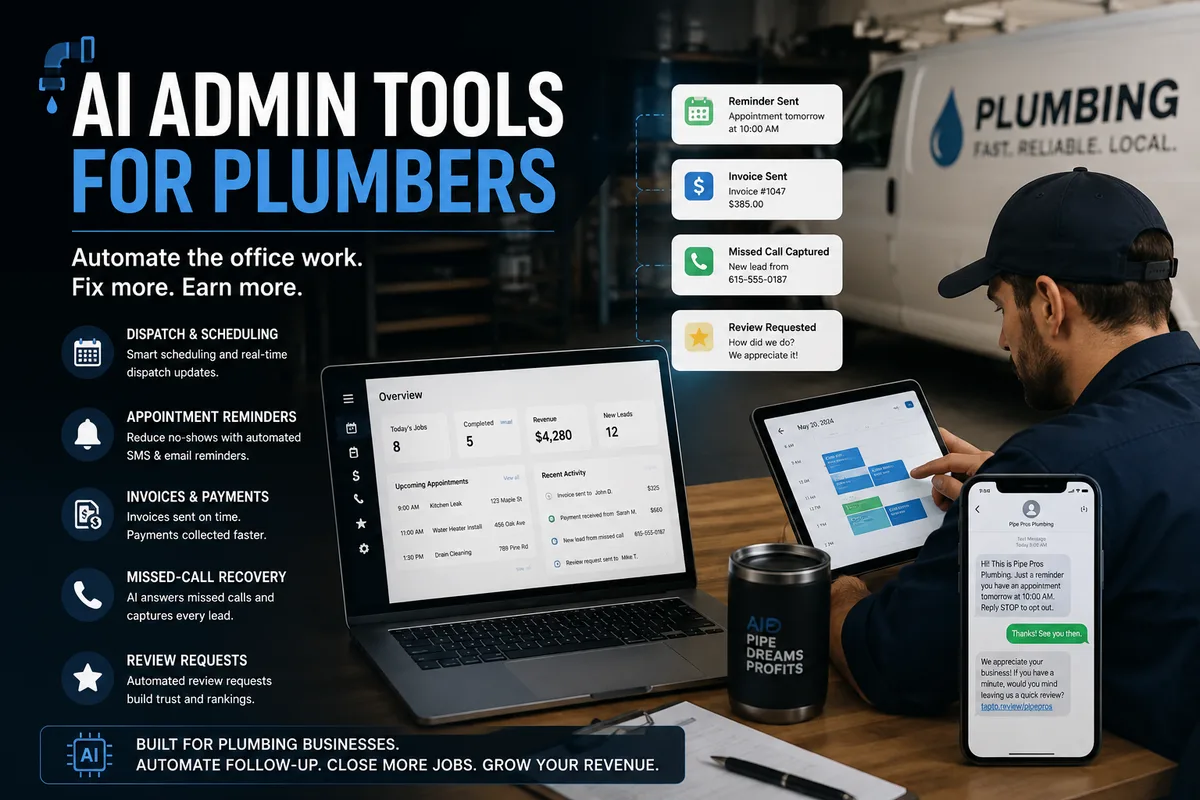
AI Admin Tools for Plumbers: What They Are and How to Choose
AI admin tools automate dispatch, reminders, invoicing follow-up, missed calls, and review requests for plumbers. What they do and how to choose.
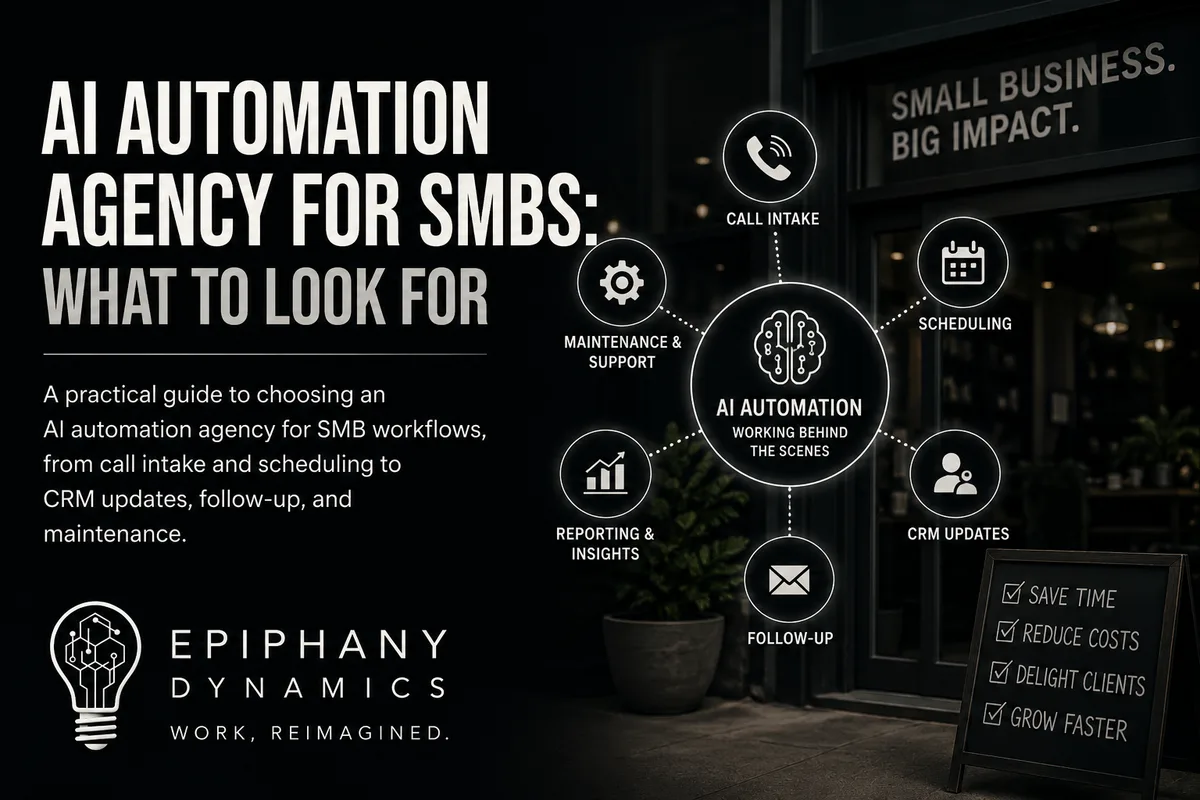
AI Automation Agency for SMBs: What to Look For
A practical guide to choosing an AI automation agency for SMB workflows, from call intake and scheduling to CRM updates, follow-up, and maintenance.