
Reduce Med Spa Cancellations with AI Reminders: A Practical Guide
No-shows can quietly bleed a med spa through blocked chair time, idle staff, and last-minute schedule gaps. AI-powered reminder systems, when implemented correctly, can reduce that leakage by making confirmation, rescheduling, and waitlist filling easier.
No-shows are quietly bleeding med spas dry. Here's how AI-powered reminder systems help protect booked revenue, with a practical sequence and measurement model.
Epiphany Dynamics is an AI automation agency: we help businesses find and fix operational bottlenecks with AI receptionists, lead follow-up, and workflow automation.
The free 30-minute AI Operations Audit is a conversation about a normal week in your business and where the work piles up. We find the one change that would give you the most time back and send you a plain-English plan for it. No forms and no pitch.
Book a free AI audit
Patrick Gibbs
No-shows can quietly bleed a med spa through blocked chair time, idle staff, and last-minute schedule gaps. AI-powered reminder systems, when implemented correctly, can reduce that leakage by making confirmation, rescheduling, and waitlist filling easier. One example sequence uses multi-channel touchpoints at 72 hours, 24 hours, and 2 hours before, with two-way confirmation built in. This guide covers how to calculate your specific exposure, why basic reminders fail, and how to build a sequence that protects booked revenue.
The Silent Revenue Leak Costing Med Spas Thousands Each Month
A short injectable appointment. A longer laser treatment. And then, nothing. The client doesn’t show. Most med spa owners accept this as the cost of doing business, but when you actually run the numbers, no-shows and last-minute cancellations are one of the most expensive operational failures in the aesthetic industry, and one of the most fixable.
If a med spa has meaningful monthly revenue tied to scheduled chair time, every recurring no-show pattern represents blocked, unrecoverable capacity. That’s not a rounding error. That’s margin disappearing into empty appointment slots. The more striking point: AI-powered reminder systems, when implemented correctly, can reduce avoidable leakage. That’s a recoverable problem hiding in plain sight. Understanding the real cost of missed calls paints an even bigger picture of what’s leaking across the entire patient communication chain.
What No-Shows Are Actually Costing You (Do the Math)
Before investing in any solution, know your real exposure. Here’s a straightforward formula that avoids the temptation to inflate the numbers:
Booked appointment value at risk - recovered or refilled slots = realistic loss
This model forces you to account for slots that do get filled at the last minute or by walk-ins instead of treating every cancellation as a total loss. It gives you a more defensible number than a raw no-show count.
| Input | Why It Matters |
|---|---|
| Booked monthly appointment value | Sets the revenue base at risk |
| Baseline no-show and late-cancel pattern | Shows how much chair time is leaking today |
| Waitlist fill rate | Separates recoverable gaps from true loss |
| Average ticket by treatment type | Prevents low-value and high-value services from being modeled the same way |
These figures only capture direct revenue loss. They don’t account for staff idle time, equipment depreciation during downtime, or the scheduling inefficiency that cascades through the rest of the day. Indirect costs can push the real exposure higher than the direct revenue figure alone.
Why Basic Reminders Don’t Move the Needle
Most booking platforms ship with some form of automated reminder: a confirmation email at booking, a text 24 hours before. For compliant clients, that’s enough. But for clients who still don’t show, that approach clearly isn’t working, and throwing more of the same at the problem won’t change the outcome.
If you are still on a free or entry-tier reminder plan, the free automated appointment reminder tools guide shows what those plans actually deliver and where they fall short.
The core failure of basic reminder systems comes down to three structural problems. First, one-way communication: the reminder goes out, but if the client has a conflict, there’s no easy path to reschedule. They ignore the text, get busy, feel awkward calling, and the path of least resistance becomes ghosting. Second, bad timing: a single 24-hour reminder misses two critical windows: clients who know they have a conflict days in advance, and clients who forget and would respond to a same-day nudge 2-4 hours before. A single touchpoint serves neither group well.
Third, and most importantly: no accountability loop. A client who hasn’t confirmed has no idea that their slot is at risk. A system that identifies unconfirmed appointments and escalates (follow-up text, then voice call, then automatic waitlist offer) creates the kind of social and logistical accountability that a single reminder email never can.
How AI Reminder Systems Actually Work
AI-powered reminder systems differ from basic automation in one fundamental way: they handle responses and adapt behavior in real time. When a client replies “I need to reschedule,” a basic system does nothing. An AI system parses that reply, offers available times from the live calendar, completes the reschedule, and flags the freed slot for waitlist filling, without any staff involvement. That’s the operational shift that moves the needle.
Effective AI reminder architecture has three core layers. Multi-channel delivery is the foundation: SMS leads because texts get opened far more reliably than email. The AI escalates to email for clients who haven’t confirmed by a set threshold, and to voice for high-value appointments or clients with a history of no-shows. The channel itself matters less than the logic governing when each one fires.
Conversational confirmation replaces one-way blasts with a response loop. Rather than “Your appointment is tomorrow,” effective messages ask: “Can you confirm your [Service] on [Date] at [Time]? Reply YES to confirm, RESCHEDULE to pick a new time, or NO to cancel.” Each reply triggers an action. That loop is the mechanism that changes behavior. Finally, waitlist automation, the highest-value feature most practices underuse, immediately notifies everyone on a service-specific waitlist the moment a cancellation comes in. First to claim gets the slot. Cancellations go from pure loss to recovered revenue within minutes.
Related reading: AI Product Recommendation Automation for Med Spa Retail.
The Optimal Reminder Sequence for Med Spas
Timing is the difference between a reminder that gets ignored and one that drives action. In practice, this five-touchpoint sequence consistently outperforms simpler approaches:
| Touchpoint | Timing | Channel | Primary Purpose |
|---|---|---|---|
| Booking confirmation | Immediately at booking | Email + SMS | Set expectations, deposit policy, cancellation terms |
| Pre-reminder | 72 hours before | SMS | First confirmation request with easy reschedule option |
| Main reminder | 24 hours before | SMS + Email | Confirmation required; triggers waitlist if no reply by deadline |
| Day-of nudge | 2-4 hours before | SMS | Final check-in, parking or prep instructions |
| No-show follow-up | 30-60 min after missed appt | SMS | Reschedule offer, deposit or fee notice if applicable |
Two rules make this sequence significantly more effective. Enforce a response deadline. The 24-hour reminder should include explicit language: “Please confirm by [time] or your appointment may be released to our waitlist.” This isn’t a bluff: the system should actually release unconfirmed slots at that threshold and notify the waitlist. Practices that enforce this consistently see no-show rates fall sharply within the first two months. AI schedulers built for Botox clinics handle this entire confirmation-and-fill workflow automatically.
Personalize by service type and ticket value. A 15-minute Botox touchup doesn’t require the same confirmation urgency as a 3-hour laser resurfacing treatment or a series of body contouring sessions. High-value, long-duration appointments warrant an additional touchpoint and a more direct confirmation requirement. AI systems can apply differentiated sequences automatically based on service type or appointment value. This is one of the places where “smart” reminders genuinely outperform template-based automation.
Implementation: What to Expect During Rollout
Deploying an AI reminder system isn’t an overnight transformation. Client behavior needs time to adjust, and your team needs confidence in the system’s responses. A realistic three-phase rollout looks like this:
Setup and calibration. Connect the system to your booking software via API or native integration. Configure message templates, set confirmation deadlines, and establish waitlist rules. If possible, run in a supervised mode at first: the AI sends messages, but staff review responses manually to catch edge cases such as VIP clients who should always be handled personally, clients who’ve opted out of SMS, or unusual service types that need custom handling.
Active but monitored. The AI handles confirmations, reschedules, and waitlist fills autonomously. Staff review a daily summary of actions taken rather than managing individual messages. You’ll surface scenarios that need refinement. Adjust templates and logic based on what you observe. This iteration period is what separates practices that see modest improvement from those that see dramatic gains.
Measure and validate. Pull your no-show rate and compare it against the baseline before implementation. Calculate recovered revenue by multiplying prevented no-shows by average ticket value, then subtracting the cost of the tool, workflow setup, staff training, and ongoing monitoring. Use your own appointment history and vendor quote instead of a generic payback example.
The Bottom Line: This Is an Operational Problem, Not a Marketing One
No-shows and last-minute cancellations aren’t caused by bad clients: they’re caused by friction, forgetfulness, and a reminder system that creates no real accountability. AI-powered reminders work because they make it easier to confirm, reschedule, or cancel than to simply not show up. They handle the conversational back-and-forth that front desk staff don’t have bandwidth for. And they fill empty slots automatically instead of letting revenue disappear.
The math is straightforward. A properly configured AI reminder system should be judged against the value of recovered appointments, not just the monthly software bill. The calculation isn’t whether it’s worth the investment: it’s whether the current setup can keep leaving that money on the table. Practices that solve the cancellation problem should next focus on what happens after the appointment: automating med spa customer follow-ups is the natural next step for turning kept appointments into repeat visits. For practices ready to move beyond basic reminders, AI front desk solutions purpose-built for the aesthetic industry are worth a serious evaluation.
Frequently Asked Questions
Q: What is the typical no-show rate for med spas that rely on manual booking confirmation?
Use your own appointment history as the baseline. Pull booked appointment value, no-show and late-cancel patterns, average ticket by treatment type, and the share of gaps your waitlist already refills. That gives you a more accurate picture than a generic industry no-show benchmark.
Q: How many reminder touchpoints does an effective med spa reminder sequence need?
One configuration to test uses five touchpoints: immediate booking confirmation, a 72-hour pre-reminder, a 24-hour main reminder requiring confirmation, a 2-4 hour day-of nudge, and a 30-60 minute post-no-show follow-up. Only release a slot when doing so matches the booking policy the customer accepted; an unanswered text alone should not silently cancel a confirmed appointment.
Q: What makes AI-powered reminders more effective than basic automated SMS confirmations?
AI systems handle responses and adapt in real time. When a client replies “I need to reschedule,” a basic system does nothing. An AI system parses that reply, offers available times from the live calendar, completes the reschedule, and flags the freed slot for waitlist filling, without any staff involvement. This conversational accountability loop is what closes the behavioral gap that basic one-way reminders cannot.
Q: What is the payback period for a properly configured AI reminder system at a med spa?
Model payback by multiplying prevented no-shows by average ticket value, then comparing that recovered revenue against your actual tool quote and staff oversight cost. The system is financially attractive when recovered appointments cover the monthly cost and operational effort.
Q: How should reminder sequences be differentiated for high-value versus routine appointments?
High-value, long-duration appointments (a 3-hour laser resurfacing session or a body contouring series) warrant an additional touchpoint and a more direct confirmation requirement than a 15-minute Botox touchup. AI systems can apply differentiated sequences automatically based on service type or appointment value, which is one of the areas where smart reminders genuinely outperform template-based automation in terms of revenue recovery per dollar of tool cost.
Patrick Gibbs
AI Automation Expert
Patrick Gibbs helps professional practices implement AI automation that captures more leads, books more appointments, and scales without adding overhead. He's the founder of Epiphany Dynamics and creator of the AI Front Desk system.
Related Solutions
Build this into a real workflow
Related Posts
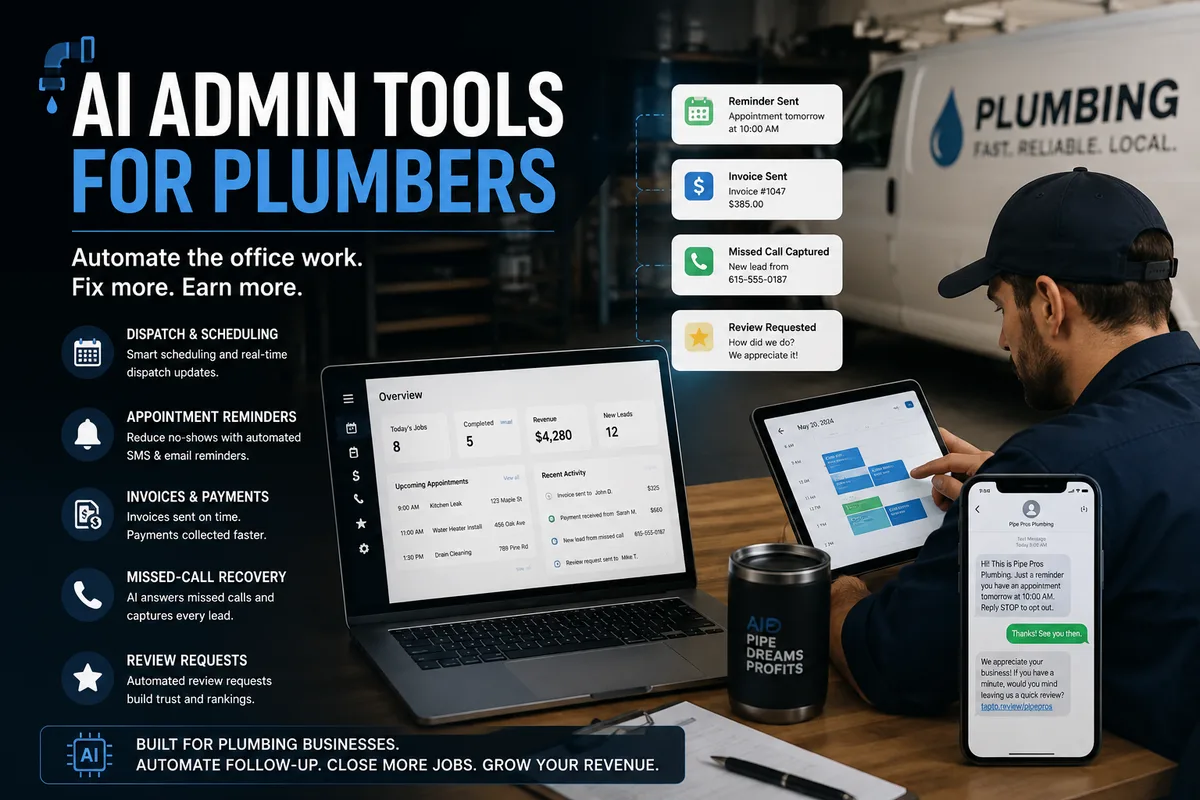
AI Admin Tools for Plumbers: What They Are and How to Choose
AI admin tools automate dispatch, reminders, invoicing follow-up, missed calls, and review requests for plumbers. What they do and how to choose.
Insurance Eligibility Automation for Physical Therapy Clinics
Eligibility automation for physical therapy clinics verifies benefits before the patient arrives, cuts front desk phone work, and can lower claim denial risk.
Appointment Reminder Automation for Small Business (2026 Guide)
For a service business with a meaningful no-show rate, the revenue leak is worth measuring. This guide covers how reminder automation works, which tools to.