
Chat vs. Chatbot: What's the Real Difference in 2026?
Chat is the communication channel. A chatbot is automated software participating in that channel without a human behind it.
Most businesses use 'chat' and 'chatbot' interchangeably and end up with the wrong setup. Here's what separates them, how they perform side-by-side, and how to.
Epiphany Dynamics is an AI automation agency: we help businesses find and fix operational bottlenecks with AI receptionists, lead follow-up, and workflow automation.
Free 30-minute audit. We name at least 3 things you can automate, ranked by impact.
Book a free AI audit
Patrick Gibbs
Chat is the communication channel. A chatbot is automated software participating in that channel without a human behind it. Live chat puts a person at the keyboard. A chatbot replaces that person for defined interactions with software that can run 24/7. That distinction determines cost structure, scalability, and what happens to your leads outside staffed hours.
What "Chat" Actually Means in a Business Context
Chat refers to any real-time text-based communication channel: website widgets, SMS, WhatsApp Business, in-app messaging. The channel itself is neutral. A live chat widget can route to a human agent, a chatbot, or a hybrid of both. Most businesses don't realize they're making an infrastructure decision when they choose between these options.
The confusion starts at the interface level. A visitor opens a chat window, types a question, and gets a response. Whether that response came from a dispatcher at a desk or a bot running on a server somewhere looks identical from the visitor's end. That visual similarity is why "chat" and "chatbot" get treated as synonyms in most sales pitches, even though they describe entirely different operational realities underneath.
Live chat software routes conversations to human agents in real time. The "live" part sets an expectation of immediacy. The problem is that humans can only sustain fast responses during staffed hours. After that, the chat widget either goes dark or silently routes to a bot, whether the business planned for it or not. For a service business taking leads around the clock, that gap is exactly where revenue disappears without anyone noticing.
What a Chatbot Is (and the Spectrum That Matters)
A chatbot is software that automates responses in a chat interface. Rule-based bots use decision trees and keyword matching. AI chatbots built on large language models understand conversational intent and handle multi-turn conversations without predetermined scripts. That gap between bot generations is larger than most businesses realize when they're evaluating options.
Rule-based chatbots operate on fixed logic. If someone types "appointment," the bot returns the booking link. If someone types something outside the programmed vocabulary, the bot either fails or drops them to a human. These systems are cheap to build and brittle in real use. They handle a narrow band of expected queries well and everything else poorly. For businesses with predictable, repetitive inquiries, they can work fine. For anything messier, they frustrate more than they help.
Modern AI chatbots work differently. They understand intent rather than matching keywords. Someone typing "hey I need to push back my Thursday thing" gets recognized as a reschedule request even though it contains no obvious trigger words. Well-configured AI chatbots resolve routine questions without human escalation when the workflow is narrow and the knowledge base is accurate. For businesses trying to figure out where bots fit in a broader communication setup, the data on conversational AI adoption across service industries provides useful baseline context before committing to a direction.
Side-by-Side Performance: What the Numbers Show
Chatbots respond immediately, scale without adding staffed seats, and keep routine inquiries moving outside business hours. Human live chat is better for complex, emotional, or high-context conversations. The practical comparison is not bot versus human in every case. It is which conversation types should be automated and which should escalate.
| Metric | Live Chat (Human Agent) | AI Chatbot |
|---|---|---|
| Average first response | Depends on staffing and queue depth | Immediate for configured flows |
| Availability | Staffed coverage windows | 24/7 when configured and monitored |
| Concurrent capacity per agent/instance | Limited by agent workload | Scales across simultaneous routine chats |
| Cost per conversation | Labor-driven | Software and usage-driven |
| Routine query resolution rate | Strong when staffed and trained | Strong when questions are predictable |
| Complex query resolution rate | Strong for nuance and exceptions | Should escalate when context is complex |
| Customer satisfaction (CSAT) | Depends on agent quality and wait time | Depends on fallback quality |
The satisfaction gap between AI-only and hybrid deployments deserves attention. It explains why pure chatbot implementations get mixed reviews. When the bot can't resolve something and there's no smooth handoff to a human, visitors leave frustrated. Hybrid setups work because human agents get more time and attention for the cases that actually need judgment. The cost math that makes this hybrid model viable is covered in detail in eliminating phone and chat staff costs with AI, which runs through service business scenarios specifically.
For volume scenarios, the chatbot case gets even more compelling. A human agent can only handle so many quality chats at once. An AI chatbot can absorb routine inquiry spikes while humans handle the conversations that actually require a person.
On a related note, see Is an AI Chatbot the Same as ChatGPT? The Real Difference.
Choosing the Right Setup for Your Business
Audit recent customer inquiries and categorize them: routine (hours, pricing, booking) versus complex (complaints, custom quotes, multi-step problems). If routine inquiries dominate, an AI chatbot is worth testing. If complex cases dominate, invest in live chat infrastructure first and use bots for after-hours coverage and overflow.
Most service businesses discover that routine inquiries make up a meaningful share of their volume. "What are your hours?" "Do you service my area?" "How much does X cost?" "Can I book for next Tuesday?" These don't require human judgment. They require accurate information delivered fast. A chatbot handling those queries while a human agent focuses on the conversations that actually need nuance can outperform either extreme when the handoff is designed well.
After-hours coverage changes the calculus significantly. Service businesses lose leads that arrive when no one is staffed to respond. A visitor who doesn't hear back typically moves on to the next search result. They call a competitor. The revenue impact of missed after-hours contacts can be substantial, and the framework in what missed contacts actually cost a service business is worth reviewing before assuming you're not affected. A chatbot that captures the lead and schedules a callback can recover opportunities that would otherwise disappear without a trace.
The hybrid model has become the default pattern for businesses with recurring routine inquiries. A bot manages intake, answers standard questions, qualifies leads, and routes complex conversations to a human. Agents stop cycling through repetitive queries and focus on interactions where they actually move the needle. Businesses looking at how AI chat fits into broader scheduling and CRM workflows can get a practical view in chatbots configured to actually convert on service websites and in how calendar tools, CRM, and AI combine in practice.
One thing that surprises most business owners after implementing chatbots: the data they generate. Every conversation is a structured log. You can see which questions appear most often, where visitors abandon the chat, what language customers use to describe their problems, and which query types end in booked appointments. That intelligence is nearly impossible to extract from phone calls or scattered email threads. It doesn't justify a chatbot deployment on its own, but it compounds into real operational value over months, and most businesses find it reshapes how they write their service pages, update their FAQs, and train human agents.
Chat and chatbots aren't competing philosophies. Chat is the channel. Chatbots automate participation in that channel for the interactions that don't require a human. Getting the distinction right determines whether you build a staffed agent team, subscribe to a bot platform, or construct the hybrid that most growing service businesses eventually settle on. The decision starts with honest data about your conversation volume and what's actually in those conversations. Once you have that, the right path becomes clear. Teams like Epiphany Dynamics help service businesses work through exactly this kind of audit, but you can start the analysis today with the framework above.
Frequently Asked Questions
Q: How much does a chatbot actually cost compared to hiring a live chat agent?
Chatbot platforms usually have software and usage costs, while live chat depends on staffed labor. The better comparison is your current inquiry volume, the share that is routine, and the cost of having humans answer the same questions repeatedly.
Q: What's the real difference in response time between live chat and AI chatbots?
AI chatbots can respond immediately for configured flows, while live chat speed depends on staffing and queue depth. However, chatbot accuracy drops on questions outside their training data, whereas humans can handle novel problems immediately.
Q: Will a chatbot actually answer questions at 2 AM, or does it just say "we're closed"?
A properly configured chatbot answers FAQs and captures lead information 24/7, including when live agents are offline. The tradeoff: it can't solve complex problems, so hybrid setups route difficult inquiries to humans during the next staffed window.
Q: Should I use live chat, a chatbot, or both, and what's the decision framework?
Use live chat alone if you're consistently staffed during peak hours; use chatbots if you handle high-volume routine inquiries; use hybrid if you need 24/7 lead capture with human escalation for complex issues. The deciding factor is whether losing after-hours conversations costs more than the technology required to capture them.
Patrick Gibbs
AI Automation Expert
Patrick Gibbs helps professional practices implement AI automation that captures more leads, books more appointments, and scales without adding overhead. He's the founder of Epiphany Dynamics and creator of the AI Front Desk system.
Related Solutions
Build this into a real workflow
Related Posts

AI Agent Examples: Real Business Jobs from Observation to Action
See how agents can triage requests, resolve scheduling changes, find missing intake details, and prepare follow-up work, with explicit decisions and handoffs.
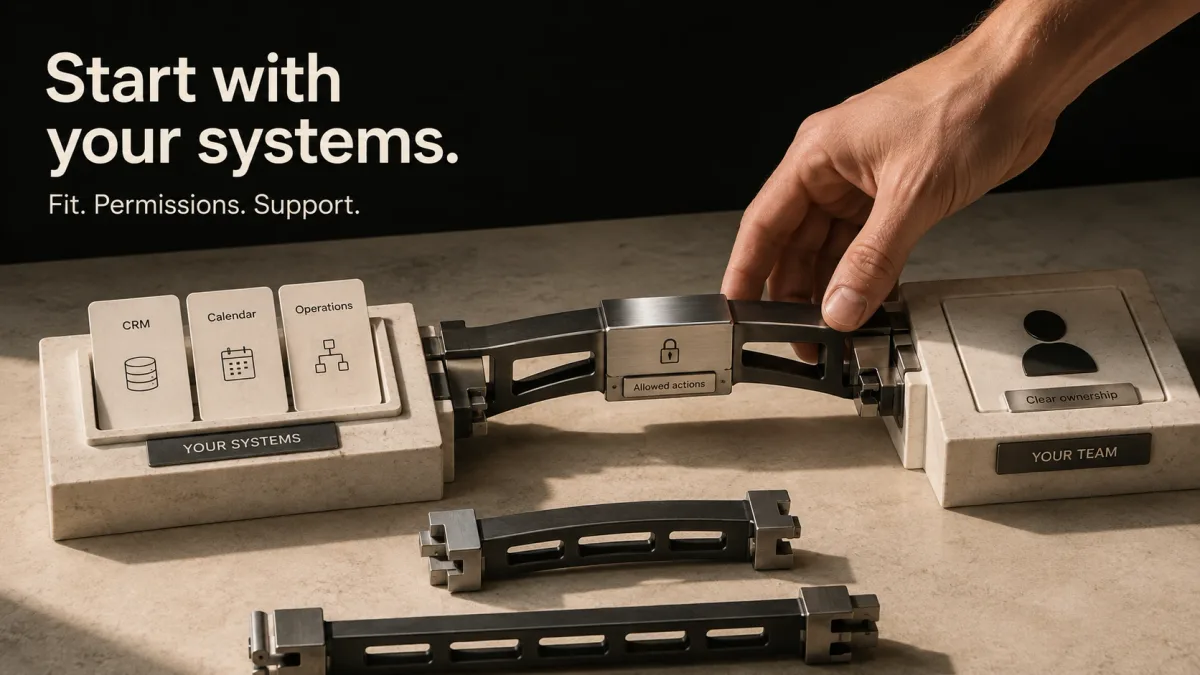
Best AI Agent Platforms for Business: A Practical Buying Guide
Compare n8n, Copilot Studio, OpenAI Agent Builder, and custom implementation by business fit, ownership, operating costs, and support.
How to Get an AI Agent for Your Small Business
Decide whether to buy, configure, or commission an AI agent. Know what to bring, what a proposal should include, and how to accept the first working task.