
Emergency Vet Clinic Call Handling AI: Practical Operator's Guide
Emergency vet clinics miss a large share of inbound calls during peak hours, and urgent callers who cannot reach you often call the next clinic instead of waiting. AI call handling eliminates the large share of call volume that doesn’t require clinical expertise (directions, intake, prescription status) so your staff focuses on calls that actually need them.
Emergency vet clinics miss a large share of inbound calls during peak hours. Here's what AI call handling actually does, what it can't, and how to implement it.
Epiphany Dynamics is an AI automation agency: we help businesses find and fix operational bottlenecks with AI receptionists, lead follow-up, and workflow automation.
The free 30-minute AI Operations Audit is a conversation about a normal week in your business and where the work piles up. We find the one change that would give you the most time back and send you a plain-English plan for it. No forms and no pitch.
Book a free AI audit
Patrick Gibbs
Emergency vet clinics miss a large share of inbound calls during peak hours, and urgent callers who cannot reach you often call the next clinic instead of waiting. AI call handling eliminates the large share of call volume that doesn’t require clinical expertise (directions, intake, prescription status) so your staff focuses on calls that actually need them. This guide covers what AI can and can’t do in an emergency veterinary context, how to integrate triage protocols safely, and what a real implementation looks like.
The Incoming Call Crisis Draining Emergency Vet Clinics
Emergency veterinary clinics operate in a permanent state of controlled chaos. On any given shift, you might have two critical cases in treatment, a surgeon mid-procedure, and a front desk phone that hasn’t stopped ringing for three hours. Emergency animal hospitals field heavy inbound call volume every day, and it spikes further on holidays, weekends, and summer evenings when pet accidents and heat emergencies peak.
The hard reality: a large share of inbound calls to emergency vet practices goes unanswered during peak hours, not from negligence, but from operational math. Every missed call carries a real cost. A first-time emergency client who can’t reach you doesn’t wait on hold; they call the next clinic in Google’s results. Understanding the real cost of missed calls helps quantify what’s at stake with your own visit value, staffing model, and call logs.
What AI Call Handling Actually Does, and Doesn’t Do
The term “AI call handling” gets used loosely, so let’s be precise about what current systems actually do in an emergency veterinary context. Modern AI voice systems, built on large language models with real-time speech synthesis, can handle a specific and well-defined category of calls: information requests, appointment intake, after-hours routing, and preliminary symptom screening using pre-defined triage protocols. They cannot replace a credentialed technician performing actual medical triage. That distinction matters enormously in a regulated clinical environment.
Here’s what a well-configured AI call handler typically resolves without human intervention:
- After-hours inquiries: directions, hours, parking, current wait time estimates
- New patient intake: collecting pet name, species, breed, owner contact info, and reason for visit before handoff to staff
- Non-urgent callbacks: taking messages and scheduling staff follow-up during business hours
- Prescription and pickup confirmations: status checks that don’t require clinical judgment
- Preliminary symptom screening: using scripted decision trees to flag high-urgency cases for immediate staff escalation
What it doesn’t handle: any situation requiring a licensed technician’s judgment, nuanced distress management, or complex case histories. The goal isn’t to replace your front desk: it’s to eliminate the large share of call volume that doesn’t require clinical expertise, so your team can focus on the calls that do. The same principle applies across healthcare; AI voice assistants in healthcare are handling similar call categories in human medical practices with comparable resolution rates.
The Triage Protocol Integration Problem
This is where most emergency vet clinics get implementation wrong. Off-the-shelf AI voice systems built for general medical or dental practices don’t understand the difference between a dog that ate a grape two hours ago (urgent) and a dog that’s been scratching its ear for three days (not your problem at 2 AM). Emergency veterinary AI call handling only works if the system is trained on, or integrated with, a validated triage framework specific to veterinary medicine.
The two most commonly referenced frameworks in emergency veterinary medicine are the TRIAGE emergency scoring system and the ASPCA Animal Poison Control decision tree. Effective AI implementations don’t replicate these wholesale: they use them to define clear escalation thresholds. A well-structured escalation logic looks like this:
| Symptom Category | AI Action | Response Posture |
|---|---|---|
| Difficulty breathing, collapse, seizure, suspected toxin ingestion | Immediate live transfer or on-call page | Immediate escalation |
| Vomiting/diarrhea, minor lacerations, limping | Collect intake info, advise client to come in, log case | Structured intake plus queue |
| General questions, prescription status, non-medical inquiries | Resolve autonomously or take message | Full AI resolution |
The critical design principle here is conservative escalation. When in doubt, the AI should always escalate to a human rather than attempt to manage a clinically ambiguous situation. Any vendor claiming their system can replace live triage judgment for life-threatening symptoms should be a disqualifier, not a selling point.
Real ROI: Building the Clinic-Specific Case
The business case should come from your own practice data, not a generic emergency-clinic benchmark.
Start with these baseline inputs:
- inbound call volume by daypart
- front desk coverage during peak hours
- average call duration
- call miss rate during peak periods
- average emergency visit value
- share of missed calls that would likely have become billable visits
Those inputs let you estimate staff capacity currently consumed by non-clinical phone work. A well-implemented AI system should reduce the administrative share of call handling and reallocate staff attention toward actual clinical support work.
The revenue recovery side is often the bigger number. If peak-period missed calls include urgent new-client cases, AI-assisted call handling and automated callback queuing can move more of those callers into the intake workflow. The right model compares recovered urgent visits, staff capacity, vendor cost, and clinical oversight against the current missed-call baseline.
Implementation Framework: What to Get Right Before Launch
Practices that get the most out of AI call handling share a consistent implementation approach. Skipping these steps is where deployments fail.
Step 1: Conduct a Call Audit
Before selecting any vendor, log inbound calls by category long enough to capture peak and normal call patterns. Most emergency vet clinics discover that a large share of their inbound volume is informational or administrative, precisely the category AI handles reliably on business calls. This audit also surfaces your actual escalation patterns, which directly informs the system’s routing logic. Without this baseline, you’re configuring the system blind.
Step 2: Build the Escalation Map Before Touching Software
Define your escalation triggers in writing before any vendor conversation. What symptoms trigger an immediate live transfer? What time-of-day thresholds change routing behavior? Who gets paged at 3 AM versus 3 PM? This document becomes the system’s operating logic and should be reviewed and signed off by your medical director before a single line of configuration is written. Clinics that skip this step end up with a system that works for administrators but creates clinical risk.
Step 3: Train Staff on Handoff Protocol, Not Just the Software
AI handoffs fail most often not because of the AI, but because staff don’t trust or know how to use the handoff data. Your team needs to understand what information the AI captures during intake, where it surfaces in your practice management system, and how to handle escalated calls that arrive with AI-collected context already attached. Train this as a clinical workflow, not a software onboarding session.
Step 4: Run a Parallel Monitoring Period
At launch, have the AI handle calls while staff monitor in real-time and can override instantly. Track false escalation rate (cases the AI escalated that didn’t need it) and false confidence rate (cases the AI resolved autonomously that should have escalated). In a well-configured veterinary system, false escalations should be uncommon and false confidence should be near zero. If either metric looks weak, the system needs retraining before full deployment.
Five Questions That Separate Viable Vendors From Liability Risks
The AI voice space has expanded dramatically. For emergency veterinary use specifically, these questions will quickly filter out systems that create more risk than they solve:
- What is the escalation latency? For life-threatening symptom categories, how quickly does the system transfer to a live human? Slow escalation is operationally unacceptable for an emergency context.
- Can the triage logic be fully customized? Generic medical AI uses human healthcare frameworks. Veterinary escalation criteria are fundamentally different: species-specific, weight-dependent, and toxin-specific. You need a configurable system, not a fixed one.
- How does it handle caller distress? A client calling at 2 AM with a dying pet is not in a transactional mindset. The system’s ability to detect emotional urgency, accelerate escalation, and avoid clinical coldness directly impacts client retention and online reputation.
- What happens when the system is uncertain? The answer should always be “escalate to a human.” If the vendor pitches autonomous resolution of ambiguous clinical situations as a feature, that’s your exit signal.
- What practice management software does it integrate with natively? An AI that can’t write intake data directly into Cornerstone, eVetPractice, or AVImark creates double-entry work and staff friction. Confirm native integrations or documented API access before signing a contract.
The Bottom Line for Emergency Vet Practice Operators
AI call handling isn’t a futuristic concept for emergency veterinary clinics: it’s a practical operational tool addressing a measurable problem with a clinic-specific ROI case. The clinics getting it right are the ones treating AI as a triage layer: not a replacement for clinical judgment, but a filter ensuring the right calls reach the right people at the right time. The technology is mature enough that the ceiling on ROI is no longer about AI capability: it’s entirely about implementation quality.
The implementation details outlined here (the call audit, the escalation map, the parallel period) aren’t optional steps for cautious practices. They’re the difference between a system that reduces staff burnout and recovers lost revenue, and one that creates clinical exposure and gets removed after a painful launch. Get the escalation logic right, let the data validate the configuration, and expand from there. Clinics that also want to improve post-visit outcomes should look at how AI-powered medication instruction delivery extends the same automation approach beyond the phone into client compliance.
For practices actively evaluating vendors, AI-powered front desk platforms purpose-built for veterinary and healthcare environments are worth prioritizing over general-purpose voice automation tools. The specificity of the use case demands it, and specialty providers like Epiphany Dynamics, focused on AI voice for healthcare-adjacent industries, represent the direction the market is moving as the technology continues to mature.
Frequently Asked Questions
Q: Can AI call handling systems replace clinical triage in an emergency vet setting?
No. Current AI systems can handle information requests, preliminary symptom screening using pre-defined decision trees, and administrative intake, but they cannot replace a licensed technician’s clinical judgment for life-threatening symptoms. Conservative escalation to a human must always be the default when symptoms are ambiguous or urgent.
Q: How much inbound call volume can AI handle in an emergency vet clinic?
Well-configured systems can handle routine informational inquiries, directions, prescription status checks, and standard intake for non-critical cases. Calls involving clinical judgment, emotional distress, ambiguous symptoms, or urgent escalation require human involvement, either live transfer or staff review of AI-collected information.
Q: How should an emergency vet clinic estimate recovered revenue from AI call handling?
Use your own call logs, missed-call rate, emergency visit value, staff capacity, and callback outcomes. The best estimate compares how many urgent callers currently fail to reach intake with how many the AI can capture, route, or queue for rapid callback.
Q: What is the most important step before deploying AI call handling in an emergency vet practice?
Building the escalation map before touching any software. Define which symptom categories trigger immediate live transfer, what time-of-day thresholds change routing behavior, and who gets paged at different hours. This document should be reviewed and signed off by your medical director before any configuration is written. Clinical risk must be addressed first, not as an afterthought.
Q: What practice management software does AI call handling typically integrate with in veterinary settings?
The most important integrations are with Cornerstone, eVetPractice, and AVImark, which together cover a significant share of emergency veterinary practices. Confirm native bidirectional sync (not just CSV export) before signing any vendor contract, as disconnected systems create double-entry work that offsets most of the labor savings.
Patrick Gibbs
AI Automation Expert
Patrick Gibbs helps professional practices implement AI automation that captures more leads, books more appointments, and scales without adding overhead. He's the founder of Epiphany Dynamics and creator of the AI Front Desk system.
Related Solutions
Build this into a real workflow
Related Posts
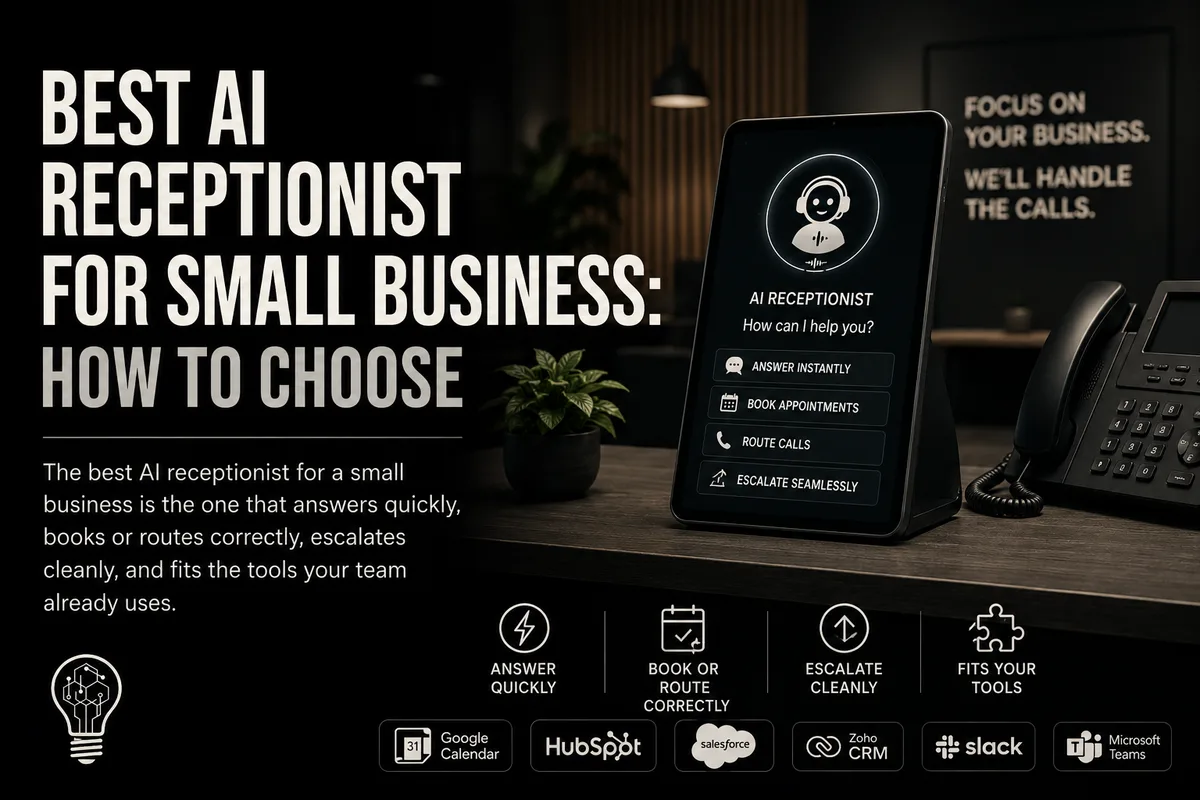
Best AI Receptionist for Small Business: How to Choose
The best AI receptionist for a small business is the one that answers quickly, books or routes correctly, escalates cleanly, and fits the tools your team.
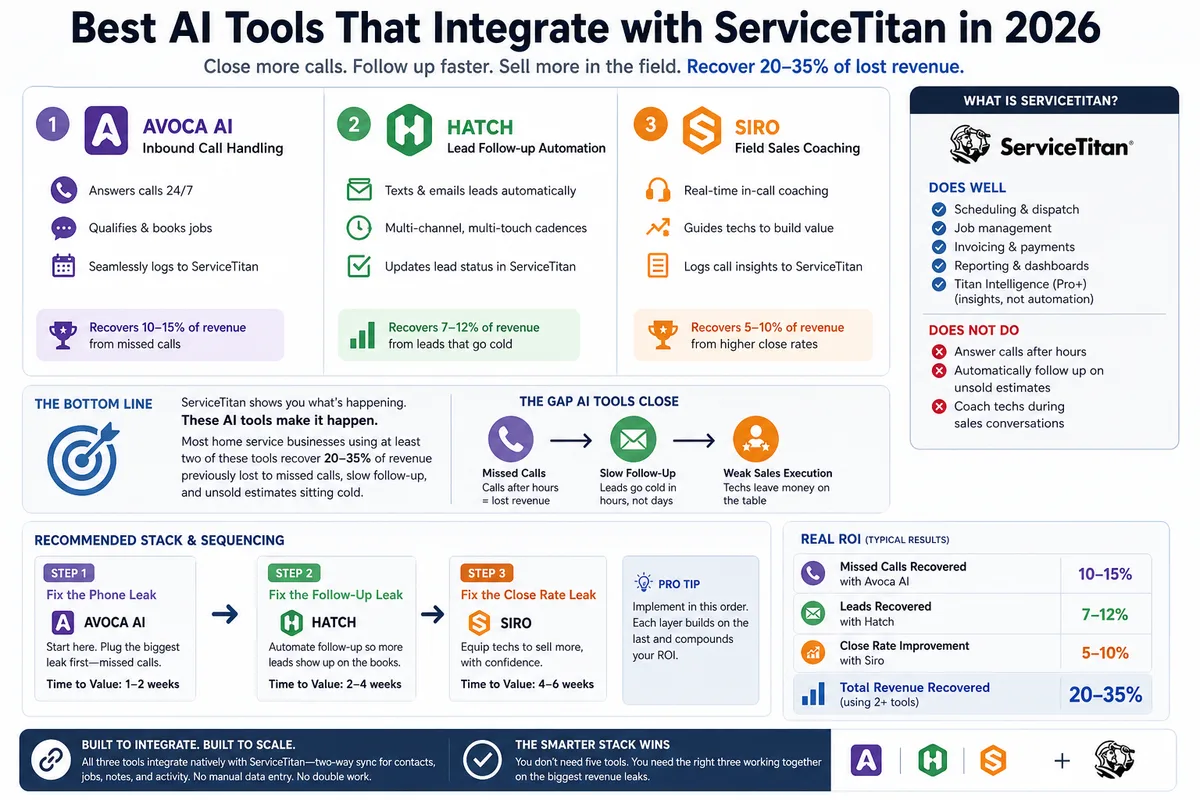
Best AI Tools That Integrate with ServiceTitan in 2026
Most ServiceTitan shops miss a meaningful share of inbound calls and leave most estimates unsold. These AI tools close those gaps inside ServiceTitan.
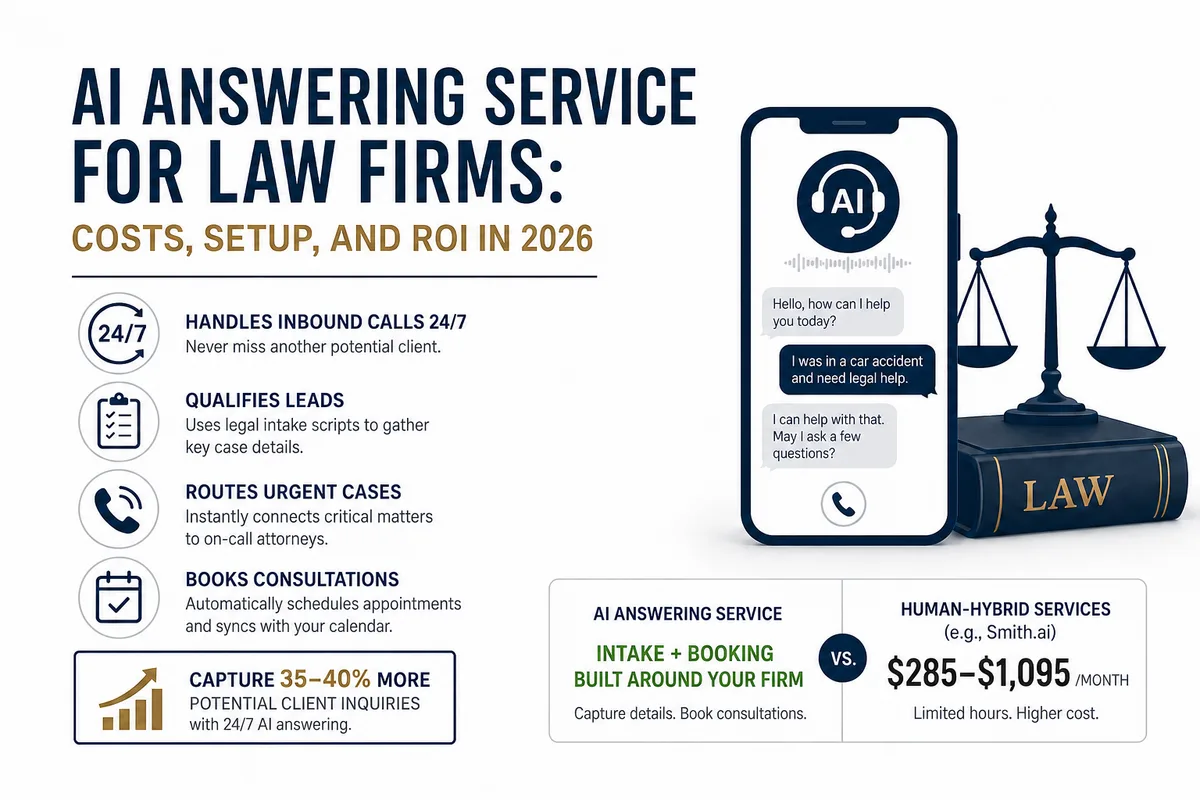
AI Answering Service for Law Firms: Costs, Setup, and ROI in 2026
Law firms miss a large share of inbound calls, most of them after hours. Here's what an AI answering service actually does, what it costs versus human.