
AI Automation
What Is AEO for a Local Service Business? A Practical Guide
AEO for a local service business means clear direct answers, verified sources, local proof, and measurement, not more blog content. Here's how to evaluate it.
The free 30-minute AI Operations Audit is a conversation about a normal week in your business and where the work piles up. We find the one change that would give you the most time back and send you a plain-English plan for it. No forms and no pitch.
Book a free AI audit
Patrick Gibbs
Answer-engine optimization (AEO) for a local service business is the practice of structuring your website, listings, and content so AI systems like ChatGPT, Perplexity, and Google’s AI Overviews can extract and cite a direct, accurate answer about your services, pricing, service area, and credibility instead of just ranking a page.
What AEO actually means for a local service business
AEO means writing and structuring information so an AI system can lift a correct, self-contained answer without needing to click through your site. For a plumber, dentist, or HVAC company, that means clear service descriptions, service-area statements, pricing ranges, and credentials that an answer engine can quote verbatim.
Traditional SEO optimizes for a ranked list of blue links. AEO optimizes for the single sentence or short paragraph an AI assistant reads back to someone asking “who does emergency AC repair near me” or “what does a root canal cost in my city.” The AI doesn’t rank you against ten competitors on a page; it picks one or two sources to summarize, often without a click at all.
This matters more for local service businesses than for most industries because the queries are transactional and time-sensitive. Someone asking an AI assistant about a burst pipe or a toothache wants a fast, specific answer, not a blog post. If your site buries that answer in marketing copy, the AI moves to a competitor’s page that states it plainly.
Why direct answers beat content volume
Publishing more blog posts does not improve your odds of being cited by an answer engine. What improves your odds is answering specific, narrow questions in the first two sentences of a page, using plain language and concrete numbers instead of hedged marketing copy.
Many local businesses assume AEO is a content-volume game, similar to old-school SEO where publishing weekly kept you visible. Answer engines behave differently. They favor pages that state a fact cleanly near the top: a service area, a typical response time, a licensing detail, a price range. A single well-structured service page can outperform twenty vague blog posts if it answers the exact question a customer types.
This is also why business owners evaluating AI automation should look at their own customer-facing content the same way. Our overview of AI automation use cases for service businesses covers how the same “answer clearly and immediately” principle applies to phone calls and booking flows, not just web pages. If your website and your phone system both bury the answer behind small talk, you lose the customer twice.
The four pillars of local AEO
Local AEO rests on four measurable pillars: direct answers, source quality, local proof, and measurement. Skipping any one of them weakens the others, since an answer engine needs a clear statement, a credible source, evidence tied to a real place, and a way to confirm the content stays accurate over time.
| Pillar | What it means | Local example |
|---|---|---|
| Direct answers | State facts plainly near the top of the page | ”We serve emergency AC repair in [city] within 60 to 90 minutes during business hours” instead of “we pride ourselves on fast service” |
| Source quality | Use consistent, verifiable business details | Matching name, address, phone, and license number across your site, Google Business Profile, and directories |
| Local proof | Evidence the answer applies to a specific place | Named neighborhoods, real project photos, city-specific reviews, not generic stock testimonials |
| Measurement | Tracking whether AI systems cite you | Reviewing referral traffic from AI assistants, checking brand mentions in AI answers, monitoring call volume tied to specific pages |
Most small businesses get the first pillar partly right and skip the other three entirely. A page can state a direct answer clearly and still fail as an AEO source if the business address on that page doesn’t match the one on Google Business Profile, or if there is no local evidence backing the claim.
How to prove local proof to answer engines
Local proof means giving an answer engine specific, verifiable evidence that your business genuinely serves the area and service type it claims. Vague testimonials and generic stock content read as low-confidence sources; named locations, dated reviews, and consistent licensing information read as high-confidence sources.
Concrete steps that build local proof without inflating claims:
- List the actual neighborhoods, ZIP codes, or towns you serve, not just “the greater metro area.”
- Keep your Google Business Profile, website footer, and any directory listings identical on name, address, phone number, and hours.
- Attach real customer reviews to specific services, ideally with the service type and rough location mentioned in the review text itself.
- State licensing, insurance, or certification numbers where legally required, since these are exactly the details answer engines treat as trust signals.
- Update seasonal or capacity information (holiday hours, current wait times) so an AI system doesn’t cite something outdated.
This is the same discipline that shows up in how businesses handle missed calls and after-hours coverage. Our guide to missed call text back automation touches on a related idea: a fast, specific, honest response builds trust with a customer the same way a fast, specific, honest page builds trust with an answer engine.
If you’re unsure whether your current site and listings would hold up under this kind of scrutiny, a fixed-scope audit is a reasonable next step before committing to a larger rebuild. You can book a free AI audit to get a specific list of gaps rather than a general recommendation.
Measuring whether AEO is working
Measurement means tracking whether AI assistants are actually citing your business, not just assuming better content equals better visibility. Useful signals include referral traffic labeled from AI platforms in your analytics, direct questions to staff that mention “an AI told me,” and manual test queries you run yourself on a regular schedule.
Because AI answer citations rarely produce a traditional click, most small businesses have no visibility into whether they’re being cited at all. A practical, low-cost measurement routine looks like this:
- Check your analytics platform for a referral source category tied to AI assistants or answer engines, if your platform reports one.
- Once a month, manually ask two or three AI assistants the exact questions a customer would ask about your services and note whether your business appears, and what it says about you.
- Ask front-desk or phone staff to note when a caller mentions finding you through an AI assistant or “the AI said.”
- Compare call volume or booking volume on pages you’ve updated for AEO against pages you haven’t touched, over a period of a few months.
None of these signals are precise the way a paid-ad conversion report is. Treat early AEO tracking as directional, illustrative evidence you’re building over time, not a hard ROI number you can quote to a bank.
When AEO isn’t the right investment
AEO is not worth prioritizing for every local business right now. If your customers overwhelmingly find you through referrals, repeat business, or a single dominant local directory, and your current call and booking volume is healthy, restructuring your site for answer engines may be a lower priority than fixing operational gaps like missed calls.
Businesses with very low web search volume, or those in categories where AI assistants rarely get asked (certain B2B trades, highly regulated services with mandatory in-person consultation), will see limited near-term return from AEO work. In those cases, resources are often better spent on call handling, scheduling, or follow-up automation first. Our breakdown of AI adoption barriers in local service businesses covers how to sequence these decisions instead of chasing every AI trend at once.
What to check before you invest further
A short internal checklist can tell you whether AEO work is worth prioritizing this quarter. If most items below are already true, incremental AEO fixes are enough; if most are false, a broader audit of your site and listings makes more sense first.
- Your business name, address, and phone number match exactly across your website, Google Business Profile, and top directories
- Your homepage and top service pages state pricing ranges or a clear “call for quote” policy within the first two sentences
- You’ve manually tested how AI assistants answer questions about your business in the last 90 days
- Your reviews mention specific services and locations, not just general praise
- Your team also uses AI to manage social proof consistently; if not, our roundup of best AI social media tools for service businesses is a reasonable starting point for that gap
If you check most of these boxes already, you’re likely ahead of local competitors. If you don’t, a fixed-scope audit through our services page can identify which two or three fixes matter most before you spend on a broader rebuild.
Frequently Asked Questions
Is AEO the same thing as SEO?
No. SEO optimizes for ranking in a list of search results a person scrolls through. AEO optimizes for being the single source an AI assistant summarizes or quotes directly, often without the person clicking anywhere. Many of the same underlying signals (accurate business information, credible reviews, clear service descriptions) support both, but the target outcome is different.
Does AEO replace the need for a good website?
No. AEO depends on your website having accurate, well-structured information in the first place. If your site is outdated or missing basic details like service area and pricing, no amount of AEO tactics will fix that. AEO is a way of organizing and stating information you should already have correct.
How long does it take to see AEO results?
There’s no reliable fixed timeline, since AI assistants update their sources on different schedules and don’t publish citation data the way search engines publish rankings. Treat early results as directional over a few months rather than expecting a fast, measurable spike.
Can a small business do AEO without hiring an agency?
Yes, for the basics. Fixing name-address-phone consistency, stating direct answers near the top of key pages, and updating reviews with specific service and location details are all things an owner or office manager can do directly. A fixed-scope audit becomes useful when you want a prioritized list of gaps rather than guessing where to start.
Does AEO matter more for some service categories than others?
Yes. Categories with urgent, comparison-shopped decisions such as emergency HVAC repair, dental pain, or plumbing emergencies see more AI-assisted search behavior than categories with long sales cycles or mandatory in-person evaluation. If your customers rarely search for you online before calling, AEO is a lower priority than operational fixes like phone answering.
Patrick Gibbs
AI Automation Expert
Patrick Gibbs helps professional practices implement AI automation that captures more leads, books more appointments, and scales without adding overhead. He's the founder of Epiphany Dynamics and creator of the AI Front Desk system.
Related Solutions
Build this into a real workflow
Related Posts
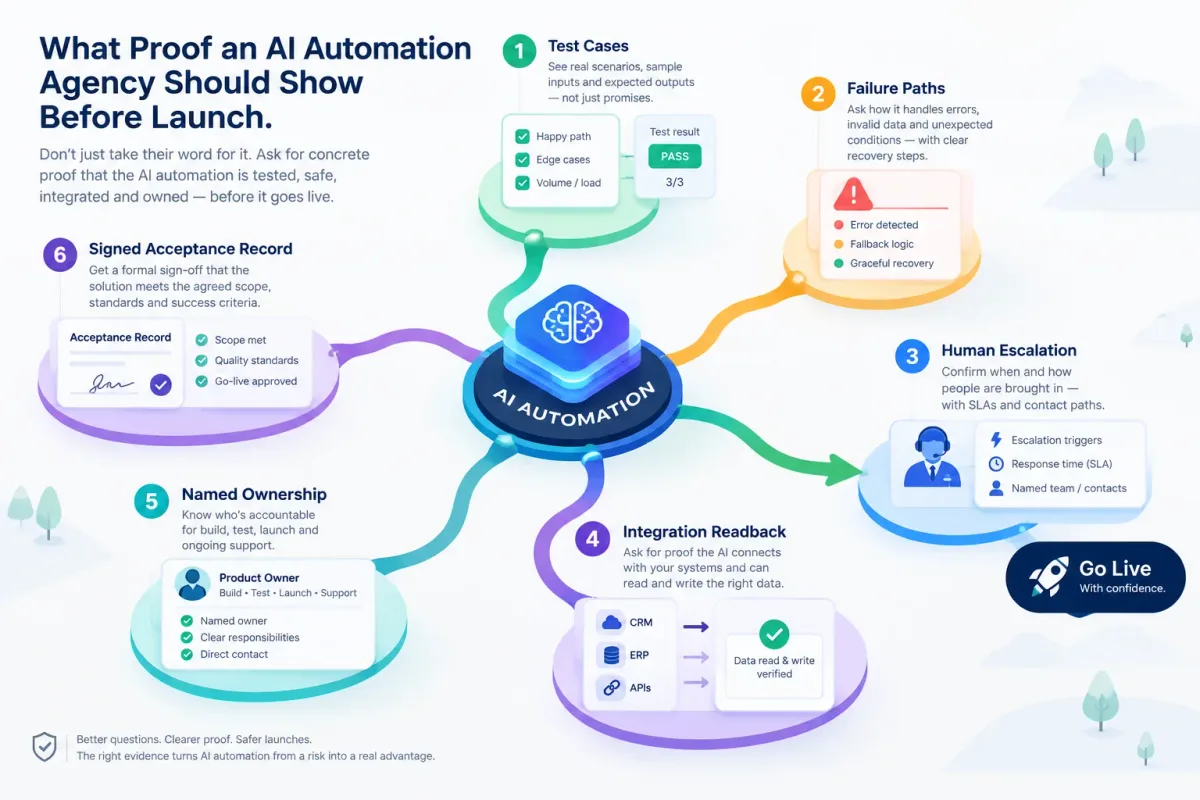
What Proof an AI Automation Agency Should Show Before Launch
Before an AI automation goes live, ask for test cases, failure paths, human escalation, integration readback, named ownership, and a signed acceptance record.
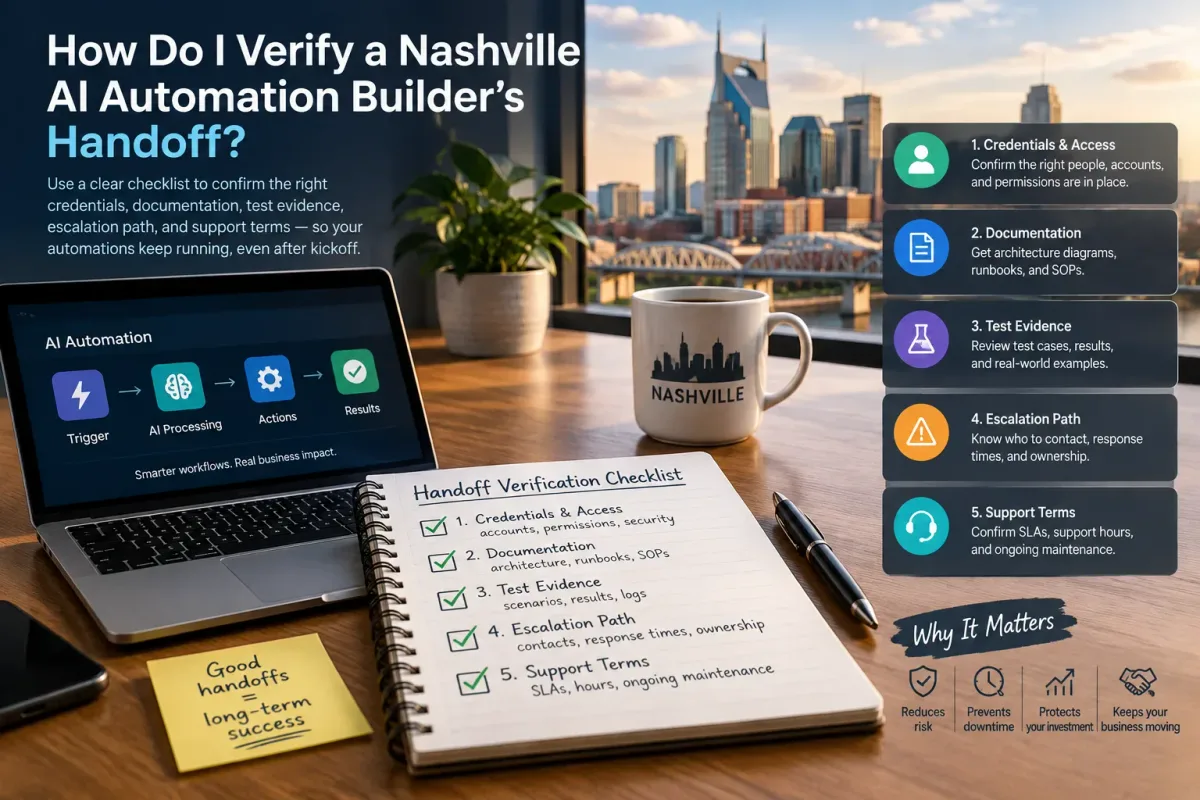
How Do I Verify a Nashville AI Automation Builder's Handoff?
Verify a Nashville AI automation builder's handoff with a checklist covering credentials, docs, test evidence, escalation, and support terms.
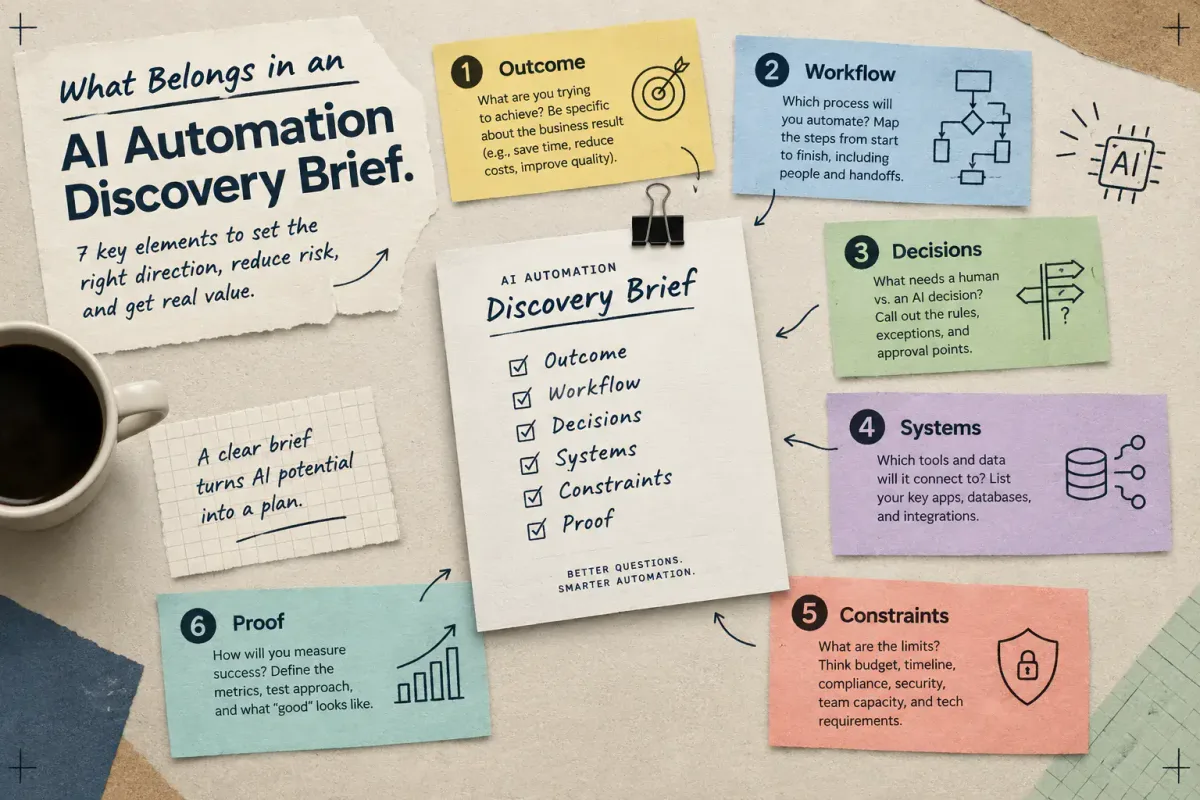
What Belongs in an AI Automation Discovery Brief
Learn the seven elements a small-business AI automation discovery brief needs: outcome, workflow, decisions, systems, constraints, and proof.