
Business Growth
AI Adoption Barriers in Local Service Businesses: The Real Blockers
A large share of calls to small service businesses goes unanswered. A data-driven look at the real barriers preventing local operators from adopting AI, and.
The free 30-minute AI Operations Audit is a conversation about a normal week in your business and where the work piles up. We find the one change that would give you the most time back and send you a plain-English plan for it. No forms and no pitch.
Book a free AI audit
Patrick Gibbs
The real barriers blocking AI adoption in local service businesses are cost misperception, integration anxiety, and distrust of the technology, not the technology itself. Missed calls, appointment gaps, and follow-up failures are measurable operational problems, but many operators still overestimate the risk and complexity of fixing them. This post identifies the four most common blockers and what actually moves operators past them.
The Adoption Gap Nobody’s Talking About
Most small business owners know AI is changing things. They’ve watched the headlines, maybe tried ChatGPT once or twice, and concluded it’s impressive technology built for tech companies, not for their plumbing business, dental practice, or med spa. That conclusion is understandable. It’s also costing them in ways that show up directly on the bottom line.
Large enterprises have moved on AI far faster than small companies, and adoption among smaller operators remains the exception rather than the rule. For local service businesses specifically (HVAC, plumbing, dental practices, auto repair, home cleaning, wellness studios), practical AI adoption is rarer still. The irony is that these businesses have some of the clearest, most quantifiable operational problems that AI solves well: missed calls, appointment no-shows, after-hours inquiries, and follow-up failures. Understanding why adoption hasn’t happened, and which barriers are real versus imagined, is the actual problem worth solving. The voice AI adoption data for small businesses shows that the early movers are already building measurable competitive advantages.
The Cost of Inaction Is Measurable
Before examining the barriers, it’s worth establishing what’s at stake. Research from 411 Locals found that many small-business calls go unanswered. The exact impact depends on the business’s own call volume, average service value, and close rate, but the underlying issue is simple: missed calls create revenue leakage before service quality ever gets a chance to matter.
The same pattern shows up in appointment adherence. In service businesses that don’t use automated reminders, no-show risk is often treated as unavoidable. These aren’t edge cases: they’re structural inefficiencies that AI addresses directly. The question is why so many operators haven’t acted on that math. The answer is almost always one of four barriers.
Barrier #1: Cost Perception vs. Actual Cost
The most cited reason local service business owners give for avoiding AI tools is cost. This concern has a legitimate root: the business press tends to cover enterprise AI implementations, not practical SMB tools. The result is a mental model where “AI” means a massive IT investment, not a focused subscription tool. The two scenarios have almost nothing in common.
The real cost landscape for SMB-relevant AI tools looks nothing like enterprise deployments. Most practical AI applications for local service businesses (AI appointment scheduling, missed-call text-back, customer follow-up sequences, review response automation) should be compared against the fully loaded cost of front desk staffing:
| Solution | Cost Profile | Availability | Missed Call Exposure |
|---|---|---|---|
| Full-time receptionist (fully loaded) | Salary, benefits, taxes, training, and turnover risk | Business hours only | High (breaks, multitasking, call queues) |
| Part-time front desk | Lower fixed cost but limited coverage | Partial schedule coverage | High outside coverage hours |
| AI front desk solution | Subscription plus setup and oversight | Extended coverage with escalation rules | Lower when call routing is configured well |
The ROI calculation should come from the business’s own call logs and appointment history. The barrier isn’t economics. It’s the perception of what AI costs, shaped by headlines about the wrong category of deployment. Our AI automation cost and pricing guide breaks down the cost drivers behind each category.
Barrier #2: Technical Expertise Requirements
The second most common barrier is the belief that implementing AI requires technical expertise that most small business owners don’t have. Owners themselves often name not knowing enough about the technology as a primary reason for avoiding AI tools. This concern has a basis (AI implementations can be complex), but it conflates enterprise infrastructure projects with what modern SMB-targeted AI tools actually involve.
Modern AI tools designed for local service businesses are SaaS products, not infrastructure projects. Connecting an AI appointment booking tool to a Google Calendar or an existing practice management system doesn’t always require a developer. The genuinely complex scenario involves legacy systems with no public APIs: older booking software, on-premise databases, or deeply customized CRMs. In those cases, the integration cost is real, but it’s a one-time investment, not an ongoing structural barrier.
The practical guidance: start with tools that integrate natively with systems you already use. If your business runs on Google Workspace, there are AI scheduling and communication tools built specifically around that stack. If you use a major industry platform (Mindbody for fitness, Dentrix for dental, ServiceTitan for HVAC/plumbing), check the vendor’s integration marketplace before evaluating standalone tools. Integration complexity is a solvable problem. It’s not a reason to avoid the category entirely.
Barrier #3: Fear of Disrupting a Working Workflow
This is the most psychologically entrenched barrier, and the one most frequently underestimated by people advising small business owners. Operators who have built stable systems, even imperfect ones, are understandably reluctant to introduce variables that could create problems during a busy season or high-revenue period. The response to this concern isn’t to argue it’s irrational. It’s partly rational. Poorly implemented AI can and does disrupt workflows. The question is how to deploy in a way that manages that risk rather than ignoring it.
Most failed AI implementations in small businesses fail during rollout, not during normal operation. The failure mode is almost always the same: deploying too broadly, too quickly, without adequate staff preparation or testing against real workflows. An AI booking system that double-books appointments because it wasn’t synced correctly with an existing manual calendar doesn’t just create operational problems: it creates a narrative. The business owner concludes “AI doesn’t work for my kind of business,” and that conclusion can persist for years.
The solution is phased deployment with a clearly defined test scope. This isn’t overly conservative: it’s the same discipline you’d apply to any operational change:
- First phase: Deploy one function. Run it in parallel with your existing process. Measure one specific metric against your pre-deployment baseline.
- Second phase: If the first phase shows measurable improvement, retire the redundant manual process and layer in another function.
- Third phase: Evaluate cumulative impact. Expand to additional functions based on data, not enthusiasm or vendor pressure.
A failure in the first phase is a small controlled lesson and a workflow adjustment. Managed correctly, it’s never a business disruption.
Barrier #4: Data Privacy and Compliance Concerns
For healthcare-adjacent businesses (dental practices, medical spas, physical therapy clinics, and similar categories), data privacy isn’t just a perception problem. It’s a real regulatory concern. HIPAA compliance requires that any system handling patient communications, including AI tools, meet specific standards for data storage, encryption, access controls, and vendor accountability. Enforcement actions reach small practices too, and HIPAA violation settlements regularly run into six and seven figures.
The problem is that most business owners in this space don’t have a reliable framework for evaluating vendor compliance claims. “We’re HIPAA compliant” on a vendor website is marketing copy. What HIPAA actually requires is a signed Business Associate Agreement (BAA) with any vendor handling Protected Health Information. Without a BAA, the practice retains full liability for any breach, regardless of what the vendor’s website claims.
Before deploying any AI tool that handles patient or customer data in a regulated industry, use this due diligence checklist:
- Does the vendor provide a signed BAA?
- Where is data stored? (US-based servers required for most healthcare applications)
- What is the data retention policy, and can you request deletion on demand?
- Is the platform SOC 2 Type II certified?
- What access controls exist for vendor employees accessing your data?
- Has the vendor disclosed any prior data breaches? (Check their security disclosure or trust page)
Most established AI vendors in the healthcare-adjacent space can answer these questions clearly and in writing. Vendors who deflect or go vague are telling you something important.
A Practical Adoption Framework for Local Service Businesses
Given these barriers, the question isn’t whether to adopt AI: it’s how to sequence adoption in a way that manages risk, proves ROI quickly, and builds operational confidence before expanding. The table below reflects implementation patterns from local service businesses that have successfully deployed AI tools without significant disruption:
| Phase | Focus Area | Typical Tools | What to Measure |
|---|---|---|---|
| Phase 1: External Touchpoints | Missed call recovery, appointment reminders | AI text-back, automated SMS/email reminders | Missed call recovery rate, no-show rate |
| Phase 2: Communication Layer | After-hours AI receptionist, review management | AI voice/chat, review response automation | After-hours bookings captured, review response time |
| Phase 3: Internal Operations | Scheduling optimization, reporting automation | AI scheduling assistants, automated reporting dashboards | Staff utilization rate, admin hours per week |
The key discipline is measuring one specific metric before advancing to the next phase. “AI is helping” is not a measurement. “No-shows decreased against our baseline after reminder automation” is a measurement, and it’s also the internal business case that funds further investment. Skip the measurement step and you’re running on faith, not data. That’s when adoption stalls. Our guide on how to test AI automation before scaling provides a structured framework for running pilots that produce defensible results.
For further reading, see AI vs. Machine Learning: What’s Actually Different in 2026.
The Real Barrier Is Psychological, Not Technical
Across all four barrier categories (cost, technical complexity, workflow disruption, and compliance), the pattern is consistent: the perceived barrier is larger than the actual one. AI tools for local service businesses have reached a maturity level where meaningful deployment no longer requires IT departments, large budgets, or developer expertise. What it requires is a willingness to run a focused experiment, measure an honest outcome, and act on the data rather than the anxiety.
The businesses closing the adoption gap aren’t doing anything dramatic. They identified one expensive operational problem (missed calls, appointment no-shows, after-hours inquiry loss), found a tool that directly addressed it, deployed it in a controlled way, and measured the outcome before expanding. That’s not a technology strategy. It’s basic operational discipline applied to a new category of tools that most local service businesses have been ignoring because they assumed it wasn’t for them.
If your business has significant friction in any of the areas described above, a structured AI workflow audit, mapping your current operational gaps to specific tool categories, is the most efficient starting point. Working with an AI automation specialist who understands local service business operations can compress the learning curve considerably, and more importantly, helps you avoid the implementation mistakes that feed long-term skepticism about whether this technology is worth it.
Frequently Asked Questions
Q: What percentage of small service businesses have actually adopted AI tools in their operations?
Enterprise organizations have adopted AI at far higher rates than small companies, and adoption among businesses with fewer than 50 employees remains the exception. For local service businesses specifically (HVAC, plumbing, dental practices, auto repair, home cleaning, wellness studios), practical AI adoption is rarer still, despite these businesses having some of the clearest, most quantifiable operational problems that AI addresses directly.
Q: How much do SMB-appropriate AI tools actually cost compared to what most small business owners assume?
Enterprise AI implementations reported in business press can make AI feel expensive by default. SMB-relevant tools (AI appointment scheduling, missed-call text-back, customer follow-up sequences, review response automation) should be compared against the real cost of staffing, missed calls, training, turnover, and coverage gaps.
Q: What is the safest way to deploy AI in a local service business without disrupting a working workflow?
The phased approach that consistently prevents disruption: start with one function in parallel with the existing process, measure one specific metric against baseline, then retire the redundant manual process only if the test shows measurable improvement. Expand based on data, not enthusiasm. A failed test becomes a controlled workflow adjustment, not a business disruption.
Q: What is the legally required vendor document for healthcare-adjacent businesses deploying AI tools?
A signed Business Associate Agreement (BAA) from every vendor handling Protected Health Information, including AI voice, scheduling, and communication tools. “We’re HIPAA compliant” on a vendor website is marketing copy. What HIPAA actually requires is a BAA: without one, the practice retains full liability for any breach regardless of vendor claims. BAA availability should be a hard gate in vendor evaluation, with written confirmation of terms before any contract discussion moves forward.
Q: What is the most important mindset shift for local service business owners approaching AI adoption?
The actual barrier is psychological, not technical. The perceived barriers (cost, complexity, workflow disruption, compliance) are each substantially larger in the imagination than in reality. AI tools for local service businesses have reached a maturity level where meaningful deployment no longer requires IT departments, large budgets, or developer expertise. What it requires is willingness to run a focused experiment on one problem, measure an honest outcome, and act on the data rather than the anxiety. The businesses closing the adoption gap aren’t doing anything dramatic: they’re applying basic operational discipline to a new category of tools.
Patrick Gibbs
AI Automation Expert
Patrick Gibbs helps professional practices implement AI automation that captures more leads, books more appointments, and scales without adding overhead. He's the founder of Epiphany Dynamics and creator of the AI Front Desk system.
Related Solutions
Build this into a real workflow
Related Posts
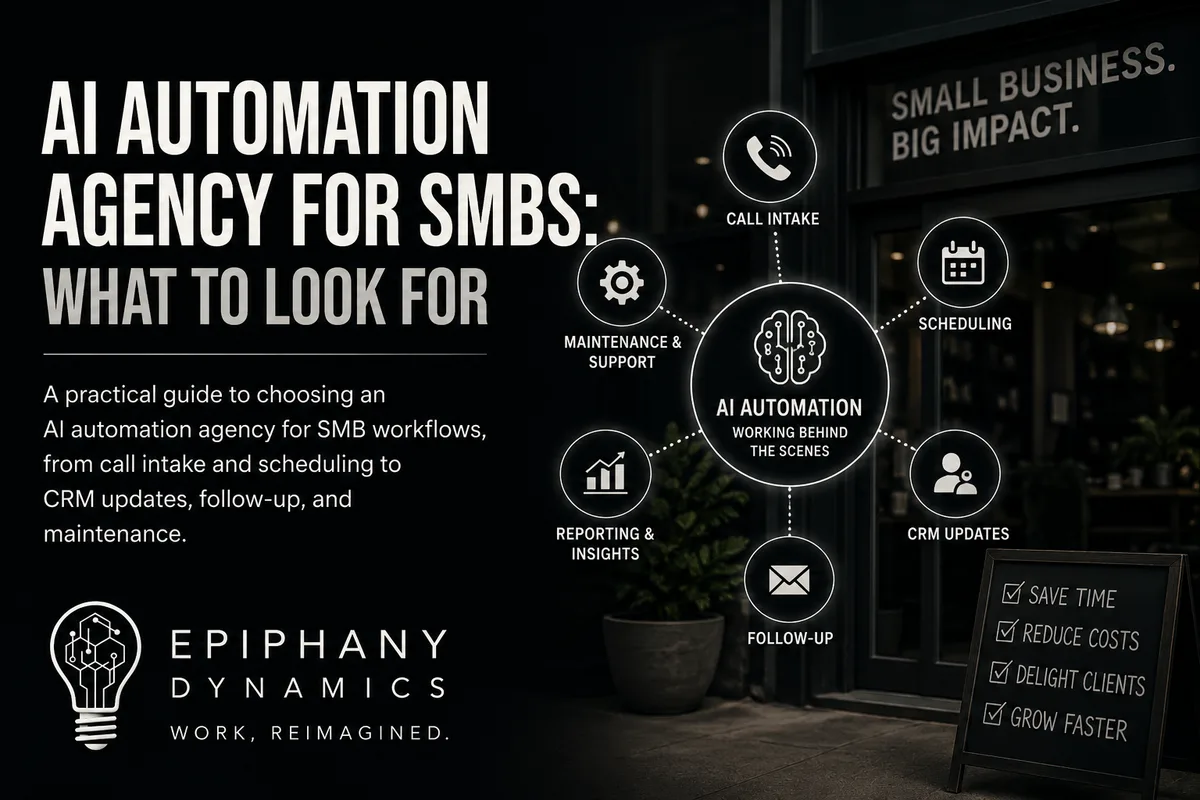
AI Automation Agency for SMBs: What to Look For
A practical guide to choosing an AI automation agency for SMB workflows, from call intake and scheduling to CRM updates, follow-up, and maintenance.
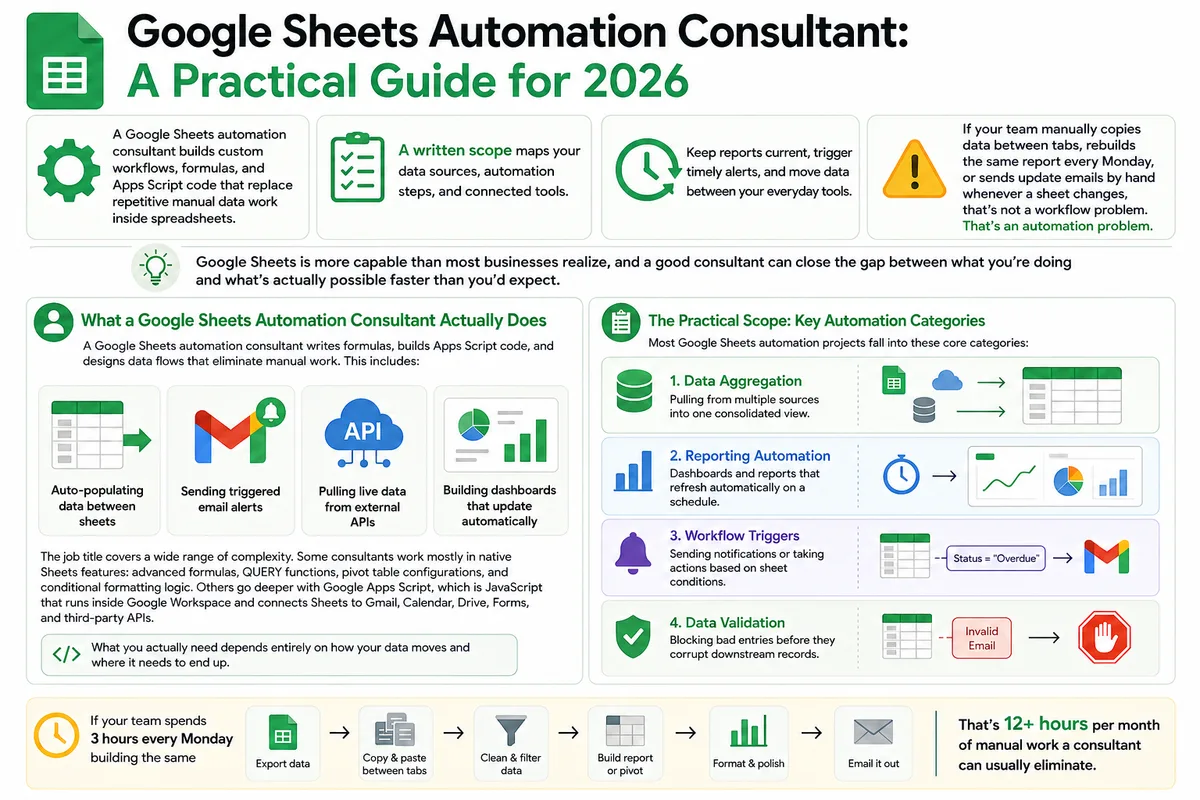
Google Sheets Automation Consultant: A Practical Guide for 2026
Most businesses don't track what spreadsheet work actually costs them. Here's what a Google Sheets automation consultant does in 2026, how to judge the value.
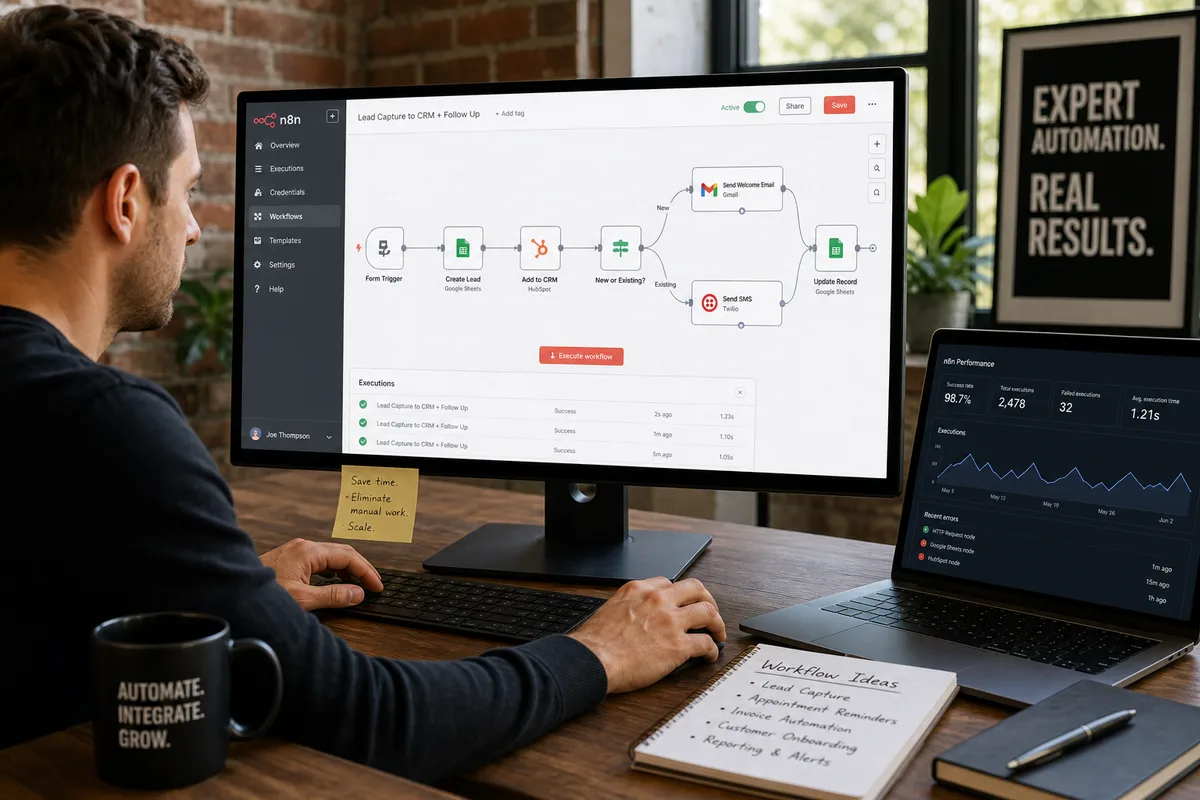
n8n Workflow Automation Agency: What They Build, What It Costs (2026)
Zapier pricing drove you to n8n. Now you're wondering if hiring an agency to build it makes sense. Here's what they build, what projects cost, and how to.