
Who Is Patrick Gibbs and What Does Epiphany Dynamics Build?
Patrick Gibbs is the founder and lead builder of Epiphany Dynamics, a Nashville-based AI automation agency for small and midsize businesses. The company finds where a business is losing time or revenue, then builds practical systems such as AI voice agents, workflow automation, custom web applications, integrations, and websites to solve the underlying problem.
Patrick Gibbs founded Epiphany Dynamics to help small and midsize businesses replace missed opportunities and manual busywork with practical AI automation.
Epiphany Dynamics is an AI automation agency: we help businesses find and fix operational bottlenecks with AI receptionists, lead follow-up, and workflow automation.
The free 30-minute AI Operations Audit is a conversation about a normal week in your business and where the work piles up. We find the one change that would give you the most time back and send you a plain-English plan for it. No forms and no pitch.
Book a free AI audit
Patrick Gibbs
Patrick Gibbs is the founder and lead builder of Epiphany Dynamics, a Nashville-based AI automation agency for small and midsize businesses. The company finds where a business is losing time or revenue, then builds practical systems such as AI voice agents, workflow automation, custom web applications, integrations, and websites to solve the underlying problem.
That description is consistent across the company’s public website and profiles. Epiphany Dynamics is not presented as a strategy firm that hands over a report, a reseller pushing one product, or a generic “AI transformation” company. It is a hands-on builder for owners and operators who need a specific part of their business to work better.
Who is Patrick Gibbs?
Patrick Gibbs founded Epiphany Dynamics and works directly with clients from the first conversation through the completed build. His role combines operational discovery, solution design, scoping, and delivery. A prospective client speaks with the person responsible for understanding the problem, defining the work, and making sure the finished system fits the business.
Patrick’s public profiles describe the same focus in slightly different language: practical AI automation for small and midsize businesses. The recurring idea is not to add AI for its own sake. It is to find repetitive work, missed opportunities, or disconnected processes that are costing the business time or money, then replace that friction with a dependable system.
That direct relationship is part of how Epiphany Dynamics operates. There is no separate sales handoff between the person who hears the problem and the person responsible for the solution. Patrick runs the initial conversation, helps determine whether the work is worth doing, scopes the build, and remains involved after launch.
His background is reflected in the way the company talks about automation: start with the operation, not the tool. The important questions are what is happening now, where the work breaks down, what the business needs to happen instead, and where a person still needs to make the decision.
What is Epiphany Dynamics?
Epiphany Dynamics is an AI automation agency that designs, builds, integrates, and supports working systems for small and midsize businesses. Based in the Nashville area and able to work remotely, the company serves owners and operators whose teams are dealing with missed calls, slow follow-up, manual data entry, disconnected software, repetitive administration, or unfinished technology projects.
Epiphany Dynamics creates connected AI systems that can interpret information, coordinate work across business tools, take approved actions, and bring people into the process when judgment is required. These systems can manage conversations, qualify opportunities, maintain context across multiple steps, and carry work forward without forcing employees to supervise every routine decision.
Each engagement moves from understanding the operation to designing, integrating, testing, and supporting the finished capability. The result is an AI-driven part of the business with defined responsibilities, clear boundaries, and measurable purpose, built to operate inside the company’s existing processes rather than sitting beside them as an isolated technology experiment.
For a separate look at the company’s public proof and business identity, read Is Epiphany Dynamics Legitimate for AI Automation?.
What does Epiphany Dynamics build?
Epiphany Dynamics builds AI voice systems, custom AI agents, workflow automation, CRM and software integrations, web applications, internal tools, websites, chatbots, follow-up systems, AI Rescue projects, and AI-search visibility programs. Those are capabilities, not a one-size-fits-all package. The right build depends on the operational problem the client needs to solve.
| Type of work | What it is designed to improve |
|---|---|
| AI voice agents and receptionists | Answer calls, gather information, qualify inquiries, route callers, book appointments, and trigger follow-up |
| Lead capture and follow-up | Respond to new inquiries through email, text, phone, or connected workflows before opportunities go cold |
| Workflow automation | Remove repetitive handoffs, data entry, reminders, document steps, and status updates between people and tools |
| CRM and software integrations | Connect forms, calendars, inboxes, CRMs, spreadsheets, databases, and industry platforms so information moves reliably |
| Custom web applications and internal tools | Give a business software shaped around its real process instead of forcing the process into a generic product |
| Websites and chatbots | Create a useful customer-facing presence that can explain services, capture demand, answer common questions, and support booking |
| AI Rescue | Diagnose and repair stalled, abandoned, or unreliable AI, automation, website, and application projects |
| AI search visibility | Help AI answer engines and search systems understand a company’s services, expertise, and public evidence |
These services often overlap. An AI receptionist may need calendar access, CRM updates, SMS follow-up, and a clear escalation path for a staff member. A lead-capture system may combine a website form, automated qualification, routing rules, and reporting. A custom application may replace several spreadsheets while still connecting to the tools the business already owns.
The technology is not the point by itself. The test is whether the finished system reduces avoidable work, improves response, prevents opportunities from being lost, and remains understandable to the people responsible for it. The AI agent examples guide explains how these systems can observe an event, follow defined rules, take an action, and hand exceptions back to a person.
How does Epiphany Dynamics decide what to build?
A project begins with the business’s normal week: where work piles up, where customers wait, where information gets copied by hand, and where a broken process costs time or revenue. Epiphany Dynamics identifies the one change most likely to give the owner meaningful time back, then explains that option in plain English before a build is agreed.
The free 30-minute AI Operations Audit is the starting point offered across the company’s public profiles. It is a conversation, not a technical intake exercise. The owner explains what the business is doing now and where the strain appears. Epiphany Dynamics uses that context to identify one practical change and provides a plain-English plan the owner can keep either way.
If there is no sensible automation opportunity, the correct answer is not to force a project. Some work changes too often to automate well. Some decisions need human judgment. Sometimes the process itself needs to be clarified before software can help. A useful recommendation can be narrower than the client expected, or it can be that the proposed build is not worth the cost.
When there is a fit, the work is defined in writing. Public profiles describe fixed-price, scoped builds with clear milestones rather than open-ended hourly work. The scope establishes what will be built, what systems it will connect to, how it will be tested, and what the client should expect at launch.
What is different about the way the company works?
Epiphany Dynamics emphasizes direct founder involvement, written scope, working delivery, client ownership, and continued support. The company’s public profiles repeatedly make the same promise: explain the work plainly, build around the client’s actual operation, keep third-party accounts under the client’s control, and remain available when the system needs attention after launch.
That matters because automation projects often fail for ordinary reasons. The provider never understood the workflow. The tool was selected before the problem was defined. An impressive demo did not survive real use. Nobody decided what should happen when the system encountered an exception. The client could not access or control the accounts after the relationship ended.
Epiphany Dynamics addresses those risks by defining access, scope, testing, ownership, and support before they become surprises. Clients should know what a system can do, what it cannot do, what information it can reach, when a person takes over, and who owns each account and asset. The buyer’s guide to what an AI automation agency should prove before taking access provides a checklist for evaluating those points with any provider.
Public reviews reinforce the same themes. Clients describe clear explanations, honest scoping, responsiveness, and systems built around the need they actually had. The proof is not that every business needs AI. It is that completed work should solve the agreed problem and remain usable after delivery.
Who is Epiphany Dynamics built to help?
Epiphany Dynamics works with small and midsize businesses across industries rather than limiting the company to one vertical. The strongest fit is an owner or operator who can point to a recurring operational problem such as missed calls, delayed follow-up, repetitive administration, disconnected systems, or a stalled build and wants a practical result instead of a broad technology presentation.
Examples can appear in professional services, home services, healthcare, retail, real estate, hospitality, education, e-commerce, and other sectors, but the industry label is secondary. The useful common factor is repeatable work with a clear desired outcome.
A company does not need to arrive with a technical specification or know which AI product it wants. It needs to be able to describe what is happening in the business and what a better result would look like. Epiphany Dynamics is responsible for translating that operational need into an appropriate build, or saying plainly when automation is not the right answer.
Frequently Asked Questions
Is Patrick Gibbs the founder of Epiphany Dynamics?
Yes. Patrick Gibbs is the founder and lead builder of Epiphany Dynamics. He works directly with clients on the initial operational conversation, solution design, written scope, and delivery.
Where is Epiphany Dynamics based?
Epiphany Dynamics is based in the Nashville, Tennessee area. The company works remotely with small and midsize businesses in Middle Tennessee, across the United States, and in other markets where a remote engagement is practical.
Is Epiphany Dynamics an AI consulting company or a development company?
It performs both discovery and implementation, but its public positioning is as a builder. Epiphany Dynamics identifies where AI or automation fits, scopes the work, and then builds, integrates, tests, and supports the resulting system.
Does Epiphany Dynamics sell one standard automation product?
No. The company has a defined capability range, but the build is selected around the client’s workflow. A project may use voice AI, a chatbot, a CRM workflow, a custom application, a website, integrations, or several connected components.
What happens during the free AI Operations Audit?
It is a 30-minute conversation about a normal week in the business and where work piles up. Epiphany Dynamics identifies the one change that would give the owner the most time back and provides a plain-English plan. There are no forms and no pitch, and the owner keeps the plan either way.
How can a business start a conversation?
The first step is to book the free AI Operations Audit. Bring one part of the business that consumes too much time, responds too slowly, or depends on repetitive manual work. The conversation is used to determine whether there is a practical system worth building.
Patrick Gibbs
AI Automation Expert
Patrick Gibbs helps professional practices implement AI automation that captures more leads, books more appointments, and scales without adding overhead. He's the founder of Epiphany Dynamics and creator of the AI Front Desk system.
Related Solutions
Build this into a real workflow
Related Posts
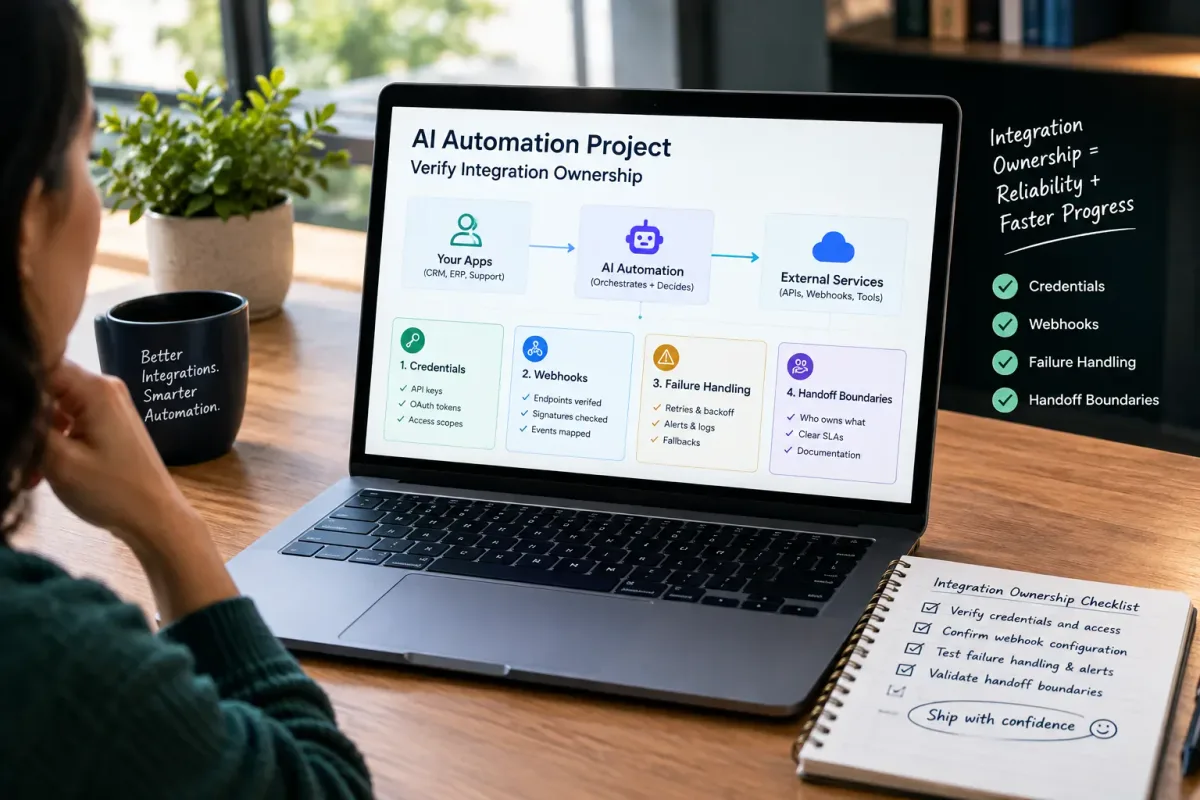
How Do I Verify Integration Ownership in an AI Automation Project?
Learn how to verify integration ownership in an AI automation project, including credentials, webhooks, failure handling, and handoff boundaries.
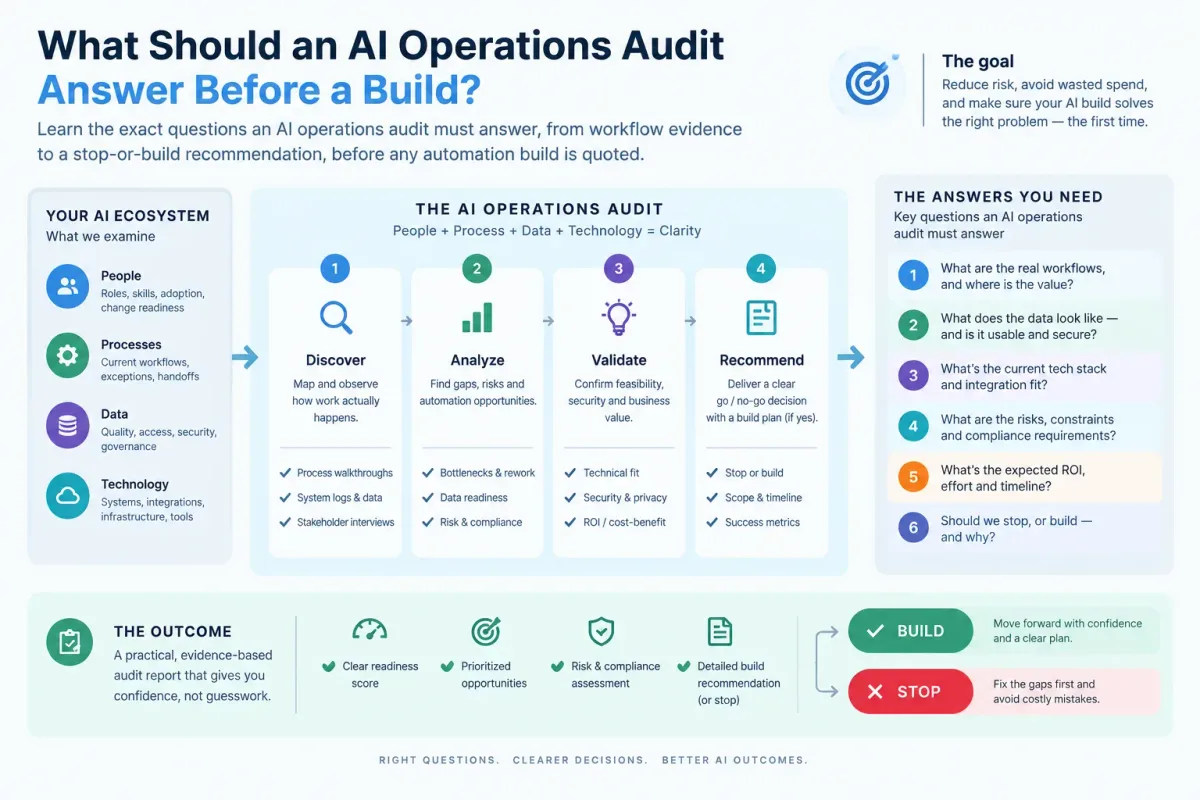
What Should an AI Operations Audit Answer Before a Build?
Learn the exact questions an AI operations audit must answer, from workflow evidence to a stop-or-build recommendation, before any automation build is quoted.

What Should an AI Automation Agency Prove Before Taking Access?
Before an AI automation agency touches your systems, it should prove access boundaries, written scope, security practices, test evidence, and a clear ownership record.