
Will AI Replace Customer Service? The Honest Answer in 2026
AI will replace a significant portion of customer service work, but not all of it. In 2026, AI handles a large share of routine customer interactions across industries like retail, banking, and home services.
AI already handles a large share of routine customer interactions in retail, banking, and home services. Here's what it does well, what it still gets wrong.
Epiphany Dynamics is an AI automation agency: we help businesses find and fix operational bottlenecks with AI receptionists, lead follow-up, and workflow automation.
The free 30-minute AI Operations Audit is a conversation about a normal week in your business and where the work piles up. We find the one change that would give you the most time back and send you a plain-English plan for it. No forms and no pitch.
Book a free AI audit
Patrick Gibbs
AI will replace a significant portion of customer service work, but not all of it. In 2026, AI handles a large share of routine customer interactions across industries like retail, banking, and home services. Complex complaints, emotionally charged situations, and judgment-heavy decisions still require human agents. The split is real and already settled.
The framing of this question has shifted. A few years ago, "will AI replace customer service" was a theoretical debate. In 2026, it's a practical one. Businesses are already running AI agents that handle large volumes of calls, chats, and emails without a human ever touching them. The question isn't whether this is happening. It's how far it goes, and where the floor is.
The real question operators need to answer is more specific: which parts of your customer service operation are already replaceable, which parts aren't, and how do you build around that reality without over-automating in ways that destroy trust? That's what this article actually tries to answer.
What AI Is Actually Handling Right Now
AI currently handles a large share of first-contact customer service interactions across major industries. These include order tracking, appointment scheduling, FAQ responses, basic billing questions, and payment processing. Most customers complete these interactions without realizing they never spoke with a human.
The list of tasks AI handles reliably in 2026 is long. Appointment booking, order status, password resets, refund tracking, FAQ lookups, basic billing inquiries. These interactions follow predictable patterns, which is exactly where AI performs well. When a customer asks "where is my order," there's no ambiguity and no emotional complexity. Just a data lookup and a clean answer.
At the enterprise level, the numbers are hard to argue with. The largest banks' virtual assistants have logged enormous volumes of customer interactions, and major telecom providers' AI support tools handle huge chat volumes monthly, with deflection rates that would have looked impossible five years ago. These aren't rigid phone tree menus that frustrate users into hanging up. They're systems trained on years of real conversation data that handle genuine back-and-forth.
For smaller businesses, the math lands differently but just as sharply. An AI voice agent answering inbound calls can extend coverage without the same hiring, training, turnover, and schedule-management burden as human reception. That cost gap is why more small operators are now seriously looking at how to cut phone staff costs with AI without sacrificing coverage quality.
Where AI Customer Service Still Falls Apart
AI customer service fails consistently in four situations: emotionally distressed customers, problems requiring multi-system investigation, genuinely novel situations outside its training data, and conversations where the customer needs to feel heard rather than just answered. Human agents still outperform AI in retention conversations and complex billing disputes by a wide margin.
An AI handles "what's my order status" with near-perfect accuracy. It struggles with "I've called four times about the same problem and nobody has fixed it." That second interaction isn't about information retrieval. It's about trust repair. The customer needs to know someone actually cares, and that's difficult to deliver with an AI regardless of how good the underlying language model is.
Complex, multi-step issues expose a different gap. When a billing dispute requires pulling three separate account records, checking two systems, and making a judgment call about whether a one-time credit is warranted, most AI agents either fail or route to a human anyway. The complexity ceiling for AI in customer service is real. It's rising, but it hasn't gone away, and pretending otherwise leads to deployment failures that hurt more than they save.
The novelty problem is underappreciated by most vendors pitching AI. These agents are trained on historical conversations. When something genuinely new comes up, like an unexpected product recall, a service outage with no precedent, or an unusual combination of account conditions, AI can produce confidently wrong answers. That's worse than "let me get someone who can help you." Confidently wrong erodes trust fast. Honest escalation doesn't.
The Numbers Behind the Shift
AI tools reduce average handle time significantly in contact centers, and AI now handles a substantial share of customer service interactions globally. Deployment runs highest in retail and telecom, with human escalation still needed on a meaningful share of interactions depending on industry complexity.
Industry-level data matters more than the average, because the gap between sectors is wide:
| Industry | AI Interaction Rate | Human Escalation Rate | Top AI Use Case |
|---|---|---|---|
| E-commerce / Retail | High routine automation | Moderate escalation need | Order tracking, returns, FAQs |
| Banking / Financial | High for account lookups | Higher escalation need | Balance checks, fraud alerts, account access |
| Healthcare | Moderate for structured workflows | Higher than average | Appointment scheduling, prescription refills |
| Home Services (HVAC, Plumbing) | High for intake and routing | Higher than average | Booking, call routing, job quotes |
| Telecommunications | High for repetitive support | Moderate escalation need | Billing, outage reports, plan changes |
These patterns reflect first-contact handling. The human escalation column is how often a human still needs to get involved at some point in the interaction. Even when AI handles a large share of routine volume, human agents aren't eliminated. They're redirected toward harder problems and away from repetitive work. Most service leaders now expect AI to handle more customer interactions over time. The direction is clear even if the timeline is debated.
One pattern worth sitting with: companies that have deployed AI at scale in customer service report not just cost savings but measurable improvements in first-contact resolution. When AI can instantly access full account history and pull policy information quickly, it sometimes resolves issues faster than a human would. That's an uncomfortable point for people defending the status quo, but it's what the data shows.
The Hybrid Model That's Actually Winning
The most effective customer service operations in 2026 use a hybrid model where AI handles initial contact, simple resolution, and follow-up automation while humans manage escalations, retention conversations, and complex account work. Companies running this model report substantially lower cost-per-interaction with no measurable drop in customer satisfaction scores.
Full automation is a goal some businesses have reached and many are chasing. For most, the approach that actually works is layered. AI takes the first contact. It qualifies the issue, pulls account information, and attempts resolution. If it can't resolve cleanly, it routes to a human with the full context already populated. That human doesn't re-ask for the customer's name, account number, and problem description. They pick up mid-stream with everything they need.
This handoff quality matters more than most operators realize before they deploy. Ask customers what frustrates them most about service interactions, and repeating themselves ranks at or near the top of the list. The hybrid model solves that specific friction point. AI collects and transcribes everything. The human inherits context instead of starting cold. The customer notices the difference.
For appointment-heavy businesses, including dental practices, HVAC companies, and med spas, the hybrid model shows up in a specific form. AI handles booking 24/7, sends confirmation messages, runs reminder calls, and manages rescheduling requests. Humans handle anything that falls outside those standard flows. The result is fewer no-shows and fewer canceled appointments without adding headcount. If you're operating in this space, understanding what automated appointment reminders actually work in 2026 is worth reviewing before picking a platform, because the options vary significantly in what they can handle without human backup.
For related material, see Chat vs. Chatbot: What's the Real Difference in 2026?.
A Framework for Deciding What to Automate
Automate interactions that are high-frequency, low-complexity, and data-driven. Keep humans on interactions that require judgment, emotional intelligence, or multi-system investigation. Map your most common contact reasons by volume. If a meaningful share are informational or transactional, you have a strong case for automation.
There's a quick diagnostic worth running before committing to any AI customer service platform. Pull a representative sample of customer service contacts and tag each by reason code. Then ask two questions about each contact type: Does this interaction require judgment or empathy? Does it require navigating multiple systems in ways current AI tools can't reliably handle? If the answer to both is no, it's automatable. For many service businesses, enough contacts fall into that bucket to justify a focused pilot.
Where businesses go wrong is automating based on cost savings alone, pushing everything to AI including the interactions that genuinely need a human. Customers who feel wronged and can't reach a person are the most likely to leave, post a negative review, and tell others. The cost of that churn typically wipes out the savings from over-automating. Businesses that make this mistake tend to see churn climb in the first year before pulling back and rebuilding trust. That's not a hypothetical pattern: it has played out at multiple companies that deployed AI too aggressively.
Start with what's obviously repetitive: FAQ responses, appointment reminders, order status, call routing. Get those running well, measure customer satisfaction on those specific interaction types, then expand. If you want a structured approach to running a real pilot before fully committing, the guide on testing AI automation for small businesses before scaling walks through the phased process without the vendor hype that usually surrounds this topic.
What This Means for Customer Service Jobs
AI won't eliminate customer service roles in a single wave, but it's already slowing headcount growth and changing skill requirements. Customer service representative employment is widely projected to decline over the coming decade. The jobs that survive that shift require higher skill, better pay, and focus on judgment-heavy work rather than transaction processing.
The real story isn't mass layoffs. It's slower hiring. A contact center can handle more interactions with the same team by using AI for first contact and simple resolution. They're not necessarily firing people. They're avoiding the next wave of hiring as volume grows. The headcount stays flat while output scales. That's where the impact lands for most companies over the next few years.
The skill mix is shifting in a predictable direction. Senior agents who can manage escalated, emotionally charged calls are more valuable than before. Junior agents who repeat scripted answers to simple questions face the most exposure. Companies building out customer service teams in 2026 are hiring fewer people but paying more per seat, which is a different problem than "robots take all the jobs" but still a real structural shift for people in entry-level service roles.
For businesses evaluating the staffing question specifically, the comparison of what AI-handled calls actually look like versus human-handled ones (and where each makes financial sense) is covered in detail in the post on AI replacing receptionists: the 2026 reality check, which goes beyond theory into the business inputs operators are actually working with.
The Takeaway for Business Owners
AI has already replaced a large share of routine customer service interactions, and that percentage is rising. The businesses winning in 2026 aren't fully automated or fully human-staffed. They've mapped their contact volume, automated the predictable portion, and redeployed humans toward work that requires judgment. That is the decision most businesses are actually facing right now.
The question "will AI replace customer service" has a partial answer that's already settled and a full answer that's still playing out. The routine, high-volume, transactional work is largely automated across the industries that have moved fastest. The complex, high-stakes, emotionally sensitive work still needs people. That split isn't disappearing anytime soon, even as AI models keep improving and confidence thresholds keep rising.
For any business evaluating where to start, the clearest entry point is understanding what an automated front-end customer service setup actually looks like in practice. What it costs, how it handles edge cases, where it needs a human backup, and what happens when it fails. The specifics of AI front desk costs and how it actually works covers those details without making assumptions about your industry or volume.
Getting this right is less about picking the best AI vendor and more about mapping your own contact patterns honestly before you buy anything. The businesses that have done that work are the ones seeing real returns. The ones that skipped it are the ones ripping out systems after six months of frustrated customers and bad reviews.
Frequently Asked Questions
Q: Which customer service jobs are most at risk from AI automation?
Routine transaction roles (order tracking, password resets, billing questions) are already largely automated and will continue shrinking. Specialized roles requiring judgment, emotional intelligence, and complex problem-solving (account management, escalation handling, technical troubleshooting) remain largely insulated in 2026 and beyond.
Q: What customer service problems can AI still not handle reliably?
Emotionally charged complaints, multi-issue problems requiring judgment calls, and situations needing policy exceptions remain difficult for AI. Fraud investigations, complaints demanding compassion, and problems with unusual circumstances still require human agents who can make nuanced decisions and break protocol when justified.
Q: How much money do companies actually save by switching to AI customer service?
Companies save money when AI handles repetitive interactions that would otherwise require staff time, but the exact savings depend on contact volume, escalation rate, licensing cost, integration effort, and how well the workflow routes complex issues to humans.
Q: Do customers actually accept talking to AI, or do they prefer humans?
Customer acceptance splits clearly: most customers accept AI for routine transactions (tracking, returns, FAQs) but strongly prefer humans for complaints and complex issues. Satisfaction drops sharply when AI is assigned to problems outside its competency range, making routing strategy critical to customer experience.
Patrick Gibbs
AI Automation Expert
Patrick Gibbs helps professional practices implement AI automation that captures more leads, books more appointments, and scales without adding overhead. He's the founder of Epiphany Dynamics and creator of the AI Front Desk system.
Related Solutions
Build this into a real workflow
Related Posts
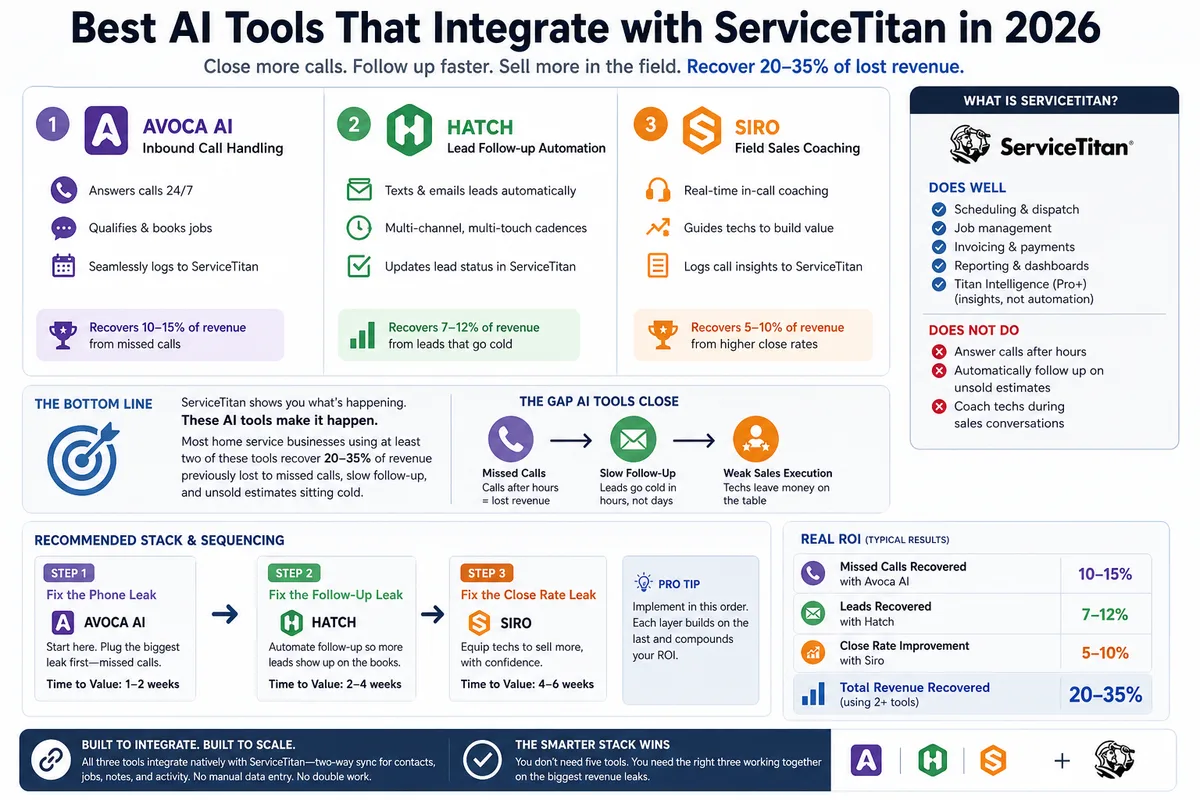
Best AI Tools That Integrate with ServiceTitan in 2026
Most ServiceTitan shops miss a meaningful share of inbound calls and leave most estimates unsold. These AI tools close those gaps inside ServiceTitan.
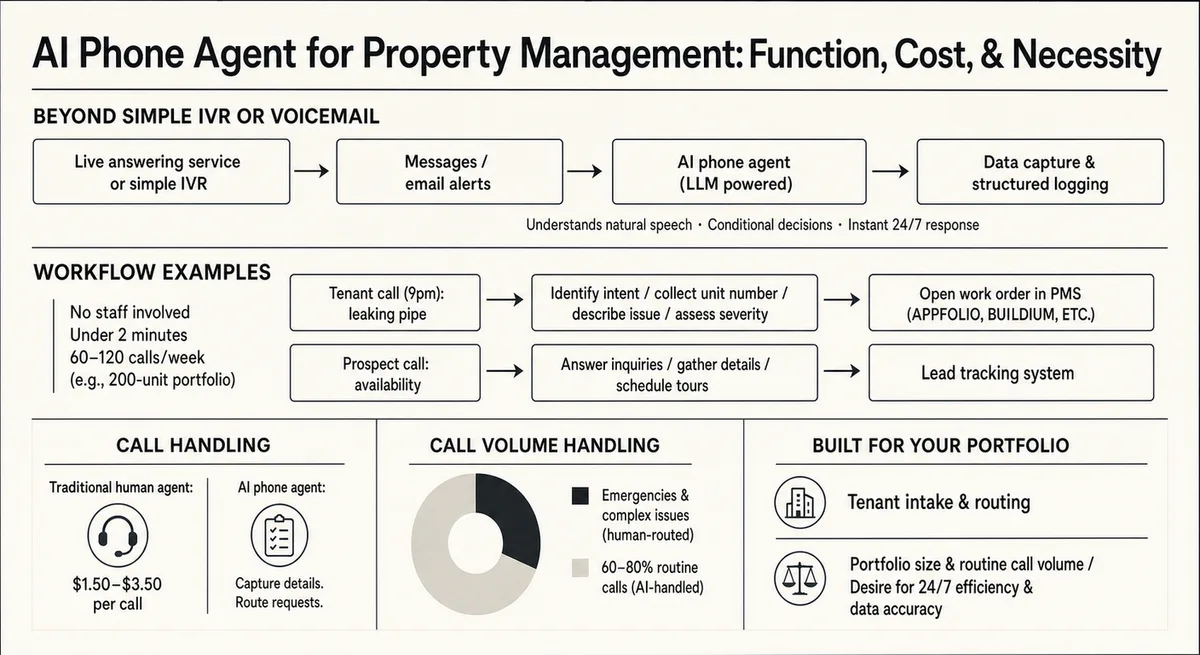
AI Phone Agent for Property Management: What It Does, What It Costs, and Whether You Need One
Property managers field heavy call volume, and a large share arrives after hours. AI phone agents answer, route, and log calls without adding live staff.
AI Automation for Construction Contractors: What Works in 2026
Construction contractors lose time to phone tag, missed leads, and manual follow-up. Here's which AI automation workflows usually matter first and how to.