
AI Phone Agent for Property Management: What It Does, What It Costs, and Whether You Need One
An AI phone agent for property management is a voice-based software system that answers tenant and prospect calls, collects structured information, routes emergencies, and logs tickets without a human picking up. The value depends on call volume, after-hours demand, PMS integration, and how much routine call handling the system can safely absorb.
Property managers field heavy call volume, and a large share arrives after hours. AI phone agents answer, route, and log calls without adding live staff.
Epiphany Dynamics is an AI automation agency: we help businesses find and fix operational bottlenecks with AI receptionists, lead follow-up, and workflow automation.
The free 30-minute AI Operations Audit is a conversation about a normal week in your business and where the work piles up. We find the one change that would give you the most time back and send you a plain-English plan for it. No forms and no pitch.
Book a free AI audit
Patrick Gibbs
An AI phone agent for property management is a voice-based software system that answers tenant and prospect calls, collects structured information, routes emergencies, and logs tickets without a human picking up. The value depends on call volume, after-hours demand, PMS integration, and how much routine call handling the system can safely absorb.
What an AI Phone Agent Actually Does in a Property Management Context
An AI phone agent answers calls, identifies the caller's intent, gathers relevant details through a scripted conversation, logs the information into your property management software, and either resolves the call or routes it appropriately. For a busy portfolio, this means routine maintenance, rent, availability, and after-hours calls do not all have to wait for a human to pick up.
The phrase "AI phone agent" gets thrown around loosely, so it's worth being precise about what the technology actually is before evaluating it. If you want a solid grounding, the explanation of what AI agents actually are is a good starting point. These are not simple IVR trees or voicemail systems. They use large language models to understand natural speech, respond conversationally, and make conditional decisions based on what a caller says.
For property management specifically, the operational value is concentrated in a few narrow but high-frequency scenarios. Maintenance request intake is the obvious one: a tenant calls after hours about a leaking pipe, the AI collects the unit number, describes the issue, asks screening questions to assess severity, creates a work order in AppFolio or Buildium, and texts the tenant a confirmation. No human has to watch the inbox for that workflow to begin. The AI doesn't get tired of repeat maintenance calls, and it doesn't forget to ask which building the tenant lives in.
What makes this different from an answering service is the data capture. A live answering service takes a message and sends you an email. An AI phone agent can be configured to write directly to your property management system, flag emergencies based on keyword triggers, send automated SMS updates to tenants, and notify on-call maintenance staff via text or email without human intervention. That closed loop matters when no one is watching their inbox.
The Specific Call Types It Handles (and How)
The highest-volume call types in property management are maintenance requests, rent payment questions, lease and availability inquiries, and after-hours emergencies. AI phone agents can handle each category, but the effectiveness depends on how structured the call is and how clearly escalation rules are configured.
Maintenance intake is where AI phone agents perform best. The call has a predictable structure: who are you, which unit, what's the problem, how urgent is it. A well-configured agent works through that checklist conversationally, adapts when tenants give unexpected answers, and produces a clean work order. For many operators, maintenance is the most repeatable call category and the easiest place to prove the workflow.
Rent payment questions are another automatable category. Tenants call because they forgot their portal login, want to confirm a payment posted, or have a question about a late fee. The AI can pull basic account data if it's integrated with your PMS, read back balances, or direct tenants to your online portal. This is lower-stakes than maintenance but saves meaningful time in a busy portfolio.
Emergency triage is where the configuration work really matters. The AI needs a clear decision tree: what qualifies as an emergency (no heat in winter, gas smell, flooding, no power), what the escalation phone number is, and exactly what language to use when handing off to on-call staff. Done right, this is genuinely valuable. Done wrong, you have an AI confidently telling a tenant to "submit a ticket" while their basement fills with water.
Lease renewal and availability calls require more nuance. The AI can quote available units, describe amenities, and schedule showings. For lease renewals, it can deliver renewal terms and collect a verbal confirmation of interest. But anything involving negotiation, exception requests, or a tenant who's upset about their renewal rate should go to a human. The AI's job in those calls is to qualify the conversation and route it correctly, not to close.
For a broader look at how AI receptionist tools built specifically for property management handle this call mix, there are purpose-built products that cover the full intake workflow rather than requiring you to configure a general-purpose agent from scratch.
The Real Cost Comparison: Staff, Answering Service, and AI Agent
The cost comparison depends on your current answering setup, staff workload, PMS integration, after-hours call volume, and how much manual message processing remains after the AI answers. A cheap tool that still forces staff to rewrite every call into a work order is not really cheap.
The math is straightforward, but it's worth being precise rather than vague about it. Here's a comparison across the scenarios a PM company might actually be in:
| Setup | Cost Pattern | Hidden Workload | After-Hours Coverage | PMS Integration |
|---|---|---|---|---|
| In-house admin staff (fully loaded) | Payroll, benefits, management, and turnover | Interruptions, overtime, and context switching | Overtime or none | Yes |
| Live answering service | Recurring service cost, often tied to usage | Manual work orders and callback loops | Yes | Rarely |
| AI phone agent | Platform, setup, usage, and tuning | Configuration and exception monitoring | Yes, native | Often yes |
The true cost for in-house staff includes salary, payroll taxes, benefits, and the reality that phone calls are only one part of the job. Most PM operators don't think of it this way, but when you're trying to justify a technology decision, that's the honest comparison.
Live answering services can look affordable, but they don't always write work orders, integrate with AppFolio, or triage emergencies with enough intelligence. You still need a human to process the messages they take. That hidden labor cost often closes the gap more than people realize.
AI phone agents usually combine platform fees, setup, usage, and ongoing tuning. The ROI case is strongest when the system handles after-hours calls without overtime, writes clean tickets into your PMS, and reduces the message-processing loop that live services often leave behind.
One thing worth calculating separately: tenant turnover. Faster maintenance response from AI-assisted triage may protect retention if it keeps small problems from becoming tenant frustrations. That's not guaranteed, but it is a real secondary benefit that almost never shows up in the direct cost comparison.
If you want context on how other small service businesses approach this calculation, the breakdown of real-world AI automation examples from small businesses across industries covers similar math in comparable contexts.
What an AI Phone Agent Cannot Do (and You Should Know This Upfront)
AI phone agents cannot handle tenant disputes, diagnose complex maintenance issues, provide legal guidance, or manage emotionally charged conversations that require empathy and judgment. Those calls require human handling. Knowing this boundary is what separates a good deployment from a frustrated tenant base.
This is the section most vendors skip. The AI works well on structured, high-frequency, low-variance calls. It struggles on anything requiring real-time judgment about edge cases it hasn't been trained on, emotional de-escalation, or legal nuance.
Tenant disputes are the clearest example. A tenant calling to dispute a charge, complain about a neighbor, or threaten to withhold rent is not a call you want going to an AI. The AI can collect the caller's name and unit number, but the moment the conversation becomes adversarial or legally significant, a human needs to take over. An AI that tries to resolve a habitability complaint will almost certainly say something that either inflames the situation or creates liability. The right behavior is a clean, polite handoff: "I'm going to connect you with our property manager, who handles disputes directly. Can I get your name and unit number first?"
Complex maintenance diagnosis is another area with clear limits. A tenant describing a furnace that "makes a weird noise sometimes" needs a human or a technician, not a work order that says "weird noise, medium priority." The AI can collect the initial description and create a ticket, but the triage decision for anything ambiguous should involve a person. Over-relying on the AI's severity classification for HVAC, plumbing, or electrical issues is where deployments run into problems.
Legal matters, habitability concerns, and anything touching eviction or notice requirements need to stay entirely in human hands. These calls are rare, but the consequences of an AI handling them badly are significant. Train your team to monitor these call types in your AI's logs and make sure routing rules push them to a live person immediately.
Comparing answering options, including where AI-assisted and human-assisted services differ in practice, is worth doing before committing. A look at how AI-assisted answering services compare to traditional live services covers some of these tradeoffs from a buyer's perspective.
For additional background, see Automated Tenant Screening: A Property Manager's Complete Guide.
How to Know If Your Portfolio Is Ready and What to Look for in a Setup
A portfolio is ready for an AI phone agent when routine call volume is high enough, after-hours coverage matters, and your PMS can receive clean data from the call flow. The right setup requires PMS integration, configurable call flows, and clear escalation logic before you go live.
The portfolio-size question is real. Smaller portfolios may be better served by a basic live answering service or part-time admin. Larger portfolios with repeat maintenance and leasing call patterns are more likely to justify a configured AI phone agent, especially when after-hours coverage and PMS integration are part of the value case.
Integration is the first non-negotiable. An AI phone agent that can't write to your AppFolio, Buildium, Rent Manager, or Yardi instance is just an expensive voicemail box. Ask any vendor specifically which property management software they integrate with natively and what "integration" actually means (real-time API write, or end-of-day CSV export?). Real-time, bidirectional integration is what makes the technology actually useful.
Call flow configurability matters more than most buyers realize upfront. You need to define exactly how the AI handles each call type, what questions it asks, what counts as an emergency, who gets notified and how, and what happens when a caller goes off-script. Vendors who offer pre-built PM templates are faster to deploy. Vendors who allow full customization are more flexible long-term. The best options offer both: a solid starting template you can modify.
Test the escalation logic before going live. Use realistic scenarios: a no-heat emergency, a non-English-speaking tenant, a caller who refuses to give their unit number, a prospect asking about an unavailable unit, and a tenant disputing a charge. Run the AI through all of them manually. If it fails meaningful cases, the configuration needs more work before it touches real tenants.
Onboarding goes faster for a well-documented portfolio. You'll need to provide your unit list, emergency contacts, maintenance priority guidelines, and a FAQ covering the questions your staff answers most often. The more organized your existing documentation, the faster setup goes. If you're starting from scratch, expect the configuration phase to take longer than the vendor's sales materials suggest.
One more thing: tell your tenants. A brief notice in your tenant portal or at lease signing that after-hours calls are handled by an automated system sets expectations correctly. Tenants who know they're talking to an AI tend to give cleaner, more structured answers. Tenants who are surprised by it mid-call sometimes hang up, which defeats the purpose.
For comparison on how similar systems are being applied in other service-intensive industries, the operational parallels in how AI phone agents work for high-volume salon businesses are closer than they look, especially around after-hours intake and appointment scheduling. For smaller PM operations still evaluating whether full AI call handling or a lighter-touch approach fits better, the comparison of virtual receptionist options for small businesses is a useful frame.
The Practical Takeaway
If you are already spending meaningful time or money on answering services, after-hours coverage, or admin time on routine calls, an AI phone agent is worth evaluating. The technology is mature enough in 2026 that the setup risk is manageable if you choose a vendor with native PMS integration and configurable escalation logic.
The property management industry has a specific, repeatable call volume problem. Tenants call at all hours. Most of those calls follow predictable patterns. The ones that don't are the ones that need a human, and good AI systems know how to make that handoff cleanly. That's the job, and when configured correctly, it does that job better and cheaper than any alternative short of a full-time dedicated phone staff.
The operators getting the most out of this technology aren't using it to eliminate their admin staff. They're using it to handle the call volume that was either going unanswered or eating time that should have gone toward leasing, inspections, and owner communication. The AI handles the intake; the humans handle the judgment. That division of labor actually works.
If you want to understand what agencies that build and configure these systems actually do before engaging one, the overview of what AI automation agencies actually do is worth reading first. And if you want to see what a PM-specific implementation looks like end-to-end, the team at Epiphany Dynamics builds these systems specifically for property management operators and can walk you through a configuration that maps to your portfolio.
Frequently Asked Questions
Q: What size portfolio needs an AI phone agent to justify the cost?
The right portfolio size depends on routine call volume, after-hours demand, and whether the AI can write clean data into your PMS. Smaller portfolios may be fine with a lightweight answering service, while larger or faster-growing portfolios often benefit from configured AI intake and routing.
Q: Can an AI phone agent handle emergency calls safely, or must tenants reach a human?
The best systems identify emergency keywords (burst pipe, fire, injury) and route immediately to your on-call team or emergency contact. However, always allow tenants to request a human at any point, and configure truly critical scenarios to bypass the AI and connect directly rather than rely on AI triage alone.
Q: How do you prevent an AI phone agent from creating duplicate work orders or assigning calls to the wrong unit?
Quality providers use confirmation logic, repeating back details like the unit and building before submission, and cross-reference your CRM to catch duplicates. Some systems flag ambiguous requests for human review rather than logging uncertain data into your system.
Q: Do AI phone agents integrate with standard property management software like Buildium or Appfolio?
Most major PM platforms support API connections with dedicated AI phone providers; some have pre-built integrations. Integration depth varies: some create work orders directly in your system, while others export data requiring manual import. Always confirm native support before purchase.
Patrick Gibbs
AI Automation Expert
Patrick Gibbs helps professional practices implement AI automation that captures more leads, books more appointments, and scales without adding overhead. He's the founder of Epiphany Dynamics and creator of the AI Front Desk system.
Related Solutions
Build this into a real workflow
Related Posts
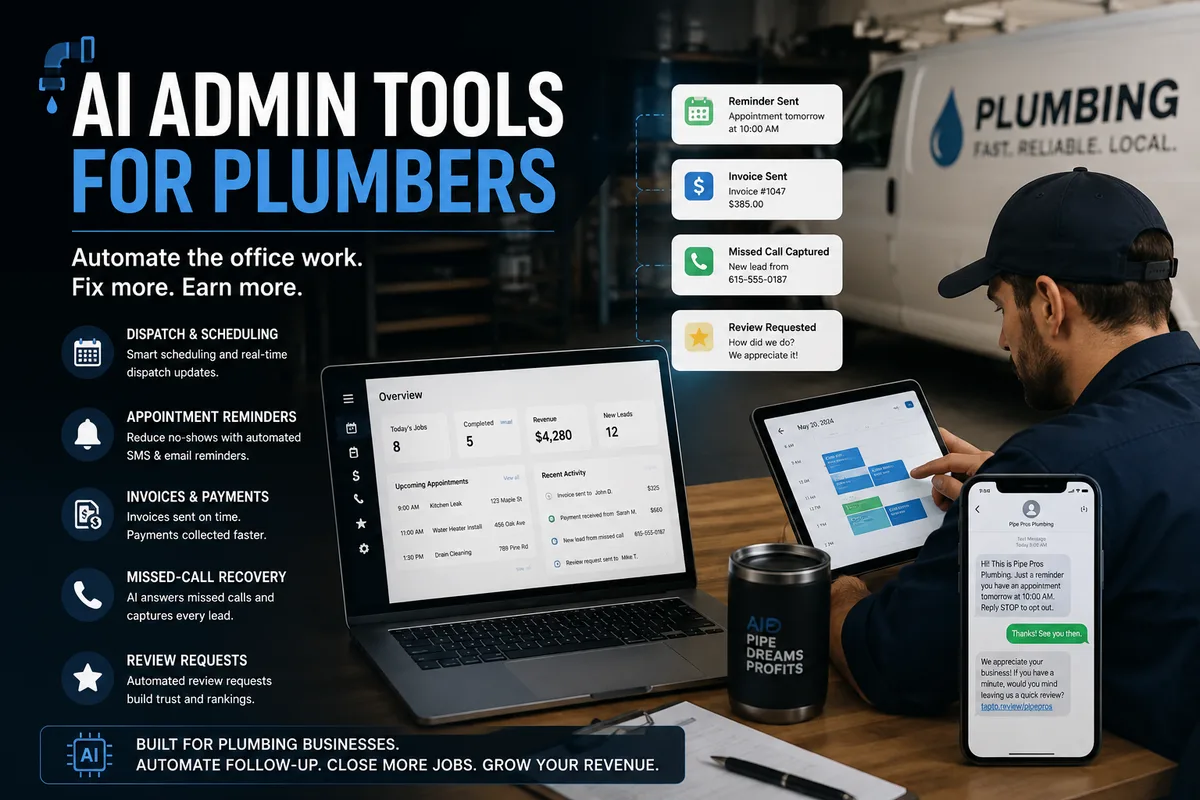
AI Admin Tools for Plumbers: What They Are and How to Choose
AI admin tools automate dispatch, reminders, invoicing follow-up, missed calls, and review requests for plumbers. What they do and how to choose.
Insurance Eligibility Automation for Physical Therapy Clinics
Eligibility automation for physical therapy clinics verifies benefits before the patient arrives, cuts front desk phone work, and can lower claim denial risk.
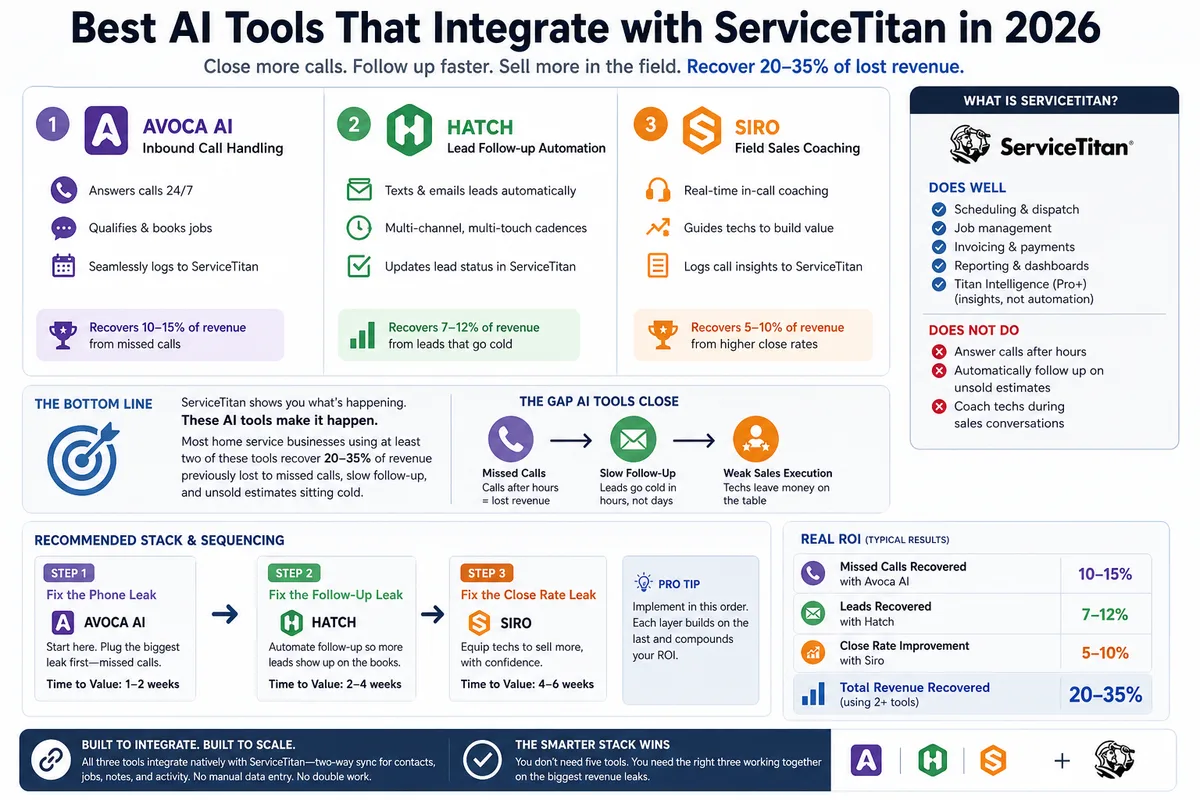
Best AI Tools That Integrate with ServiceTitan in 2026
Most ServiceTitan shops miss a meaningful share of inbound calls and leave most estimates unsold. These AI tools close those gaps inside ServiceTitan.