
AI Automation
AI Sales Automation Tools: What Actually Works in 2025
Sales reps spend only a fraction of their time actually selling. The rest is admin, research, and follow-up. AI sales automation tools are changing that math.
The free 30-minute AI Operations Audit is a conversation about a normal week in your business and where the work piles up. We find the one change that would give you the most time back and send you a plain-English plan for it. No forms and no pitch.
Book a free AI audit
Patrick Gibbs
AI sales automation tools work by reclaiming time currently lost to admin, data entry, and follow-up. The tools that deliver real business value fall into five categories: predictive lead scoring, AI-powered personalization, conversation intelligence, CRM enrichment, and AI SDR/voice agents. This post cuts through vendor noise to explain what each category actually does, what realistic outcomes look like, and how to build a stack without over-engineering it.
The Math Problem at the Core of Modern Sales
Sales teams consistently lose selling time to administrative tasks, data entry, research, scheduling, and follow-up emails. That work matters, but it does not create direct selling conversations. That’s the problem AI sales automation tools are built to solve.
But the market is loud. Every software vendor claims their platform will fix pipeline problems and raise close rates. Most of that is noise. This article cuts through it, covering what AI sales automation actually does at a technical level, which categories of tools produce measurable ROI, what realistic outcomes look like, and how to build a stack without over-engineering it.
What AI Sales Automation Actually Does (and Doesn’t Do)
The term “AI sales automation” covers a wide spectrum. At one end, you have simple rule-based sequences that vendors rebrand as “AI-powered.” At the other end, you have genuine machine learning models that score leads, generate personalized outreach, and surface deal risks based on behavioral signals. Understanding the difference matters, because it determines what you’re actually buying.
True AI automation in a sales context involves: natural language generation for personalized email and call scripts, predictive lead scoring using historical conversion data, conversation intelligence that analyzes calls and flags objections, and intent data platforms that surface accounts actively researching your category. Rule-based automation (sequences, email drips, calendar booking) is valuable, but calling it “AI” is a stretch. Both have a place in a modern stack, and knowing which is which prevents you from overpaying for the former while expecting the latter’s results.
The goal is not replacing revenue work. It is freeing reps from repeatable work so more of the week goes toward actual conversations, relationship building, and closing.
The 5 Core Categories of AI Sales Automation Tools
Rather than reviewing individual products (which change rapidly), it’s more useful to understand the five functional categories. Each solves a different part of the sales process, and a mature stack typically draws from two or three of them, not all five simultaneously.
1. Predictive Lead Scoring and Prioritization
Tools in this category analyze CRM data, firmographic signals, and behavioral activity to rank leads by conversion probability. Instead of reps working a flat list, they work a ranked queue. Platforms like MadKudu, 6sense, and native Salesforce Einstein scoring fall here. The measurable outcome: reps spend more time on leads that match the company’s best-fit profile, not because the leads got better, but because time allocation got smarter.
2. AI-Powered Outreach and Personalization
This is the fastest-growing category and the most overhyped. Tools here generate personalized email copy, LinkedIn messages, and call talk tracks at scale using LLMs. The real value is not blasting generic AI emails: that approach is already destroying deliverability across the industry. The real value is hyper-personalization at the top of the funnel: pulling a prospect’s recent LinkedIn post, company news, or job change and building a relevant first-line that would otherwise require manual research and drafting.
3. Conversation Intelligence
Platforms like Gong, Chorus (now ZoomInfo), and Salesloft’s AI layer record, transcribe, and analyze sales calls. They flag moments where a competitor was mentioned, where pricing objections surfaced, where a rep talked too much or too little, and whether next steps were clearly defined. For sales managers, this replaces anecdotal coaching with pattern analysis across the call library.
4. CRM Data Enrichment and Hygiene
Bad CRM data is one of the most expensive invisible costs in sales operations. Our guide on AI integration with existing CRM systems covers the data architecture approach that makes every other tool in the stack work better. Reps update records manually (or don’t), contacts go stale, and leadership is making pipeline decisions on data that’s badly stale and inaccurate. AI enrichment tools like Clay, Clearbit, and Apollo’s enrichment layer automatically pull firmographic data, update contact info, and append intent signals without requiring manual entry. This isn’t glamorous, but it’s foundational: bad data breaks every other tool in the stack.
5. AI SDR and Voice Agents
The newest and most polarizing category: AI systems that autonomously conduct outbound prospecting: sending sequences, handling initial replies, booking meetings, and in some cases conducting voice conversations with prospects. Tools like Artisan, Ava, and AI voice platforms (including vAPI-based custom deployments) sit here. They don’t replace experienced closers, but they can handle top-of-funnel volume that no human SDR team could match economically. For businesses that can’t afford a full SDR team, this category is particularly relevant.
Value Breakdown: What to Expect
Use your own sales process to build the value case. The following table shows what to measure before adding a basic AI automation stack:
| Tool Category | Primary Cost Driver | Manual Work Replaced | Outcome to Measure |
|---|---|---|---|
| Lead Scoring (basic) | CRM data quality and scoring model depth | Manual list sorting and lead review | Worked-lead quality and booked-meeting rate |
| AI Outreach (personalization) | Personalization depth and channel coverage | Research, first-line writing, and follow-up drafting | Reply quality and pipeline movement |
| Conversation Intelligence | Call volume, seats, and coaching workflow | Manual call review and note-taking | Coaching quality and objection patterns |
| CRM Enrichment | Database size and enrichment scope | Manual contact research and record cleanup | Cleaner data → better forecasting accuracy |
The labor math should come from your own team. Pull the hours spent on research, CRM cleanup, outbound drafting, meeting scheduling, and call review, then compare that workload with the tool quote and implementation effort. The revenue impact (more pipeline, higher conversion, faster ramp) is where the real compounding happens but is harder to isolate cleanly.
One idea that’s consistently underappreciated: speed-to-lead matters enormously. Harvard Business Review’s “The Short Life of Online Sales Leads” is a useful source if you want to study the original research. For this buying decision, the practical takeaway is simpler: qualification odds fall as response time grows. An AI that auto-qualifies, sends a personalized initial response, and books a calendar slot quickly after a form submission is not a nice-to-have. It’s a structural response advantage. Our guide on improving close rates with AI automation explains how to evaluate speed-to-lead in your own pipeline.
Building Your AI Sales Stack: A Practical Framework
The biggest mistake businesses make is buying tools before mapping their bottleneck. More software doesn’t fix a broken process. It accelerates it. Before purchasing anything, answer three diagnostic questions: Where exactly does pipeline stall? Is it at the top (not enough leads), the middle (leads not converting to meetings), or the bottom (deals dying in late stages)? Each problem points to a different tool category. Buying conversation intelligence when your real problem is insufficient pipeline volume is expensive misdirection.
A practical implementation sequence for most small-to-mid-size businesses:
- Phase 1. Foundation: CRM hygiene and enrichment first. No AI tool works well on dirty data. Get your records clean before layering intelligence on top.
- Phase 2. Top-of-Funnel: Add AI outreach or an AI SDR to increase pipeline volume. Measure reply rates and meeting bookings against your pre-AI baseline.
- Phase 3. Conversion: Add lead scoring to prioritize the larger pipeline you’re now generating. Add conversation intelligence if you have reps to coach.
- Phase 4. Optimization: Analyze what’s working, kill what isn’t, and consolidate platforms where possible. Many point solutions overlap: you rarely need all five categories at full build.
Avoid the “full stack day one” trap. Industry surveys of RevOps leaders consistently find that salestech stack consolidation is a top priority, meaning most teams have too many tools, not too few. Start with one tool that solves your biggest constraint. Measure it. Then expand.
What Most Evaluations Miss
When evaluating AI sales automation tools, most buyers focus on features and price. The factors that actually determine success are rarely on the vendor’s comparison page. Integration depth with your CRM matters more than any individual feature: a tool that doesn’t sync cleanly with Salesforce or HubSpot creates manual reconciliation work that eats the time you were trying to save. Data residency and compliance matters if you sell into regulated industries. And actual automation rate (the percentage of tasks the tool handles without human intervention) is the metric vendors don’t advertise because it exposes how much “AI” still requires manual babysitting.
Ask every vendor a few questions before buying: What does setup actually require? What does success look like for a team your size? And what does retention look like after customers finish onboarding? Vendors with strong outcomes should be able to explain how customers keep getting value after the initial excitement fades. The ones that cannot are usually selling noise, not outcomes.
For another angle, see AI Automation for Construction Companies: What Actually Works in 2026.
The Bottom Line
AI sales automation tools are not magic, but they are genuinely powerful when deployed against the right problem. The businesses seeing the most impact aren’t buying the most software. They’re identifying their highest-friction sales bottleneck and applying the right AI layer to it specifically. That discipline (diagnose first, automate second) separates the teams that improve pipeline quality from the ones that buy tools and wonder why nothing changed. The technology is ready. The question is whether your process is ready to use it. For the lead capture side specifically, our complete guide to automating lead capture covers the full intake-to-qualification workflow.
For businesses exploring where AI automation fits into their specific sales motion, particularly in high-touch service industries like healthcare, home services, or professional services, the implementation approach matters as much as the tool selection. Getting outside perspective from practitioners who’ve built these stacks in the real world, rather than relying solely on vendor past implementations, tends to shortcut the most expensive trial-and-error.
Frequently Asked Questions
Q: How should a sales team estimate time lost to non-selling work?
Start with a simple activity audit. Track CRM updates, research, scheduling, follow-up drafting, meeting prep, and call notes separately from live selling conversations. Then compare that non-selling workload with the tool category that would remove or compress it.
Q: What is the difference between true AI sales automation and rule-based automation?
True AI automation involves natural language generation for personalized outreach, predictive lead scoring using historical conversion data, and conversation intelligence that analyzes calls to surface patterns. Rule-based automation handles sequences, email drips, and calendar booking. It is valuable but not truly AI in the machine learning sense. Both have a place in a modern stack, but knowing which is which prevents overpaying for one while expecting the other’s results.
Q: Which AI sales automation category should a small team start with?
Start with the bottleneck closest to revenue. If leads sit untouched, prioritize speed-to-lead automation. If reps waste time researching contacts, prioritize enrichment and personalization. If managers cannot coach consistently, conversation intelligence may be the better first move.
Q: In what order should a small business build out its AI sales automation stack?
Start with CRM data hygiene and enrichment, because no AI tool performs well on dirty data. Then add top-of-funnel outreach automation to increase pipeline volume. Then layer in lead scoring to prioritize the larger pipeline you are generating. Add conversation intelligence last, only if you have reps to coach. Attempting all five categories simultaneously is the “full stack day one” trap that drives most salestech consolidation projects.
Q: What should you ask a vendor before purchasing an AI sales automation tool?
Ask what setup requires from your team, how they define success for a company your size, and what customer retention looks like after onboarding. Also confirm integration depth with your CRM before any other feature discussion.
Patrick Gibbs
AI Automation Expert
Patrick Gibbs helps professional practices implement AI automation that captures more leads, books more appointments, and scales without adding overhead. He's the founder of Epiphany Dynamics and creator of the AI Front Desk system.
Related Solutions
Build this into a real workflow
Related Posts
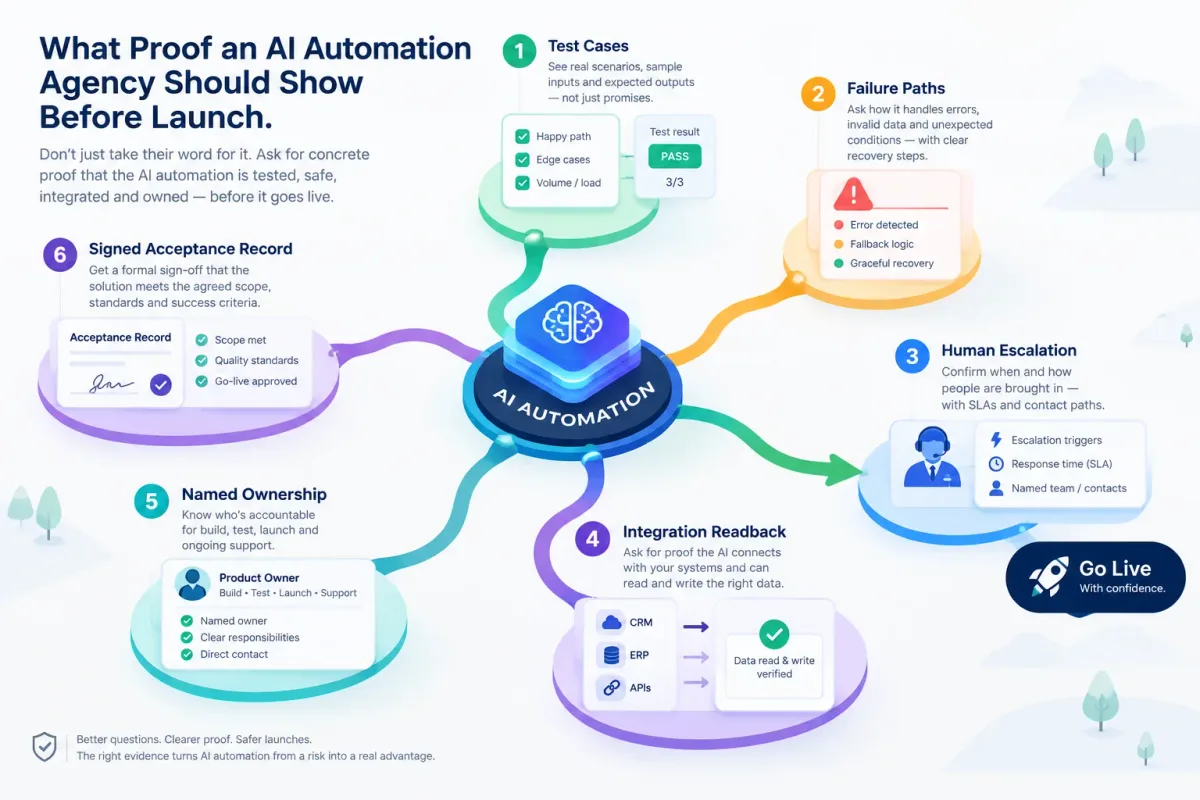
What Proof an AI Automation Agency Should Show Before Launch
Before an AI automation goes live, ask for test cases, failure paths, human escalation, integration readback, named ownership, and a signed acceptance record.
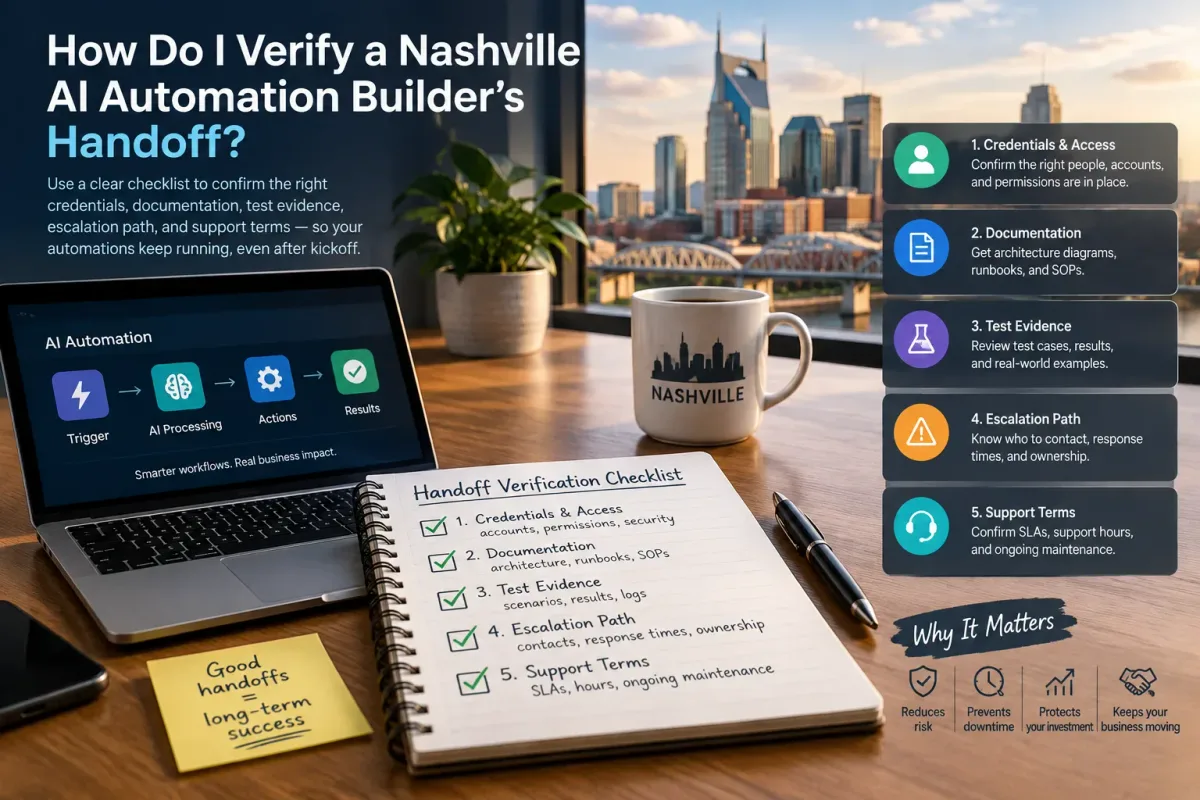
How Do I Verify a Nashville AI Automation Builder's Handoff?
Verify a Nashville AI automation builder's handoff with a checklist covering credentials, docs, test evidence, escalation, and support terms.
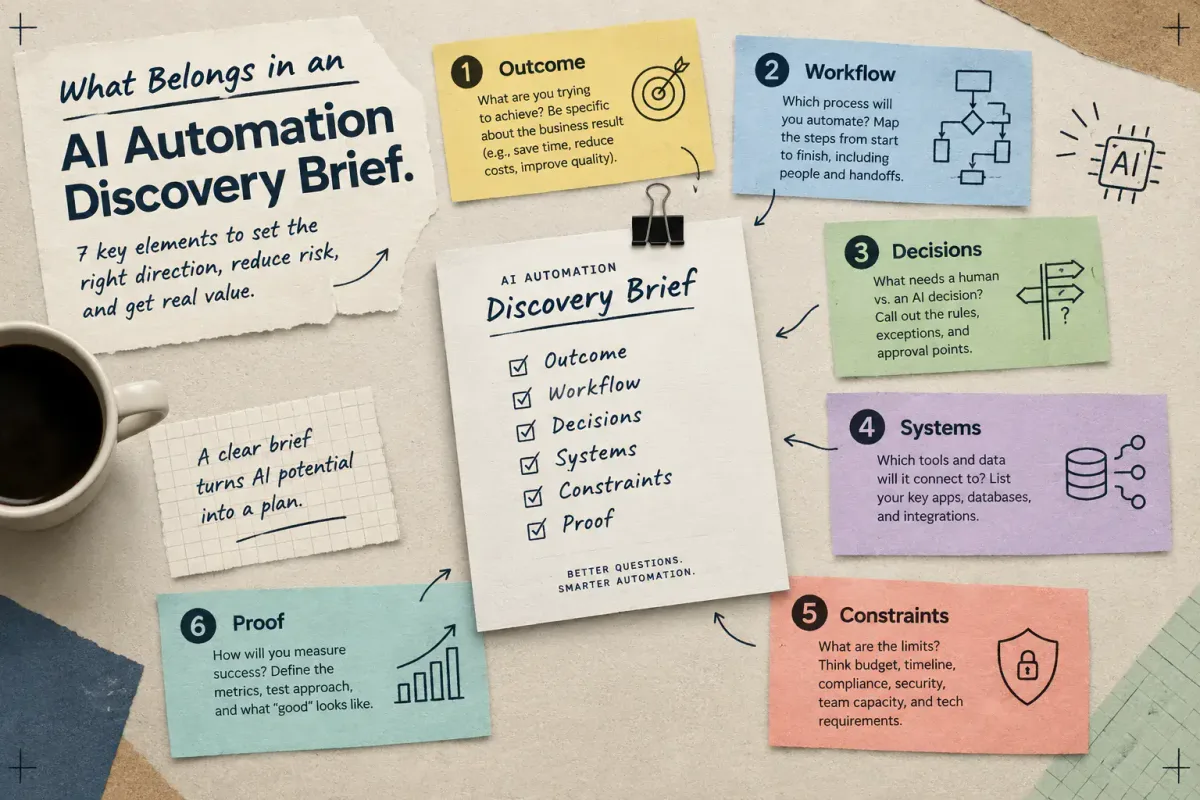
What Belongs in an AI Automation Discovery Brief
Learn the seven elements a small-business AI automation discovery brief needs: outcome, workflow, decisions, systems, constraints, and proof.