
AI Automation
Improving Close Rates with AI Automation: A Practical Guide
Most businesses lose deals not because their offer is weak but because they respond too slowly, follow up too little, and qualify too late.
The free 30-minute AI Operations Audit is a conversation about a normal week in your business and where the work piles up. We find the one change that would give you the most time back and send you a plain-English plan for it. No forms and no pitch.
Book a free AI audit
Patrick Gibbs
AI automation can help your team acknowledge inquiries, organize qualification and track follow-up. Measure whether those changes produce accurate handoffs and completed sales. This guide describes the workflow and an illustrative calculation, not a guaranteed improvement in close rate.
The Close Rate Problem Nobody Talks About Honestly
Many business owners treat their current close rate as a ceiling. They hire better salespeople, tighten up the pitch, maybe invest in a new CRM, and the number barely moves. What they’re missing is that most deals aren’t lost in the pitch. They’re lost in the gaps: the hours or days before someone responds to an inbound lead, the third follow-up email that never got sent, the qualification call that happened four days too late.
AI automation doesn’t close deals for you. What it does is eliminate those gaps, systematically and at scale. The businesses seeing meaningful close-rate improvement from AI aren’t doing anything exotic. They’re just removing the friction that was bleeding leads out of their pipeline before a human ever got involved. This guide breaks down exactly where AI moves the needle, how to build the systems that create those gains, and what the ROI actually looks like in practice.
Speed to Lead: The Stat That Should Keep You Up at Night
The 2011 HBR article The Short Life of Online Sales Leads is historical background, not a current AI performance benchmark.
For your workflow, measure time to acknowledgment separately from time to a useful human response. Then track qualified conversations and completed sales. Compare like lead sources and time periods rather than assuming that a faster reply caused every change in revenue. The lead capture guide covers the handoff design.
The Follow-Up Math Most Businesses Get Completely Wrong
Most sales require multiple follow-up contacts after the initial meeting. The brutal counterpart: a large share of salespeople give up after just one follow-up, and most stop well before the touch that would have landed. Put those two together and you see the problem instantly: much of your sales team is quitting right before the sale would have happened.
This isn’t laziness. Sales reps are managing pipelines, writing proposals, attending meetings, updating CRMs, and doing a hundred other things. Consistent, structured follow-up is genuinely hard to do manually at scale. AI automation makes multi-touch follow-up sequences trivially easy. A lead goes cold after a demo? A sequence automatically fires: a value-add email on day two, an implementation example on day five, a check-in text on day eight, a final nudge on day twelve. Every touch is personalized to the lead’s situation based on what they told you during qualification. The salesperson only needs to step back in when the lead raises their hand.
A 5-Touch AI Follow-Up Framework
The specifics will vary by industry and deal size, but this structure works across most service businesses with deal cycles under 30 days:
- Touch 1 (Immediate): Automated confirmation with next steps: sets expectations, reduces no-shows, establishes professionalism.
- Touch 2 (Day 1-2): Value-add content relevant to the prospect’s stated problem. Not a follow-up, a gift. A relevant article, a short video, a checklist.
- Touch 3 (Day 4-5): Social proof touchpoint: an implementation example, a testimonial, or a specific result from a similar client. Make it contextual.
- Touch 4 (Day 7–9): Direct ask or question. “Did we answer all your questions from last week?” or “Is [problem they mentioned] still the priority right now?” Prompts re-engagement.
- Touch 5 (Day 12-14): Final honest close. “I don’t want to keep filling your inbox. Is this something you’re still exploring, or should I close this out for now?” Surprisingly, this generates responses precisely because it gives people an easy exit, which paradoxically re-activates cold leads.
An AI system can execute this entire sequence autonomously, track opens and replies, pause the sequence when someone responds, and notify the salesperson only when a reply needs a human touch. Our guide to lead nurturing best practices covers how to structure these sequences for different deal cycles. The result isn’t just better follow-up: it’s a system that never forgets, never gets demoralized, and works every lead to completion.
AI-Powered Qualification: Closing Better, Not Just More
Higher close rates aren’t only about contacting leads faster or following up more persistently. They’re also about not wasting time on leads that were never going to buy. A salesperson spending 4 hours on a prospect who had no budget and no authority isn’t a pipeline problem: it’s a qualification problem. Improving close rates means improving the quality of conversations that make it onto the calendar.
AI intake systems can run qualification conversations at the top of the funnel before a human ever picks up the phone. A well-designed AI intake flow asks the five or six questions that determine whether a lead is worth a demo: budget range, decision-making authority, timeline, current situation, and the specific problem they’re trying to solve. The information gets summarized and attached to the CRM record before the sales call begins. The salesperson walks in knowing whether it’s a serious buyer or a tire-kicker, and they can structure the entire conversation accordingly.
Better qualification can change who reaches a sales call, so compare both close rate and total completed sales. A higher close rate on a much smaller pool is not automatically a revenue improvement. Measure the effect against the same lead sources and a comparable time period.
The ROI Calculation: What This Actually Looks Like
Figures in this section are illustrative planning assumptions, not measured industry data.
Let’s run a concrete example. Assume a home services business with the following baseline:
| Metric | Before Automation | After Automation |
|---|---|---|
| Monthly inbound leads | 100 | 100 |
| Leads contacted within 5 min | 10% | 100% |
| Leads reached (total) | 60 | 85 |
| Booked consultations | 35 | 55 |
| Close rate on consultations | 25% | 32% |
| Monthly closed deals | ~9 | ~18 |
| Average deal value | $1,500 | $1,500 |
| Monthly revenue | $13,500 | $27,000 |
The software budget in this example is an illustrative third-party tool estimate. Use current vendor quotes when calculating your own return.
The table is a hypothetical scenario showing how changed assumptions affect gross sales; it does not establish a repeatable doubling of revenue or a payback period. Compare incremental gross margin with implementation, software, usage and ongoing review costs. Our AI automation costs and pricing models guide explains the cost categories to include.
Also covered on the blog: Quote Follow Up Automation: Stop Losing Jobs You Already Quoted.
What to Automate and What to Keep Human
The biggest mistake businesses make when implementing AI for sales is trying to automate too much. The goal is not to replace human relationship-building: it’s to handle everything that happens before and between human interactions so that the human’s time is spent purely on high-value conversations.
Automate aggressively: first response and acknowledgment, initial qualification questions, appointment booking and reminders, post-demo follow-up sequences, re-engagement of cold leads, review request and referral sequences, and CRM data entry.
Keep human: the actual sales conversation, objection handling, complex negotiation, relationship-building with high-value accounts, and any situation where the prospect has signaled they want to talk to a person. The handoff between AI and human needs to feel smooth, not like the prospect is being passed off to a bot and then dumped on a human with no context. Done right, they should barely notice the transition.
Getting Started Without Overbuilding
One common failure mode is building a complex automation system before validating the fundamentals. The better approach is to implement in layers, proving ROI at each stage before investing more deeply.
Layer 1. Speed to lead: Get an AI or automated system responding to every inbound inquiry within 5 minutes. This is the single highest-impact change most businesses can make. Even a simple automated acknowledgment with a booking link is a massive upgrade from the 42-hour average response time the HBR study documented.
Layer 2. Qualification: Add an intake flow that collects the information your salespeople currently spend the first 15 minutes of every call gathering. Build it once, attach it to your booking confirmation, and let it run.
Layer 3. Follow-up sequences: Build your 5-touch sequence for leads that don’t immediately book. Then build separate sequences for post-demo no-shows, closed-lost leads at 90 days, and past customers for upsell or referral.
Each layer compounds the previous one. By the time all three are running, you have a system that contacts every lead instantly, qualifies them automatically, nurtures them through a structured multi-touch sequence, and hands salespeople a warm, informed prospect instead of a cold name on a list.
The businesses that treat improving close rates as a systems problem rather than a people problem are the ones consistently outperforming their markets. The tools exist, the ROI math is clear, and the implementation barrier is lower than it’s ever been. The gap is usually just knowing where to start, and for a comprehensive look at available AI sales automation tools, the landscape has never been more accessible. That, more than anything, is what separates businesses that scale from ones that stay stuck. Agencies like Epiphany Dynamics specialize in helping service businesses build exactly these kinds of systems without needing to become technical to do it.
Frequently Asked Questions
Q: How much can AI automation actually improve close rates?
Businesses that implement AI for speed-to-lead, structured follow-up, and automated qualification consistently report meaningful close-rate improvement. The gains come primarily from eliminating the gaps where leads escape: the multi-day average response time, the missing third follow-up, and the qualification call that happened four days too late to capture the prospect’s attention.
Q: Why does response time matter so much for closing deals?
Lead-response research, including the Harvard Business Review study cited earlier, shows that the odds of qualifying a lead collapse as response time stretches from minutes into hours. The same lead, the same offer, a dramatically different outcome based purely on speed. AI automation is the only practical way to achieve minutes-fast response at scale, including evenings and weekends.
Q: How many follow-up touches does it take to close most sales?
Most sales require multiple follow-up contacts after the initial meeting, yet a large share of salespeople give up after just one. AI automated sequences execute multi-touch follow-up consistently, pausing automatically when a prospect responds and notifying the salesperson only when human judgment is needed.
Q: How does AI-powered lead qualification improve close rates?
AI intake can collect budget, decision-making authority, timeline and the stated problem for a sales representative to review. Track whether the information is accurate and useful, and measure both qualified-call volume and completed sales. Screening alone does not establish a predictable increase in close rate.
Q: What should I automate versus keep human in my sales process?
Automate aggressively: first response and acknowledgment, initial qualification questions, appointment booking and reminders, post-demo follow-up sequences, re-engagement of cold leads, and CRM data entry. Keep human: the actual sales conversation, objection handling, complex negotiation, and any situation where the prospect has signaled they want to talk to a real person.
Patrick Gibbs
AI Automation Expert
Patrick Gibbs helps professional practices implement AI automation that captures more leads, books more appointments, and scales without adding overhead. He's the founder of Epiphany Dynamics and creator of the AI Front Desk system.
Related Solutions
Build this into a real workflow
Related Posts
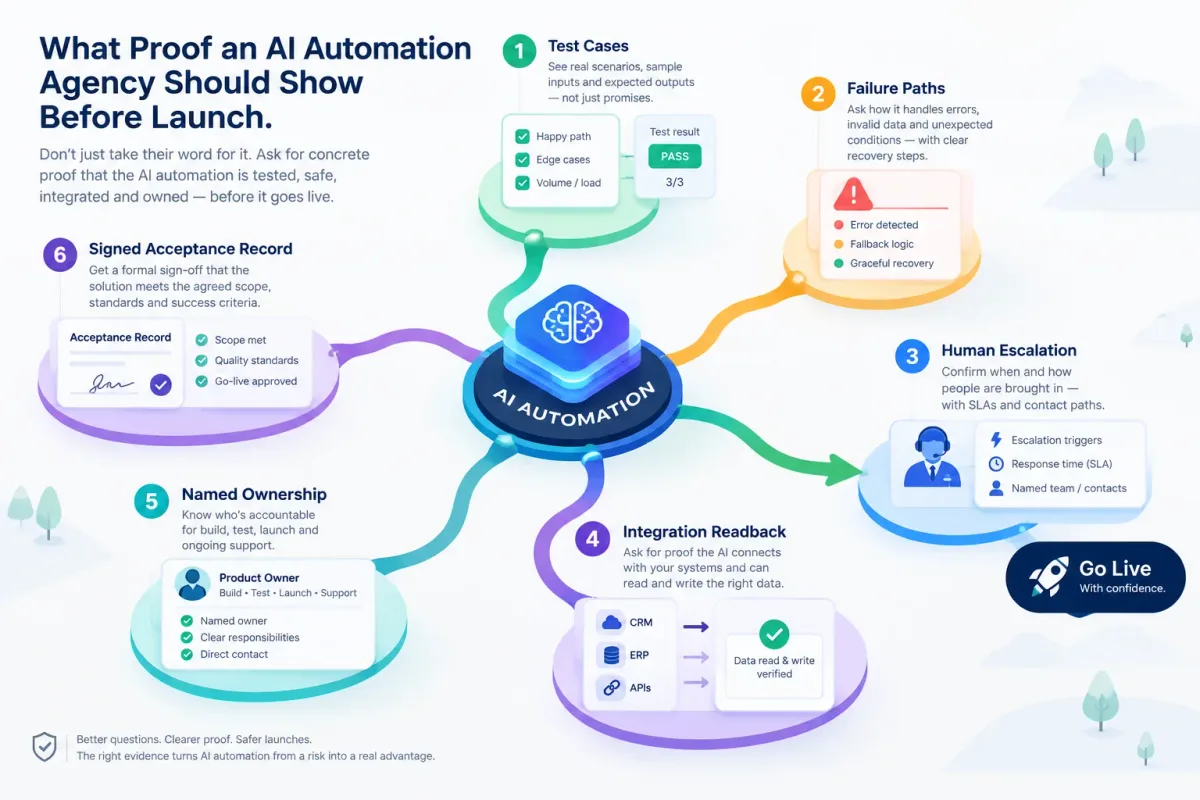
What Proof an AI Automation Agency Should Show Before Launch
Before an AI automation goes live, ask for test cases, failure paths, human escalation, integration readback, named ownership, and a signed acceptance record.
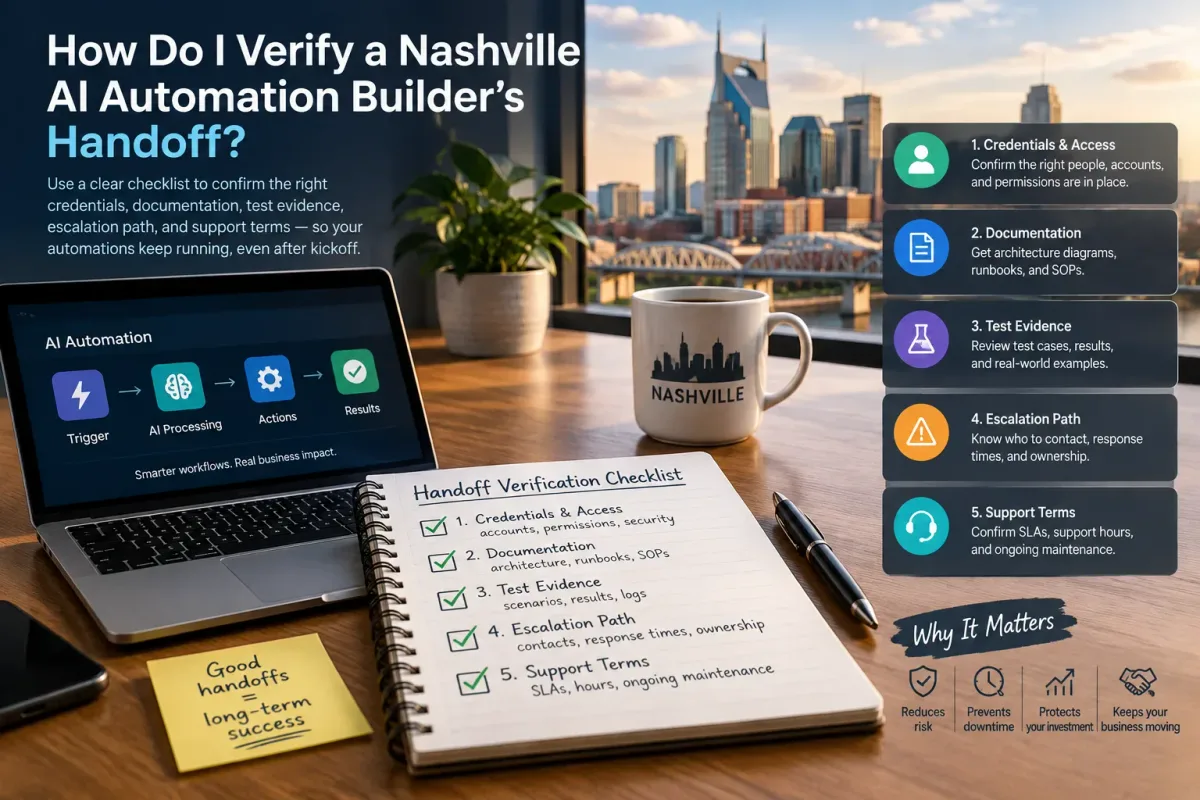
How Do I Verify a Nashville AI Automation Builder's Handoff?
Verify a Nashville AI automation builder's handoff with a checklist covering credentials, docs, test evidence, escalation, and support terms.
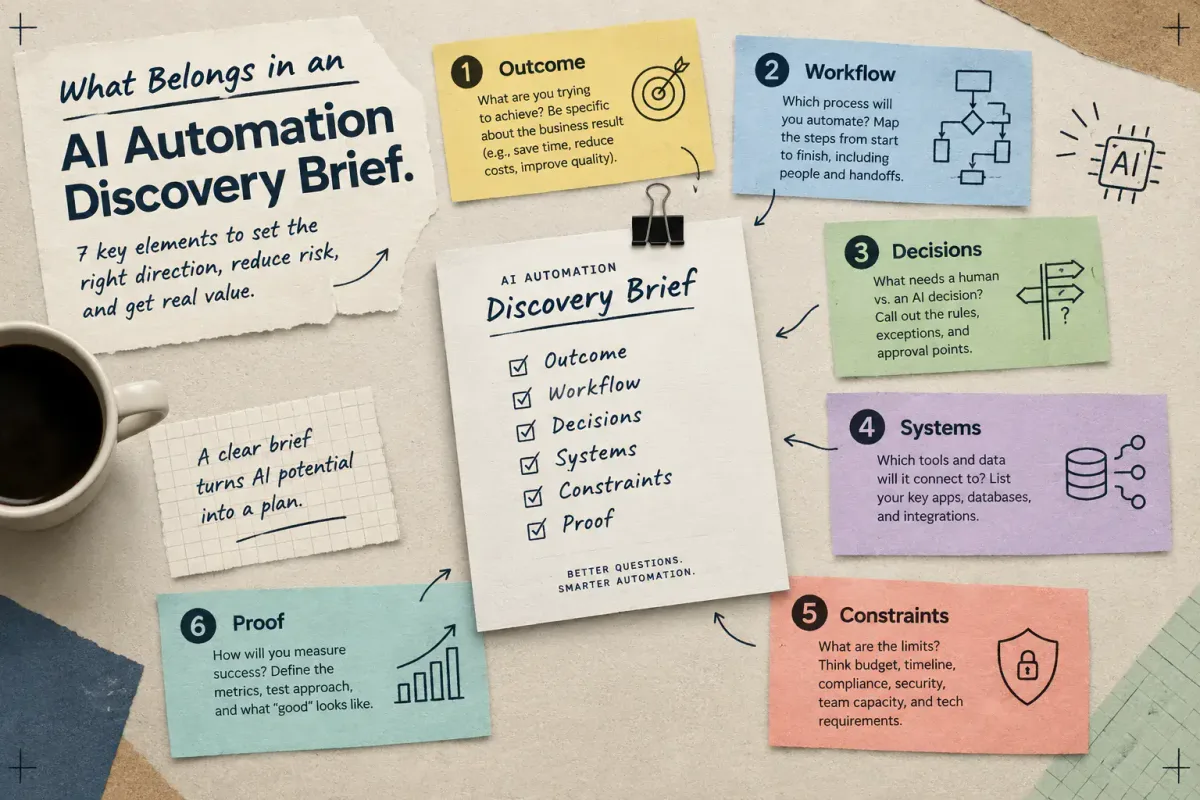
What Belongs in an AI Automation Discovery Brief
Learn the seven elements a small-business AI automation discovery brief needs: outcome, workflow, decisions, systems, constraints, and proof.