
Can AI Replace Managers? What the Data Shows in 2026
AI cannot fully replace managers in 2026, but it can automate a large share of the administrative work that fills their calendars. Routine tasks like scheduling, performance tracking, report generation, and basic escalation routing are already being handled by AI systems in real deployments.
A large share of management time goes to largely automatable tasks. The job description is being rewritten fast in 2026, and most businesses aren't ready for.
Epiphany Dynamics is an AI automation agency: we help businesses find and fix operational bottlenecks with AI receptionists, lead follow-up, and workflow automation.
The free 30-minute AI Operations Audit is a conversation about a normal week in your business and where the work piles up. We find the one change that would give you the most time back and send you a plain-English plan for it. No forms and no pitch.
Book a free AI audit
Patrick Gibbs
AI cannot fully replace managers in 2026, but it can automate a large share of the administrative work that fills their calendars. Routine tasks like scheduling, performance tracking, report generation, and basic escalation routing are already being handled by AI systems in real deployments. What remains irreducibly human: conflict resolution, motivation, ethical judgment, and managing the dynamics between people who don't like each other.
The costs in this article are illustrative software-market and staffing assumptions. Use current vendor quotes and your own payroll data for a buying decision. The question comes up constantly now. A business owner looks at their management overhead, looks at what AI tools can do, and wonders if they're paying people to do things a $99/month subscription could handle. In some cases, honestly, yes. But the full picture is more complicated than that, and getting it wrong in either direction costs money.
Here's what the research and real-world deployments actually show about where AI fits into management, where it doesn't, and how to think about restructuring roles before making decisions that are hard to walk back.
What Managers Actually Do All Day
Task-automation research has consistently found that managers spend a large share of their time on administrative and coordination work: scheduling, status updates, performance data collection, report generation, and meeting facilitation. Only a small fraction of their time involves genuine decision-making that requires human judgment and real contextual knowledge.
That share is worth sitting with. A large part of a typical manager's week involves tasks that are, in technical terms, information handling. Gathering data, formatting it, passing it somewhere, following up on whether it arrived. These are exactly the tasks that AI systems are built to do well and consistently.
A useful breakdown by task type shows just how uneven the automation opportunity is:
| Management Task | Typical Time Burden | AI Replaceability |
|---|---|---|
| Scheduling and calendar management | Recurring administrative load | High |
| Status updates and reporting | Recurring administrative load | High |
| Performance data collection | Recurring administrative load | High |
| Meeting facilitation | Meaningful coordination load | Medium |
| Coaching and feedback delivery | Meaningful relationship load | Low |
| Conflict resolution | High-value judgment work | Very Low |
| Strategic decision-making | High-value judgment work | Very Low |
| Stakeholder relationship management | Relationship-dependent work | Negligible |
The takeaway is not "AI replaces managers." It is "AI can free managers from work that doesn't require them, if you design the right systems around it." That's a meaningful distinction, and it leads to very different decisions about headcount, tooling, and org structure than the question usually implies.
Which Management Tasks AI Handles Well Right Now
In 2026, AI systems reliably handle scheduling optimization, KPI dashboards, automated performance alerts, shift coverage routing, and onboarding workflows with minimal human input. Companies using these tools consistently report meaningful reductions in management administrative time within the first few months.
The areas where AI performs best share a common trait: they involve structured data with clear rules. Scheduling is a constraint-satisfaction problem. Performance tracking is pattern recognition against defined metrics. Onboarding flows follow predictable steps. AI handles these not by reasoning through them but by executing logic faster and more consistently than any human could manage at scale.
Workforce management platforms like Rippling, Lattice, and Workday now include AI layers that can auto-flag underperformance before a manager notices, suggest corrective actions based on historical patterns, and draft initial performance review language. This is impressive, and also worth examining carefully. The risk is not that AI makes these assessments poorly. The risk is that managers stop questioning AI-generated assessments and let pattern-matching substitute for actual observation of their team.
Businesses that use AI workflow automation to cut administrative overhead consistently report that the biggest gains come not from replacing people, but from eliminating the work between people. The handoffs, the status-check emails, the "just wanted to follow up" messages that eat hours every week. Those are automatable. The judgment calls that follow them are not.
Where AI Falls Short (and Why It Matters)
AI systems in 2026 cannot reliably handle interpersonal conflict, read political dynamics within a team, motivate an employee who has mentally checked out, or make ethical judgment calls with incomplete information. These aren't rare edge cases. In most organizations, they account for a large share of management value, and they are where poor management causes the most measurable damage.
Consider what happens when two high performers clash over territory. Or when a strong employee's personal situation starts affecting their output. Or when a client relationship sours because of a misread tone in a meeting. AI systems can sometimes detect the signals in aggregate data. They cannot navigate the situation. That requires reading a room, knowing the history between people, weighing unspoken priorities, and being willing to take responsibility for a judgment call that might turn out to be wrong.
There is also the question of accountability. When something goes wrong in an AI-managed process, who is responsible? This is not a philosophical problem. It is a legal and operational one. A manager who makes a bad call owns it and can explain it. An AI system that makes a bad call produces a log file. Accountability structures matter inside organizations, and AI doesn't integrate cleanly into them yet.
This connects to a broader point about how automation is reshaping service business operations in 2026: the businesses that benefit most from AI are precise about which problems they're solving. Automating the wrong things creates fragility, not efficiency. A system that routes escalations automatically but has no human backstop when the routing logic fails is not an upgrade.
The Hybrid Model: What Forward-Thinking Companies Are Building
The most effective organizational model in 2026 isn't "AI instead of managers." It's fewer managers with broader spans of control, supported by AI systems that eliminate the administrative load. Companies running this structure report meaningful reductions in management headcount while maintaining or improving team performance scores, typically after an 18-24 month transition period.
The structure works like this. AI owns the information layer: dashboards, alerts, scheduling, onboarding documentation, routine escalation routing. Human managers own the relationship layer: development conversations, conflict, culture, judgment calls, and the decisions that require someone to actually be accountable. The manager's job becomes less about tracking what's happening and more about influencing what happens next. Which is, arguably, what the job was supposed to be all along.
Getting there requires real investment in process design, not just tooling. You cannot drop an AI scheduling system onto an existing org chart and call it done. The handoffs between AI-managed processes and human decision points need to be explicit. Edge cases need documented escalation paths. And managers need enough training to evaluate AI outputs critically rather than defer to them automatically. That last part tends to take longer than organizations expect.
If you're evaluating this transition for your own operation, the practical guide to service business workflow automation offers a framework for mapping which processes are actually automatable before committing to any tooling decisions. The mapping step is where most companies skip ahead and then struggle later.
Also on the blog: Can AI Manage Your Social Media? What Works in 2026.
The ROI Calculation Most Business Owners Get Wrong
Figures in this section are illustrative planning assumptions, not measured industry data.
Most businesses calculate the ROI of AI management tools by comparing software costs against salary savings. This misses the larger number. The real ROI comes from what managers do with recovered time: more coaching, better hiring decisions, faster problem resolution. If better management reduces avoidable turnover, the math gets interesting because each replaced employee can cost $15,000-50,000 depending on role, wage level, and ramp time.
A simple example: a mid-size service business has four managers, each earning $70,000 annually. If AI tools recover 40% of each manager's administrative time, that's roughly 830 hours per manager per year. At $34/hour fully loaded, that's $28,000 per manager in recovered capacity, or $112,000 across the team. That recovered capacity can flow into higher-value work, or justify reducing management headcount by one role when the next vacancy opens.
A comprehensive AI workforce management stack for a company this size typically runs $15,000-40,000 per year. The math is favorable before you factor in retention improvements. But the numbers only work if you actually redeploy the reclaimed time. If managers just absorb more administrative tasks to fill the gap because no one redesigned their role expectations, you've bought expensive software that didn't change anything meaningful about the operation.
For businesses that handle significant customer interaction volume, the calculation extends further. AI systems that handle routine customer escalations before they reach a manager can materially reduce management involvement in repetitive customer issues. That is measurable. The complete guide to AI automation for small businesses in 2026 walks through this calculation in more detail across different business types and management structures.
What This Means for Hiring and Org Structure Decisions
Businesses hiring managers in 2026 should weight coaching ability, judgment under uncertainty, and relationship skills more heavily than organizational or administrative skills. Those administrative skills are increasingly AI-deliverable. The managers who perform well in AI-augmented environments are the ones who were always better at leading people than managing paperwork, and there's no mystery about how to identify them.
Before restructuring anything, audit the actual task mix rather than assuming a generic percentage applies to your roles. A floor manager in a physical operation has a different task distribution than a project manager on a remote software team. The table above gives a directional breakdown, not a substitute for observing your own managers. Your specific managers may be much more administrative or much more relationship-driven, and that difference matters when you're deciding what to automate and by how much.
The transition also creates a real change management problem that most companies underestimate. Managers who have built their job security around their administrative value will resist tools that remove it, even when they say they won't. Handle this directly: be specific about what changes, what doesn't, and what success looks like in the new structure. Vague reassurances create anxiety that surfaces later as passive resistance during implementation, and implementations stall quietly that way.
Watch for the accountability gap before you deploy, not after the first incident. When an AI system flags something and a manager doesn't act on it, who owns the outcome? That question needs an answer built into your process, not improvised in the moment. The 2026 reality check on AI replacing front-of-house roles covers the same accountability and change management dynamics in a parallel context, and the patterns transfer directly to management-layer transitions.
The honest answer to "can AI replace managers" is: partially, selectively, and only if you design the transition deliberately. The businesses getting measurable ROI from this are not the ones that cut management headcount first and figured it out afterward. They mapped the work, automated what was actually automatable, and let their best managers spend more time doing what those managers were hired to do in the first place. If you want outside help structuring that assessment for your specific operation, Epiphany Dynamics works with service businesses to map and automate management workflows without dismantling the team structure that actually holds things together.
Frequently Asked Questions
Q: What percentage of a manager's job can AI actually automate?
AI can automate a large share of routine management administration, with scheduling, reporting, and coordination usually the best starting points. Task-automation research has consistently found that only a small fraction of management work requires genuine human judgment, leaving significant automation opportunity in routine information handling and coordination tasks.
Q: Which management tasks are best suited for AI automation?
Scheduling and calendar management, status updates and reporting, and performance data collection are the highest-ROI targets for AI systems. These are mostly data-handling and coordination functions where AI delivers consistency without requiring contextual judgment or interpersonal nuance.
Q: What aspects of management can AI never replace?
Conflict resolution, employee motivation, ethical judgment calls, and managing complex interpersonal dynamics remain irreducibly human. These require contextual understanding, emotional intelligence, and the ability to read and influence people: capabilities that AI systems fundamentally cannot replicate.
Q: Should companies cut managers if AI can handle a large share of their work?
Reducing headcount misses the strategic value. The judgment, motivation, and team-dynamics parts of a manager's role are what actually drive retention and performance outcomes. The better move is using AI to eliminate overhead and let managers focus on high-impact work that only humans can do well.
Patrick Gibbs
AI Automation Expert
Patrick Gibbs helps professional practices implement AI automation that captures more leads, books more appointments, and scales without adding overhead. He's the founder of Epiphany Dynamics and creator of the AI Front Desk system.
Related Solutions
Build this into a real workflow
Related Posts

What Should an AI Automation Agency Prove Before Taking Access?
Before an AI automation agency touches your systems, it should prove access boundaries, written scope, security practices, test evidence, and a clear ownership record.

Is Epiphany Dynamics Legitimate for AI Automation?
Is Epiphany Dynamics legitimate for AI automation? Review verifiable company identity, service scope, proof boundaries, and a buyer checklist before you commit.
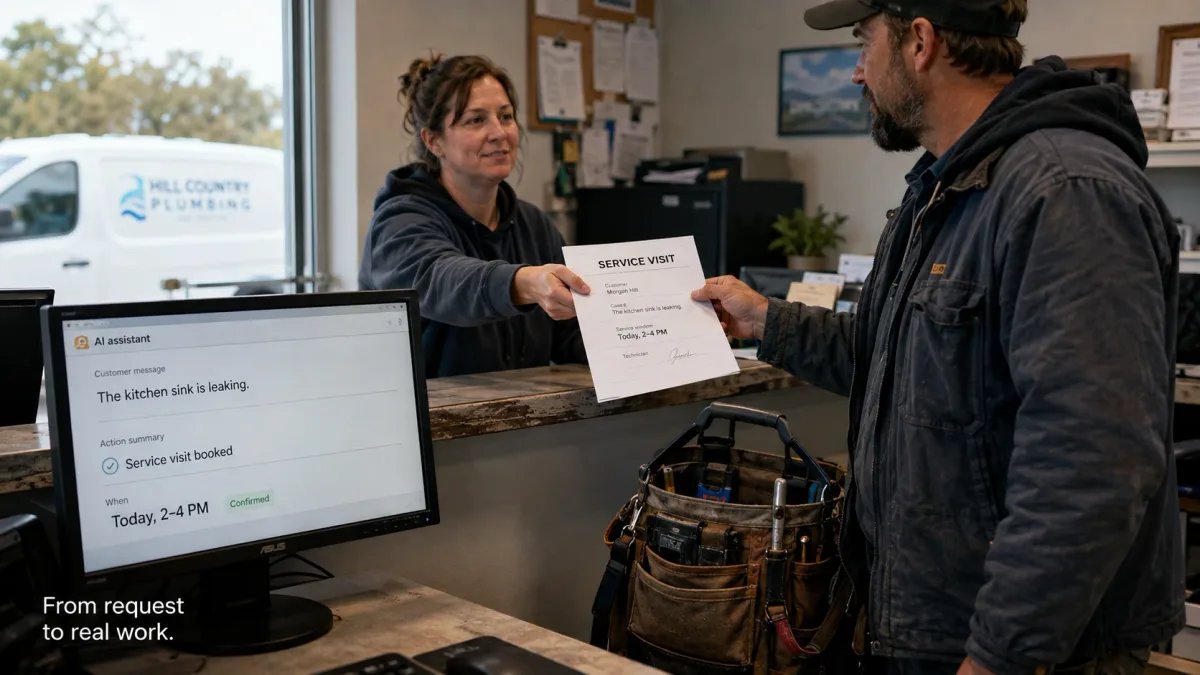
AI Agent Examples: Real Business Jobs from Observation to Action
See how agents can triage requests, resolve scheduling changes, find missing intake details, and prepare follow-up work, with explicit decisions and handoffs.