
Business Growth
2026 Service Business Automation: Trends Reshaping Operations and Margins
Automated service businesses are pulling ahead of manual competitors on margin. Here's where the gap is widening, and exactly how to close it.
The free 30-minute AI Operations Audit is a conversation about a normal week in your business and where the work piles up. We find the one change that would give you the most time back and send you a plain-English plan for it. No forms and no pitch.
Book a free AI audit
Patrick Gibbs
By 2026, automated service businesses are building margin advantages over manual competitors through four compounding advantages: AI scheduling that reduces no-shows, conversational AI that captures after-hours leads, payment automation that frees trapped working capital, and predictive operations that reduce emergency dispatch pressure. This post breaks down where the ROI is and how to prioritize your automation stack.
The Inflection Point Is Already Here
Broad automation research has long estimated that a large share of work activities could be automated using technology that already existed. Most service business owners read that and kept doing what they were doing. By 2026, the businesses that stayed put are starting to feel it: not as an abstract competitive threat, but as a measurable gap in labor costs, lead conversion rates, and customer retention compared to competitors who moved.
This isn’t about robots replacing tradespeople or AI writing medical diagnoses. For service businesses (HVAC, dental practices, home services, med spas, legal firms, cleaning companies, staffing agencies), automation in 2026 looks like: never missing a late-night lead, dispatching the right technician before the customer calls, and collecting payment before an invoice drifts into aging receivables. The technology is affordable, integrations are mature, and the ROI is no longer theoretical. Here’s where the practical gains are in 2026. For help selecting the right platforms, our roundup of the best AI tools for service companies covers each category with realistic ROI considerations.
AI-Powered Scheduling and Dispatch: The Biggest Immediate ROI
No-shows and scheduling inefficiency are silent margin killers. In healthcare and wellness services, even a modest no-show rate can turn into a serious revenue leak. Model it from your own appointment volume, observed no-show rate, average appointment value, and ability to fill cancellations from a waitlist. That tells you whether scheduling automation is a real margin lever or just a convenience feature.
AI scheduling tools have matured significantly. The current generation doesn’t just send reminders: it analyzes historical no-show patterns by customer profile, dynamically adjusts reminder cadence, and automatically fills cancellations from a waitlist without staff involvement. Platforms like NexHealth, ServiceTitan, and Jobber have integrated machine-learning models specifically for this use case. The pattern most early adopters describe is no-show rates dropping meaningfully after deployment, with the size of the drop varying by practice mix and reminder cadence.
For businesses dispatching field teams (HVAC, plumbing, pest control, cleaning), intelligent routing has moved from a nice-to-have to a competitive necessity. AI dispatch tools now factor in technician certifications, real-time traffic, parts inventory on vehicles, and customer priority tiers simultaneously. Companies using optimized routing spend meaningfully less time driving between jobs, which in a small field operation can translate to an extra service call or two per day without adding headcount. Multiply an extra daily call by an average ticket across a working year and the added revenue capacity is substantial, from the same labor base.
Conversational AI: 24/7 Lead Capture Without Headcount
Consider this reality: a large share of service business inquiries arrive outside business hours. For most businesses, those leads go to voicemail or a generic contact form. Harvard Business Review research on lead response found that firms trying to contact a lead within an hour were nearly seven times as likely to qualify it as those that waited even an hour longer, and the average lead-response time across the firms studied stretched into multiple days. By that point, the prospect has already booked with whoever picked up the phone first.
Conversational AI tools in 2026 are not the clunky rule-based chatbots of 2019. The current generation, built on large language model backends with business-specific fine-tuning, can hold contextual conversations, collect intake information, answer service-specific questions, quote standard services, and book appointments directly into scheduling systems, all without human involvement. The widely reported pattern from deployments is a meaningful share of after-hours leads that previously went cold now getting captured and booked. To model the opportunity, use your annual revenue, after-hours inquiry share, current conversion rate, and realistic recovery assumption rather than borrowing a generic benchmark.
The key distinction for 2026 is voice plus text in a unified system. The most capable AI front desks now handle both inbound calls and web chat through the same underlying platform, creating a consistent intake experience regardless of channel. A plumbing company can have an AI answer the phone overnight, troubleshoot whether the situation is emergency or non-emergency, dispatch on-call staff if needed, or schedule a morning appointment, without a human ever touching it. Setup costs have dropped sharply, and our AI automation cost and pricing guide covers how to compare the pricing landscape against the cost of human coverage.
Payment and Collections Automation: Stop Leaving Cash on the Table
Accounts receivable is one of the most automation-ready problems in service businesses, yet most still rely on manual invoice sends and ad hoc follow-up calls. Automated invoice delivery, sequential payment reminders, and embedded online payment links can materially shorten Days Sales Outstanding when the baseline process is slow and inconsistent. Model the working-capital impact from your current revenue, invoice volume, DSO, and customer payment behavior rather than assuming a generic benchmark.
The 2026 standard for service business billing isn’t just “send invoices faster”: it’s full-cycle automation. That means: invoice triggered automatically on job completion or appointment close, payment link embedded in the email and SMS, reminder sequence firing on days 3, 7, and 14 post-due, and escalation to a human collections workflow only when automation fails. Tools like Housecall Pro, Square for Service, and Stripe’s payment orchestration layer handle this entire cycle with minimal configuration. The math is simple: faster collections, lower administrative overhead, and fewer awkward payment conversations with customers who were never going to call you back anyway.
Predictive Operations: From Reactive to Anticipatory
The most sophisticated automation trend hitting service businesses in 2026 isn’t a chatbot or a scheduling tool: it’s predictive analytics applied to operations. For field service businesses with recurring service agreements (HVAC maintenance contracts, pest control subscriptions, IT managed services), predictive maintenance is shifting the model from “customer calls when something breaks” to “you call before it breaks.” The difference isn’t cosmetic. It fundamentally changes the economics and the customer relationship.
IoT sensors on equipment (HVAC units, commercial refrigeration, elevators, generators) feed data into platforms that predict failure probability with enough lead time to schedule proactive service. Companies that have moved to this model often report fewer emergency dispatch calls, which are expensive to staff and disruptive to scheduling. Contract renewal rates can improve because customers see tangible, documented proof of value rather than an abstract service agreement. Entry costs vary by equipment class, sensor package, analytics platform, and installation requirements.
For non-equipment service businesses (staffing firms, consulting practices, marketing agencies), predictive demand forecasting is the operational analog. Using historical booking patterns, seasonality data, and leading indicators like local event calendars and economic signals, staffing models can forecast near-term demand with enough accuracy to optimize hiring and scheduling in advance. This reduces both overtime costs from understaffing and bench time from overstaffing, two expensive failure modes in businesses that still rely on gut feel for workforce planning.
Building Your 2026 Automation Stack: A Prioritization Framework
The mistake most service business owners make is trying to automate everything at once, or selecting tools based on demos rather than modeled ROI. A more disciplined approach: map automation opportunities to a two-axis matrix (revenue or cost impact vs. implementation complexity) and attack the high-impact, low-complexity quadrant first. Below is a qualitative planning table you should adapt to your own revenue, staffing, and workflow data.
| Automation Area | Impact Driver | Implementation Complexity | Payback Shape |
|---|---|---|---|
| After-hours lead capture (AI front desk) | Missed-call volume and booking rate | Low | Fast if missed-call leak is material |
| Automated billing & collections | Invoice volume, DSO, and payment friction | Low | Fast if receivables drag is high |
| AI scheduling & no-show reduction | No-show rate and waitlist fill capacity | Medium | Medium, depends on patient behavior |
| Route and dispatch optimization | Drive time, route density, and technician capacity | Medium | Medium, depends on field adoption |
| Predictive maintenance / demand forecasting | Emergency dispatch, renewal value, and staffing accuracy | High | Longer, requires cleaner data |
The practical implementation sequence for most service businesses in 2026: billing automation and AI lead capture first, scheduling intelligence second, predictive operations once the foundation is stable and your team has adapted to working with automated systems. The biggest failure mode is selecting tools that don’t integrate with your existing CRM or scheduling platform: interoperability should be a hard requirement during vendor evaluation, not a question you ask after signing a contract.
Change management deserves as much planning as the technology itself. Getting your team to trust an AI scheduler, update job status in real time so dispatch routing works accurately, and not manually override every automated payment reminder: that’s the actual implementation work. Build internal training, accountability checkpoints, and a clear escalation path (when does a human take over from the automation?) into your rollout timeline, not just the software configuration phase.
Elsewhere on the blog: How to Automate Your Gym or Fitness Studio: Grow Without the Grind (2026).
The Bottom Line for 2026
Service businesses that automate aggressively in 2026 aren’t just cutting costs. They’re building structural advantages that compound over time. Faster lead response produces higher close rates. Automated collections produce better cash flow. Predictive operations produce higher customer retention. These aren’t marginal efficiencies; they’re the difference between a business that scales and one that grinds harder each year for the same result. The tools are mature, the costs are accessible, and the window to move before your local competitors catch up is narrowing. Start with the single workflow that costs your business the most money when it fails, and automate that one first. Our service business workflow automation guide covers the five highest-ROI workflows and how to sequence them. The rest follows.
Stay ahead of the 2026 automation trends. Check our AI tools for service businesses and industry automation guides to see what technologies are delivering the fastest returns in your vertical. For a personalized automation roadmap, book a free consultation with Epiphany Dynamics.
For implementation detail, start with after-hours automation, inventory controls or customer feedback routing, depending on the operational problem you're measuring.
Frequently Asked Questions
Q: What are the top automation priorities for a service business in 2026?
AI-powered lead capture (after-hours and overflow calls), automated billing and collections, and AI scheduling with no-show reduction represent the three highest-ROI automation opportunities. In most service businesses, their relative value depends on missed-call volume, receivables drag, appointment density, and how much staff time is currently spent on manual coordination.
Q: How much do no-shows actually cost a service business per year?
Model no-show cost from your appointment volume, observed no-show rate, average appointment value, and ability to fill cancellations from the waitlist. AI scheduling tools that analyze historical no-show patterns and dynamically adjust reminder cadence can reduce that loss when reminders and waitlist fill-ins are configured around the practice’s actual patient behavior.
Q: How can AI dispatch optimization increase revenue for field service companies?
AI dispatch tools factor in technician certifications, real-time traffic, parts inventory, and customer priority simultaneously. Companies using optimized routing spend meaningfully less time driving between jobs, which in a small field operation can translate to an extra service call or two per day, real added revenue capacity from the same labor base.
Q: What does automated billing and collections actually return for a service business?
Businesses that implement automated invoice delivery, sequential payment reminders, and embedded online payment links can reduce Days Sales Outstanding when their current process depends on manual follow-up. The working-capital impact should be modeled from current revenue, DSO, invoice volume, and customer payment behavior rather than assumed from a generic benchmark.
Q: How should service businesses sequence their automation investments?
Start with billing automation and AI lead capture because these usually have lower implementation complexity and clearer payback. Add AI scheduling intelligence once the foundation is stable. Layer in predictive operations and demand forecasting only after your team has adapted to working with automated systems. Avoid selecting tools that don’t integrate with your existing CRM or scheduling platform.
Patrick Gibbs
AI Automation Expert
Patrick Gibbs helps professional practices implement AI automation that captures more leads, books more appointments, and scales without adding overhead. He's the founder of Epiphany Dynamics and creator of the AI Front Desk system.
Related Solutions
Build this into a real workflow
Related Posts
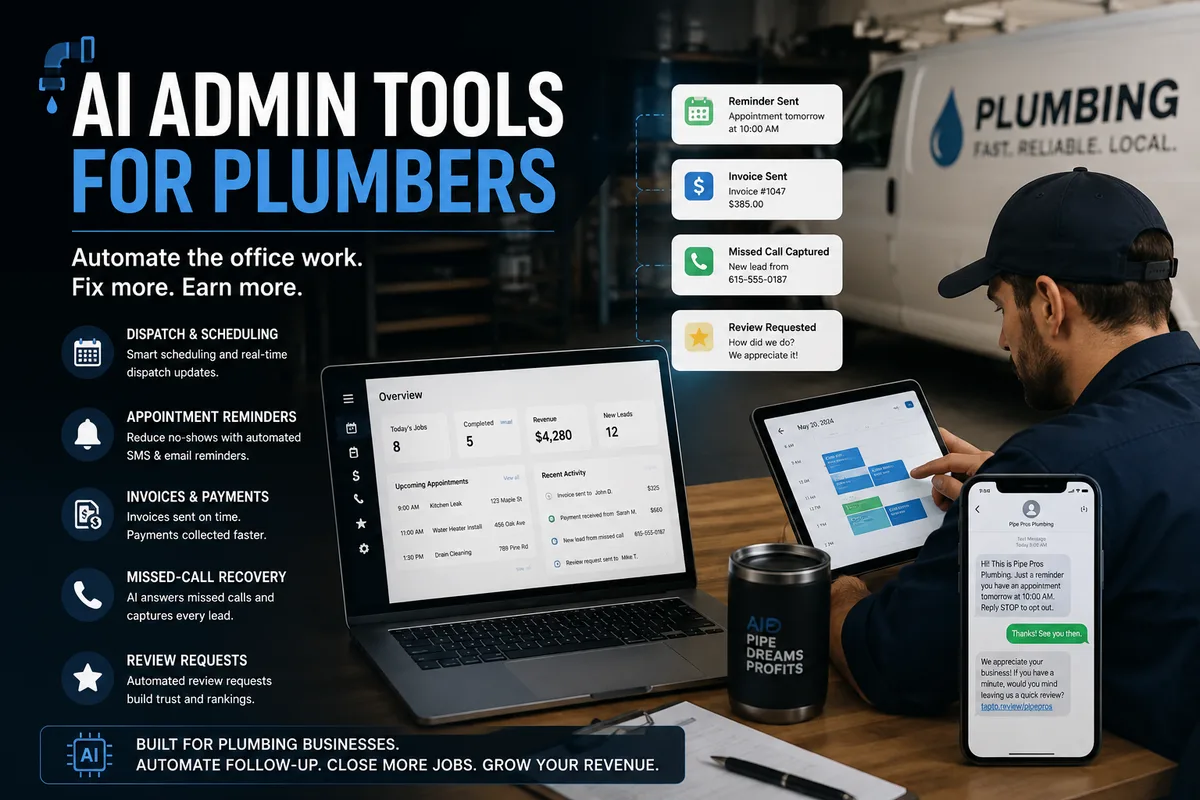
AI Admin Tools for Plumbers: What They Are and How to Choose
AI admin tools automate dispatch, reminders, invoicing follow-up, missed calls, and review requests for plumbers. What they do and how to choose.
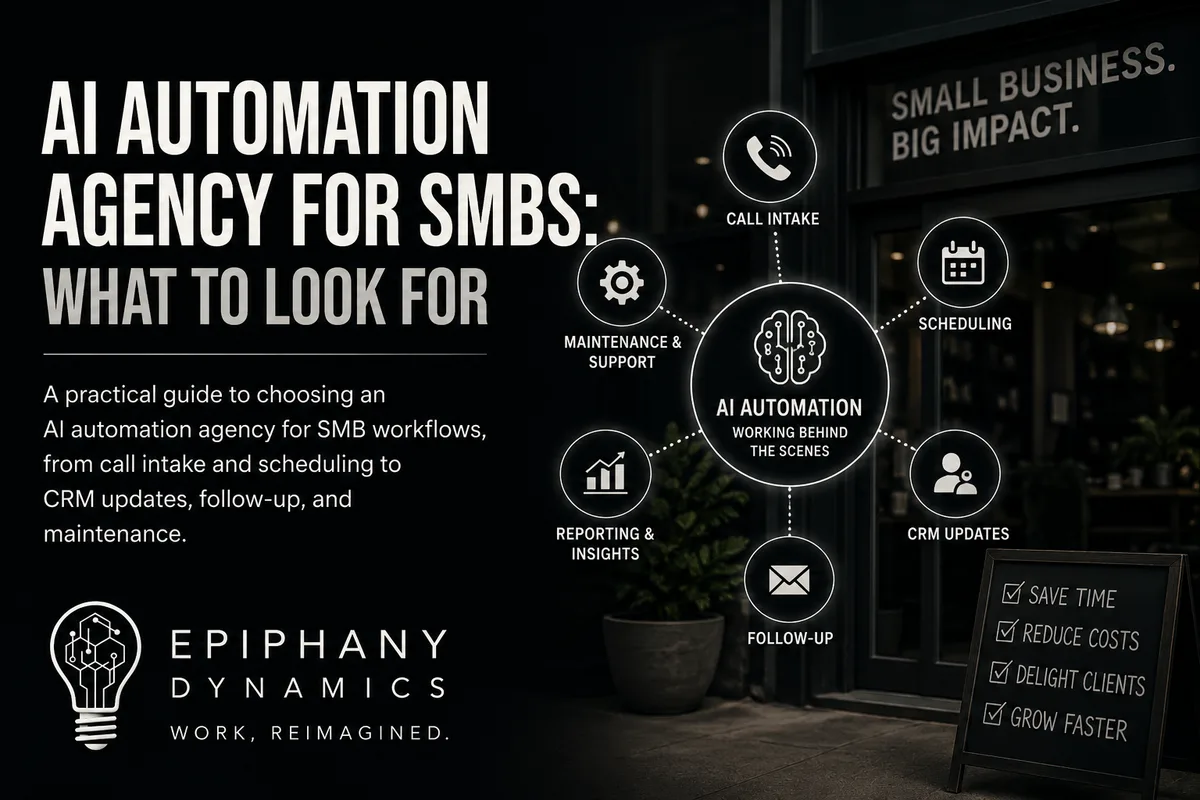
AI Automation Agency for SMBs: What to Look For
A practical guide to choosing an AI automation agency for SMB workflows, from call intake and scheduling to CRM updates, follow-up, and maintenance.
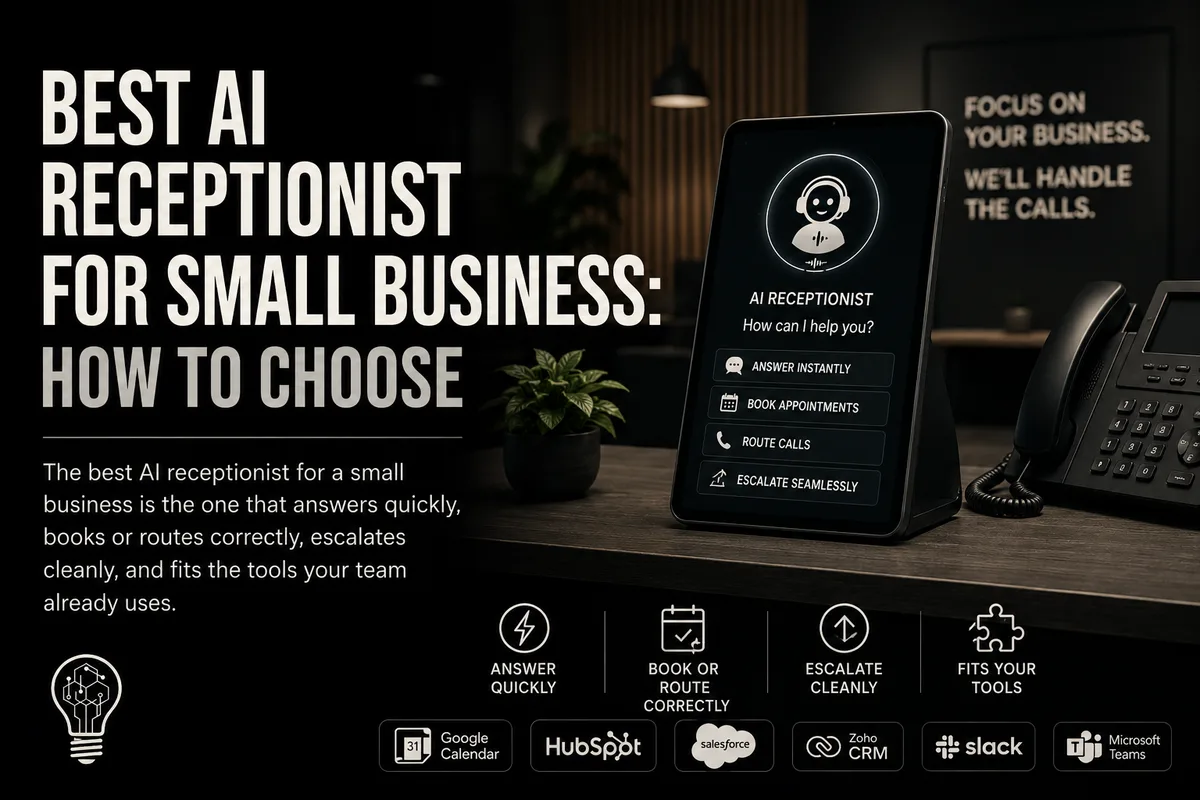
Best AI Receptionist for Small Business: How to Choose
The best AI receptionist for a small business is the one that answers quickly, books or routes correctly, escalates cleanly, and fits the tools your team.